President Duntsova Addresses the Nation

Journalist and politician Yekaterina Duntsova, whose candidacy in the upcoming presidential election was rejected by the Russian Central Election Commission (the Russian Supreme Court later upheld this decision), released a New Year’s address on Instagram.

“I promise you that I will do everything that depends on me to return our country’s life to a normal direction without special operations and political crackdowns, with a government accountable to us that will work to grow the economy and improve the well-being of ordinary families,” she said, wishing that 2024 would bring Russians “self-confidence, long-awaited peace, and more basic human happiness.”

Duntsova said that the New Year is “when we live in peace with ourselves and our neighbors,” and people who are dear to us are with us, and not “somewhere far away, risking their lives performing missions whose purpose cannot be explained to us.”

Duntzova also promised that the new political party she announced earlier would be “an association of people who just want to live peacefully.”

Source: Deutsche Welle Russian Service. Translated by the Russian Reader. This post was made possible by a generous donation from Sumanth Gopinath.


On 27 December 2023, the Supreme Court of the Russian Federation dismissed the suit filed by Yekaterina Duntsova, a journalist from Rzhev, against the Russian Central Election Commission (CEC), which had refused to register Duntsova’s initiative group for collecting signatures in support of her run as an independent candidate for the Russian presidency.

Duntsova was thus practically left with no chance to run in next year’s presidential elections as an independent. DW has compiled all the most important facts we know about her.
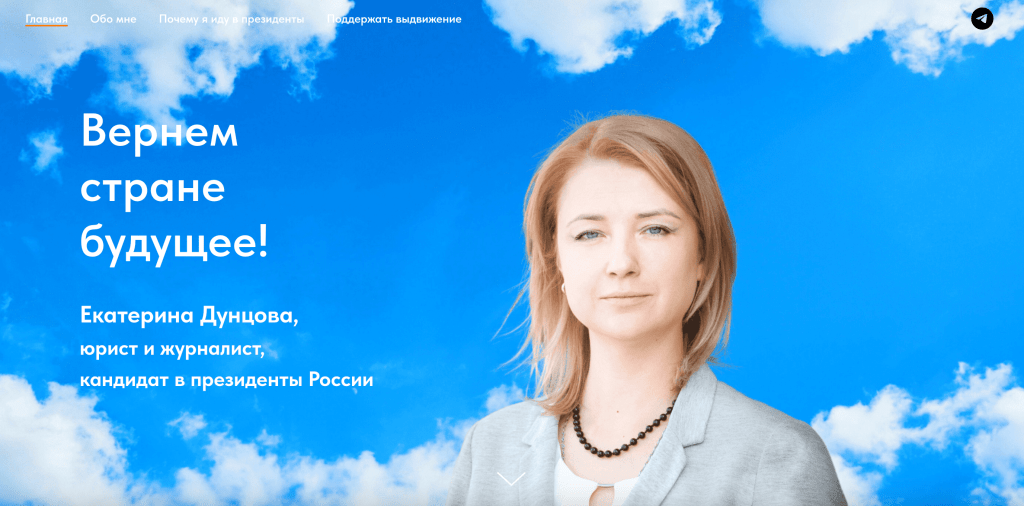
A screenshot of the landing page on Yekaterina Duntsova’s campaign website, which is still up and running.

What we know about Yekaterina Duntsova

Ekaterina Duntsova is forty years old. She was born in Krasnoyarsk. She graduated from high school in Rzhev, Tver Region. She has two university degrees, in law and journalism. Duntsova studied law at Tver State University and also studied directing at the St. Petersburg State Institute of Cinema and Television. Russian state media note that she studied at both universities by correspondence.

Duntsova works as a journalist and is the coordinator of the Sova (“Owl”) volunteer search and rescue team in Rzhev. On the Web, many people refer to her as “radio operator Kat” — that’s Duntzova’s call sign on the team. Many liberal internet users have compared her with ex-Belarusian presidential candidate Svetlana Tikhanovskaya. State media have dubbed Duntsova “the fugitive oligarch Mikhail Khodorkovsky’s pet project.”

In 2003, Duntsova worked for about a year at the Rzhev municipal television company, then for many years headed the school television studio Friday the 13th and was editor-in-chief at RIT Independent Studio, a television company founded in 2003 by Duntsova’s husband Roman Nagoryansky. RIT closed in 2022. Duntsova has three children: two daughters and a son. The eldest daughter is studying in Tokyo. Duntsova and her husband separated in 2021.

In 2014, Duntsova ran as an independent for a seat in the sixth Rzhev City Duma but failed to win. Duntsova served in the seventh Rzhev City Duma, which sat between 2019 and 2022.

How Duntsova announced her run for the Russian presidency

On 16 November 2023, Duntsova announced on VKontakte that she would run as a candidate in the Russian presidential election and unveiled her campaign website, duntsova2024.ru. At the time of her nomination, she was the only woman to declare her desire to compete for the Russian presidency.

Duntsova’s candidacy was supported by Our Headquarters, a project created by the staff of Ark, a support group for Russians who have left the country over the war with Ukraine (in cooperation with the Russian Anti-War Committee). Posts about Duntsova’s nomination went out on many Telegram channels.

Duntsova explained her decision to run for president by arguing that “for the last ten years the country has been moving in the wrong direction: we have been pursuing a policy not of growth but of self-destruction.” Duntsova said she favors an end to the war in Ukraine, democratic reforms, and the release of political prisoners, particularly Alexei Navalny. “We have to abolish all inhumane laws and restore relations with the outside world. We have to change budget priorities by spending money on improving the lives of citizens, not on new tanks,” she noted.

“Why Yekaterina Duntsova was not allowed to run in the election,” Deutsche Welle Russian Service, 23 December 2023

At the same time, the journalist was cautious in her comments about Russia’s invasion of Ukraine. “Unfortunately, I cannot afford to delve deeply into this topic while I am in Russia,” she said. In order to remain on the right side of the law, she said that she would refer to the fighting in Ukraine as the “special military operation.” For the same reason, Duntsova declined to comment on the fate of the annexed territories in a future possible peace deal between Russia and Ukraine.

And yet, Duntsova argued that Russians should shed their “collective guilt complex.” She also avoided direct criticism of Vladimir Putin, stressing that she did not want to get personal, adding, however, that “it is possible to criticize the policies of the current government, it is possible to criticize certain laws and decisions made.”

Duntsova’s nomination campaign

On November 20, Duntsova was summoned to the prosecutor’s office in Rzhev to discuss the social media post about her intentions to run for the Russian presidency. “They asked what I thought about the [special military operation]. I invoked Article 51 of the Russian Constitution [which stipulates that no one is obliged to give evidence against themselves]. Apparently, they also wanted to find whether my intentions were real,” the journalist said at the time in a conversation with DW. In early December, Duntsova reported that VTB Bank had blocked transfers to her account after she appealed to supporters to back her campaign financially.

On December 20, Duntsova submitted the paperwork to the CEC to register her initiative group, which had to have at least 500 people. As an independent candidate, she also needed to gather 300,000 signatures in at least forty regions of the Russian Federation. The Central Election Commission had to review the package of documents and make a decision within five days. There were no grounds for refusing to register the initiative group, Duntsova argued.

However, on December 23, the CEC did not register the group, claiming that it had uncovered more than one hundred errors in Duntsova’s paperwork. As an example, it cited a document in which the patronymic “Valeryevna” had been written “Valerievna.” In addition, the CEC claimed that the notary who certified the documents, in particular, erroneously reported the [internal] passport number of the organizer of the initiative group’s meeting. Earlier, inspectors from Russian Justice Ministry paid this notary a visit.

On December 25, Duntsova appealed the CEC’s refusal to allow her to collect signatures in support of her campaign for the Russian presidency by filing suit with the Supreme Court. According to Duntsova, the CEC supported its arguments “solely with an internal memo. The law does not stipulate the use of such a document in principle, so it cannot be used as the basis for the decision.”

On December 27, the Russian Supreme Court dismissed the journalist’s lawsuit against the CEC, thus making it practically impossible for Duntsova to register as a candidate for the presidential election. Theoretically, she could ran as some party’s candidate. Duntsova has already called on the Yabloko Party to hold a congress and nominate her as their presidential candidate. The party responded that they do not nominate “random individuals about whom nothing is known.”

Duntsova said she intends to consider nominations from other parties as well. She also declared her plans to create her own political party: “The party I propose to create is not the Yekaterina Duntsova party. It will be the party of all those who are in favor of peace, freedom and democracy. My goal is to launch our self-organization [sic], which will be built around many new faces, around people who share our views. In the near future we will publish a program and work on it together.” Earlier, the journalist also spoke about her willingness to join forces with presidential contender Boris Nadezhdin.

Whose candidates have been nominated to run in the presidential election

The presidential election in Russia will be held 15–17 March 2024. The incumbent head of state Vladimir Putin is running as an independent. The Liberal Democratic Party of Russia (LDPR) nominated its leader Leonid Slutsky as a candidate for the highest state office. The Communist Party of the Russian Federation (CPRF) nominated Nikolai Kharitonov, while Civic Initiative nominated Moscow Region MP Boris Nadezhdin, and New People nominated State Duma deputy speaker Vladislav Davankov.

DW News [in Russian], 23 December 2023. The anchor interviews Yekaterina Duntsova live on air, starting at 15:44

The conservative Russian All-People’s Union decided to nominate its leader Sergei Baburin as a candidate in the upcoming presidential election. In addition, a meeting was held in Moscow to nominate Igor Strelkov (Girkin), a reserve FSB colonel and former “defense minister” of the Donetsk separatists, who has been in pretrial detention since July 2023 on charges of calling for extremist activity. Strelkov’s initiative group gathered 566 signatures from nomination meeting attendees, but the notaries did not arrive to certify them.

Source: Natalya Pozdnyakova, “What you need to know about Yekaterina Duntsova, who wanted to become president of the Russian Federation,” Deutsche Welle Russian Service, 27 December 2023. Translated by the Russian Reader. This post was made possible by a generous donation from Sumanth Gopinath.


Independent Russian presidential candidate Yekaterina Duntsova will not be permitted to appear on the ballot in the March 2024 vote after the Central Election Commission (CEC) rejected her nomination documents.

Duntsova, 40, a journalist and local politician from the Tver region northwest of Moscow, announced her bid for the presidency in November on a pro-peace, pro-democracy platform.

This week, she secured the endorsement of an initiative group of more than 500 supporters as is required for candidates not running as part of a political party.

At a meeting Saturday, the Central Election Commission (CEC) rejected her documents, saying it found over 100 typos and other errors, the Ostorozhno Novosti Telegram news channel reported.

“We have carefully studied the documents, and we have the impression that they were filled out in haste without complying with legal standards,” the BBC’s Russian service quoted CEC member Yevgeny Shevchenko as saying at the commission’s meeting.

If the CEC had accepted her documents, she would have then needed to collect 300,000 unique voter signatures from at least 40 regions of Russia to be able to appear on the ballot.

Following the meeting, Duntsova said she plans to appeal the commission’s decision in court and intends to ask the liberal Yabloko party to nominate her as a candidate.

“I want us all to believe that we will be able to take another chance. Don’t lose faith, don’t lose hope,” she said.

Duntsova’s campaign has reported several instances of pressure since she announced her bid for the presidency.

She was summoned to the prosecutor’s office to discuss her campaign and attitude toward Russia’s actions in Ukraine shortly after announcing her campaign.

One of Duntsova’s supporters was detained in the Siberian city of Krasnoyarsk after returning from the nomination meeting, according to women’s activist group Myagkaya Sila (Soft Power). The supporter, who is also a member of Myagkaya Sila, was reportedly accused of falsely filing a complaint against a police officer.

She has also faced speculation that she could be a Kremlin-endorsed spoiler candidate.

The state-run RIA Novosti news agency claimed this week without evidence that Duntsova had the financial backing of Mikhail Khodorkovsky, a former oligarch turned exiled Kremlin critic.

President Vladimir Putin, 71, is expected to handily win re-election to a fifth term — keeping him in power until at least 2030 — in the March 2024 vote after the elimination of virtually all opposition.

“Yekaterina Sergeyevna, you are a young woman, you still have everything ahead of you. Any minus can always be turned into a plus. Any experience is still experience,” CEC chief Ella Pamfilova told Duntsova at the end of Saturday’s meeting.

Source: “Pro-Peace Putin Challenger Blocked from Ballot,” Moscow Times, 23 December 2023. This post was made possible by a generous donation from Sumanth Gopinath.

All the Tabs Open in Chrome


Yekaterina Duntsova, who wants to run for president, said the Kremlin should end the conflict in Ukraine, free political prisoners and undertake major reform to halt the slide towards a new era of “barbed wire” division between Russia and the West.

Nearly 32 years since the 1991 fall of the Soviet Union stoked hopes that Russia would blossom into an open democracy, Duntsova, 40, said she was afraid as she spoke to Reuters in Moscow.

Source


In opinion polls, Russians voice support for the Putin regime’s action in Ukraine. And yet, many Russia would like the war to end, and the dynamics of recruiting “contract” soldiers does not demonstrate that a large number of people are ready to rise up “to fight the West in Ukraine.” What are the real sentiments of Russians? What do they think about the war and how do they justify it?

  • Lev Gudkov, deputy director, research director, Levada Center, “The war and collective identity,” (online)
  • Andrei Kolesnikov, senior researcher at the Carnegie Russia Eurasia Center in Berlin, “A semi-mobilized society in a hybrid totalitarian regime” (online)
  • Svetlana Erpyleva, Humboldt Fellow, Research Center for Eastern European Studies at the University of Bremen; researcher, Public Sociology Lab and the Centre for Independent Sociological Research, “Accepting the inevitable: how Russians justify the war in Ukraine”

Source. Annotation translated by the Russian Reader


Viktor Filinkov, convicted in the Petersburg portion of the high-profile Network Case, turned twenty-nine in early November. It was his third birthday in the penal colony, and for the first time he was not given any special “gift” there. Previously, surprises had been waiting for him that were even hard to imagine—for example, a new uniform with a piece of razor inside it. Filinkov has been imprisoned for six years total. During this time, he has seen a lot, including being threatened with dispatch to a war zone, but he quickly put a stop to such “jokes.” Now he is housed in the high-security wing along with other “repeat offenders.” And he constantly files suits against the penal colony. We talked to his girlfriend and public defender Yevgenia Kulakova, who loves him with all her heart and helps defend his rights behind bars.

Source. Excerpt translated by the Russian Reader, who looks forward to the day when he can see his friend and heroine Jenya Kulakova again and meet his hero Viktor Filinkov in person.


Putin noted that visitors from Tajikistan can stay in Russia for an extended period—fifteen days—without registering with the immigration authorities. They can also apply for a work permit that is valid for up to three years.

In addition, Putin announced the expansion of the quota for university students and postgraduates from Tajikistan—from 900 to 1,000 individuals.

The head of the Russian Federation added that the state would allocate 200 million rubles annually from this year for purchasing textbooks for Russian-speaking schools in Tajikistan.

Various regions of Russia have recently imposed restrictions on migrant labor. There have also been proposals to introduce such bans everywhere for visitors from countries where the Russian language is not recognized at the state level. In Tajikistan, Russian is enshrined in the constitution as the language of interethnic communication.

Due to the unstable financial situation, migrant workers have been leaving Russia. Up to a third of Tajik and Uzbek nationals may leave the country.

Source. Translated by the Russian Reader


As of February 24, 2022, Russian President Vladimir Putin declared the beginning of what he dubbed the “special military operation” and the Russian Armed Forces invaded Ukrainian territory. What the Russian authorities assumed would be a swift operation soon became a drawn-out, full-fledged war. Many events occurred over the course of the first year of war, keeping Russians in suspense, forcing them to detach themselves from the situation, giving them hope, and then driving them to despair. When we conducted our first interviews in spring 2022, many thought the war would not last long.

Since then, it has become clear that the war will be with us for a while. The daily life of Russian citizens has been invaded time and again by dramatic events. The Russian retreat from the occupied territories, the annexation of new regions, the bombing of Kiev, the first Crimean Bridge explosion, and the “partial mobilization”— to name just a few. Have these events changed the average Russian’s view of the war, and if so, how? How did residents of the Russian Federation perceive the “special military operation” more than half a year later? These questions are the focus of the report you see before you.

There are several research teams monitoring changes in Russian perceptions of the war through opinion polls (for example, Russian Field and Chronicles). The work they are doing is very important. However, like any research method, surveys have their drawbacks—there are some things they simply will not show. For example, surveys do not always allow us to understand a respondent’s attitude towards sensitive or hot-button topics, as sometimes people have a tendency to hide their true views. But more importantly, for Russians largely removed from the political process, perceptions of such politically-charged issues as the “special military operation,” war, and military conflict do not fit neatly into the standardized set of coherent positions that a survey is capable of capturing. These perceptions may be complex and contradictory, and in this case, in-depth interviews and long conversations with people allow us to better understand the idiosyncrasies of each viewpoint. To our knowledge, we are the only team that systematically monitors Russian perceptions of the war using qualitative (interview) rather than quantitative (survey) methods.

We released our first analytical report in September 2022. You can read it here (in Russian) and here (in English). In it, we presented the results of our qualitative study through interviews conducted over several months after the start of the war, in March, April, and May 2022. Our interviewees held a variety of opinions on the military conflict—there were those who supported the hostilities in one way or another (war supporters), those who condemned military aggression (war opposers), and those who tried to avoid giving any explicit assessment of the situation (undecided). We compared these three groups of respondents with each other: how they perceive the armed conflict, what emotions they associate with it, and how they consume information, assess the victims of the conflict, discuss the situation with loved ones, reflect on the consequences of the war, and so on. We have also published the results of this research in analytical media outlets, a few examples of which can be found herehere, and here, as well as in scientific journals, such as those found here (in Russian) and here.

The paper you are currently reading is the second analytical report we have published and a continuation of this research. It is based on qualitative sociological interviews with Russian citizens conducted in fall 2022, from 7 to 9 months after the outbreak of the war. We wanted to determine how Russian perceptions of the war had changed during this period. This time, we excluded subjects who consistently opposed the war from the sample and decided to focus our study on the specifics of perceptions held by Russian citizens who did not have an unambiguous anti-war stance.

Source


In audio intercepts from the front lines in Ukraine, Russian soldiers speak in shorthand of 200s to mean dead, 300s to mean wounded. The urge to flee has become common enough that they also talk of 500s — people who refuse to fight.

As the war grinds into its second winter, a growing number of Russian soldiers want out, as suggested in secret recordings obtained by The Associated Press of Russian soldiers calling home from the battlefields of the Kharkiv, Luhansk and Donetsk regions in Ukraine.

The calls offer a rare glimpse of the war as it looked through Russian eyes — a point of view that seldom makes its way into Western media, largely because Russia has made it a crime to speak honestly about the conflict in Ukraine. They also show clearly how the war has progressed, from the professional soldiers who initially powered Vladimir Putin’s full-scale invasion to men from all walks of life compelled to serve in grueling conditions.

“There’s no f—— ‘dying the death of the brave’ here,” one soldier told his brother from the front in Ukraine’s Kharkiv region. “You just die like a f—— earthworm.”

The prospect of another wave of mobilization lingers, even as Moscow has been trying to lure people into signing contracts with the military. Russia’s annual autumn conscription draft kicked off in October, pulling in some 130,000 fresh young men. Though Moscow says conscripts won’t be sent to Ukraine, after a year of service they automatically become reservists — prime candidates for mobilization.

Source


Twenty months ago, after Vladimir Putin had launched his full-scale invasion of Ukraine, many high-ranking Russians believed that the end was near. The economy faced disaster, as they saw it, and the Putin regime was on the brink of collapse.

Today, the mood has changed dramatically. Business leaders, officials and ordinary people tell me that the economy has stabilized, defying the Western sanctions that were once expected to have a devastating effect. Putin’s regime, they say, looks more stable than at any other time in the past two years.

Restaurants in Moscow are packed. “The restaurant market is growing, not only in Moscow, but throughout Russia, facilitated by the development of domestic tourism,” said a top Russian restaurateur. “And the quality of food is also changing for the better. Sure, panic struck the industry in early 2022, but it quickly passed.”

Source


Due to Helsinki’s decision to temporarily close the border with Russia, Finnish resident Yevgeny doesn’t know when he will be able to see his father again. He and other Russian-speaking residents of Finland are trying to get through to the authorities to convince them to open at least one border crossing.

Source. Annotation translated by the Russian Reader


Unprecedented dragnets for conscripts have been taking place in Moscow. The capital’s military enlistment offices have launched a large-scale “single-day” conscription campaign, dispatching people with serious illnesses and visitors from other regions to the army. The Russian conscripts have not yet been sent to Ukraine for full-scaled combat. But the number of lawsuits against draft commissions has tripled compared to 2022 and is approaching a thousand cases. The BBC tells how conscription is taking place in the Russian capital, which lawyers describe as lawlessness.

Source. Excerpt translated by the Russian Reader


Maria Andreeva, whose husband has been fighting in Ukraine for more than a year, is also waging a battle in Moscow: to get him home.

She is not alone.

A growing movement of Russian women is demanding the return from the front of their husbands, sons and brothers who were mobilised after a decree by President Vladimir Putin in September last year.

Initially, the movement pledged loyalty to what the Kremlin calls its “special military operation” (SVO) but what they regard as the perfunctory response they have received is hardening some of their opinions.

Source


The Udege language is so phonetically rich that linguists have devised several Cyrillic-based alphabets for it in an attempt to capture this wealth. Udege has both an inclusive and exclusive first-person plural pronoun (“we”), and the terms describing spatial relationships have parallel meanings in the home and beyond its confines. The language of the Udege people reflects their idea of the equality of time and space, and the starting point for the speaker is either a river or a hearth. Linguist Elena Perekhvalskaya acquaints us with the Udege language.

Source. Excerpt translated by the Russian Reader, who was told the other day by a prominent Udege civil rights activist that the number of native speakers of Udege is now eleven.


In reality, as the testimony of numerous witnesses shows, the armed conflicts between the Russian state and the subjugated peoples of Siberia demonstrate that Russian colonization differs little from European colonialism in Africa, Asia, and the Americas. The only apparent difference was how the colonizers treated the people they conquered. While the Spanish Conquistadors committed large-scale massacres in their pursuit of gold, the Siberian Cossacks were more interested in extracting lucrative tributes from locals. These tributes, paid in the form of furs collected by the legendary hunters of the conquered peoples, became a major source of wealth for the tsars. The legend that indigenous peoples were such expert hunters they could “shoot a squirrel in the eye” persists to this day.

Source


Irina Gurskaya, a human rights activist and volunteer, arrived in Cologne from Penza a year ago. More precisely, she did not come willingly but fled to Germany on a humanitarian visa. At the age of sixty, the pensioner had to leave her home, fearing for her life. The reason for Irina’s intimidation and harassment by the security forces in Penza was that she had helped Mariupol residents taken to Penza to return to their homeland or leave for safe countries.

Source. Excerpt translated by the Russian Reader


We don’t know whether there will be a stalemate on the battlefield moving into 2024, or more dramatic changes in the frontline like we saw in May and November 2022. It remains to be seen whether a more ambitious mobilization campaign will be attempted after the presidential elections in March 2024. It would face the same problems as those I have described here. Utter lack of capacity and resources among the commissariat, informal institutionalized ways of avoiding or undoing the will of the centre to recruit. Massive labour shortages which make industry hostile. A counter-productive administrative system of coercive command. Active and passive agency of the vast majority to avoid the draft. There are various indirect signs that the authorities collectively fear the results of having to implement further mobilization.

The botched first mobilization created an atmosphere of bitterness, fear and hostility to the state’s conduct regarding the war. It would be a mistake to say that mobilization in 2022 broke the social contract between state and people, because there was none to begin with. If the war continues, Russian society will become ‘insurgent’. Not literally, but figuratively, people will become more actively resistant to recruitment to the meatgrinder. No monetary offers, nor spreadsheet autocracy will be effective.

Source


Despite decades under Putin’s rule, it is too simplistic to assert that authoritarianism in Russia has eliminated activism, especially in relation to everyday life. Instead, we must build an awareness of diverse efforts to mobilize citizens to better understand how activism is shaped by and, in turn, shapes the regime.
 
Varieties of Russian Activism focuses on a broad range of collective actions addressing issues from labor organizing to housing renovation, religion, electoral politics, minority language rights, and urban planning. Contributors draw attention to significant forms of grassroots politics that have not received sufficient attention in scholarship or that deserve fresh examination. The volume shows that Russians find novel ways to redress everyday problems and demand new services. Together, these essays interrogate what kinds of practices can be defined as activism in a fast-changing, politically volatile society.
 
An engaging collection, Varieties of Russian Activism unites leading scholars in the common aim of approaching the embeddedness of civic activism in the conditions of everyday life, connectedness, and rising society-state expectations.

Source


The Bolshoy Kinel River flows among the forests of the Orenburg Region. Its name derives from the Bulgar word kin, meaning “wide.” When the ancient Bulgars first encountered it, they saw a wide, full-flowing river and decided to settle there. But nowadays the river is gradually disappearing: the banks have shoaled, the bottom is silted up, and the springs that feed it are clogged. And yet, the Bolshoy Kinel is only source of water for several towns. Its tributaries are also drying up. In 2021, the Turkhanovka River, which flows through the entire length of the city of Buguruslan, completely disappeared. It was a tragedy for the townspeople. The local residents joined together and together cleared the river of debris—and the water returned. It transpired that there are many people living in the town who feel a great love for their land. I spoke with them. And, as I gathered their stories, I saw how everyone’s small deeds, like rivulets, combine into one big, important cause—just as the Turkhanovka River flows into the Bolshoy Kinel, the Bolshoy Kinel into the Samara, the Samara into the Volga, and the Volga into the Caspian Sea.

Source. Excerpt translated by the Russian Reader. Photo by Darya Aslanyan for Takie Dela


There’s an idea about how children learn to read that’s held sway in schools for more than a generation — even though it was proven wrong by cognitive scientists decades ago. Teaching methods based on this idea can make it harder for children to learn how to read. In this podcast, host Emily Hanford investigates the influential authors who promote this idea and the company that sells their work. It’s an exposé of how educators came to believe in something that isn’t true and are now reckoning with the consequences — children harmed, money wasted, an education system upended.

Source


Both sides of the author’s family were remarkable. His maternal grandfather, Alfred Wiener, was a prominent German Jew who created the most extensive archives documenting the Holocaust; Alfred’s wife and daughters were deported to a concentration camp. The author’s paternal grandmother was transported to a gulag in Siberia. A tale of survival, eloquently told.

Source


A lyrical excavation of trauma and healing in the midst of early motherhood – the debut work of an endlessly inventive poet whose work ‘fizzes with energy, physicality, and the levitating openness of song’.

Source


It was snowing heavily when Yulia walked across the only open border between Ukraine and Russia last month, carrying her two cats and dragging a large suitcase behind her.

She had left her village on the edge of Russian-occupied Melitopol, a city in Ukraine’s Zaporizhzhia region, more than 24 hours earlier, paying a Russian ‘carrier’ with a minivan around $250 (nearly £200) to take her to the border-crossing in Ukraine’s northern Sumy region.

Walking across the two-kilometre no-man’s land was the final step in a long journey that is not without risk. Just two weeks earlier, a Russian volunteer who was transporting Ukrainians to the Sumy checkpoint was detained and tortured by Russian security personnel.

It was Yulia’s second attempt at the crossing. The first time, in early autumn, she was turned back at the border because she did not have a Russian passport and her name was flagged in a Russian state database as she had been questioned by the security services twice: once for tearing down Russian propaganda posters and then for arguing with a neighbour about life during the Soviet Union.

Source


If you’d like to see any of the Russian-language articles excerpted here translated in full and published on this website, make a donation in any amount to me via PayPal, indicating which article you’d like me to translate, and I’ll make it happen. ||| TRR