

When was the last time a book changed your life?
It gets rarer as you get older.
Early in her writing career, author Lois Lowry realized that adolescents are in a golden era of reading, when a book can change everything.
The 89-year-old young adult writer is best known for her work of dystopian fiction “The Giver” about a 12-year-old named Jonas and his world-altering realization that the safety of his peaceful-seeming “community” relies on horrific tradeoffs kept secret from children.
“The Giver,” published in 1993, is both loved and hated. It’s sold more than twelve million copies, and it also frequently appears on lists of banned or challenged books because of its dark themes.
From her home base in Maine, Lowry has written more than 50 books for young adults, and she’s done it again. Her new book is called “Building 903,” which, like “The Giver,” takes place in a dystopian future society where books are outlawed and storytelling is forbidden. Her protagonist, Tessa, must break out of the ideological confines of her world to rescue her twin brother Theo, who’s gone missing.
Lowry visited the Globe studio for a “Say More” interview about “dangerous” books and the enduring angst of adolescence. Here are three takeaways from our conversation.
A world without books is a world without empathy
The premise of Lowry’s new book “Building 903” is that a tyrannical government has outlawed books for generations, resulting in a society with no storytelling or imagination. Lowry says she was inspired to write this book when, seven years ago, she visited her grandson’s high school and found a library with no books on the shelves.
This made Lowry fear that young people won’t value the thing she cares about dearly: the power of stories.
“What happens when you don’t have literature, what do you lose?” Lowry asked. “What you lose is your imagination. And what evolves out of imagination is empathy. And when you lose that, you lose your humanity. I think that’s what I most fear.”
Book bans hurt kids and make us all less free.
Again and again in Lowry’s books, including the new one, is the idea that books are powerful. They can change a person who can then change the world. Books are dangerous to oppressive societies.
“Hitler knew that,” said Lowry. “Hitler banned books in ’36. It’s always the first impulse of a dictator to remove knowledge.”
Lowry has empathy for the parents who want to keep upsetting books away from children. It’s an impulse that guides many of the adults in her dystopian novels. But she thinks their protective bans are misguided.
“[Parents] don’t want their kids to be scared or worried or harmed in any way,” she said. “Of course they miss the truth that the things contained in books are what make kids grow and learn.”
Books, even really sad and scary ones, help children grow strong.
“Every kid who is born into this world is going to face hard things. And the best way to prepare for that is sitting in the room with a trusted adult, talking about these things, reading about these things, feeling these things before you’re feeling them for real,” said Lowry.
Lowery worries deeply about the ever-lengthening list of banned books in the US. But writing for children and sharing stories with them brings her feelings of hope and courage.
“I think if we work at it, if we write good books, if we put them into the hands of children, that has to be a good thing,” she said.
[…]
Since the start of the full-scale war in Ukraine, Russia’s book publishing industry has faced increasing censorship. Police have raided bookstores, and books by authors designated “foreign agents” or “extremists” have been pulled from shelves. Fearing prosecution, publishers are scrubbing references to the war, queer relationships, and other subjects they worry might anger the authorities. Yet self-censorship is now catching even seemingly innocuous books.
Why is following the rules no longer enough to get a book published in Russia?
Publishers are wary of anything that might attract the authorities’ attention, even if it doesn’t seem to fall afoul of the law. And because there’s no clear way to predict what will cause trouble, books can be shelved for reasons even their editors don’t understand, according to Alexey Kiselev, the former editor-in-chief of the Russian publishing house Individuum. “You don’t know which book will be banned or why, which contracts you’ll have to terminate, or which print runs you’ll have to destroy,” he told Meduza in a recent interview.
Bot blocked
Kiselev was Individuum’s last editor-in-chief. Eksmo, the Russian publishing giant that acquired Individuum and its young-adult imprint Popcorn Books in 2023, shut down both after Russian authorities arrested three people connected to the two publishers, including their warehouse manager, in May 2025 on “extremism” charges over queer literature. Popcorn Books was the first to go. Individuum survived until September 2026.
After the arrests, Kiselev said, Eksmo began using an automated screening system to check books for potentially prohibited content. The system made a lot of mistakes. In one case, it insisted a bestselling parenting guide should be pulled because the book supposedly promoted not having children. The book was Fediatrics: What to Do If You Have a Child.
“At first it’s funny,” Kiselev said. “But you can’t print a book until the bot says ‘yes.’” When the AI system flagged something by mistake, he had to make the case to management that the concern was unfounded.
How to kill a book
The Beam, a science fiction novel by journalist Daniil Turovsky, is set in an alternate-reality version of Russia, with flashbacks to the country’s real history. Individuum had already printed the book and was about to ship copies to stores when Eksmo abruptly put it on hold. Individuum’s editors had spent a long time carefully editing the manuscript and checking it for legal risks, Kiselev said, and they believed it was ready.
The voice actor recording the audiobook, it turned out, felt the novel was “anti-Russian” and said working on it made him feel unsafe. Eksmo sent the book for legal review, a step that, Kiselev said, effectively “kills a book.” Once lawyers begin looking for potential problems, he said, they’ll always say the book can’t be printed in its current form. “They have to show they’ve done some work,” he said. “They’re not going to hand the book back and say, ‘It’s all fine, go ahead and print it.’”
The lawyers objected to the book’s nonfiction passages about Russian history, above all an account of atrocities committed by Russian soldiers in Chechnya. The editors blacked out the passage in violet and added a footnote explaining the omission. But the revised edition was on shelves only briefly. A pro-war blogger got hold of the uncensored original, and Eksmo pulled the book again, “just to be on the safe side,” Kiselev said.
Flying blind
Kiselev said he couldn’t get an explanation from Eksmo of why it had decided not to publish books his team had spent a year and a half working on, even though their layouts and covers were finished. He didn’t know what to tell the authors.
All the uncertainty was making publishing less and less profitable, Kiselev said. Even books Individuum already held the rights to could become impossible to reprint if a character smoked or an author was designated a “foreign agent.”
Before the criminal case against the three publishing employees, Kiselev said, people in the industry assumed that obeying the law and not provoking anyone would keep them safe. “Then the rules changed dramatically,” he said. “It turned out you could simply work in a warehouse or look for ways to grow a publishing business, and that was enough to get you called a terrorist.”
Hi!
My name is Olesia Bida, and I am a journalist with the War Crimes Investigations Unit at the Kyiv Independent.
Today, I want to recommend a book that holds a special place in the hearts of many Ukrainians. Almost everyone in Ukraine has learned its author’s poems at school. His name is on streets, squares, universities, and cultural institutions across the country.
I am talking about Taras Shevchenko and Kobzar, his landmark collection of poetry, first published in 1840.
Shevchenko was born in 1814, when most of present-day Ukraine was ruled by the Russian Empire. He wrote about Ukraine, freedom, injustice, and imperial oppression — themes that still resonate deeply in Ukraine today. He wrote in Ukrainian at a time when Ukrainian publishing was heavily censored by the Russian Empire. His own works were subject to censorship.
In 1847, Shevchenko was sent into military exile for ten years, with Tsar Nicholas I personally ordering that he be forbidden to write. He continued writing in secret anyway, hiding his poems in tiny handmade notebooks.
Ukrainians often call Shevchenko a prophet. His poetry is full of resistance and the refusal to accept oppression as normal, but also of deep love for Ukraine.
One moment that made his continuing relevance especially vivid to me came during the liberation of Balakliia in Kharkiv Oblast in September 2022.
When Ukrainian soldiers entered the city, they began removing Russian propaganda. One billboard carried the occupation message that Ukrainians and Russians were “one people.” When soldiers tore it down, they discovered an older Ukrainian banner underneath, with Shevchenko’s portrait and lines from his poem “The Caucasus”:
Keep fighting — you are sure to win!
God helps you in your fight!
For fame and freedom march with you,
And right is on your side!
(Translated by John Weir)
The banner had remained there, hidden beneath Russian propaganda, throughout the occupation.
If you would like to read Shevchenko in English, a multilingual edition of Kobzar is available online through the Ukrainian digital library Diasporiana.
There is also a new English-language edition of selected poems from Ukrainian publisher Osnovy, translated by Vira Rich, a British poet and translator who devoted much of her life to Ukrainian literature.
Recommending a Ukrainian book also feels particularly meaningful now. Russian strikes have repeatedly hit Ukraine’s printing houses, publishers’ offices, and book warehouses, destroying millions of books.
There is something painfully symbolic about reading Kobzar in this context: a book associated with the survival of Ukrainian culture under the Russian Empire is still being printed and read while Ukrainian books and the infrastructure that produces them are again being destroyed by Russia.
For me, Kobzar is also part of my own family history. My grandmother gave me my first copy when I was a child, and I still have it.
SOURCE: “Recommendations from the Kyiv Independent: Taras Shevchenko and Kobzar,” Team Recommendations members’ newsletter, 19 November 2026
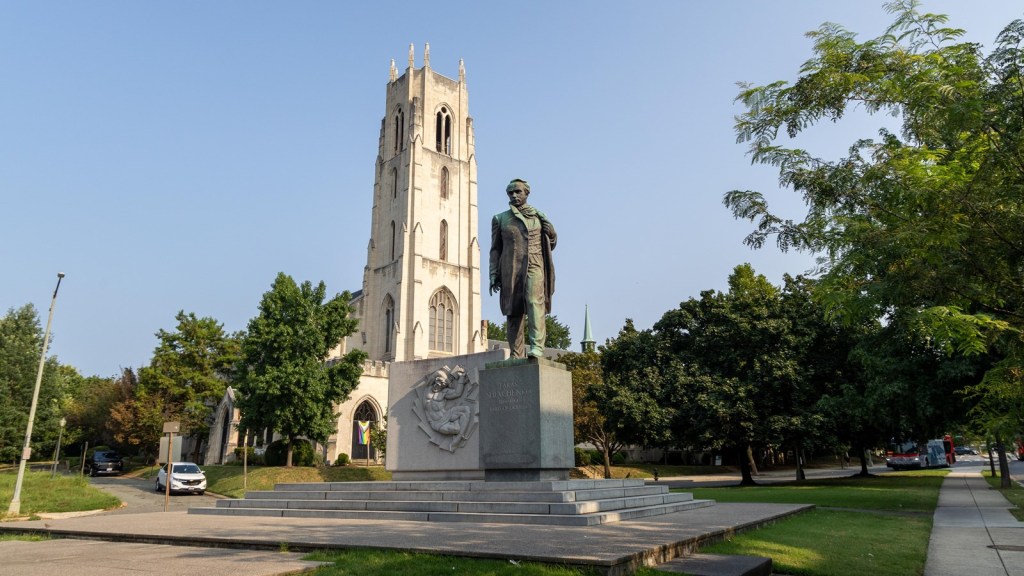
Taras Shevchenko (1814-1861) was a Ukrainian poet and artist who spent many years imprisoned for his pro-Ukrainian independence activities in tsarist Russia. He is revered for his literary works and self-sacrificing contributions to the people of Ukraine.
Inscriptions
Statue platform front face
TARAS
SHEVCHENKO
1814-1861
BARD OF UKRAINE
ТАРАС
ШЕВЧЕНКО
1814-1861
БАРД УКРАЇНИ
Statue platform back face
Dedicated to the Liberation, Freedom and Independence of all Captive Nations
This monument of Taras Shevchenko, 19th century Ukrainian poet and fighter for the independence of Ukraine and the freedom of all mankind, who under foreign Russian imperialist tyranny and colonial rule appealed for “the new and righteous law of Washington”, was unveiled in June 27th, 1964. This historic event commemorated the 150th anniversary of Shevchenko’s birth. The memorial was authorized by the 86th Congress of the United States of America on August 31, 1960 and signed into public law 86-749 by Dwight D. Eisenhower, the 34th President of the United States of America. On September 13, 1960, the statue was erected by Americans of Ukrainian ancestry and friends.
Pedestal left bottom rear
Leo Mol – Sculptor
Radoslav Zuk – Architect
Лео Мол – Скульптор
Радослав Жук – Архітектор
White granite wall back
..Не вмирає душа наша.
Не вмирає воля,
І неситий не виоре
На дні моря поле.
Не скує душі живої
І слова живого.
Не понесе слави Бога,
Великого Бога.
Тарас Шевченко – Кавказ – 1845
..Our Soul Shall Never Perish.
Freedom Knows No Dying,
And the Greedy Cannot Harvest
Fields Where Seas Are Lying;
Cannot Bind the Living Spirit
Nor the Living Word.
Cannot Smirch the Sacred Glory
Of Th’Almighty Lord.
Taras Shechenko – The Caucasus – 1845
SOURCE: “Taras Shevchenko Memorial,” National Park Service, n.d.