Cars for Ukraine

Vadim Volkov

The European University at St. Petersburg has purchased and dispatched a UAZ vehicle to the war in Ukraine “for transporting the wounded in the combat zone,” the university’s press service has reported.

It notes that the vehicle was sent to Military Unit No. 11076, which was formed from mobilized residents of St. Petersburg, the Leningrad, Murmansk, and Arkhangelsk regions, and the Komi Republic.

The university’s press service posted a commendation to university rector Vadim Volkov from the unit’s commander, who praised Volkov for his “social activism” and support of the military “as it carries out missions in the special military operation zone in Ukraine, the Donetsk People’s Republic, the Luhansk People’s Republic, the Zaporizhzhia region, and the Kherson region.”
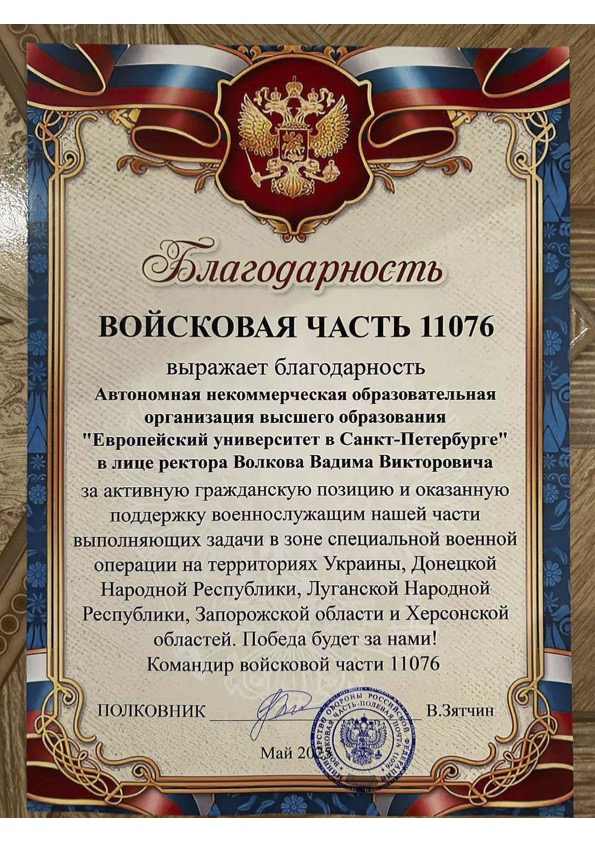
“Military Unit No. 11076 expresses gratitude to the autonomous noncommercial higher education organization ‘European University at St. Petersburg’ in the person of Vadim Viktorovich Volkov for social activism and support rendered to the soldiers of our unit as they carry out missions in the special military operation zone in Ukraine, the Donetsk People’s Republic, the Luhansk People’s Republic, Zaporizhzhia Region, and Kherson Region. Victory will be ours! Military Unit No. 11076’s commander, Colonel V. Zyatchin, May 2025.”

The European University is a private university founded in St. Petersburg in 1994. The university was funded by grants from American and European NGOs. In 2016, the university was stripped of its accreditation for a year after an audit undertaken by the Prosecutor’s Office and Rosobrnadzor [the Russian federal education watchdog], after which such audits became routine.

In 2023, the Russian authorities audited the European University “for extremism,” and the university was also fined over books in its library published by “undesirable” organizations. Rector Volkov reported in an interview with RBC on June 24 that the prosecutor’s office had audited ninety-eight programs at the university and twelve master’s theses, after which the university had amended the programs and made changes to its academic advising process based on the recommendations of the authorities.

In March 2024, the European University fired Ivan Kurilla, an Americanist who taught in its political science and sociology departments. Kurilla opposed the Russian invasion of Ukraine and was among the signatories of an open letter against the war by Russian academics and science journalists.

Source: “European University at St. Petersburg sends vehicle to war, garnering thank-you from Russian military,” Meduza, 10 June 2025. Photo courtesy of European University at St. Petersburg. Translated by the Russian Reader. Thanks to Comrade Koganzon for the heads-up.


Jesper Lindholt

Where are you from? And where are you now? Doing what?

I am from Aarhus, Denmark, and have lived in Kyiv for almost 20 years. I own a software company, Livatek, which works with clients in Northern Europe.

As a foreigner working and living in Ukraine for many years, what is the best and the worst thing about Ukraine?

The worst thing about Ukraine is that nothing is possible. The best about Ukraine is that everything in the end is possible.

How has the war changed your life? Has the war changed you personally?

With the start of the war, my brother Morten and I reactivated a Danish initiative called “Biler til Ukraine” – “Cars for Ukraine”—which had already helped a Ukrainian NGO bring SUVs to the front for medical evacuation during the war in Donbas. Within a week of the full-scale invasion in 2022, we were back in Ukraine with the first three cars.

Since then, we have scaled up tremendously and delivered more than 400 vehicles to the Ukrainian military for logistics and tactical purposes, including 75 buses for personnel transports. These days, we are managing more than one car per day. All in all, as a rough estimate, the value of these cars is somewhere close to $2 million. The money comes from absolutely average, normal Danes and private companies. I am often surprised by people’s generosity. They often donate their car and even drive it with us to Ukraine!

Growing a business has become more difficult with the war. With “Cars for Ukraine,” I have found another outlet for my professional energy to defend Ukraine. It has allowed me to work with some unique people in Denmark and Ukraine. Their strength and dedication inspire me.

What has surprised you most about Ukrainians these past couple of years? Good or bad?

I was not surprised to see the tenacity of the Ukrainians as they resisted Russia’s efforts to eradicate their culture. On the negative side—and here I am probably a bit naïve—I can still be disappointed by corruption. I know it is good news that corruption and the people who commit it are discovered and prosecuted, but I would prefer things to be nipped in the bud instead of cracked down afterward.

What are your plans?

I think I am like most Ukrainians in that “the future” does not exist anymore. We have a war to fight and win—after that, there is a future—and it is bright and open.

How do you see the war ending and Ukraine returning to a normal life?

Forces at play now do not point to a happy-end scenario for Ukraine. The dynamics need to change. Specifically, more political leaders of the West must do “a Macron” — to understand that Ukraine is fighting for every country of the liberal, Western world. (French President Emmanuel Macron underwent a radical change in his view on Russia’s war from dovish to hawkish and insisting on Russia’s defeat.) Because, honestly, for Ukraine to have a normal future, Russia not only needs to be beaten back to within its borders. It needs such an educational wacking that it will give up on its aggressive ways – and never again even consider attacking Ukraine or other states.

Tell us one thing people abroad do not know about Ukraine but they really should.

For too many centuries, Russian culture has defined itself as being unique, and outside rules and measures apply only to other countries. The mere existence of an independent Ukraine is a challenge to that myth. And, when Russia is attacking its neighbor, it is fighting its own demons and inferiority complexes.

You can learn more about the work of “Cars for Ukraine” (in Danish “Biler til Ukraine”) here.

Source: “BLITZ INTERVIEW: Jesper Lindholt, a Danish tech executive bringing hundreds of cars to the Ukrainian army,” Two Grumpy Old Men on Ukraine, 20 May 2024

A Thorn in Their Side

Kushelev-Bezborodko Palace on Gagarin Street, Petersburg
Kushelev-Bezborodko Palace on Gagarin Street, Petersburg, home of the European University

European University Faces Eviction for Plastic Windows
Maria Karpenko
Kommersant
January 24, 2017

The European University in St. Petersburg, one of the leading non-public educational institutions in Russia, may lose its building. Petersburg city hall has unilaterally terminated the lease agreement for the Kushelev-Bezborodko Palace, which has housed the university since 1995. The Smolny claims university management violated the conditions for using the historic building by making alterations and installing windows and air conditioners. Meanwhile, the university had been preparing to reconstruct the palace, investing 2.2 billion rubles in the project, 670 million rubles of which were to be spent on restoring the historic section of the building.

On December 27 of last year, the St. Petersburg City Committee for Property Relations (KIO) sent the European University notice it was unilaterally terminating the rental agreement. As a source at the committee told Kommersant, the European University hd not fulfilled its obligations to preserve the mansion of Count Kushelev-Bezborodko, built in the nineteenth century.

Officials discovered the violations last summer during an unscheduled inspection. (The Smolny could not explain yesterday why the inspection had been necessary.) As a source at the City Landmarks Use and Preservation Committee (KGIOP) informed Kommersant, university officials had made alterations to the premises and installed reinforced plastic windows and air conditioners without providing authorized documentation and obtaining permission for the repairs. The Dzerzhinsky District Court fined the European University 200,000 rubles in its capacity as user of a culture heritage site.

The Property Relations Committee then deemed it possible to terminate the lease agreement. The European University challenged the agreement’s termination in commercial court, arguing it was groundless. The court adopted interim measures, halting the university’s eviction from the premises until a decision has been made on the claim. The first hearing has been scheduled for March 15.

Meanwhile, the European University had planned in the near future to begin implementing an investment project for adapting the Kushelev-Bezborodko Palace to modern educational needs. The university estimates its cost at 2.2 to 2.4 billion rubles, 670 million rubles of which should go to restoring the historic section of the palace. The project has been in the works since 2013. Architect Jean-Michel Wilmotte, designer of the Russian Cultural Center in Paris, won the competition to carry out the project. As European University Vice-Rector Vadim Volkov told Kommersant, the KGIOP had already partly authorized the reconstruction. (Our sources in the KGIOP confirmed that the methods for restoring the interiors of the palace that had artistic value had been approved.) Next week, the university had anticipated the KGIOP’s decision on the entire project.

“Given our intention to implement such an ambitious project, the KIO’s decision to evict us from the building on account of three windows, a plastic partition, and and extension that was erected under Brezhnev looks odd, at very least,” Mr. Volkov said.

The official statement on the university’s website stresses that none of  the violations uncovered during the inspection “put the cultural heritage of the palace at risk. They would be automatically corrected during the adjustment project as mentioned above.”

The statement goes on to say “[t]here is a degree of incommensurability between the claims of the Committee and the consequences entailed by the latter’s tough stance.”

Vice-Rector Volkov likewise noted that the clause giving the city the right to terminate the lease agreement if the university violated its landmark protection obligations had been added to the agreement only in April 2015 at the behest of the KIO.

“First, the KIO inserted these conditions in the agreement, and then showed up to check just this, certain they would be able to turn up violations of some kind,” Mr. Volkov suggested.

Maxim Reznik, chair of the education, culture and science committee in the city’s legislative assembly, believes the claims are politically motivated.

“Apparently, the presence of such a university, when all the rest have long ago been marching in step, keeps someone awake at night. In my view, the situation can be resolved in the university’s favor only if if the head of state [i.e., Vladimir Putin] or people close to him intervene,” the city MP told Kommersant.

In December of last year, Rosobrnadzor (Federal Service for Supervision in Education and Science) suspended the university’s license. The European University appealed to President Putin, who asked Vice-Premier Olga Golodets to get to the bottom of the matter. As Kommersant wrote, officials who attended a closed meeting concluded the claims were unsubstantial and spoke out in the university’s favor. Three days later, its educational license had been restored.

The university first encountered problems with oversight authorities in 2008, when it was closed for a month and a half [allegedly] for fire safety violations. Last summer, the Prosecutor General’s Office inspected the European University at the behest of Petersburg MP Vitaly Milonov. Prosecutors then gave the university two months to eliminate violations.

Translated by the Russian Reader. Photo courtesy of saint-petersburg.com