Minnesota Now, the U.S. Then and Now

I want to try and describe what it is like in Minnesota right now for my friends in other states. As a reminder, Alyse and I live in the suburbs — Apple Valley — not Minneapolis. This federal invasion and occupation is occurring all across the state, not just in Minneapolis.

ICE is not looking for specific people. They don’t have a sheet of paper with specific names, specific addresses, that they are arriving in communities to get. They drive around looking for kidnappings of opportunity.

So they will sit and idle in their car, waiting for a Black, brown or Asian person who is walking into the gas station, taking out their trash, walking their dog, or working at their job and then swarm and grab them.

ICE drives around *incredibly recklessly* and uses license plate readers to find people with mostly-Hispanic sounding last names, pulls them over, and kidnaps them. Again, these aren’t specific people ICE has been tasked with finding. Most of the people who are kidnapped are U.S. citizens, lawful permanent residents, or have legal status of some sort (work permit, a social security number, or are a refugee or asylee) (picture 1). These are documented immigrants or citizens who have broken no laws — including not having broken laws entering the country. These are people just going about their daily life who get stopped and snatched because they’re Black, brown or Asian.

Just going about OUR daily life, we see abandoned cars in the middle of highways, on neighborhood streets, in front of doctors offices. Sometimes the doors are still open and the car is still running. We could be in line to get Burger King and watch ICE snatch a teenager on his way into work (picture 2). We could be taking out the trash, walking kids to the bus stop, going for a walk outside, and there will all of a sudden be a swarm of anonymous, masked, violent men ripping a family from their home or out of the booth at a restaurant. Picture 3 is a neighborhood, one mile from my house, at 8:30AM this past Wednesday. It was school bus pick up time and also trash day in that neighborhood. This is just in the middle of the neighborhood.

This can happen any where at any time. There is no place we can go and be assured we won’t see someone be violently taken. Target. The grocery store. A restaurant. Driving Hattie to swim lessons. Driving to church. Going to the doctor (picture 4). Multiple times a day, we get texts from co-workers, neighbors, friends, family members about a person they know (or are related to, or work with, or are their kids’ friends parents) who was taken.

ICE sets up checkpoints in neighborhoods and make everyone leaving or entering show their papers (note: very few people can prove their citizenship at a moments notice. A majority of Minnesotans don’t have passports. Citizens don’t just carry their birth certificate around). They go door-to-door in apartment buildings and neighborhoods, just hoping a Black, brown or Asian person will open their door (because they have no judicial warrant to take a specific person(s), just kidnapping whoever accidentally opens their door).

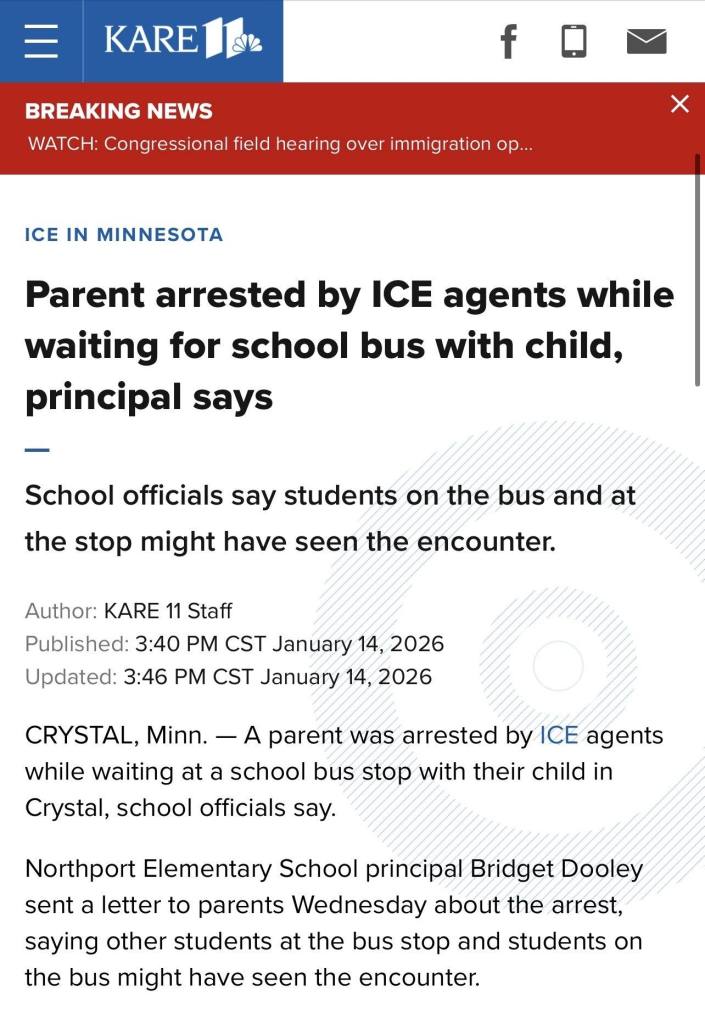
Schools have had to close. ICE has shown up to schools and just pepper sprayed kids and parents (picture 5). Districts are calling families and advising that their kids switch to online school. ICE circles and targets Spanish-immersion programs, forcing moms and dads to sit watch over their kids’ school to keep their kids and teachers safe (picture 6). Kids come home from school to empty houses, their parents having been stolen sometime during the day. When parents are kidnapped in front of others, they will yell out their full names and the name of their kids’ school(s) so someone can call the school and alert the administration, hoping their kids can be put with a safe adult instead of coming home to no one. There are people who signed delegation of parental authority (DOPA) forms — agreeing to take a neighbor or friend’s kids in the event of an emergency — who now have multiple children from multiple families.

ICE is ubiquitous. They are everywhere. We see them 3, 5, 7 times a day just going through our normal routine. There are more federal agents in Minnesota than there are local law enforcement from the ten largest metro police departments COMBINED (picture 7).

This is going to come to other states and I want people to be prepared, because I cannot overstate how many people have (had to) come together to respond.

Regular Minnesotans — people who have never once gone to a protest, called their elective representatives, participated in an economic strike, people who rarely even vote — have been activated. Grandparents carry whistles in their cars in case they come across ICE while living their lives and need to warn the surrounding area. Parents of kids in K-12 organize to ensure there’s parents at bus stops and the area around schools, because ICE stakes out bus stops and school properties — taking parents who are waiting at the bus stop or in the carpool line (picture 😎. We’ve set up massive food donation and delivery infrastructure. We organize rides to school and work. People are literally taking in families.
SO many kids aren’t going to school right now (picture 9). So many businesses are closed or have lost their customer base entirely. So many families are facing eviction because they can’t go to work and won’t be able to pay their rent.

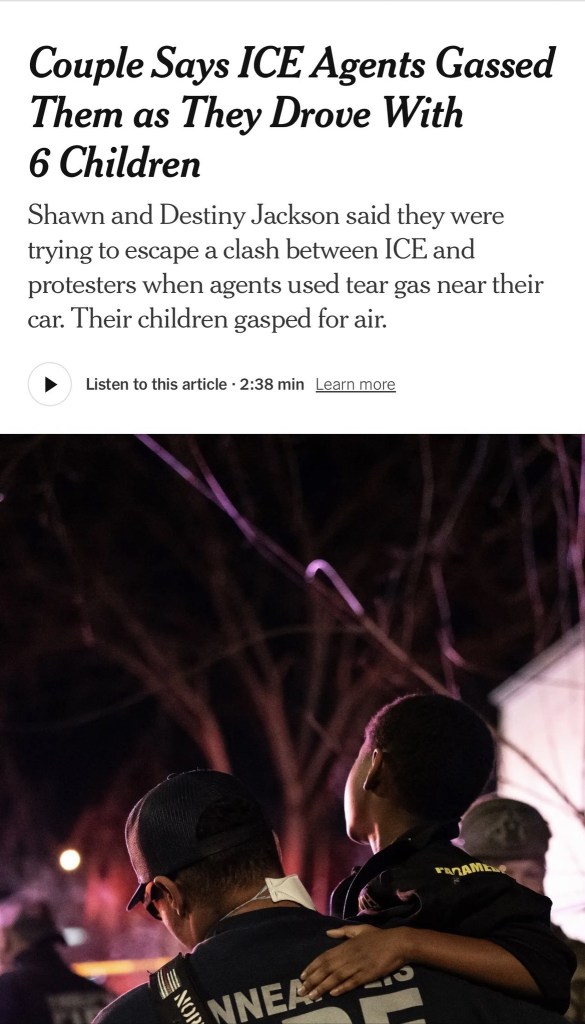
Minnesotans are being collectively punished and traumatized. 6 month old babies have been teargassed because their parents are just driving in their own neighborhood (picture 10). We are coming together in the most beautiful ways — I don’t want to understate that. But I want everyone outside of Minnesota to understand: we are under a federal invasion and occupation of armed, masked, paramilitary that roam our streets, brutalizing, harassing and murdering with impunity.
There may be people who might think that when this comes to your state, being white or being a U.S. citizen or living in a suburb or rural area or living in a neighborhood with few or no immigrant neighbors means you won’t see or experience this kind of daily assault of an invasion and occupation. I want to dispel that idea.

There are things I’m forgetting, certainly, but I wanted to try and paint the picture because this isn’t ending in Minnesota. We are the test case before expanding to other states in the country.

Help us now to stop this before it spreads. Organize in your communities now.

To support MN’s during this time, donate here: http://standwithminnesota.com/

Source: Erin Maye Quade (Facebook), 18 January 2026. Thanks to Rahul Mahajan for the heads-up.


On January 7 U.S. Immigration and Customs Enforcement (ICE) agent Jonathan Ross shot and killed Renee Good, a thirty-seven-year-old woman who had been observing ICE raids from her car in her Minneapolis neighborhood. In videos of the incident, we can see Ross firing through Good’s windshield and open window as she begins to drive away. The horrific footage of the killing felt like a stark symbol of today’s authoritarian moment—but at the same time, I knew that anyone involved in the struggle against police violence would find it tragically familiar.

To put Good’s killing in context, I spoke with historian and Boston Review contributing editor Robin D. G. Kelley, whose forthcoming book, Making a Killing: Capitalism, Cops, and the War on Black Life, covers the history of county, state, and municipal police violence—as well as the activism against it. In an email exchange, we discussed the pitfalls of the “perfect-victim narrative,” policing’s terror tactics, why agents don’t need more training, and where we go from here.

Deborah Chasman: Good’s killing shocked Americans. But much about it reflects violence that’s very familiar to you. Can you put the murder in the context of your research?

Robin D. G. Kelley: Despite having spent more than thirty years studying and writing about police violence, I am still shocked by every death—even when the outcome is predictable. But the killing of Good shocked even the most seasoned organizers. She was a white woman and a mother—two things you’re not supposed to be when armed agents of the state put you in a body bag. (That she was queer and a poet, not so much.)

Of course, the very idea that certain people, by virtue of their characteristics, don’t deserve to be brutalized, caged, or killed by police is the problem. Mariame Kaba warns against “perfect-victim narratives,” which reinforce what Ruth Wilson Gilmore calls “the problem of innocence.” Centering someone’s innocence clouds the case for abolition, which seeks to create a world where no one is caged or gunned down even if they broke the law. No matter who she was, what she looked like, her marital or citizenship status, or what she might have done in the past or even in the moment, Good had the absolute right not to be shot for driving away.

What doesn’t surprise me is why and how Jonathan Ross shot her and the federal government’s efforts to cover up what happened. Researching Making a Killing, I found too many incidents to count where police fatally shot people for attempting to drive away. These were not high-speed chases, by the way—sometimes it was just a car lurching forward or an engine revving up that prompted a shooting. They all have one thing in common: police justify the shootings as acts of self-defense. The alleged “suspect,” the story goes, intended to ram the officer, who opened fire because he feared for his life. After these shootings, cops rarely argue they were simply trying to stop a fleeing suspect, because it opens them up to two objections: that firing at a driver puts others in harm’s way, and that they could have taken down the license plate and pursued the person later. Fearing for one’s life is always used to absolve cops from having to explain why they didn’t act differently.

This is why, in videos of the moments before the shooting, we can hear Good’s wife Rebecca saying, “We don’t change our plates every morning, just so you know. It will be the same plate when you come talk to us later.” And this is also why, for many years and in different cities, movements fighting police misconduct demanded that officers be banned from using lethal force against fleeing suspects who do not pose an imminent threat, whether on foot or in a car.

I’m also not shocked by the utter refusal of the federal government to investigate or consider bringing charges against Ross. I’ve lived through and documented so many cases of officers whose egregious acts of violence led to no indictments and no investigations; so many cases of police and even prosecutors destroying incriminating evidence. The question is, why are so many people surprised and indignant about the feds’ unqualified defense of Ross? Maybe because we’ve fallen into the trap of distinguishing ICE and CBP (bad) from local police (good). Maybe it’s a residual effect of the January 6 insurrection, in which some police officers had been victims of right-wing mobs (which themselves included a disproportionate number of cops and soldiers). In any case, the narrative has taken hold that ICE agents are rogue cops or cops on steroids, trained to terrorize or simply untrained. Strangest of all in this story is the liberal pipe dream that local police will stand up against ICE and CBP, when police have collaborated with ICE and been deployed to protect agents from protesters, even in so-called sanctuary cities.

I’m not sure if it’s amnesia or just wishful thinking, but it seems like the well-documented terror tactics of municipal, county, and state police have just disappeared from people’s memory. Chicago and Los Angeles, where resistance to ICE has been extraordinary and well-organized, have histories of police violence that rival anything ICE agents are doing. Indeed, it is precisely the long experience of organizing against this violence that prepared activists in these cities to resist ICE.

Chicago, which takes up a very long chapter in my book, is known for police torture, the maintenance of secret “black sites,” assassinations and executions, and prosecutors who have consistently protected police even to the point of hiding evidence. This is the city where the second Black police superintendent, LeRoy Martin, bragged in 1987, “When you talk about gangs, I’ve got the toughest gang in town: the Chicago Police Department.” And it is the same city that has been a model of resistance to police repression for more than half a century, culminating in the collective struggles for justice for Rekia Boyd, Laquan McDonald, and victims of torture that brought down the ruling regime of Rahm Emanuel.

This is not to diminish ICE and CBP’s violent tactics. These outright abductions are terrifying, though again, not without precedent. Police have abducted Black men standing on a street corner or a stoop and tossed them into unmarked vans just for looking suspicious, and there are numerous cases of young Black women abducted off the streets and sexually assaulted by police. But there is a fundamental difference between these abductions and ICE’s: the former were intended to be secret, the latter publicized. ICE and CBP agents are either filming these acts of terror themselves (Ross had one hand on his gun and the other holding his cell phone to film!), or they are arriving with a film crew. The point is to create fear, to terrorize people into submission, to create a state of emergency.

Finally, let’s try not to make these attacks about Trump or even Stephen Miller. Both ICE and CBP have histories of violence dating back to well before 2016. My colleague Kelly Lytle Hernandez has written on the history of the Border Patrol, which has been terrorizing people since 1924.

DC: Republicans and right-wing pundits have been relentless in blaming Good for her murder, or calling her a domestic terrorist and warning that any activism will put you in harm’s way. Clearly there’s a legal element to blaming Good—it’s meant to exonerate the agent. But how do those narratives function politically?

RK: Anyone organizing against state power will be a target, whether their protest abides by the law or involves civil disobedience. Either way, nothing justifies the harm, which is what these narratives attempt to do. Just last night, after ICE shot another person in Minnesota and protesters were in the streets battling federal agents, there was a lot of talk—including from Governor Tim Walz and Minneapolis Mayor Jacob Frey—about the need for peaceful protest: code for candlelight vigils and silent prayer. Militant civil disobedience, aggressively confronting a phalanx of masked agents in riot gear, or blocking traffic is nonviolent, but these tactics are not considered by the political class to count as “peaceful protest.” And by now, it should be clear that peaceful protest, whatever form it takes, will not get ICE or CBP out of your city; it will not stop the terror or the abductions.

And yet, when we return to Good’s death, we must remember that she actually wasn’t protesting. She was a legal observer doing her job, and when told to leave she was complying. Unsurprisingly, J. D. Vance and all the right-wingers who blame Good for her death are simply lying. Calling her a domestic terrorist—it’s the oldest trick in the book. The subtext to which we ought to pay attention is how her gender and sexuality constituted the real threat to Ross, his fellow agents, Vance, Stephen Miller, and MAGA. One must imagine what it meant to Ross for a smiling queer woman to tell him, “I’m not mad at you.” After shooting her three times, Ross or an agent near him mutters, “Fucking bitch!” That says it all.

Nearly every victim of an ICE or CBP shooting is blamed for being either a fugitive or domestic terrorist. When ICE agents fatally shot Silverio Villegas-González, a thirty-eight-year-old immigrant from Mexico, as he tried to drive away from what amounted to an ambush in Chicago, DHS released a brazenly false statement claiming that he “refused to follow law enforcement officers’ commands” and used his car as a weapon, hitting and dragging one of the officers. And so the same old story goes: “Fearing for his own life and broader public safety, the officer fired his weapon.” We know now that no officer was hit or dragged, and the one officer allegedly hurt suffered minor cuts from breaking Villegas-González’s window.

Likewise, when CBP agents shot Marimar Martinez, a thirty-year-old schoolteacher and U.S. citizen—also in Chicago—they labeled her a domestic terrorist and charged her with ramming a federal law enforcement officer. We know now that the agent, Charles Exum, rammed her vehicle, jumped out with his gun drawn, and said “Do something bitch” before shooting her five times. The DHS lies were so egregious (and Exum didn’t help their case by bragging about it in text messages) that the prosecution had no choice but to drop all the charges.

DC: In the wake of Good’s murder, many have called for better training for ICE officers—a response that activist Kelly Hayes, among others, has forcefully rejected. I know you agree. Can you explain why?

RK: Jonathan Ross wasn’t one of those cats recruited with a $50,000 bonus and handed a gun. Besides being a veteran of the Iraq war, he had spent a decade as a member of the special response team of ICE’s enforcement and removal operation. He got more training than most of the other masked goons running the streets of the Twin Cities. The argument for more and better training was thoroughly discredited after George Floyd’s murder in 2020. As it turned out, Derek Chauvin had lots of training: he had taken the crisis intervention training, use-of-force training, de-escalation vs. restraint training, and even training in implicit bias, which became mandatory for Minneapolis police officers beginning in 2018. The result? Chauvin racked up seventeen misconduct complaints over nineteen years on the force. And after 2018, cases of police brutality and excessive force complaints increased across the city.

But if training hasn’t worked, why does it continue? Why is it always trotted out, alongside new technologies, as the solution? Because training and technologies (body cams, Tasers, so-called less-than-lethal weapons, predictive policing software) are a boondoggle for corporate interests. Training costs money, which increases police budgets, which are paid for through taxes and bonds—a hidden source of revenue for financial institutions that administer the bonds. The money for training flows to private companies, usually run by former police chiefs and so-called criminal justice experts—not community organizations that have been fighting for accountability. Sometimes the investment in new technologies and training comes from corporate-funded private police foundations, whose donations enable departments to purchase equipment, such as surveillance technology, guns, ballistic helmets, cameras, and drones, and assist officers with bonuses or legal fees, with no oversight or public input. But corporations like Amazon and Google get a great return on their investment since law enforcement agencies adopt technologies of surveillance, data mining and management, etc., coming from these companies.

To understand what “training” produces, let’s focus on one company: 21st Century Policing Solutions, LLC (21CP), which grew directly out of an Obama-era task force formed in late 2014 after the killing of Michael Brown. 21CP is made up of law enforcement officials, lawyers, and academics, and it’s paid by municipalities and university public safety forces to train police in a host of areas: gaining community trust, racial equity, changing use-of-force policies, communication, transparency, strategic management, and community policing. Usually, this work entails producing reports that ultimately just repeat boilerplate recommendations. Oklahoma City paid 21CP $193,000 for a report many Black residents found to be useless—nothing changed. Aurora, Colorado, paid 21CP $340,000 to “investigate” the police missteps that resulted in the death of Elijah McClain, a young Black man who had been injected with ketamine under police custody and died. 21CP produced a 161-page report that primarily described the operations of the Aurora Police Department, compared it with other departments in similar-sized cities, repeated what we all know about the death of McClain, and offered obvious and fairly innocuous recommendations: prohibiting chokeholds, retaliatory violence, using force on people who are handcuffed—in other words, prohibiting behavior that is already prohibited. And worse, these reports often suggest recruiting and training more officers. I want to suggest that when we talk about training and technology, we need to follow the money. And in the case of CBP and ICE, the last thing we should be doing is proposing reforms that give them more money.

As the coercive arm of the state, the police—including CBP and ICE—are the primary instruments of state violence within the borders of the United States. They function as an occupying force in America’s impoverished ghettos, barrios, reservations, on the Southwest border, and in any territory with high concentrations of subjugated communities. For people who reside in these communities, keeping us safe is not the objective. Instead, the modern police force—whether local, state, or federal—wages domestic war. Whether we call it a war on crime, a war on militants, or a war on drugs, law enforcement at every level has turned many Black working-class neighborhoods in particular into killing fields and open-air prisons, stripping vulnerable residents of equal protection, habeas corpus, freedom of movement, and even protection from torture. The attack on non-white immigrants is just another front in a war the police have waged since their inception.

And despite the handwringing and outrage over the Trump administration’s flagrant violation of the Posse Comitatus Act of 1878 limiting the use of the military in domestic matters, the police have long functioned as an army against dissident social movements. The police are the first line of defense against strikes and left-wing protests, while often serving as a cordon to protect Klansman, Nazis, and the alt-right.

DC: What are the chances that Ross will be held accountable? How does this end?

RK: Simply put, Ross will not be held accountable, nor will anyone else responsible for the death or injury of victims of ICE or CBP attacks. As I document in my book, we can’t get accountability from the “regular” police, whatever that means: after decades, we haven’t been able to achieve something as basic as an honest civilian review board with subpoena powers and the ability to hire and fire officers! Since Trump’s second term, things have gotten even worse. Guided by the Heritage Foundation’s Project 2025, the Trump administration rescinded Biden-era police and criminal justice reforms; shuttered the National Law Enforcement Accountability Database (NLEAD) created in 2023 to allow prospective employers to access the records of federal law enforcement officers in order to check their backgrounds for misconduct; halted all open federal investigations into law enforcement, notably in Jackson, Mississippi, and New York City; ended federal consent decrees mandating reforms of Louisville and Minneapolis police departments; made the extraordinary offer of free private-sector legal services for officers accused of misconduct.

It is not enough to abolish ICE. We need to abolish the police and cages and build other institutions and relationships that can bring us genuine safety. Abolition is less an act of demolition than a construction project. It is creative creation, the boundless, boundary-less struggle to make our collective lives better, what Ruth Wilson Gilmore calls “life in rehearsal.”

Ironically, the federal government’s escalation of violence and its spillover into other communities have actually forced people to find their own strategies to keep each other safe, through communication, patrols, whistles, trainings in nonviolent resistance, and old-fashioned organizing. It’s not just about keeping ICE out, but making sure that the medical and child care needs of neighbors are being met, that people who can’t leave their homes out of fear are fed, and that some homes can become designated safe houses.

I’m reminded of a 2009 statement issued by the abolitionist organization Critical Resistance. Instead of police, the statement asks,

What if we got together with members of our communities and created systems of support for each other?. . . . Relying on and deploying policing denies our ability to do this, to create real safety in our communities.

We’re seeing this in action now in the mobilizations against ICE. The question is whether it can be sustained and turned into something that can replace our dependence on armed agents of the state to solve human problems.

Independent and nonprofit, Boston Review relies on reader funding. To support work like this, please donate here. Robin D. G. Kelley is Distinguished Professor and Gary B. Nash Endowed Chair of U.S. History at UCLA and a contributing editor at Boston Review. His many books include Freedom Dreams: The Black Radical Imagination. Deborah Chasman is publisher and coeditor of Boston Review. Her writing has also appeared in New York magazine and the Chronicle of Higher Education.

Source: Robin D.G. Kelley and Deborah Chasman, “Renee Good’s Murder and Other Acts of Terror,” Boston Review, 17 January 2026

Daily Beasts


“Let’s stand up for the truth.” A military recruiting billboard photographed earlier this summer in Kaluga, promising five million rubles (approx. 56,000 euros) for one year of “contract” (voluntary) military service, a one-time signing bonus of two and a half million rubles, and a monthly salary of 210,000 rubles for service in the “Special Military Operation zone.” Photo: Alexander Gronsky (Facebook). Thanks to Sergei Medvedev for the heads-up.


An American father who moved to Russia to avoid LGBTQ+ “indoctrination” for his kids is being sent to the front line in Ukraine, despite being assured he would serve in a non-combat role.

Derek Huffman, 46, feels he is being “thrown to the wolves” after being told that his job in the military would be as a correspondent or as a welder, his wife, DeAnna, said in a recorded plea for prayers, which has since been removed from her YouTube page.

Huffman has no prior military experience, DeAnna said, adding that his limited training was conducted in Russian. She suggested the language barrier has made her husband particularly unprepared for the horrors of combat.

“Unfortunately, when you’re taught in a different language, and you don’t understand the language, how are you really getting taught?” she pondered. “You’re not. So, unfortunately, he feels like he’s being thrown to the wolves right now, and he’s kind of having to lean on faith, and that’s what we’re all doing.”

Huffman joined the military in the hope of gaining Russian citizenship for his family through an expedited process. He also felt such service would allow him to “earn” the respect of his new countrymen, which is something he once said migrants in the United States refuse to do.

“The point of this act for me is to earn a place here in Russia,” he told Russian state media last month. “If I risk myself for our new country, no one will say that I am not a part of it. Unlike migrants in America who come there just like that, do not assimilate, and at the same time want free handouts.”

Undocumented migrants cannot join the U.S. military during peacetime. A program launched by former President George W. Bush allowed such immigrants to seek citizenship by serving in the military, but that pathway was shuttered during President Donald Trump’s first term.

DeAnna, 42, suggested her husband had been misled during the military recruiting process. She added that, after a month of service, her family had yet to receive any pay.

“When he signed up and had all of that done, he was told he would not be training for two weeks and going straight to the front lines,” she said. “But it seems as though he is getting one more week of training, closer to the front lines, and then they are going to put him on the front lines.”

Huffman moved his family to a village outside Moscow in spring. It was launched by American blogger Tim Kirby—who has lived in Russia for two decades—in 2023 to attract Americans seeking to escape the “liberal gender norm.” That project has been a flop, with United24Media reporting that only two families, including the Huffmans, have moved in.

Huffman, a native Texan, brought his wife, three daughters, and their family Husky, “Baby,” with him to Russia. The couple also have three sons from prior marriages who opted to remain in the United States.

Huffman’s admiration for Russia runs deep. The Russian state-operated news agency RIA Novosti reported last month that the couple honeymooned in Moscow.

“The city charmed us with its rich history, vibrant culture, and welcoming atmosphere,” DeAnna told the outlet. “Before that, we figured out whether moving to Russia would fit our family’s needs and values. However, it wasn’t until we saw Moscow in person that we truly felt a connection.”

DeAnna said that she was not surprised that her husband wanted to volunteer for the Russian military, even as it is in its third year of a bloody war with Ukraine. Ukrainian officials estimated this week that more than 1 million Russian soldiers have died in the conflict, which continues to rage on despite President Trump’s demands for peace.

”It didn’t come as a surprise to me,” she said of his joining the military. “He always spoke so highly of the country, its president, and its people, and he has a strong passion for doing the right thing.”

Source: Josh Fiallo, “Anti-Woke Dad Who Fled With Family to Russia Sent to War Zone,” Daily Beast, 20 July 2025


“I got upset when the doctor told me I had diabetes,” said Yurii. “Because uneaten sweets are waiting for me at home, and we’ve already bought lemonade for New Year’s.”

Yurii is 16 years old, and every day he starts with a long-acting insulin injection. Later throughout the day, ten minutes before each meal, he measures his blood sugar levels, calculates the amount of carbohydrates he will get from food, and injects the appropriate dose of insulin.

Type 1 diabetes is an autoimmune disease that changes your life forever and can be triggered by infections or, as it is in Yurii’s case, by severe stress – especially after what happened to his brother.

Chronic stress has been rising among Ukrainians since the start of Russia’s full-scale invasion, as Moscow continues to shell the country daily. The continuous sleepless nights and the fear of being hit by a drone or missile are affecting both the mental and physical health of the people in Ukraine.

In June 2025, Russians increased the number of drones and missiles launched at Ukraine increased by 60 percent, according to Oleksandr Syrskyi, the Commander-in-Chief of the Armed Forces of Ukraine. In addition, June saw the highest number of civilian deaths since April 2022 as a result of military actions: 232 people.

The invisible effects are compounding: Ukrainian children have begun to experience health conditions that could affect the rest of their lives.

Statistics show a rise in the number of patients with type 1 diabetes in the frontline Kharkiv region, and the number of people diagnosed with diabetes in general is also on the rise across the country.

Before the invasion, Yurii lived with his parents in the central Ukrainian city of Cherkasy. They tried to get out of town every weekend — whether that meant going fishing or mushroom-picking in the forest.

“Children need to breathe fresh air,” Olena, Yurii’s mother, told The Counteroffensive with a nostalgic smile on her face.

She begins the conversation by saying, “I am the mother of two wonderful sons.”

Yurii has a brother, Volodymyr, also known as Vova, who is 10 years older and who looked after Yurii from an early age.

“We walked all over Cherkasy together, went to parks, squares, the Dnipro River, and he treated me to McDonald’s. Vova [a nickname for Volodymyr] always told me, ‘When you grow up, we’ll go out with girls together. ’ And Vova loved everything related to the army,” said Yurii.

When Olena talks about her eldest son, her voice begins to tremble.

Vova died on May 3, 2022, while defending Mariupol at Azovstal, a strategic steel factory that was besieged by Russian forces for almost three months, a famous last stand.

He died after his car rolled onto an enemy mine.

The family only learned about his death six months later.

“One day, Vova’s commander called me, introduced himself, and asked how I was doing. I replied, ‘Do you know where my son is? Wasn’t he in captivity with you?’ He told me that Vova had died on May 3 and asked, ‘Didn’t you know?’ It felt like half my heart had been cut out of my chest at that moment,” remembered Olena.

Volodymyr was only buried in February 2023. After the tragedy, Olena began to have health problems: she constantly felt weak, and eventually doctors had to remove her thyroid gland so that she could get better.

In the fall of 2023, months after Volodymyr’s funeral, the family went to the Carpathians for a break. During the trip, Olena noticed that Yurii, then 14 years old, was drinking more water than usual and had lost a significant amount of weight. Despite being naturally thin and 1.74 meters tall (5 feet 9 inches), he weighed just 45 kilograms (99.2 pounds).

“Yurii took his brother’s death very hard. It wasn’t that he cried a lot, but as if something inside him had burned out,” said Olena.

Yurii and Olena returned to Cherkasy and went to see the doctors. While Olena had developed a problem with her thyroid, everything seemed normal in Yurii.

But when the doctor routinely tested Yurii’s blood sugar levels, they found he had developed type 1 diabetes.

“It felt like I was beaten to death with feet, after all the horror we had already gone through,” said Olena.

Many autoimmune diseases of the endocrine system occur in childhood or young adulthood, as these are periods of active growth and hormonal changes, said Natalia Pogadaeva, head of the endocrinology department at Okhmatdyt, Ukraine’s largest pediatric hospital, which was hit by a missile strike last year.

Genetics plays a significant role in the onset of diabetes, as in other autoimmune diseases. However, the trigger for their onset is usually stress, she added. The following six months after the start of Russia’s invasion of Ukraine, the number of patients with diabetes and other immune diseases surged, she added.

Due to full-scale Russian invasion and the displacement of the Ukrainian population both within Ukraine and abroad, it is very difficult to determine the actual extent of the increase in diabetes, Pogadayeva says.

“Children who lived in Kyiv could have gone abroad and realized they were sick, or vice versa: a child moved from Kherson to Kyiv and is being treated in Kyiv, not where they lived,” she added.

Still, some statistics hint at the broader toll. For example, 398 patients with type 1 diabetes under the age of 18 were registered in the first 9 months of 2023 in the Kharkiv region, a frontline region in the northeast of Ukraine. During the same period in 2024, the number had already increased to 501 patients – a more than 25 percent increase.

According to the Ministry of Health of Ukraine, 531,200 people were diagnosed with different types of diabetes in 2023, the first full year of the full-scale invasion. In 2022, the number was 489,934 – an 8 percent increase.

Many of the children who went to Okhmatdyt to get treated had either survived Russia’s occupation, had experienced the aggression firsthand, or had evacuated from Mariupol or Bakhmut, Pogadaeva said.

“At the beginning of the full-scale invasion, among other things, logistics were also greatly changed,” said Pogadaeva, the head of the endocrinology department at Okhmatdyt.

Children who already had diabetes had a hard time accessing insulin and the supplies needed to measure their blood sugar. As a result, they had to be hospitalized.

Diabetes can have severe complications if not taken care of properly. Uncontrolled blood sugar can damage blood vessels, which are present in every organ of the body. If affected, the kidneys, the limbs, and the eyes are the first to suffer. In the long run, it can lead to kidney failure, loss of sensitivity, loss of vision, and even to the amputation of limbs.

Pogadaeva explains that our bodies have a stress hormone called cortisol, which can be released during periods of prolonged stress, such as experiencing daily shelling, night-time air raid alarms, and lack of sleep — all situations Ukrainian children have been experiencing for the past three years.

The release of cortisol leads to uncontrolled fluctuations in blood sugar levels, she added.

Yurii will start college this year. Olena fears that having to prepare for exams will add to the stress of the war. She said that while at her house, they have adapted to a diet appropriate for the disease.

Yet Yurii’s blood sugar levels are still fluctuating.

They relocated to a village near the regional centre to be closer to nature. There, Yurii has his workshop and chickens, for which he recently built a drinking trough.

The family fondly remembers his older brother, Volodymyr, who was posthumously awarded the Order for Courage, a state award given by the President of Ukraine for heroism shown in emergencies.

“It’s hard to say that anything in our lives has changed significantly because of the illness. Now it’s just a way of our life.

My husband is only sometimes dissatisfied, saying, ‘I don’t want porridge, I don’t want salads. When will we have varenyky [Ukrainian dumplings]?’ But that’s it, if the child can’t have it, then no one can,” Olena said.

Source: Tanya Novakivska, “Surge of childhood diabetes due to wartime stress,” The Counteroffensive, 20 July 2025


A BBC Russian investigation can reveal that at least 240 Russian eighteen-year-olds have been killed fighting in Ukraine in the past two years. Many joined up straight from school taking advantage of new rules allowing them to bypass military service and go straight into the regular army as contract soldiers. Some of those on our list were killed within weeks. BBC Russian has been speaking to bereaved families to find out why school leavers whose lives are only just beginning, are signing up to die in Putin’s brutal war.

On 7 May 2025, pupils at School No. 110 in Chelyabinsk took part in a ceremony to mark the eightieth anniversary of the end of the Second World War.

Dressed in tunics and khaki-coloured shorts, the older children paraded into the school hall waving Russian and Soviet flags. The younger ones followed behind – little girls in knee-high socks and boys in smart shirts. The children were also carrying pictures of former pupils who had gone on to fight in the full-scale war in Ukraine.

One of the pictures was of Aleskandr Petlinsky who joined up two weeks after his eighteenth birthday, and was killed just twenty days later. His mother Elena, and his aunt, Ekaterina stood side by side in the hall, tearfully watching the ceremony.

After a minute’s silence to honour the dead, Ekaterina took to the stage to speak about her nephew.

Sasha, as she called him was a determined and passionate boy who dreamed of a career in medicine and had got a place at the Chelyabinsk Medical College.

“But Sasha had another dream,” Ekaterina added after a pause. “When the special military operation began, Sasha was fifteen. And he dreamed of going to the front.”

She was referring to the full-scale war in Ukraine, which Russia launched in February 2022.

Sasha Petlinksy is one of at least 240 eighteen-year olds killed in Ukraine over the past two years, according to open source information compiled and confirmed by BBC Russian.

How did someone so young and barely out of school end up dead on the frontline, and what does his story tell us about the choices facing young people in Russia today?

Red lines and rule changes

Since the first months of the war in Ukraine, the involvement of very young people in combat has been a subject of debate in Russia.

At first, the focus was on army conscripts.

Vladimir Putin has pledged several times that no young men called up to do their obligatory military service at the age of eighteen would be sent to fight in Ukraine. However, in March 2022, just four days after Putin promised no conscripts were involved in the ‘special military operation’ the Defence Ministry admitted that some had indeed been sent into the combat zone.

The BBC has confirmed the names of at least 81 conscripts killed in Ukraine during the first year of the full-scale war. The Ukrainian authorities claim to have captured “hundreds” more.

The army is no longer sending conscripts to fight in Ukraine, but there are other ways that very young people are being drawn into the conflict.

When Ukrainian troops occupied parts of Russia’s Kursk Region in August 2024, conscripts guarding the border were among the first to come under fire.

But according to data gathered by the BBC the way most eighteen-year-olds end up on the battlefield is by signing up as contract soldiers.

In the spring of 2022, the Russian authorities changed the law in order to actively encourage men of fighting age to join up. And since 2023 regional authorities have been offering big cash payments to new recruits.

Initially young men who wanted to take advantage of the new rules had to have at least three months’ conscript service under their belts. However, in April 2023 this restriction was quietly dropped, despite protests from some MPs, and now any young man who has reached the age of eighteen and finished school can sign up to join the army.

MP Nina Ostanina, who is head of the Duma Committee on Family, Women, and Children, warned that the changes would have dire consequences for vulnerable school leavers.

“Children just out of the classroom who want to earn money today by signing a contract will simply be unprotected,” she said.

“Contract service — a worthy future”

Since the beginning of the full-scale invasion, Russian teachers have been required by law to hold classes dedicated to the ‘special military operation’. And as the war has ground on, it’s become normal for soldiers returning from the front to visit schools and talk about their experiences.

Children are taught how to make camouflage nets and trench candles, and even nursery school pupils are encouraged to send letters and drawings to soldiers on the frontline.

Since eighteen-year olds were allowed to sign contracts to join the army, many Russian independent media outlets have reported that schools are increasing efforts to promote contract service.

There are many examples from across the country.

In Perm, schoolchildren were given leaflets with a photo of a middle-aged man in military uniform hugging his wife and young son, and the slogan: “Contract service — a worthy future!”

In the Khanty-Mansisk Autonomous Region, posters appeared on school noticeboards urging everyone to “Stand shoulder to shoulder for the Motherland”.

In Krasnoyarsk a poster with the slogan “Call now” was put up on a classroom board.

At the start of the new school year on 1 September 2024, a new subject was brought into the curriculum.

In a throwback to the Soviet era, senior students are once again being taught how to use Kalashnikov rifles and hand grenades as part of a course called “The Basics of Safety and Homeland Defence”.

In many regions, military recruiters now attend careers lessons in schools and technical colleges, telling young people how to sign up as contract soldiers after they graduate.

In April 2024, Konstantin Dizendorf, head of the Taseyevsky District in the Krasnoyarsk Region, visited a local technical college to talk to the children about their futures. He singled out one particular student for praise. Eighteen-year-old Aleksandr Vinshu had already announced that he wanted to join the army. Vinshu was held up as local hero and allowed to take his final exams early in order to sign up as soon as possible. Seven months later in November 2024 news came that Vinshu had been killed.

Counting Russia’s young war dead

As part of our ongoing project using open sources to count Russia’s war dead, BBC Russian has looked at casualty figures from April 2023, when the law changed allowing school leavers to skip conscription and sign up to join the army.

We have identified and confirmed the names of 240 eighteen-year-old contract soldiers killed in Ukraine between April 2023 and May 2025.

All were enlisted as contract servicemen and judging from published obituaries, most joined the armed forces voluntarily. However, twenty-one were very recent school leavers who signed contracts while they were doing their military service. Families of some of these young men allege they were pressured to join up by senior officers.

Our data shows that the regions with the highest number of deaths among eighteen-year-olds are all in Siberia or the Russian Far East: We confirmed eleven deaths in Novosibirsk Region, another eleven in Zabaykalsky Region, and ten more in the Altai and Primorsky regions, respectively.

The BBC’s figures are based on open-source information and because not every death is publicly reported, the real losses among eighteen-year-old contract soldiers are likely to be higher.

However, it’s important to note that these losses, devastating as they are for the families concerned, are still dwarfed by the casualty figures for older men signing contracts to join the army.

From the open source data gathered by the BBC since the start of the full-scale invasion we have identified the names of 486 individuals aged 18–20 years who have been killed in Ukraine fighting as contract soldiers. This compares to 3,703 deaths of men aged 48–50.

While older soldiers may face higher fatality rates due to being in poorer physical shape, the stark imbalance likely also reflects a lower willingness among younger men to enlist, even when substantial financial incentives are offered.

This aligns with аn opinion poll conducted by the independent Levada Centre in May 2025, which showed thirty-five per cent of 18–24 year olds supported the war in Ukraine, compared to forty-two per cent of 40–54 year olds, and fifty-four per cent of those aged over fifty-five.

Taken together, these figures suggest that as a whole younger Russians are more reluctant to participate in the conflict and less ideologically aligned with its objectives. However, as the young men featured in this story show, some are still either susceptible to propaganda narratives or to pressure from the authorities.

Shining eyes

According to his friends, Aleksandr Petlinsky was a gentle young man who liked to help others. He loved drawing and was always ready to do sketches of favourite cartoon characters for his friends. He was also an active member of a local youth organisation, collecting books for local libraries, going on visits to local museums, and organising a meeting with a nurse who had worked on the frontline in Ukraine.

Everyone we spoke to told us Aleksandr dreamed of becoming a doctor, but no-one seemed to know why he also dreamed of joining the army and going to fight in Ukraine.

Was his romanticizing of the war a result of the patriotic education he’d been subjected to at school? Did he really understand that he would be involved in killing soldiers of a neighbouring country? Had he given any serious thought to all the peaceful civilian lives being destroyed in the war?

On 31 January 2025, Aleksandr turned eighteen. The first thing he did was to apply to take a year out of college so that he could sign a contract with the Defence Ministry.

“When he submitted the request I asked him what his mother would say,” the college secretary later told local journalists. “He said – what’s it got to do with my mum? It’s my choice. His eyes were shining.”

Just three weeks later Aleksandr had already signed a contract and joined his training unit. Just before he set off, he met up with his friend Anastasia.

The two former classmates sat on a bench talking about drawings. Aleksandr drew a torch with a flame on Anastasia’s wrist as a farewell gift.

It was the last time she would ever see him.

Handcuffed and beaten

The story of how eighteen-year-old Vitaly Ivanov from Irkutsk region in Siberia ended up in the army could not have been more different.

He was born and raised in Tayturka, a small working-class settlement two hours from Irkutsk, with a population of just 5,000 people.

In high school, he and his friend Misha, had worked part-time at a local boiler house and helped dig potatoes in gardens. In the summer, he earned money by taking inflatable bouncy castles round neighbouring villages.

During that time, he met a young woman who we’ll call Alina. They began dating, and Vitaly often visited her. He helped her too—digging potatoes at her dacha and fixing things around the house.

“He used to tell me that I was under his wing, under his protection,” Alina says. But sometimes, when they argued, Vitaly would threaten to leave and sign up for the army. “It was like, I’ll go and I’ll be fine,” Alina remembers.

When he turned sixteen, Vasily left school and got a place as a trainee mechanic in a local college. But he soon dropped out. When he turned eighteen he planned to do his compulsory military service and then go to Kazan to work shifts road building, his friend Misha told the BBC.

But in November 2024 everything changed. There was a robbery at a local shop and when the police looked at the CCTV they decided that one of the perpetrators looked like Vitaly.

Vitaly’s mother Anna told the BBC he was known to the police because the previous year he had been arrested after getting into a fight with someone she says was a local drug dealer. He was charged and sentenced to community service.

Vitaly was summoned to the police station and held there for several hours. When he was finally released he sent his girlfriend a Telegram video message, which she shared with the BBC. In it, Vitaly is crying as tells his girlfriend he was handcuffed and beaten up by the police. “Those devils were so horrible,” he says between sobs. “I was just so fucking shocked.”

Vitaly told his mother and his girlfriend that the police wanted him to confess to the robbery. His mother thinks it was the police who told him to sign a contract to join the army. “It’s understandable, he was scared, he was just eighteen,” she says. “They handcuffed him and beat him for two hours.”

Straight out of the police station Vitaly met Misha and told him he had decided to sign up to join the army. Misha was shocked: “I said, what do you want to do that for?” Come to Kazan with me to do the road building, You’ll be much better off.”

Misha told the BBC another friend also had tried to dissuade him but Vitaly deleted all their messages and cut off contact.

The day before leaving home, Vitaly called his mother, who had left for work.

“Mum, I’m leaving soon.”

“For Kazan? Okay, off you go.”

“No Mum you don’t get it. I’m going to the special military operation.”

Anna says she “cried all night”. “He was so secretive about it all. He didn’t tell me anything. Never complained. And did everything behind my back,” she says.

Alina remembers that during their last meeting Vitaly seemed completely calm. He bid her a restrained goodbye to her and told her not to cry. Then he calmly went home, packed his things, and left for the train station.

On the advice of a friend who had already been to the front, he decided to sign up in Samara Region instead of Irkutsk.

In the autumn of 2024, Samara Region that was offering some of the highest sign-up bonus payments in the country. Vitaly would have received about four million roubles in regional and federal bonus payments — that’s the equivalent of around fifty thousand US dollars, an almost imaginable sum for an eighteen-year-old village boy with little education and even less prospects.

A first and last mission

By their very different routes, and both just turned eighteen, Vitaly and Aleksandr arrived at the front at about the same time — in February 2025.

Alina recalls that while Vitaly was still in training, they stayed in constant contact. “He wrote that he regretted it. That he was having trouble sleeping,” she says.

“Mum, I’ve realized this is no joke,” his mother Anna remembers him telling her. After just two weeks training, Vitaly was assigned to a role in military reconnaissance.

“Son, did you learn anything in training?” Alina asked him.

The answer was not reassuring.

“Mum, to become a real recon soldier, you have to study for three years!” he replied. “I’ve only learned just a little bit.”

The last time Anna heard from Vitaly was on 5 February. He wrote that he was being sent on a combat mission.

“It was his first and last mission,” Anna says.

On 4 March, officials from the military enlistment office called Anna and told her that her son had been killed in action on 11 February 2025. He had served just one week at the frontline.

His body was brought back to Tayturka in a zinc coffin. Several dozen people came to pay their respects and then the coffin was taken to the local cemetery.

Officials from the city administration gave speeches at the funeral.

“They said he gave his life for our homeland, that he was brave and went off to fight. The usual stuff,” says Misha. “But everyone was asking why he did it, and saying it was pointless to go to war at such a young age. Many people still couldn’t believe it – including me.”

Vitaly’s family and friends did not comment on the fact that his participation in the war could have led to the deaths of Ukrainian soldiers or civilians.

Deeply upset

A month after Vitaly’s death, on 9 March, Aleksandr Petlinsky was also killed.

His friends from the local youth movement posted a memorial message online noting that he had “died in the line of military duty during the Special Military Operation”.

“How could he have even been there if he had only just turned eighteen a month before???” someone wrote in the comments underneath.

Aleksandr’s funeral took place in the memorial hall of the Russian Railways hospital in Chelyabinsk. “Everyone cried a lot,” his aunt told the school event. “You could hear the sobbing in the room.”

Officials gave speeches, but Aleksandr’s friends “preferred to stay silent” as one of them told the BBC.

Anastasia says they were all deeply upset by the fact that he had lived less than two months after turning eighteen and had spent just a couple of weeks at war before being killed.

Aleksandr’s mother, Elena, told the BBC: “As a citizen of the Russian Federation, I am proud of my son. But as a mother — I can’t cope with this loss.” She declined to say more.

The BBC was only able to reach Vitaly’s mother, Anna, on the second or third attempt — in the first minutes of the call, she was sobbing and unable to speak. She said keeps replaying her last goodbye with her son in her mind. “It still feels like it happened yesterday.”

Anastasia, Aleksandr’s friend, says that for her, the fact that eighteen-year-olds are signing contracts to join the army is now a very “painful subject”.

“They’re young and naïve, and there’s so much they don’t understand,” she says. “They just don’t grasp the full responsibility of what they’re doing.”

Vitaly’s friend Misha thinks the same. He spoke to the BBC from Kazan where he’s now working on the road-building project he and Vitaly were planning to do together. Asked whether he might decide to sign a contract to join up himself he said: “I don’t even want to think about it.”

“No one’s interested and no one cares”

Although the deaths of Aleksandr and Vitaly have deeply affected their friends and family, the fact that eighteen-year-olds are signing up and getting killed in Ukraine does not so far seem to have had wider resonance in Russian society.

The family of another very young man who joined up from school and was killed very soon after did try to campaign to stop high school graduates being sent to the frontline.

Daniil Chistyakov from Smolensk, was less than two months past his eighteenth birthday when he was killed. Like Aleksandr and Vitaly he had just arrived at the front. His family only found out he was joining the army on the day he signed up.

“I wrote to many agencies, trying to reach someone, to get the law repealed that allows eighteen-year-olds to sign contracts,” one of his relatives told the BBC. “But no one was interested or cared.”

Vitaly’s mother Anna has tried and failed to get the authorities to investigate the police officers who detained her son and who she believes are responsible for his sudden decision to sign up.

In her efforts to “get justice”, she also wrote a long letter about her son’s case to the state TV Channel One talk show Men and Women in Moscow. The letter was sent by recorded mail but no-one from the show ever came to pick it up from the post office.

Source: Anastasia Platonova and Olga Ivshina, “From the classroom to the frontline — the 18-year-old Russians fighting and dying in Ukraine,” BBC News Russian, 17 July 2025. I have lightly copy-edited the original text to make it more readable. ||| TRR


“A volunteer legal observer says she was left bruised after being detained by ICE,” KPBS Public Media

Earlier this week—in a story that reads as a perfect encapsulation of abuses by Trump’s immigration enforcement—masked ICE agents roughed up and detained a 71-year-old U.S. citizen volunteering as a legal observer to monitor them at a federal courthouse in San Diego.

Grandmother Barbara Stone says she was documenting the detention of asylum-seekers with the group “Detention Resistance” at San Diego’s immigration court when she was baselessly accused of pushing an officer. Multiple masked agents then pursued Stone, grabbed and handcuffed her (leaving bruises), confiscated her phone and purse, and detained her for over eight hours, she says.

Once Stone was released, ICE returned her bag but kept possession of her phone. Why? Stone says an ICE agent compared the situation to “a drug bust where they keep a drug dealer’s phone because I had used it in the crime.”

But the only “crime” of which Stone says she’s guilty is documenting immigration enforcement. If this is true, the episode would track with other apparent attempts by ICE agents to avoid accountability of late, for instance, by wearing masks so they can conduct raids and arrests anonymously.

In a statement to a local outlet, ICE accused Stone of assaulting an officer, citing “a 700% increase in assaults” against its agents over the last year (a statistic the agency uses to justify agents concealing their identities, as well).

That 700 percent increase, it should be noted, is a somewhat misleading way to say there have been 79 alleged assaults against ICE agents this year, compared to 10 in the same timeframe last year. Meanwhile, ICE interactions have become dramatically more frequent and aggressive.

ICE’s numbers unfortunately deserve further scrutiny, as the agency has been defining “assault” quite loosely. In another high-profile arrest of a U.S. citizen, for example, ICE last month detained New York City Comptroller Brad Lander for assault—an accusation not unlike when a schoolyard bully accuses his victim of getting in the way of his fist, as Washington Post columnist Philip Bump put it.

One might add, to this list of questionable ICE allegations, its new claims about Stone.

Source: Robert McCoy, “Why Did ICE Agents Arrest and Detain a 71-Year-Old U.S. Citizen?” The New Republic, 11 July 2025. Thanks to Tom Digby for the heads-up.