Dankhaiaa Khovalyg: Russia’s Asian Republics Speak

Dankhaiaa Khovalyg. Photo: Rinchinaaa/Baikal People

‘I was made from Russian anyway,’ 28-year-old Dankhaiaa Khovalyg writes in her story ‘Ayalga,’ published in early 2022. Its female protagonist tells a psychologist how she feels like a stranger in her own country. When Dankhaiaa was a teenager, she deliberately detached herself from her native culture. She was proud to speak Russian without an accent, and dreamt of leaving Kyzyl ‘to be with her own people’ in Moscow.

During her eight years in Moscow, Dankhaiaa was involved in decolonial activism, researched her own painful background, and launched a project about indigenous people from Russia’s six ethnic Asian regions —the podcast re.public_speaking.

Alina Golovina, a Baikal People correspondent based in Buryatia, spoke with Khovalyg about why it is important to talk about trauma, where decolonization begins, and whether Russia’s ethnic republics can unite for their own benefit. At Danhkaiaa’s suggestion, they spoke to each other using the informal second-person pronoun ty.

As soon as I would lеave home, the world would crash down on me with all its xenophobia

— Tell me about yourself, Dankhaiaa.

— I was born and raised in Kyzyl. After graduating from school, I went to study in Moscow and lived there for eight years. I worked as a client manager in an IT company and was involved in feminist activism. In 2021, I quit my job and realized my childhood dream: I enrolled in literature classes and took up writing. Since March 2022, I have been living in Berlin and doing podcasts and anti-war activism.

— You told me that up to ninety percent of the indigenous people in Tuva speak Tuvan and consider it their native tongue. Why have you prioritized Russian? Is it a problem?

— I’m a city girl: I grew up in Kyzyl. I was sent to a Russian-language kindergarten and, later, to a Russian-language class at school. That was how my mother showed that she cared about me: Russian-speaking classes were considered tonier. I was a bookworm and was engrossed in Russian literature. Unfortunately, I didn’t have access to a large amount of foreign literature at school, and at that moment, eighty percent of me certainly consisted of this great and beautiful Russian literature by the so-called Tolstoyevskys. I read all of that stuff and would dream of going to Moscow. I was a little proud that I spoke such beautiful Russian. Basically, I went through all that internalized colonial chauvinist crap that life was better there, that I was going to get out because I was more like them.

— Did it save you from ethnic discrimination? If not, when did you first encounter it?

— My experience of discrimination actually began long before I moved to Moscow. My mother found opportunities using travel vouchers to send me to summer camps in Krasnodar Territory, Khakassia, and other regions. I was eleven and twelve years old at the time. It didn’t matter whether I traveled five hundred kilometers from home or several thousand, because everywhere I went I encountered phenomenal bullying. I was labeled ‘China girl’ and ‘black.’ No one asked me to dance at dance parties. I was either totally ignored or talked to condescendingly and peppered with passive-aggressive insults. I had lived in my native Tuva in a groovy, comfortable bubble: most people spoke Tuvan, and we didn’t encounter any racism there. But as soon as I would leave home, the world would crash down on me with all its xenophobia. Whereas in Tuva I was considered pretty, smart, and cool, everything and everyone at those camps made it clear to me that I was second-rate.

— How did this affect you?

— These contrasts generated very unhealthy takeaways in my head: that Tuva’s overall level [of development] was much lower than the rest of Russia’s. This absolutely perverted assumption made me, as a teenager, condescend to Tuvan culture and my Tuvan side. It is quite painful for me to remember the instances when relatives addressed me in Tuvan, but I would reply in Russian, saying that I didn’t understand them, although that was a lie. Those memories now make me feel bitter. I feel sorry for that teenage girl.

— What happened later in life? How did Moscow welcome you?

— I often encountered micro-aggressions in public places. For example, I would be standing in the queue at a store, and a huge Russian guy would push me aside and go in front of me. There was no explicit verbal indication that this was because I was non-Russian, but I think this wouldn’t hae happened if I had been of Slavic appearance. I repeatedly had big problems finding a place to live because of my name and my appearance. Or, for example, I would be climbing the stairs to my floor, and neighbors descending the stairs would say, ‘The churkas have come and taken over the place’ when they would see me. They would not say it to my face, but under their breath as it were, and when they were already a flight below me, so I couldn’t even shout back at them as it happened. I would just stand there for a while, frozen on the steps. You always deal with this alone because when you are with your husband or a group of people, those very same neighbors keep their mouths shut. Every such episode of chauvinism really demoralized me, although I didn’t express it outwardly. Because no matter who I would tell, they would say, ‘Oh, don’t pay attention! Rise above it! We don’t stoop to their level.’ I swear that there has never been an instance when someone just shared my indignation for a second.

— Have you experienced physical violence? Have you been attacked?

— I didn’t encounter any actual boneheads (far-right skinheads): I moved to Moscow in 2013, by which time the most ardent supporters of that ideology had been jailed. The cases of physical violence that happened to me are difficult to categorize. The first time it happened was when I was in my first year at university. I was traveling from my part-time job in an empty train carriage to my dormitory. I had leaned my head against the window and fallen asleep with my legs stretched out. I woke up to an old man kicking me and saying, ‘Move your damn feet.’ I did and asked him what was the matter, and he said he wanted to sit down. I suggested he sit down in one of the other free seats, upon which he started kicking me again, saying that I was a churka and if I gave him any guff, he would beat the shit out of me. It was so horrible, because the old man spoke softly and looked like a harmless creature. I didn’t leave because I didn’t want to look weak. He stared at me point-blank the whole way and commented that I behaved very freely in Russia. It was forty minutes of violence.

The second incident happened on Leninsky Prospekt near the Oktyabrskaya subway station. It was summer, I was walking with headphones on in a crowd of people, listening to music. I noticed out of the corner of my eye that a man was walking in my direction and looking at me intently. Over the years, you develop something like a muscle that reacts to unwanted attention and makes you tense up and pull yourself together as if you’re getting ready to react. When the man walked by, he hit me over the head with a bottle. I fell down. He walked on. So there I was, lying propped up on my elbows, looking at the man walking away, and all the other people just passed me by. I thought at the time that it could have been a scene from a film, because only in a film can you get hit and nobody comes up and asks how you’re doing or tries to help you. And there were a lot of little situations — elbowing, pushing, kicking. Several times when I was putting away my dirty tray at a food court, I was told, ‘Hey, clean this up.’

Continue reading “Dankhaiaa Khovalyg: Russia’s Asian Republics Speak”

The Real State of Russia Today

fullsizeoutput_215fRussia is a great place for pipelines, dirt, weeds, and skyscrapers, but it is hell on its people. Photo by the Russian Reader
Natalia Vvedenskaya
Facebook
September 17, 2019

Some of my friends say the regime will collapse soon, while others argue it is only picking up a head of steam. It occurred to me yesterday that we mistakenly use the word “regime” when talking about the processes taking place in our midst. A regime can last a very long time, and crackdowns, no matter how ridiculous or chaotic, are not symptoms of its demise.

Since ancient times, the state has had only two fundamental functions: defending borders and administering justice (making laws). Everything else—medical care, education, pensions, and bike lanes—is a recent superstructure. Political regimes can be different, from totalitarian to democratic, and they can forego treating people when they are ill, teaching them, and paying them pensions while still maintaining stability. But it must perform the basic functions; otherwise, it stops being a state.

In Russia, on the contrary, one of these foundations has been completely destroyed over the past decades. I am not talking about crackdowns. There has never been any justice either for so-called dissidents or people who randomly fall victim to the state apparatus. People understood this in the Soviet Union, and they understand it now: you fight the law, and the law whacks you upside the head. The majority of Russians do not dispute the state’s right to crack down on the opposition or meddle in the affairs of other countries.

I am talking, instead, about ordinary life and everyday justice, about what we find in the Code of Hammurabi, the Law of the Twelve Tables, and Yaroslav’s Law—about the promises the state makes to citizens, about the fact that you cannot just be beaten, robbed, and wrongfully accused for no reason at all.

And what about Russia? What should we think when, for example, as a friend told me, a youth gang orders food deliveries and then beats up and robs the delivery people, and they have been running this scam for nearly a year, but the police simply refuse to do anything about it? When a person cannot find protection from his bully of neighbor, who shoots at his windows? When you go to court because traffic cops confiscated your driving license for no reason and then solicited a bribe to give it back to you, and the trial drags on for a year and a half? When you even win the case but the time you spent on it was worth much more in monetary terms than the bribe itself?

I made a point of giving more or less innocuous examples. Any of us knows several such stories. What is the point of doing public opinion polls and asking people whether they trust Putin? Ask people whether they trust the Russian courts and Russian law enforcement agencies. Their answer will show you the depths of the disaster. The Russian state has forfeited its basic function, and so we are slowly returning to the state of nature. Scattered tribes roam the landscape, and whether you are safe or not depends on the biceps of your fellow tribesmen. Strong communities can defend their members, while loners and weaklings die off.

The current outrage at the prison sentence handed down to an actor is not about crackdowns, but about the degradation of the state’s basic functions. This protest will only grow because the state has been vanishing before our eyes. All that remains are armed men who have monopolized power. What will be next? No one knows.

___________________________________

Andrey Tchabovsky
Facebook
September 17, 2019

Our Motherland

We returned from a conference in Kyzyl (Tuva).

Two Germans, a respected professor, and his wife and colleague, had supplied the event with its international credentials. For over twenty years, they have invested both their money and their labor in research in Tuva. They had become fans of the place. They had made friends. They were friends to numerous local zoologists and zoologists from other parts of Russia. The professor is an honorary member of the Russian Theriological Society, an affiliate of the Russian Academy of Sciences. For the conference, they minted very nice commemorative medals, paying for them with their own money, to present to their respected Russian colleagues.

Local officials of the Russian Ministry of Science and Higher Education did not let them into the conference at the university and deleted their papers from the conference program. They were not even allowed into the building, all because of Kotyukov’s decree about interactions with foreign scientists. It is clear the decree can and should be roundly ignored regardless of whether it is legitimate or not. It is equally clear that many people will not ignore it because of the stupid need to stay on the safe side and, so, the decree will do what it was meant to do.

It is an utterly shameful disgrace.

Thanks to Natalia Vvedenskaya for her permission to translate and publish her remarks. Thanks to Victoria Andreyeva for bringing Andrey Tchabovsky’s remarks to my attention. Translated by the Russian Reader

The Eighty Percent: Defending Ethnic Russians in Russia

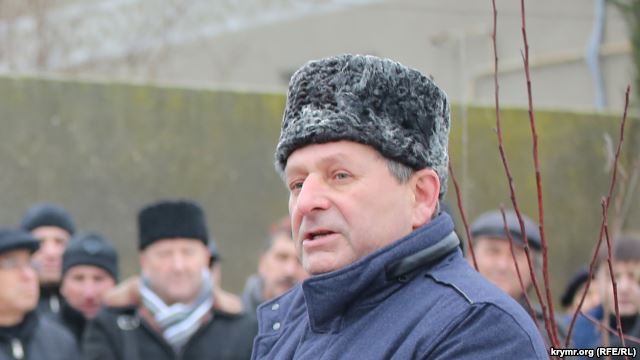
Ahtem Chiygoz, a member of the Mejlis of the Crimean Tatars who has spent the last year and a half in jail on trumped-up charges of "organizing rioting" and "destruction of property." Photo courtesy of 112 UA and RFE/RL
Ahtem Chiygoz, a member of the Mejlis of the Crimean Tatar People who has spent the last year and a half in jail on trumped-up charges of “organizing rioting” and “destruction of property.” Photo courtesy of 112 UA and RFE/RL. See the second article, below, for details

FADN Called on to Protect Ethnic Russians
Irina Nagornykh
Kommersant
July 27, 2016

Nine percent of Russian citizens feel they are discriminated against ethnically. In some regions, for example, Tuva, such citizens constitute as many as twenty-six percent, and they hail from the Russian-speaking population. These figures were arrived at by pollsters commissioned by the Federal Agency for Ethnic Affairs (FADN), Igor Barinov, the agency’s head, said yesterday at the Terra Scientia camp. Barinov promised to protect the ethnic Russian population in such regions, and said next year the agency planned to earmark 170 million rubles [approx. 2.3 million euros] on grants for projects in the field of interethnic relations.

Barinov cited the results of a сlassified Georating survey conducted by the Public Opinion Foundation (FOM) while speaking to young people at the Terra Scientia Russian Education Youth Forum on the Klyazma River on the last day of a session that brought together young experts in the field of interethnic relations. According to Barinov, the poll was conducted in June at the FADN’s behest. Pollsters discovered that, on average nationwide, nine percent of the population experienced ethnic discrimination. In certain regions, however, such as Karachay-Cherkessia and Tuva, the situation was more tense. In Tuva, twenty-six percent of citizens complained of ethnic discrimination.

According to Barinov, the number coincided with the number of Russian speakers resident in Tuva, which means we can assume it was this segment of the population who felt they were ethnically discriminated against. Barinov was asked who would protect the interests of ethnic Russians. According to some young people in the audience, ethnic Russian were not as well organized in defending their interests as other ethnic groups in Russia. Barinov cited the fact that 115 million ethnic Russians resided in the Russian Federation, which constituted eighty percent of the country’s population, and in places where the ethnic Russian population predominated, as in Central Russia, this assistance was social and economic in nature. But in regions like Karachay-Cherkessia and Tuva, he promised to protect ethnic Russians.

“We have the authority,” he stressed.

Responding to the same question, Magomedsalam Magomedov, who oversees ethnic relations in the presidential administration, said the “Russian people’s historical mission [was] to unite Russia’s ethnic groups,” and the outcome was the “emergence of a unique civilization whose national leader is President Vladimir Putin.”

“None of the ethnic groups in Russia can feel good if the Russian people feels bad,” concluded to Mr. Magomedov.

According to Barinov, next year the FADN plans to allocate around 170 million rubles on grants for projects in the field of ethnic relations.

“If everything is okay with the budget. We’re at the head of the Finance Ministry’s queue,” he added, reminding the audience that the FADN is awaiting the transfer of the part of the Federally Targeted Program for developing Crimea that concerns the rehabilitation of ethnic groups repressed during Soviet times.

Campers will receive several grants in the amounts of 300,000, 200,000, and 100,000 rubles to support existing interethnic policy projects in the country’s regions from the camp’s organizers: the Russian Federal Public Chamber, Rosmolodezh (Russian Federal Agency for Youth Affairs), and the presidential administration’s Office for Domestic Policy. Moreover, the FADN plans to summarized suggestions made by the campers on concepts for celebrating National Unity Day (November 4), including the brand Russian Braid, which would weave together all the peoples of Russia, comics about different ethnic groups on buses, video clips in airports, and the project Travel with Purpose, which would involve ethnic youth exchange tourism. Session participants plan to appeal to the present not to limit the celebrations to one day a war, but to declare an entire “year of national unity.”

Translated by the Russian Reader. Thanks to Sergey Abashin for the heads-up

________

Who Is Ahtem Chiygoz? The Story of a Crimean Tatar Political Prisoner
Ehor Vasylyev
112 UA
July 29, 2016

A Case That Will Last for Years
Ahtem Chiygoz was arrested on January 29, 2015, as part of the so-called February 26 case. That day he went to the State Investigative Committee in Crimea for questioning, and in the evening the illegitimate Kyiv District Court of Simferopol sentenced him to three months in police custody.

Chiygoz was charged under Article 212.1 of Criminal Code of the Russian Federation: organization of riots accompanied by violence and destruction of property.

Russia accuses activists of being involved in the “riots” on February 26, 2014, which arose near the Crimean parliament during two rallies, one held by the supporters of Ukraine’s territorial integrity , another, by activists of the party Russian Unity.

Since Chiygoz’s arrest, the Crimean courts have been periodically extending his time in police custody. (The last time it was extended until October 8, 2016.)

From March 8 to March 11, 2016, Chiygoz was a hostage: a so-called judge of the Crimean Supreme Court, Galina Redko, arbitrarily (extrajudicially) extended his time in jail.

In addition to Chiygoz, other Crimean Tatars have been charged with involvement in the “riots”: Ali Asanov, Mustafa Degermendzhi, Eskender Kantemirov, Arsene Yunusov, and Eskender Emirvaliev.

The first two have been in police custody for over a year. Another two men, Eskender Nebiev and Talat Yunusov, have already been convicted and sentenced to probation.

In February 2016, two years after the events, the court decided to re-investigate the case. Chiygoz, Asanov, and Degermendzhi were forced to remain in custody.

On July 20, the preliminary hearing began, but it was closed to the public. The Supreme Court of Crimea proposed to divide the case and try Chiygoz separately from the other defendants.

“There are 80 injured parties and witnesses: the case could drag on for years. The court usually questions one or two witnesses a day,” says one of Chiygoz’s lawyers, Emil Kurbedinov.

An Alien Land
Russian prosecutors accuse Ahtem Chiygoz of acts carried out in Ukraine by a Ukrainian citizen against other Ukrainian citizens. Russian prosecutors have prosecuted only Crimean Tatars.

The prosecution is trying to assert the right of the Russian justice system to react to the February 26 rally, which was allegedly directed against Russian interests. The prosecutor general says Russian Unity had a special permit for holding a rally, while the Mejlis did not have such a document.

In addition to violence during the riots, Chiygoz is accused of destruction of property.

“Unidentified Crimean Tatars rushed into the Crimean Parliament, damaged and destroyed its property in the amount of 9,730 rubles,” claims one of the court documents. However, a few hours after the incident, armed Russians occupied the Crimean Parliament and also damaged property.

Why Chiygoz?
“Ahtem Chiygoz at first took a moderately radical position. The prosecutor’s office called him a man ‘in charge of the Mejlis power bloc.’ In winter 2014, he openly expressed the quite radical position that we should not recognize anything,” noted First Deputy Chairman of the Mejlis Nariman Jalal.

In fact, Chiygoz’s position coincides with the opinion of Ilmi Umerov, who is known as an experienced, fairly moderate politician. Ilmi Umerov is quite close to Chiygoz. They both belong to the Bakhchisarai wing of the Mejlis.

“In 2014, we organized many pickets, along the roads, near the military units. Ahtem was actively involved in organizing these events,” says Umerov.

Chiygoz was warned about avoiding “extremist activity,” and some people even complained about him to the Russian FSB. However, Chiygoz did not stop his work, and a month before his arrest, he attended a meeting between Crimean leaders Mustafa Dzhemilev and Refat Chubarov and Ukrainian President Poroshenko.

In 2014, the two Crimean Tatar leaders, Dzhemilev and Chubarov, were not allowed entry to Crimea.

“Chubarov had five deputies, and Ahtem was the main one,” Umerov explains.

Dzhemilev and Chubarov were refused entry to Crimea as a part of a Russian plan. The Mejlis should be headed by a collaborator. Ahtem Chiygoz was the main obstacle to implementing this plan.

“The Russians believed that Chiygoz encouraged them to rebel. That was why they decided to remove him. At the same time, Chiygoz has been a ‘show’ victim: do not stick your heads out, otherwise your fate will be the same,” stresses Nariman Jalal.

But the plans to co-opt the Mejlis have failed.

“It was a miscalculation. They thought Chiygoz was a kind of central link. They failed to realize the majority of the members of the Mejlis took the same position as Chiygoz; they did not want to be co-opted,” adds the First Deputy Chairman of the Mejlis.

Chiygoz called upon all Crimean Tatars to harshly boycott compatriots who collaborated with the occupying power.

“Different challenges have befallen our people. And we deal with them with honor! No one can break us with prisons or camps! We are not afraid of searches and arrests! We cannot be fooled by puppets! Crimea will never be without the Crimean Tatars,” Chiygoz has written from prison.

And his name is etched in gold in the history of Crimea.

The original of this article was published, in Russian, by Ukrainska Pravda. I have lightly edited the heavily abridged English translation, above, to make it more readable. TRR