The Price of “Treason” Is 2,500 Rubles: The Case of Tamara Parshina

Tamara Parshina
Photo courtesy of the BBC via Activatica

A Khabarovsk woman, detained in March on suspicion of treason for financing the Ukrainian armed forces, has been identified by BBC journalists as twenty-three-year-old Tamara Parshina. Parshina’s initials and surname appeared in a judicial database in late April, when her term of detention was extended at the FSB’s request.

Parshina graduated from the Far Eastern State University of Railway Engineering (DVGUPS) with a degree in information systems and information technologies. Prior to that, the accused studied at the prep school on Leningrad Street, which was also where she was detained. The young woman was employed at the Khabarovsk Regional Compulsory Health Insurance Fund.

After Parshina’s arrest, there were rumors that she was an activist in the I Am/We Are Furgal movement. However, the regular attendees of the pickets in support of ex-regional governor Sergei Furgal said that no one they knew had been arrested in the case. Furgal’s headquarters called the claim that the detainee was an activist in the movement an attempt to discredit it.

The attorney Kaloy Akhilgov reported that Parshina had donated a total of 2,500 rubles [approx. 29 euros] in small amounts to various Ukrainian charitable foundations. She is currently in custody at Moscow’s Lefortovo remand prison.

Parshina is the youngest person so far detained on suspicion of treason in Russia. She faces up to twenty years in prison if convicted. The toughening of the punishment for treason occurred after Parshina’s arrest. Also, women are not given life sentences in Russia: the maximum sentence for women is twenty-five years.

Source: “Khabarovsk woman arrested for treason identified,” Activatica, 13 May 2023. Translated by the Russian Reader. Thanks to Olga Mazurova for the heads-up.


“The FSB has detained a Khabarovsk woman, an activist in the I Am/We Are Furgal movement, on suspicion of treason for financing the Ukrainian armed forces, the FSB’s public relations office has told us. Criminal charges have been filed. Video footage courtesy of Russian Federal Security Service Public Relations Office.” Source: TASS (Telegram), 13 March 2023

In March, the FSB began accusing Russians of providing financial assistance to the Ukrainian armed forces and charging them with treason. The BBC has discovered that 36-year-old Nina Slobodchikova from Novosibirsk was the first to be detained, followed by 23-year-old Tamara Parshina from Khabarovsk (who is the youngest Russian woman so far accused of treason). Both women were employed in the IT field before their arrests. One of them has relatives in Ukraine.

Two men in camouflage walk briskly, skirting snowdrifts, down a snow-covered sidewalk. They chase down and grab a young woman in a light-colored down jacket carrying a small bag. Her face has been blurred: only a strand of hair that has escaped from under her cap is visible. She is confused and crying. Something falls from her hands to the ground; one of the men picks it up and says, “Calm down.” The girl is bundled into a black minibus with tinted windows.

This is video footage shot by the FSB. In the next scene, the detainee, now carrying a backpack, enters the FSB’s Khabarovsk Territory offices, escorted by security forces officers. She is then seen being led up the gangway of an Aeroflot Boeing 777 named in honor of Marshal of the USSR Vasily Chuikov. The sign above the airport reads “Khabarovsk.” At the end of the video, the young woman disembarks from the plane at Moscow’s Sheremetyevo airport. In the final shots, she is led through the courtyard of Lefortovo remand prison. Her hands are cuffed behind her back.

The video appeared in the media on March 13, the same day the FSB reported that it had detained a Khabarovsk woman on suspicion of treason for financially aiding the Ukrainian army. The BBC was told by the Lefortov court that pretrial restraints had been imposed on Parshina on March 9 in Khabarovsk. According to information obtained on the website Flightradar24, the Chuikov Boeing flew to Moscow around three o’clock in the afternoon on March 9.

[…]

The BBC tracked down classmates and acquaintances of 23-year-old Tamara Parshina on social media. One of them recognized the young woman in the video released by FSB. “Those are her sneakers,” she said. “And she seems to be sobbing too. I remember because she often cried at school. The hair is curly, like hers. She also wore glasses.” Her description matches photos of Parshina on social media.

Parshina’s friends do not know the exact nature of the charges against her. “It seems that she donated money last spring [in 2022] to some organization that helps someone in Ukraine,” an acquaintance of the young woman wrote to the BBC. Parshina’s mother declined to speak with the BBC about her daughter.

The FSB reported that the young woman was detained on Leningrad Street in Khabarovsk “near the train station.” According to a friend, [that was a coincidence]: she merely lived in the neighborhood. Leningrad Street is also the location of the prep school that Parshina attended and where she won academic competitions. [I was unable to access this link from my computer — TRR.]

In 2021, Parshina graduated from the Far Eastern State University of Railway Engineering (DVGUPS) with a degree in information systems and information technologies. “Novice web developer […] looking for remote work, but would also consider relocating,” she wrote about herself on LinkedIn.

After graduating from university, the young woman worked at the Khabarovsk Regional Compulsory Health Insurance Fund, said a former university classmate.

Friends of Parshina with whom the BBC spoke had lost contact with her in the winter. “[In February] some friend of hers wrote to me: he was also looking for her. I wrote to her wherever I could, but she didn’t reply to me,” one of them said. Another friend of Parshina from a group in which they played board games together claims that Parshina had not been in touch with him since late January.

The FSB alleged that Parshina was “an activist in the ‘I Am/We Are Furgal’ movement.” With this as their slogan, thousands of the region’s residents protested in support of ex-governor Sergei Furgal after his arrest [on murder charges] in the summer of 2020. In February of this year, Furgal was sentenced to 22 years in prison. According to the FSB, the Khabarovsk woman, motivated, allegedly, by “political hatred and enmity,” donated money to the Ukrainian armed forces for the purchase of weapons, ammunition, and uniforms. Now she is housed in the same Moscow prison as Furgal.

Parshina’s friends were not aware of her protest activities. “To be honest, I don’t think she was involved in that,” a former university classmate told the BBC. “I know that she was subscribed to various environmental activists and feminists on Instagram.”

Six months before his arrest, Furgal paid a visit to DVGUPS, where Parshina was studying at that time. There were many students in attendance, and the Khabarovsk Territory government published a report about the visit on its website. [This website seems to be blocked to users outside Russia — TRR.] Parshina is not in any of the photos of this event.

On March 13, Khabarovsk regional MP Sergei Bezdenezhnykh, a Furgal ally, wrote on his Telegram channel that “none of the I Am/We Are Furgal activists recognized the detainee.”

“As a member of the Furgal team, I can say that she has nothing to do with us. I have the sense that certain forces want to link financing of the Armed Forces of Ukraine with the ex-governor’s name. The movement is not official, it is not registered anywhere. First and foremost, it is an indefinitely large group of people,” Bezdenezhnykh wrote. The Furgal team, he claims, supports Russia, not Ukraine.

The FSB alleges that Parshina donated “personal funds” to the Armed Forces of Ukraine on grounds of “political hatred and enmity,” without specifying at whom these feelings of hers were directed.

It was this motive that the Khabarovsk Regional Court had previously ruled an aggravating circumstance in another treason case. In the autumn of 2022, it sentenced Vyacheslav Mamukov to twelve and a half years in a maximum-security penal colony for, allegedly, attempting to sell information on the design of thirty Russian bridges to the Ukrainian special services.

[…]

Source: Sergei Goryashko and Ksenia Churmanova, “‘I want peace, to hug my mother, and to walk around Kyiv’: two stories of Russian women accused by FSB of financing the Ukrainian army,” BBC News Russian Service, 11 May 2023. Translated by the Russian Reader
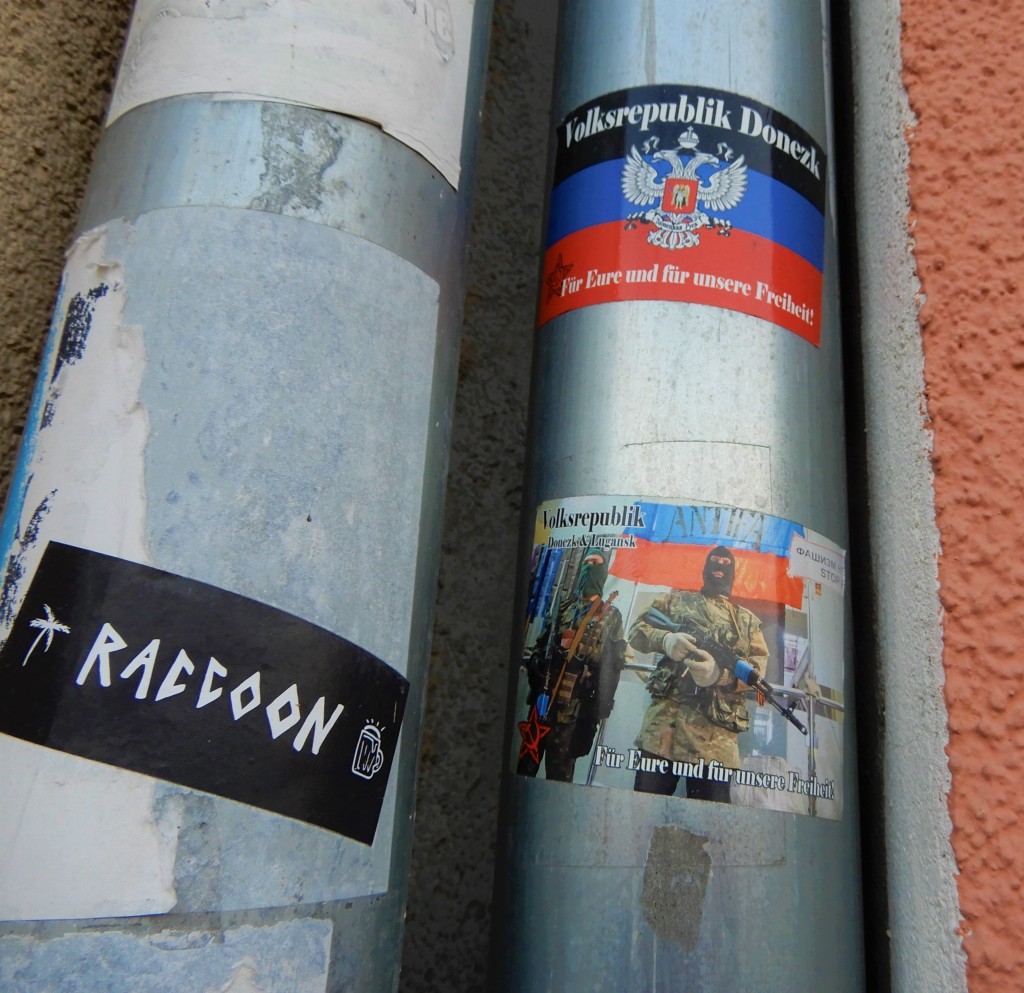
Death to Traitors!

“Donetsk People’s Republic. For your and our freedom!” Berlin-Friedrichshain, 6 February 2023. Photo by the Russian Reader

State Duma deputy Andrei Kolesnik proposes reinstating the death penalty for treason

A proposal has been made in the Russian State Duma to revive the death penalty for those who have left the country and commenced criticizing the Russian authorities. The initiative was launched by deputy Andrei Kolesnik.

In an interview with Moscow Region Today [see translation below], the parliamentarian noted that an exception could be made for those who have simply left the country. According to him, traitors are those who have left and at the same time are waging an information war against Russia.

Security Council deputy chair Dmitry Medvedev said that Russians who fled the country and wish its destruction should be treated in accordance with the law, but the rules of wartime should also be remembered.

Source: Ekaterina Shmakova, “Proposal in State Duma to reinstate death penalty for ‘traitors to Russia,’” Radio 1. Thanks to VB for the heads-up. Translated by TRR


Following Nevzorov, Belotserkovskaya has been sentenced in absentia to nine years in prison for spreading fake news. State Duma deputy Andrei Kolesnik commented on this practice of “absentee sentences.”

“Okay, some people merely fled Russia. There are a lot of yellow bellies. They can stay there and work. But when a person works against Russia, it is called an information war. It’s more serious than a weapon, sometimes. Evil tongues are scarier than a gun,” the deputy said in an interview with Moscow Region Today.

However, Kolesnik stressed that the “traitors to the Motherland” had been punished according to the law: there is evidence, i.e., publications. But the deputy noted that he himself would have dealt with them more harshly.

“This is my personal opinion, although maybe I will voice it in parliament. If a person has committed serious crimes against Russia, then the sentence might be different. And this sentence could be enforced in the place where he (“traitor to the Motherland” — ed.) is located. Combat is currently underway. So, they should behave more carefully,” the deputy said.

When our correspondent asked whether he was talking about the death penalty, Kolesnik replied as follows.

“The [death penalty] can be employed for treason. We currently have a moratorium on the death penalty, although it exists in our laws. The decision to lift the moratorium is made not by the State Duma, but by the court. Although many people in the State Duma are leaning in this direction,” the deputy said.

Earlier, State Duma deputy [Maxim Ivanov] said that the unemployed could be sent to the SMO zone.

Source: Maria Valdaiskaya, “Moratorium against death penalty may be lifted for ‘traitors to the Motherland,'” Moscow Region Today, 6 February 2023. Translated by TRR

Yesterday in Soviet History (Susanna Pechuro, Maya Ulanovskaya, and the SDR)

Susanna Pechuro. Photo courtesy of Sergei Stepanov

Sergei Stepanov
Facebook
February 7, 2017

On February 7, 1952, the closed trial of members of a Moscow young people’s literary club was held in Moscow. They were accused of disseminating leaflets, produced on a hectograph, about the undemocratic Soviet electoral system. A total of sixteen schoolchildren and university students stood as defendants in the case. They were charged with treason and planning the murder of [Politburo member and Stalin henchman Georgy] Malenkov. The group’s three organizers were sentenced to death. Three other members were sentenced to ten years in the camps, while the remaining ten members were sentenced to twenty-five years in the camps. In addition, Susanna Pechuro was accused of acting as a liaison between youth organizations and Jewish Zionist organizations.

Yevgeny Gurevich, Boris Slutsky, and Vladlen Furman, executed in 1952. Photo courtesy of Sergei Stepanov
Yevgeny Gurevich, Boris Slutsky, and Vladlen Furman, the group’s three organizers, executed in 1952. Photo courtesy of Sergei Stepanov and Wikipedia

_____________

At the end of World War II and shortly after, Malenkov implemented Stalin’s plan to destroy all political and cultural competition from Leningrad, the former capital of Russia, in order to concentrate all power in Moscow. Leningrad and its leaders earned immense respect and popular support due to winning the heroic Siege of Leningrad. Both Stalin and Malenkov expressed their hatred to anyone born and educated in Leningrad, so they organized and led the attack on the Leningrad elite. Beria and Malenkov together with Abakumov organized massive executions of their rivals in the Leningrad Affair where all leaders of Leningrad and Zhdanov’s allies were killed, and thousands more were locked up in Gulag labour camps upon Stalin’s approval. Malenkov personally ordered the destruction of the Museum of the Siege of Leningrad and declared the 900-day-long defense of Leningrad “a myth designed by traitors trying to diminish the greatness of comrade Stalin.” Simultaneously, Malenkov replaced all communist party and administrative leadership in Leningrad [with] provincial communists loyal to Stalin.

Source: Wikipedia

_____________

Susanna Pechuro, circa 1950-1951, before her arrest. Photo courtesy of Wikipedia

Susanna Solomonovna Pechuro (22 July 1933, Moscow—1 January 2014, Moscow) was Soviet dissident, political prisoner, and historian.

In 1950, while still a schoolgirl, she became involved in the underground youth organization Union of Struggle for the Revolution (SDR), formed by several 16- and 17-year-olds who had met in a literary club at the Moscow Young Pioneers House. The SDR tasked itself with returning Soviet society and the Soviet state to Leninist principles of organization, which, in their opinion, had been perverted by Stalin’s Bonapartist regime.

On January 18, 1951, Pechuro was arrested along with the organization’s other members. On February 13, 1952, the Military Collegium of the USSR Supreme Court sentenced Pechuro to 25 years in labor camps on charges of treason and planning the murder of Georgy Malenkov[.] The organization’s three leaders, Boris Slutsky (born 1932), Vladlen Furman (born 1932), and Yevgeny Gurevich (born 1931) were shot.

Pechuro served her sentence in various Gulag camps, including camps in Inta, Abez, and Potma. In 1956, the group’s case was reexamined. Pechuro’s sentence was reduced to five years and she was released.

Although she passed the entrance exams to Moscow State University’s history department, she was not enrolled. She graduated from the Moscow State Historical Archives Institute.

At the Historical Archives Institute, Pechuro researched the purges during the reign of Ivan the Terrible. Her work was published in the Proceedings of the Moscow State Historical Archives Institute. In 1961, she successfully defended her thesis, “The Decree Books as a Source on the History of Ivan the Terrible’s Zemshchina,” with Alexander Zimin as her advisor.

Pechuro worked in the Archive of Ancient Documents at the Institute for African Studies.

She was rehabilitated only on July 18, 1989, by the Plenum of the USSR Supreme Court.

A long-time member of Memorial, she signed the“Putin Must Go” petition in 2010.

Pechuro died in Moscow on January 1, 2014. She is buried at St. Nicholas Archangel Cemetery.

Source: Wikipedia

_____________

The Union of Struggle for the Revolution (SDR) was a radical left-wing anti-Stalinist underground youth organization that existed between 1950 and 1951.

The Union of Struggle for the Revolution (SDR) was organized in Moscow by university students Boris Slutsky, Yevgeny Gurevich, and Vladlen Furman in 1950. The organization drafted a program and manifesto that spoke of socialism’s degeneration into state capitalism, described the Stalinist regime as Bonapartist, and noted the lack of civil liberties, the farcical elections, the imperial nature of [Soviet] foreign policy, and the disastrous state of agriculture. The members of the organization reproduced the documents on a hectograph.

The members of the organization were arrested by the MGB in January and February 1951.

On February 13, 1952, the Military Collegium of the USSR Supreme Court issued a verdict in the case. The verdict stated that a group of Jewish nationalists had established a treacherous terrorist organization whose members had tasked themselves with overthrowing the current Soviet regime by means of an armed uprising and terrorist acts against the leaders of the Soviet government and Communist Party. The only SDR member who did not plead guilty was Maya Ulanovskaya. Slutsky, Gurevich, and Furman were sentenced to death. Ten members of the organization were sentenced to 25 years in prison, and three more, to 10 years. The three leaders of the SDR were shot on March 26, 1952, and their ashes were buried at Donskoe Cemetery. The surviving defendants were released from the camps after a retrial in 1956. In 1989, all the defendants in the case, some posthumously, were rehabilitated “for lack of evidence of a crime.”

SDR Members

Sentenced to death:
Yevgeny Gurevich (born 1931)
Boris Slutsky (born 1932)
Vladlen Furman (born 1931)

Sentenced to 10 years in prison:
Tamara Lazarevna (born 1932)
Galina Smirnova (born 1931)
Nina Uflyand (born 1934)

Sentenced to 25 years in prison:
Irena Arginskaya (born 1932)
Ida Vinnikova (born 1931)
Felix Voin (born 1931)
Grigory Mazur (born 1931)
Vladimir Melnikov (born 1932)
Yekaterina Panfilova (born 1932)
Susanna Pechuro (born 1933)
Alla Reif (born 1931)
Maya Ulanovskaya (born 1932)
Inna Elgisser (born 1930)

Source: Wikipedia

_____________

Maya Ulanovskaya in the Gulag, 1955. Courtesy of Wikipedia

Maya Alexandrovna Ulanovskaya (born October 20, 1932, New York) is a translator and writer who was a member of the Soviet dissident movement.

Ulanovskaya was born in New York, where her parents Alexander Ulanovsky (1891—1971) and Nadezhda (Esther) Markovna (1903—1986) were Soviet spies working for the Main Intelligence Directorate (GRU). They were arrested in 1948 and 1949 on political charges.

In 1949, after graduating from high school, Ulanovskaya enrolled in the Moscow Food Industry Institute. There she joined the underground anti-Stalinist youth organization Union of Struggle for the Revolution (SDR).

On February 7, 1951, Ulanovskaya was arrested by the MGB. On February 13, 1952, she was sentenced to 25 years in prison. She served her sentence in Ozerlag.

In February 1956, the case was reviewed, Ulanovskaya’s sentence was reduced to five years, and she and her accomplices were released under an amnesty.

The same year, she married Anatoly Yakobson. In 1959, she gave birth to a son, who later became a historian, journalist, and politician.

In the 1960s and 1970s, Ulanovskaya worked at the library of the Institute of Scientific Information on Social Sciences of the Russian Academy of Sciences (INION RAN) and was involved in the Soviet human rights movement, retyping samizdat publications, passing information overseas, etc.

In 1973, she emigrated with her husband and son to Israel. In 1974, she divorced her husband.

Ulanovskaya worked at the National Library in Jerusalem. She has translated several books from English (including books by Arthur Koestler), Hebrew, and Yiddish. She and her mother co-authored a memoir entitled The Story of One Family, published in the US in 1982 and later reprinted in Russia. She is author of the book Freedom and Dogma: The Life and Work of Arthur Koestler (Jerusalem Publishing Center, 1996).

Source: Wikipedia

All texts except the excerpt about Malenkov translated by the Russian Reader. Thanks to Yuri Albert for the heads-up on Sergei Stepanov’s Facebook post, which got this ball rolling.