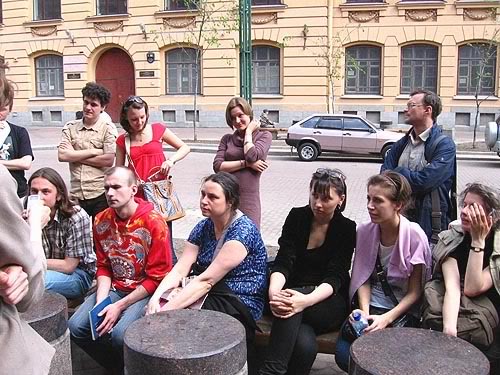
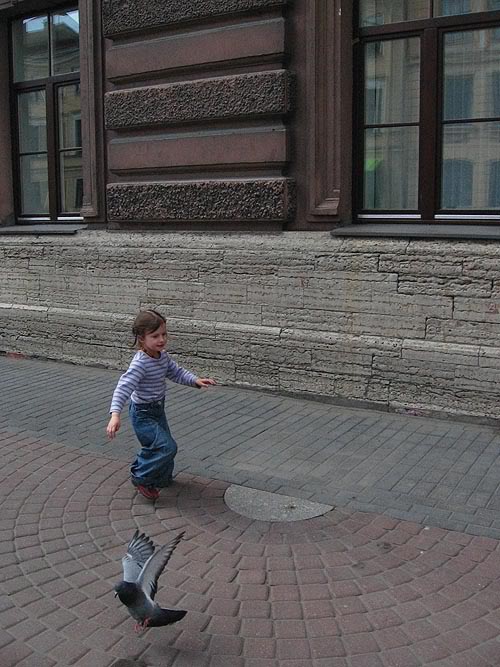
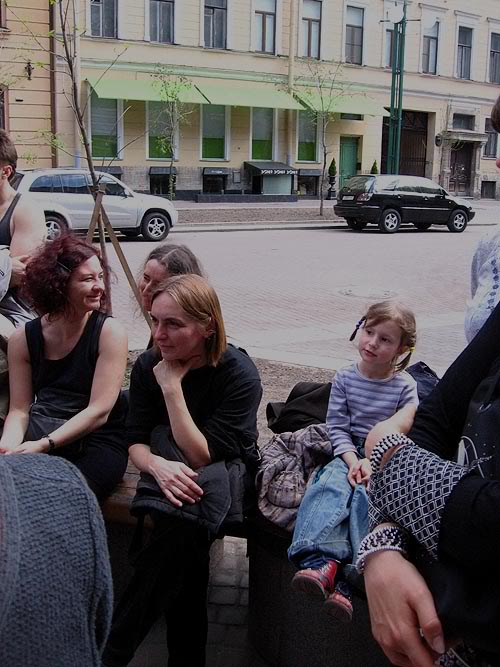
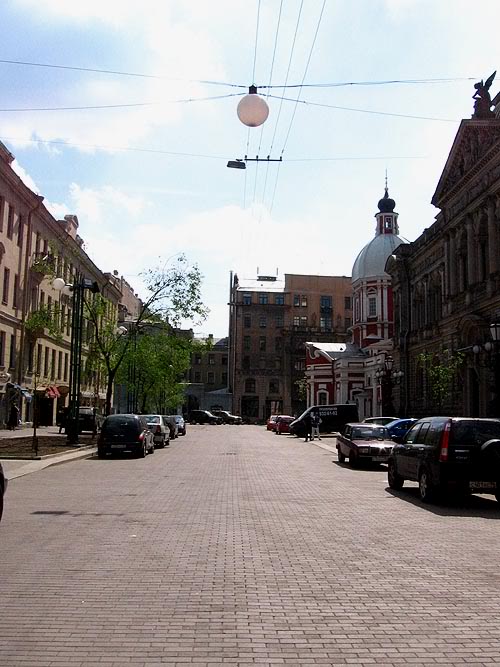
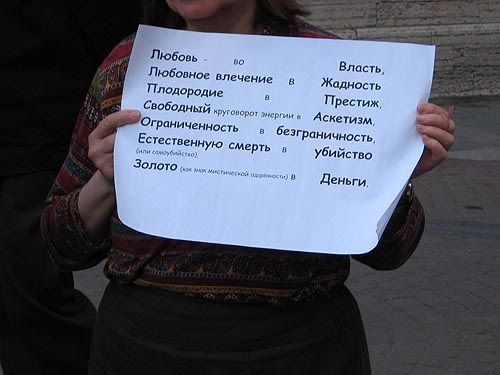
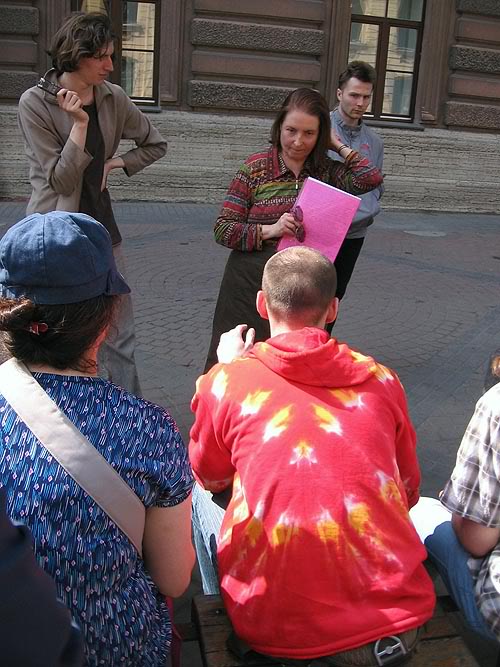
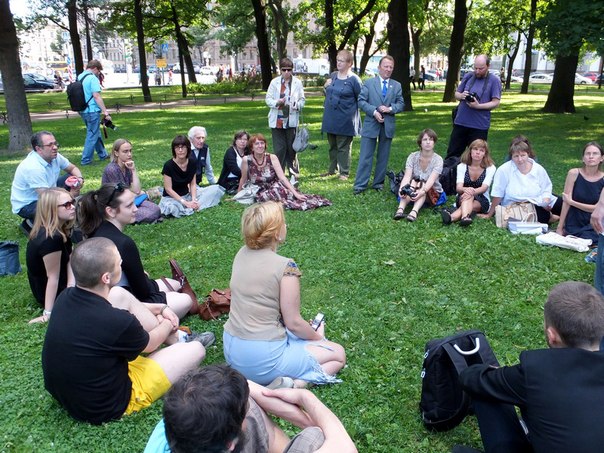
These are scenes from a May 2008 session of Petersburg’s Street University, a grassroots undertaking that I helped launch in response to the Putin regime’s sudden, underhanded shutdown of the nearby European University in February 2008. I unearthed these snapshots from my long-dormant Photobucket account, about whose existence I was reminded by an email from the service that I found by accident in my spam folder whilst working on this post earlier this morning. I think it’s a nice illustration of the point made, below, by Armen Aramyan, who must have been nearly the same age as Tasya, the little girl in the second and third pictures, when I took them. If the war can be stopped and Russian society can be salvaged in the foreseeable future, however, it will require a lot more than creative “sociology,” the right combination of critical theories, the power of (“progressive”) positive thinking, and hypervigilant discursive gatekeeping. At minimum, it will require a massive manifestation. This would be different in kind and magnitude from the current instances of grassroots resistance that Mr. Aramyan enumerates below, which are almost entirely the work of lone individuals, not the actions of a seriously mobilized grassroots or, much less, of a more or less widespread and vigorous “anti-war movement.” ||| TRR
Hi, this is Armen Aramyan!
On Monday, iStories published a column by its editor, Roman Anin, in which he laments the moral degradation that “has engulfed not only the so-called elites, but also society.” He claims that the majority of Russians support military aggression, and that the political system is in such decline that we can make predictions about Russia’s future by invoking the discourse of primatology.
“Human DNA is 99% the same as the DNA of chimpanzees, whose entire polity revolves around the alpha male. While the alpha male is young and strong, he keeps the whole pack at bay, manages the distribution of resources, mates with all the females, and severely punishes those who question his authority. But as soon as the alpha male begins to age and show signs of weakness, a fierce war to take his place ensues. […] In my opinion, the Russian political system today is not much different from the power arrangements in chimpanzee troops.”
There is no grassroots resistance in the Russia about which Anin writes. There is no torching of military enlistment offices, no teachers who refuse to conduct propaganda lessons, no activists who assist Ukrainians in getting out of Russia. There are no people prosecuted for speaking out and acting against the authorities. There are only big shots who divvy up the loot behind closed doors.
But activists and anti-war resistance do exist, and [some] sociologists have claimed that the pro-war segment of Russian society is a small minority that is averse to political action of any kind.
Why do we continue to encounter such remarks?
I would suggest calling the worldview that informs such remarks Naive Anti-Putinism, or NAP.
NAP sees Russia as a fringe country. The processes in it can be explained only through allusions to fantasy novels, such as dubbing Russia “Mordor,” from The Lord of the Rings, or referencing the Harry Potter universe. (Have the images from fantasy novels run out and we are now on the Planet of the Apes?) Russia is so unique that there are processes taking place in it that don’t exist anywhere else (with the possible exception of North Korea). This Russia suffers from a patriarchal regime and a total absence of democratic institutions. (That is, power belongs to individual groups and their leaders, who do not rely on any institutions). The enlightened achievements of European democracies have not yet reached Russia, and so now we are doomed to live amidst an endless Games of Thrones (to invoke yet another fantasy novel comparison). In this system, all that remains for us is to analyze what intrigues the different Kremlin clans are pursuing.
Resistance, grassroots movements, the struggle for democracy, and revolution are impossible in this reality. So, all that naive anti-Putinists are capable of doing is resorting to moral critiques delivered from a superior position and continuing to admonish us that the common folk in Russia are bad, having failed to accept the enlightened achievements of European democracies. If there is no democracy [in Russia], [that is because] the ordinary folk simply don’t want it. That is NAP’s entire explanatory arsenal.
Naive Anti-Putinism does not envision the possibility of change in Russia, much less revolution or the destruction of Putin’s elite. It is a readymade scheme that enables certain groups in society to make peace with reality and continue to watch the new season of Game of Thrones.
For example, if you are a businessman or an IT worker who relocated [to another country] after the war’s outbreak and invested all your resources in adapting to a new place (most likely — quite successfully), you probably don’t really want to figure out how to build democracy in Russia and support the grassroots resistance.
But you can also imagine another situation: you are a researcher who has spent a great deal of time and effort investigating how the power elite throws bags of money around. Probably, at some point, you might imagine that there is nothing else besides this cynical redistribution of the loot.
But if we want to end the war and build democracy in Russia, we need to think differently. Even if we imagine that this is impossible right now, do we really think that democracy is altogether impossible in Russia? And if it is possible, what would it look like in reality? What movements would be needed to make it happen? How would they gain power? How would this power be redistributed and how to make sure that it is not abused? These are the questions that should concern all of us members of the anti-war movement on a daily basis.
Centuries of class, colonial, and gender oppression led to the emergence of strong theories elucidating the structure of power in modern societies. The crises of the nineteenth century spurred the elaboration of theories about class and capitalism. Representattives colonized peoples, as well as their allies in the West, formulated theories about how imperialism and colonialism function. Activists and theorists of women’s movements offered accounts of how gender dominance operates in modern societies.
If we reject the entire legacy of critical theory, as many NAPpers do, then we need to propose something else. But this something is definitely not primatology or allusions to Harry Potter. But one might have to read other books to to find this something else.
P. S. But also do not assume that the animal kingdom — and in particular the political systems of primates — is so primitive. Usually, reducing people to animals is a conservative move whose purpose is to show that human relations are grounded in competition and the struggle for survival, in which the strongest win. I recommend reading this essay by the anthropologist David Graeber, in which he argues that this is not at all the case.
Source: Armen Aramyan, DOXA Anti-War Newsletter #313 (10 January 2023). Mr. Aramyan is one of the editors of the online anti-war magazine DOXA. In April 2021, he and three other editors of the then-student magazine were sentenced to two years of “correctional labor” (i.e., community service) over a video questioning whether it was right for teachers to discourage students from attending rallies protesting opposition leader Aleksei Navalny’s incarceration. Translated by the Russian Reader
Editor’s Note. The latest news from the front lines in the confrontation between the Russian Institute of Art History (Zubov Institute) in Petersburg and the Russian Federal Ministry of Culture is that Jamilya Kumukova, chair of the trade union committee at the Institute, has been threatened with firing in the run-up to a protest rally scheduled for July 9.
An Academic Treasure Trove Doesn’t Want to Be a Klondike for Bureaucrats
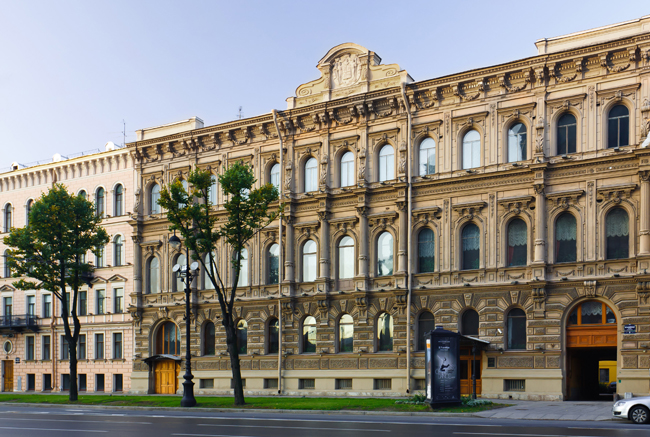
A fight has erupted in Petersburg over the Russian Institute of Art History [also known as the Zubov Institute and abbreviated “RIII” in Russian]. The Ministry of Culture has been carrying out a hostile takeover of the institute in an attempt to get its hands on the institute’s premises, [a nineteenth-century mansion in downtown Petersburg]. Researchers and graduate students have been trying to fight off the siege.
It all began in May 2012, when President Vladimir Putin signed a decree increasing salaries for scientists and scholars. The Ministry of Culture, which had just then been headed by Vladimir Medinsky, ordered the research institutes under its jurisdiction to increase salaries. But no funds for this increase were earmarked in the state budget. To fulfill the president’s decree, RIII director Tatyana Klyavina had to cut seventy-one positions. But that was only the beginning.
In 2013, the Ministry of Culture ordered yet another salary increase (of 28%), which would have meant dismissing a further fifteen employees. Klyavina refused to raise salaries through layoffs, for which she was subjected to a vigorous harassment campaign and eventually fired after leading the Institute impeccably for twenty-one years.
The Ministry of Culture got ready to celebrate. After all, by 2018, when salaries were slated to be increased to 200% of current levels, no one at all would have been left in the Institute. This meant it could already relocate the remaining miserable clutch of useless scholars to any old outbuilding, thus freeing the famous mansion with a view of St. Isaac’s Cathedral for more pressing needs, and merge the Institute itself with the first comer.
Today, the state has no use for research on Tchaikovsky, Scriabin, and Malevich. What it needs are people to carry out practical “monitoring” of Russian culture and compile exhibition booklets. It thus does not understand the essence and purpose of the research conducted at the institutes under its jurisdiction. Despite its incompetence, however, like a bull in a china shop it goes through the motions of “reform” and “modernization.” The main thing is not to deviate from the general line, and let the consequences be damned.
But whomever the Ministry sent to cajole the Institute’s indignant staff, it only aggravated the situation. After all, the RIII, which was founded in 1912 and in whose halls such renowned literary scholars, art historians, and musicologists as Yuri Tynyanov, Boris Eichenbaum, Boris Asafyev, Viktor Zhirmunsky, and Antonin Preobrazhensky worked, has experienced revolution, civil war, Stalin’s purges, and the Siege of Leningrad over its history. In the 1990s, it regained its autonomy and original name. The Institute’s staff has thus developed immunity to all manner of crackdowns and takeovers.
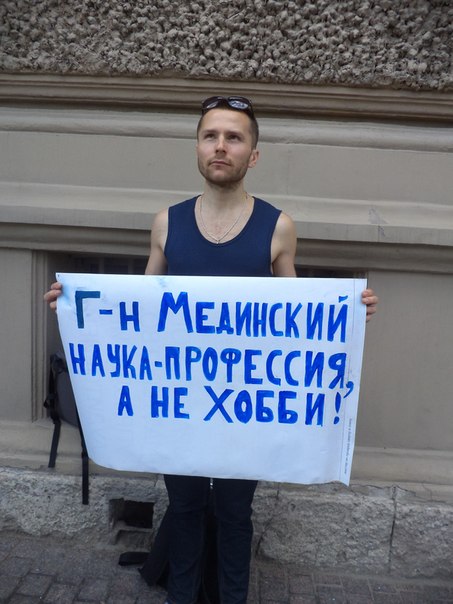
“Mr. Medinsky, research is a profession, not a hobby!”
Today, news from the Zubov Institute resembles reports from the front lines. Here is a brief chronicle of recent events.
On June 31, Culture Minister Medinsky descended on the RIII without warning. Locking himself in the director’s office, Mr. Medinsky refused to talk to staff, leaving Andrei Karpov, acting director of the Ministry’s oversight and personnel department, to act as his “hellhound” in the waiting room. Mr. Karpov, who currently heads the ministerial committee auditing the Institute, took his role as guard so seriously that he struck cinema department grad student Olga Yevseyeva, who had come to give the minister a letter written by the Institute’s graduate students.
On July 2, an emergency meeting of RIII staff took place. In the middle of the meeting, the new director, Olga Koch, appeared in the hall, accompanied by private security guards. The guards said they had been hired by the Institute’s new management to protect historical valuables, although in the Institute’s hundred-year history not a single rare manuscript or musical score has ever disappeared from the building.
The art scholars unanimously stood up and turned their backs to Koch, stamping their feet and chanting, “Get out!” After the director ran out of the room as if she had been scalded, the assembly continued, adopting a strongly worded resolution. Here are its principal points:
1. We voice our lack of confidence in the ministerial commission headed by Andrei Karpov, who permitted himself to use force against a graduate student of the Institute.
2. We voice our indignation at Culture Minister Vladimir Medinsky’s arbitrary decision to shift the work of the Ministry’s departments to the Institute.
3. We protest against the transformation of the Institute into a high-security facility in connection with the hiring of a private security firm to work at the Institute.
4. We demand that Minister Medinsky retract his statement that the apartments in the wing of the Institute are “handed out right and left.”
5. We voice our lack of confidence in acting director Olga Koch, who publicly threatened staff with a “crackdown,” and we demand that the decree appointing her, dated June 18, be rescinded.
6. We are sending a telegram to Russian President Putin and Prime Minister Medvedev.
On July 3, graduate students from the RIII and the European University held a series of solo pickets in support of Institute staff and against the Ministry of Culture’s policies. The young people stood outside Petersburg city hall, the city’s legislative assembly, and the entrance to the Institute with placards reading, “Mr. Medinsky, research is a profession, not a hobby” (a play on Medinsky’s statement that the “government won’t be funding a hobby”), “Save the Zubov Institute!,” and “No to Mass Layoffs at the Zubov Institute.”
The graduate students handed out leaflets that read as follows:
For the second month running, we, researchers and graduate students at the Russian Institute of Art History, have been forced to defend our right to do research instead of doing that research. In May 2012, Russian President Vladimir Putin issued a decree ordering an increase in the wages of scientists and scholars to the average cost of living in their regions.
This good intention, however, was brought low by the total lack of additional funding. The new effective managers from the Ministry of Culture, led by Vladimir Medinsky, took the easy route and decide to fire everyone whose research was not sufficiently in demand. In their opinion, demand is nothing more than the amount of money earned. But the humanities cannot be reduced to a monetary equivalent.
By cutting back on basic research and firing specialists who are unique in their fields, Russia is rapidly turning into a peripheral power, capable only of supplying raw materials to more developed countries. What is more, it is forever losing access to the history of its art and culture, which means irrevocably losing its capacity for nurturing full-fledged individuals and citizens. So defending the Zubov Institute is for us today not just a matter of professional honor but also a civic duty.
The same evening an open street conference in support of the Zubov Institute took place. It took the form of a Street University—lectures and meetings of students and teachers held outdoors and open to all comers. Street University was established in 2008 during the campaign against attempts to close the European University in Petersburg under false pretexts.
Street University in Defense of Zubov Institute, July 3, 2013
In that case, the authorities backed down, and the European University continued to operate in its old mansion on Gagarinskaya. What will happen in this case?
Both RIII staff and graduate students attended the conference, along with colleagues from friendly institutes. Tamara Ismagulova talked about the history of the Zubov Mansion, how the institute was established, and how it survived during the hard years of the Stalinist Thermidor. Yevgenia Hazdan talked about the journal Annals of the Zubov Institute, which was first published in the 1920s, lasting all of four years. Who would have thought that the recently revived journal might repeat the fate of its predecessor?
Sociologist Oleg Zhuravlev from the European University Institute in Florence argued that what is happening to the Zubov Institute is consistent with the overall trend in Europe of cutting spending on science and education, a trend that reveals the contradiction between democracy and the market economy.
Dmitry Golynko, from the contemporary artistic culture department, shared his recollections of the department’s work during the nineties, when the Institute was a hotbed for cutting-edge research in art. Pavel Arseniev and Roman Osminkin read poems, and at the evening’s conclusion a researcher from the musicology department even played several songs on the accordion, including “If I Had Mountains of Gold.” It was a quite symbolic coda, because the whole point of the conflict between the Ministry of Culture and the Zubov Institute is the Ministry’s insatiable desire to turn art scholarship into a gold mine.
5 July 2013 — Roman Osminkin, Russian Socialist Movement
Dmitry Golynko-Volfson
3 July 2013 The Language of Violence: Scholarship and Power in the Russian Federation
Literally overnight, the Russian Institute of Art History (also know as the Zubov Institute for its founder, Count Valentin Zubov) was transformed from a quiet academic oasis (as Petersburgers are used to seeing it) into the epicenter of a scandal, a tense standoff between the academic community and managers from the Ministry of Culture. At the Ministry’s behest, Tatyana Alexeevna Klyavina, who for over twenty years had skillfully and competently managed the Institute, preserving its pleasant working environment and atmosphere of unconditional mutual respect, was fired. Thanks to her efforts, both during the momentous nineties and the stable (and allegedly sated, but in reality very sparingly state-subsidized) noughties, the RIII’s team of researchers had been able to focus on basic academic research without personally worrying about urgent economic problems. In addition, her tenure was focused on making sure the Institute maintained a well-calibrated balance between classical, traditional art scholarship and experimental, innovative, future-oriented research. Tatyana Alexeevna was also the long-time chair of the contemporary artistic culture department, which I had the good fortune to join in 1995. In the nineties, the department was a unique place where cutting-edge research in postmodernist theory was combined with the direct involvement of researchers in shaping the new culture and new art of the legendary post-perestroika period.
Culture Minister Vladimir Medinsky
The confrontation between Institute staff and the Ministry slowly but relentlessly escalated throughout the first six months of this year (after the newly appointed Minister Vladimir Medinsky had announced plans to reform the research institutes under his jurisdiction). The showdown between researchers and bureaucrats shifted into an active phase after Klyavina was fired, and Olga Koch, former rector of the Saint Petersburg University of Culture and Art, was named acting director. Institute staff was openly hostile to Koch’s top-down appointment and refused to cooperate with her on any issues related to academic planning. In addition, at meetings of the academic council and the staff union, which were open to the press, they passed toughly worded resolutions and proposed strategic methods for resolving the conflict (from shifting the Institute to the jurisdiction of the Russian Academy of Sciences to putting it under the care of the municipal government).
The conflict reached an obvious climax on Friday, June 28. As a result of a visit by Culture Minister Medinsky to the RIII that was deliberately kept secret from the Institute’s researchers, a monstrously absurd “brawl” took place in the waiting room of the director’s office, which was widely reported in print and online media. Unfortunately, I witnessed this shameful episode. Since the minister had locked himself in the director’s office and refused to meet with research staff, who were demanding an explanation, his aide, Andrei Karpov, acting head of the Ministry’s oversight and personnel department, began using brutal methods to pacify the researchers besieging the office—simply put, he started pushing them. In particular, this portly gentleman, intending to slam shut the door to the waiting room, pushed Olga Yevseyeva, a graduate student in the cinema department, and Anna Nekrylova, deputy director for research, who had come to Olga’s rescue, in front of numerous witnesses and the press. (Medical personnel at an emergency room attested the injuries they received.)
After the battle, Vladimir Medinsky “went out to the people” after all, reassuring staff that the Institute would be preserved, and Count Zubov’s mansion, a tasty morsel for developers, would not be expropriated. However, it was clear that a point of no return had been passed. The already difficult dialogue between scholars and culture bureaucrats had moved from the mild, evasive language of administrative accommodation, persuasion, and intimidation to the jargon of institutional violence (or “mythical violence,” to borrow Walter Benjamin’s term). Olga Serebryanaya has offered a curious analysis of this incident from the standpoint of Hannah Arendt’s theory of violence. She writes, “Medinsky does not explain his position or try to convince the researchers that he is right; [instead] he sets a limit on their involvement.” (It is telling that Medinsky pointedly refused to take a letter from the graduate student body delivered to him by Olga Yevseyeva.)
Ex-Zubov Institute Director Tatyana Klyavina
In addition to a painful emotional state, this protracted conflict has caused staff to have well-founded, troubling doubts about the Institute’s immediate future. These doubts have to do with both practical, administrative and financial, matters (whether salaries will be paid on time) and more abstract, theoretical questions — how the Institute’s academic and research policy will shape up, and what the scenario and trajectory for future fundamental changes is. In fact, the reorganization of the Zubov Institute, which has caused a flurry of discontent, is a consequence of the revamping of the entire system of the humanities in Russia, a painful revamping carried out by the authorities that, according to many experts and observers, seriously threatens to destabilize (if not destroy) this system. Against the backdrop of the massive public campaign currently unfolding in support of the Russian Academy of Sciences, the tense situation around the Zubov Institute is a vivid symptom of the communicative impasse and total absence of feedback between basic science and scholarship and the state agencies supervising it.
Over the past six months, the Ministry of Culture has changed directors in four of the five institutes under its jurisdiction. We have to assume that it is planning (and already eagerly implementing) a radical renovation of the entire infrastructure of academic art scholarship, its transition into the realm of the strictly practical and utilitarian. But what are the criteria and parameters of this renovation, aside from the rather vague demands for efficiency and optimization, regularly voiced by officials? In December 2012, the Ministry of Culture circulated a proposal for staff at its research institutes to include in their scholarly work the “creation of calculation methods, cumulative indices based on the use of expert assessments, for determining the effectiveness of institutions working in the field of the performing arts and folk art.” The Ministry of Culture envisions the future of art scholarship as part of a major government contract that would stipulate the specific cognitive services academic researchers provide to the state. The state commission launched by the Ministry of Culture suggests that a researcher’s routine work will range from calculating efficiency indices and optimization coefficients (thus equating the researcher to an economic consultant) to drafting concepts for the long-term development of the industry under the auspices of “national projects” (thus saddling the researcher with the role of manager).
Russian Institute of Art History (Zubov Institute)
Hardly anyone today would dispute the fact that the humanities in Russia are in need of an urgent and comprehensive transformation. But the direction of such reforms should still be determined by taking into account the interests, opinions, and wishes of the humanities scholars themselves, rather than by the impulsive decisions of state officials, which paradoxically combine neoliberal technocracy with elements of Soviet economic planning. Apparently, the only chance to settle the administrative conflict that has now broken out at the Zubov Institute is to organize a dialogue between researchers and the authorities not in the “brawling” mode, but as a conceptual and ideological debate. If the authorities nevertheless do not dare to listen respectfully to the academic community and sit down to constructive negotiations with it, then I am afraid the dark and dismal prospects now looming on the horizon will become quite inevitable realities. The research institutes, the cognitive factories where academic researchers, despite many years of precarity, have been diligently engaged in producing new meanings and promoting knowledge, will gradually and inevitably be dismantled. Fighting today to save the Zubov Institute and other research institutes under the Ministry of Culture’s jurisdiction also means fighting for (the seemingly long ago reclaimed) freedom and autonomy of the humanities.
____
Footage by Sergey Yugov of the Street University in defense of the Zubov Institute, held on July 3, 2013. More footage from the event can be found here, here, here, here, and here.