The Spirals of Silence in Wartime Russian Society and the US Republican Party

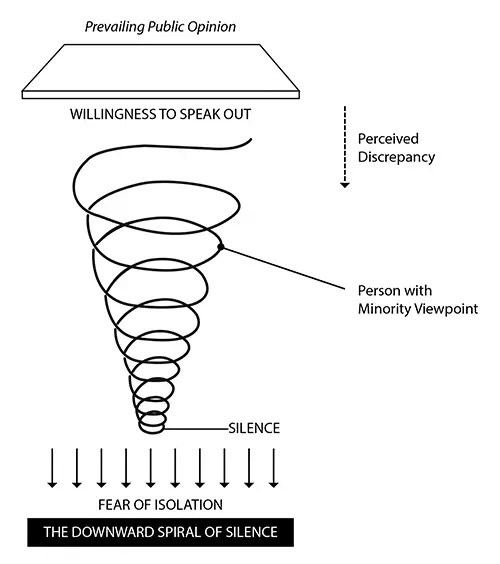
Popular opinion polls show that the majority of Russians support the military action in Ukraine. Researchers, however, continue to argue that society’s support for the war is much lower than these figures suggest. In their new study “Perception of the conflict with Ukraine among Russians: testing the spiral of silence hypothesis,” V.B. Zvonovsky and A.V. Khodykin, drawing on Elisabeth Noelle-Neumann’s “spiral of silence” model, argue that many opponents of the war are not willing to voice their opinion, believing that it is unpopular and fearing social disapproval.

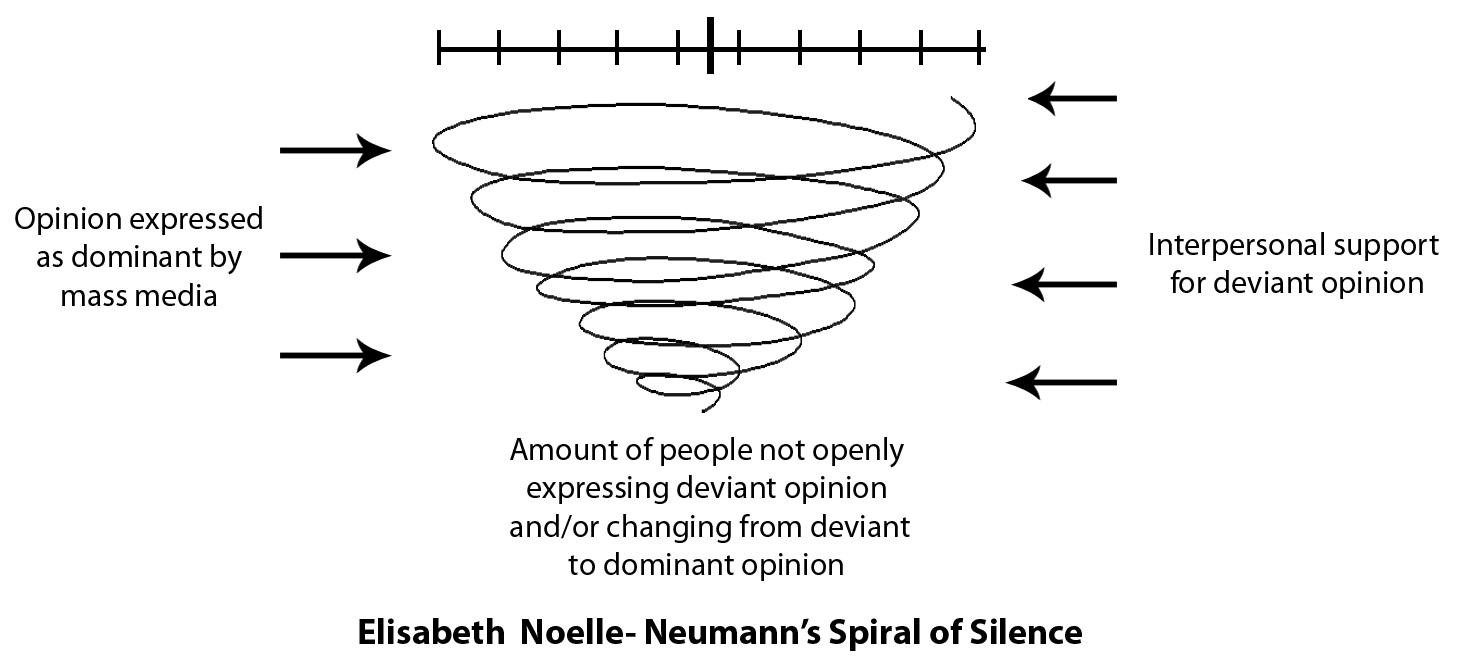
Noelle-Neumann argues that before people with a “limited interest in politics” decide to voice their opinion on a politically significant matter, they assess the risk of being condemned by others. The spiral of silence “twists” as follows: people who are afraid of being isolated due to the unpopularity of their opinion refrain from voicing it → this opinion is thus heard less and less often in society → people thus increasingly think that their own opinion is not popular → they are thus even less likely to be willing to voicing it.

Zvonovsky and Khodykin discovered that the spiral of silence actually does have a great impact on discussion of the Russian-Ukrainian conflict in Russian society. They were able to verify this by doing a nationwide telephone survey (N = 1977) using Noelle-Neumann’s “train test.” The “train test” measures the willingness of “adherents of a particular stance on a socially significant matter to openly voice it by discussing it on a train with a random fellow passenger.” Supporters of the more popular stance, in their opinion, are more likely to openly voice it, believing that they are “in a stronger camp and less at risk of being judged by others.” Sometimes, their opponents are also encouraged to side with the “stronger” position.

Applying the “train test” to the Russian context showed that the topic of the war is highly sensitive both to its supporters and opponents, and that the spiral of silence affects both sides of the discussion. However, its impact on opponents of the war has proved to be much stronger than on its supporters. Thus, people who oppose the special military operation in Ukraine are less willing to discuss the Russian-Ukrainian conflict with those who support it.

Another important finding made by the researchers is the fact that a person’s willingness to speak out about the war is influenced most by the distribution of opinions about it in their immediate circle of acquaintances. So, the more people in the orbit of respondents who had shared a similar opinion with them, the more the respondents were willing to discuss the war, and vice versa. It can be assumed that the need to maintain social ties is stronger for Russians than the need to defend and disseminate their political views, as we noted in our analytical report “The war near and far.” Zvonovsky and Khodykin suggest another explanation, however: the “bad experience” of political discussions, which often end in conflict and frustration, also has an impact, since the opinions of interlocutors are not changed, and the desire to talk about the war with one’s political opponents thus simply disappears.

The last interesting finding of the authors about which we want to tell you is the following. If the environment of the respondents is divided approximately equally (~50% “for” the war and ~50% “against”), then the probability that those oppose the special military operation will discuss it does not decrease—unlike supporters of the war, who are much less likely under the same circumstances to discuss the military operation with strangers of opposite views. Thus, the opponents of the military conflict “have learned to resist the spiral of silence better than their opponents.” This means that if the distribution of opinions in Russia changes, “opponents of the military conflict will have greater opportunities than [their] opponents to promote their own narrative about the Russian-Ukrainian conflict.”

Source: PS Lab (Telegraph), “The spiral of silence and the war in Ukraine: review of a new sociological study,” 14 December 2023. Translated by the Russian Reader. Image, above, courtesy of Businesstopia


IOWA CITY, Iowa — Anti-Donald Trump Republicans know they are in the middle of a critical moment to stop the former president’s political comeback. But for some, the steep cost of voicing resistance to Trump often renders them silent.

“If you go against Trump, like — you’re over,” said Kyle Clare, 20, a member of the University of Iowa’s College Republicans.

“I don’t talk about Donald Trump a lot because I’m afraid of the backlash,” said Jody Sears, 66, a registered Republican from Grimes, Iowa.

“If you would say something negative about Trump, we had one person that would just go bang for your throat,” said Barbra Spencer, 83, a former Trump voter describing her experience living in senior apartments in Spillville, Iowa.

Trump still enjoys broad popularity in the Republican Party, and that’s driving his polling leads among Republicans in Iowa, New Hampshire and every other state ahead of the 2024 primaries. But he has also used that popularity to enforce unity. And the same impulse that has led Republican officeholders to avoid criticizing Trump because of potential threats to their safety and their jobs is also holding back rank-and-file voters from opposing the former president in public with the full strength of their personal convictions.

NBC News spoke to more than a half-dozen Iowa voters turned off by Trump — but some were anxious about talking on the record out of fear of being shunned by friends or family. One Iowan said they plan on saying they caucused for Trump when asked by members of their community but will actually caucus for Vivek Ramaswamy.

That adds up to signs going unplaced on front lawns, conversations with friends and family about other candidates avoided — and fewer opportunities for opposition to Trump to take hold in different Republican communities.

NBC News first spoke with Clare in a University of Iowa auditorium Aug. 23, the night of the first GOP presidential debate. Fellow College Republicans were reacting to the debate and voicing steadfast support for the GOP candidate who wasn’t on the stage: Trump.

Clare chose to wait until the end of the night, after the rest of his classmates left the auditorium, to share his thoughts.

“I’m just so scared of doing this right now,” he said, fighting back tears. “I want to be able to have my opinions on our politicians, and I want to be able to speak freely about them and people still understand I’m a conservative.”

Clare criticized Trump, particularly for his actions Jan. 6, 2021, saying, “The end of his administration was un-American.” He also said Trump’s supporters are in denial about losing the 2020 election.

“They don’t want to believe he lost the election. It’s hard to swallow. Losing is hard to swallow. But it’s important that when we lose, we recognize that we lost and we think, ‘What can we do better next time to win over Americans?’” Clare said.

Clare was right to expect backlash from speaking out on Trump. After NBC News published the interview with him on a “Meet The Press” social media account, hateful and homophobic comments poured in. Clare said later that a student came up to him at a university event, shoved a phone in his face with the video on it, and asked him why he’s “scared of Trump and not scared of getting AIDS from having gay sex.”

“Say something they disagree with, and they go after your sexuality,” said Clare, who added that he doesn’t regret doing the interview with NBC News. Many of the comments questioned if Clare — who holds a leadership role at the University of Iowa’s College Republican organization, interned for a Republican on Capitol Hill, and is heavily involved in the Johnson County, Iowa, GOP — was truly a Republican.

“I think it shouldn’t be a bad thing for me to say I am conservative and that I think there are other options, and I don’t think that this person is good for our country,” Clare said. But he’s worried those opinions will stunt his own long-term political ambitions.

“If people as powerful and as prominent as members of Congress can be taken down because of their criticisms of one man, what’s stopping that from happening to me?” Clare noted, referring to the Republicans ousted from Congress after voting to impeach Trump.

Trump’s criticism forced several senators and House members into retirement or primary defeat during his first years in office. Later, of the 10 House Republicans who voted to bring impeachment charges against Trump following the Jan. 6 Capitol riot, four retired before facing voters in 2022 and another four lost their next primaries. Only two remain in the House.

In the Senate, three of the seven Republicans who voted to convict Trump have since retired or resigned, and Sen. Mitt Romney of Utah is retiring next year.

Romney recounted to biographer McKay Coppins that Republican members of Congress confided to him they wanted Trump impeached and convicted but would vote against the charges because they were worried about threats to their families.

Former Rep. Liz Cheney of Wyoming, one of the Republicans who lost a 2022 primary after voting to impeach Trump, detailed similar conversations in her new memoir.

Cheney wrote about one colleague that she “absolutely understood his fear” about what would happen if he voted to impeach Trump. But, she continued, “I also thought, ‘Perhaps you need to be in another job.’”

‘It was easier to be quiet about it’

Rank-and-file voters are less prominent and thus less likely to be harassed or threatened, but some of the same worries and experiences remain. Sears, the Republican from Grimes, Iowa, feels Trump doesn’t reflect her values. But that’s an opinion she kept to herself until recently, because of the fear of being cast off by family and friends.

“Family and people I work with are Trump supporters,” said Sears, describing her hesitancy to speak out about her beliefs.

“I think Trump supporters tried to coerce or bully people into also being Trump supporters. And so it was easier to be quiet about it,” she said.

Spencer, a retiree now living in a nursing home in Decorah, Iowa, says Trump supporters at her previous retirement community created a toxic environment that stopped her and her friends from voicing opinions.

“We were afraid of arguments,” she said. “When you live with that many old people, sometimes they have very strange but very firm thoughts and you better think the way they do,” she said, explaining her silence.

Clare, Sears and Spencer are not the only people who feel this way.

And as Cheney and Romney’s stories demonstrate, social ostracization isn’t limited to just voters who speak out against Trump. Former Rep. Denver Riggleman, a Republican who represented a slice of Virginia from 2019 to 2021, says his mother texted him, “I’m sorry you were ever elected,” after he came out against Trump.

“It was so soul-crushing to have a family member choose Donald Trump over you,” Riggleman continued. He said evangelical Trump supporters in his life saw Trump as being blessed by God. “I was going directly against religious beliefs. And that’s a losing battle.”

It’s now been almost six months since a member of Congress endorsed a non-Trump candidate in the 2024 GOP primary, according to NBC News’ endorsement tracking.

The trend has popped up elsewhere on the 2024 campaign trail, too. When Iowa Gov. Kim Reynolds endorsed Ron DeSantis in November, the Florida governor mentioned in an interview with NBC News that he “had people come to me and say they endorsed [Trump] because of the threats and everything like that” during the campaign.

Trump quickly went after Reynolds after news of her DeSantis endorsement broke, posting on social media that it would “be the end of her political career.”

‘Vortex of controversy and vilification’

Charlie Sykes was a conservative radio show host in Wisconsin for more than 20 years before Trump burst onto the political scene. Sykes was skeptical and critical of Trump, eventually confronting him in a heated interview about insults Trump hurled at Texas Sen. Ted Cruz’s wife in 2016. But for Sykes, it began to become clear that there was no room anymore for anti-Trump conservatives on talk radio.

“The audience of conservative talk radio began to think that loyalty was required. They wanted conservative media to be a safe space for them,” Sykes said, describing how his role became untenable.

After leaving radio, Sykes didn’t let up on his Trump criticism, which he says got him booted from a think tank and led him to lose friends and become a self-described political orphan. He says his criticism was met with bullying — and he understands why people who don’t work in the public eye might be hesitant to voice their true feelings about Trump.

“I do understand why people in their normal lives don’t want to be caught up in this vortex of controversy and vilification — why they would step back from all of this,” Sykes said.

Another longtime Wisconsin Republican recently detailed one of the results of that pressure.

Former House Speaker Paul Ryan recently spoke on video at an event for Teneo, a global consulting firm where he serves as vice-chair. Ryan said the impulse to avoid getting on the wrong side of angry Trump supporters pushed former colleagues to vote against impeachment even though they wanted Trump gone — and now he thinks there are many who regret those votes.

“They figured, ‘I’m not gonna take this heat and I’m going to vote against this impeachment because he’s gone anyway,’” Ryan said. “But what’s happened is that he’s been resurrected.”

Source: Alex Tabet, “Trump’s secret weapon consolidating the GOP: fear,” NBC News, 15 December 2023
Talk of the Town

You would be forgiven if you imagined Russia’s liberal, leftist, technical, creative, conservative and other intelligentsias were abuzz right now with righteous anger or triumphant glee about what the country’s air force (now officially known, bizarrely, as the Russian Aerospace Forces or VKS) has been up to in Syria and, more specifically, Aleppo, these days.

No, many of them are terribly exercised, in various directions, about the controversy over an exhibition by American photographer Jock Sturges in Moscow.

This was borne out by the websites of some of the country’s leading dailies this morning.

vedomosti-syria

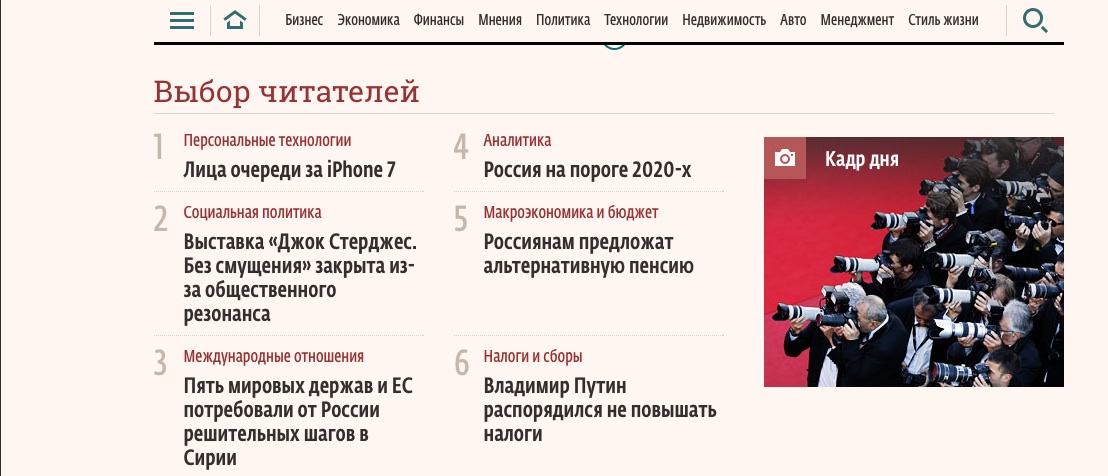
The liberal Vedomosti, a business-oriented newspaper, listed its top stories this morning. The top story was entitled “Faces in a Queue for the iPhone 7”; the second most-read story was about the Sturges show.

True, Vedomosti readers are serious lads and lassies, so the number three story was about Syria. It was headlined, “Five World Powers and EU Demand Decisive Steps from Russia in Syria.”

Earlier today, I posted a few bits from the bizarre article about yesterday’s emergency meeting of the UN Security Council, published in the country’s other serious, formerly liberal, business daily, Kommersant.

Similarly, Moskovsky Komsolomets could not figure out what its readers would find more titillating: reading about how the VKS’s top guns were bombing Aleppo to smithereens or how astroturfed patriots were threatening the God-given right of every self-respecting intelligent to implement Dostoevsky’s maxim that beauty would save the world.

mk-syria

By way of splitting the difference, this morning’s website featured a picture of a chap obviously meant to embody the most average-looking Russian bloke on earth, sadly contemplating one of Sturges’s blasphemous nudes, while a sidebar headline shouts, “Everyone [sic] Is Bombing: Churkin Thinks Peace Impossible in Syria.”

Izvestia has become a particularly noxious loudspeaker for the regime in the past years, so the front page of its website contained a fair number of articles and op-ed pieces chockablock with baldfaced lies about the bloodbath in Aleppo, but at least it had the dignity not to yield to the fake moral panic brewing around the Sturges show.

The relative paucity of Russian media coverage of the Syrian conflict and publicly accessible grassroots reactions was confirmed by the following completely unscientific Google search.

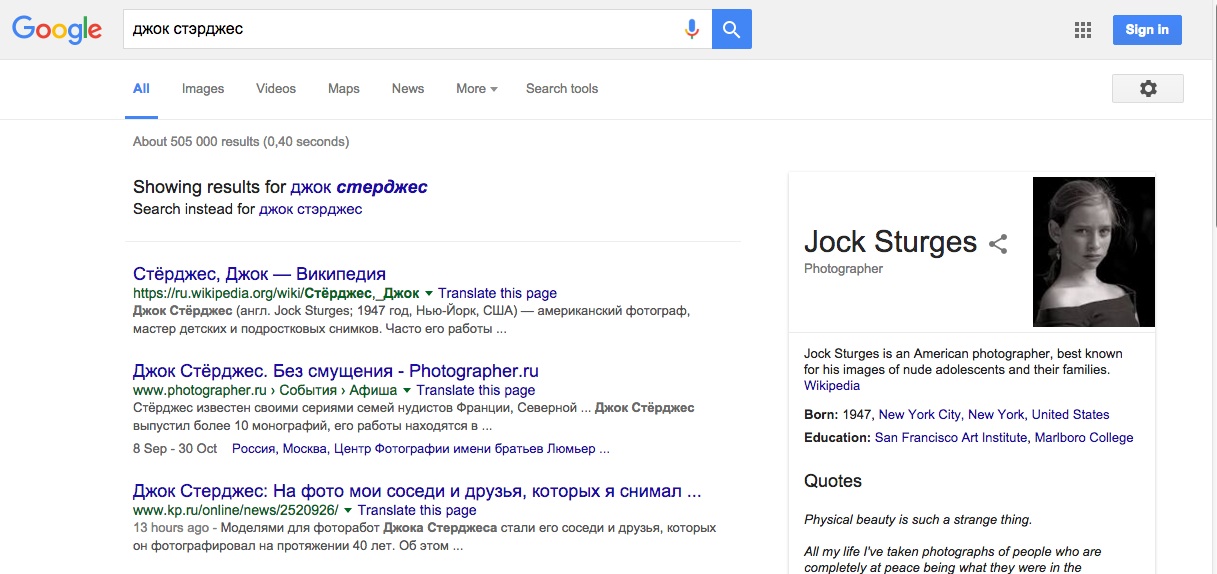
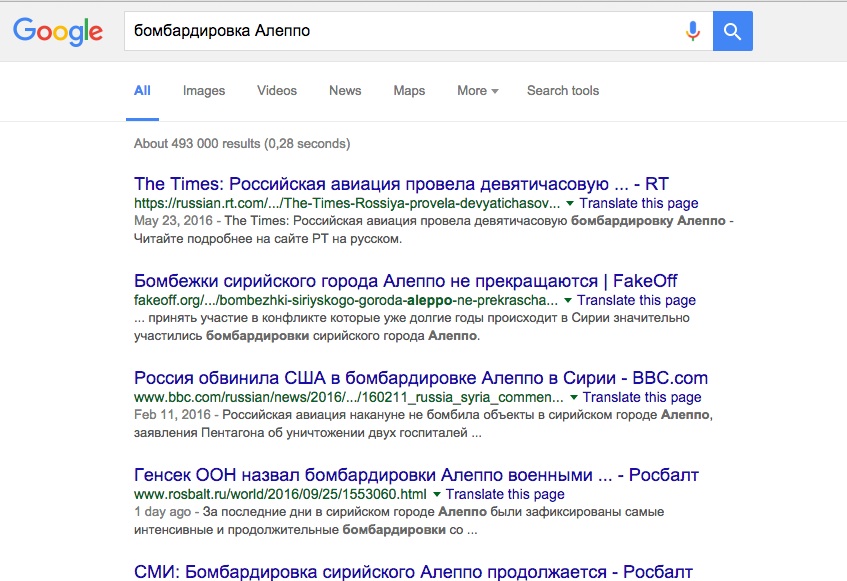
“Джок Стержес” (“Jock Sturges”) got 12,000 more hits than “бомбардироква Алеппо” (“bombing Aleppo”), even though, one could argue, the bombing of Aleppo by somebody or other has been a more topical item in the news for a longer time than Jock Sturges, whatever his longevity or virtues as a contemporary artist.

Results of Google search for
Results of Google search for “Jock Sturges” in Russian, September 26, 2016

Results of Google search for
Results of Google search for “bombing Aleppo,” in Russian, September 26, 2016

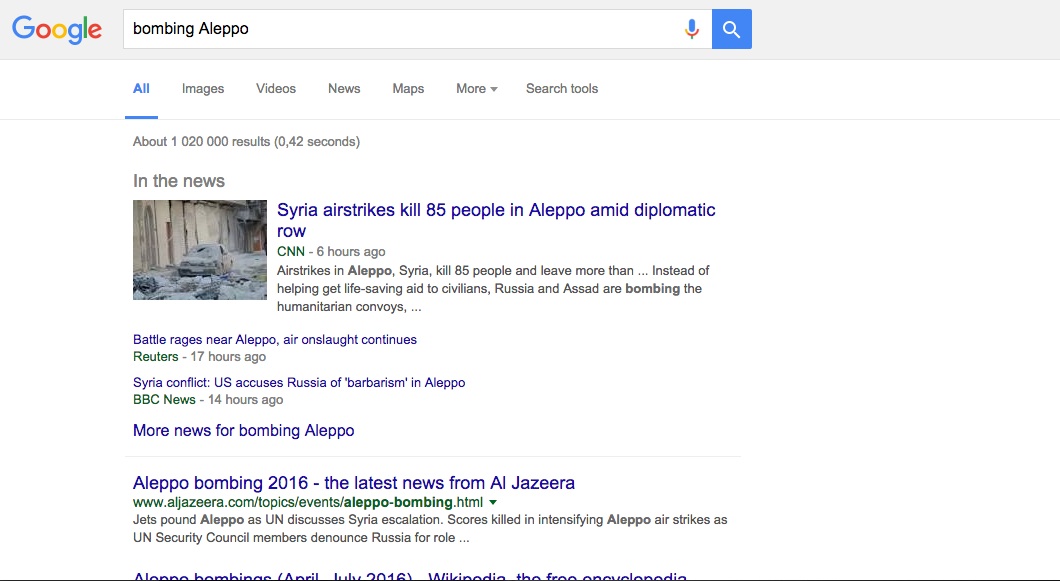
When I did the same search (“bombing Aleppo”) in English, I got over a million hits.

Results of Google for
Results of Google search for “bombing Aleppo,” in English, September 26, 2016

Certainly, we immediately have to factor in the sheer numbers of Anglophone media and readers in the world. There are quite a few more of both than there are Russophone media and readers, and so one would expect to find more responses to particular topics of global interest in English than in Russian.

But what about the vox pop?

An even more unscientific survey of the Russophone segment of Facebook this morning (that is, the part of the segment to which I have access, amounting to several hundred people, most of whom could be identified as intelligentsia or quasi-intelligentisa) showed that quite a few people were up in arms over the Sturges show or coolly editorializing about it to their extended communities of invisible friends, while literally no one was writing anything about Syria.

This has been the case for the past year. Not only that, but I have shared a fairly large number of articles and opinions about Syria, including my own, over that time, and have elicited a total of zero likes and comments from my Russian Facebook friends.

Non-Russian friends, on the contrary, like and comment on these posts in the same numbers as they and their Russian counterparts usually react to the other, non-Syrian things I write about.

Maybe I have the wrong Russian friends, but my hypothesis is that “politically engaged” or “socially conscious” Russians are literally afraid to say or write anything in public about the Syrian conflict. They have the good sense to know that their president-for-life has sunken his teeth into this geopolitical chew toy and has no intention of unclenching them.

Hence, anyone foolish enough to comment on this catastrophic attempt to reassert an increasingly impoverished country as a super power might get themselves in trouble with the powers that be. Over the last year, they have been hauling in utterly ordinary people  on “extremism” charges in fairly large numbers for reposting or commenting on the most innocuous things on Facebook and its Russian equivalent, Vkontakte.

Even more telling, there has not been a single public demonstration in Russia against Russian military involvement in Syria during the past year—to my knowledge, at least.*

Again, this has to be taken with a grain of salt. The current Russian regime has gone out of its way to make public demonstrations and pickets an unattractive pastime for all but the bravest of Russians.

Still, the war in Syria is the central international conflict of our time, and Russia’s best and brightest have literally nothing to say about it, even though their nominally elected government has not been merely a party to the conflict, but has come firmly down on one side, arguably, the wrong side, the side causing the most damage.

I find this deafening public silence about Syria more disturbing than anything else happening in Russia right now.

* After I posted this, Comrade BN wrote the following to me: “In Moscow last year there were some very small pickets protesting against the war in Syria, and the people who organized it attempted to set up an anti-war committee. As far as I know, though, the authorities pretty much intimidated them with varying degrees of extremity into giving up.”

“We Have a Surrogate Democracy”: An Interview with Ekaterina Schulman

Ekaterina Schulman. Photo courtesy of Andrei Stekachov and The Village

Political Scientist Ekaterina Schulman on Why You Should Vote
Anya Chesova and Natasha Fedorenko
The Village
September 16, 2016

This Sunday, September 18, the country will vote for a new State Duma, the seventh since the fall of the Soviet Union. The peculiarity of this vote is that it will take place under a mixed electoral system for the first time since 2003. 225 MPs will be elected to five-year tears from party lists, while the other 225 MPs will be elected from single-mandate districts. Several days before the elections, The Village met with Ekaterina Schulman, a political scientist and senior lecturer at the Russian Presidential Academy of National Economy and Public Administration (RANEPA). We talked with her about why you should vote if United Russia is going to win in any case, as well as about the changes in store for the Russian political system in the coming years.


The Upcoming Elections

The Village: On Sunday, the country will hold the first elections to the State Duma since 2011. The social climate in the city and the country as a whole has changed completely since that time. Protests erupted in 2011, and the people who protested on Bolotnaya Square and Sakharov Avenue believed they could impact the political situation. Nowadays, few people have held on to such hopes. What should we expect from the upcoming elections? And why should we bother with them?

Ekaterina Schulman: Everything happening now with the State Duma election is a consequence of the 2011–2012 protests, including changes in the laws, the introduction of the mixed system, the return of single-mandate MPs, the lowering of the threshold for parties to be seated in the Duma from seven to five percent, and the increased number of parties on the ballot. These are the political reforms outlined by then-president Dmitry Medvedev as a response to the events of December 2011. Later, we got a new head of state, but it was already impossible to take back these promises. The entire political reality we observe now has grown to one degree or another out of the 2011–2012 protest campaign, whether as rejection, reaction or consequence. It is the most important thing to happen in the Russian political arena in recent years.

The statements made by Vyacheslav Volodin, the president’s deputy chief of staff, on the need to hold honest elections, Vladimir Churov’s replacement by Ella Pamfilova as head of the Central Electoral Commission, the departure of someone more important than Churov from the CEC, deputy chair Leonid Ivlev, and the vigorous sacking of chairs of regional electoral commissions are all consequences of the protests. If they had not taken place, nothing would have changed. We would still have the same proportional voting system, the same seven-percent threshold, the same old Churov or Churov 2.0. Continue reading ““We Have a Surrogate Democracy”: An Interview with Ekaterina Schulman”

Spiral of Silence

spiral-of-silence-communication-theory

Greg Yudin
Facebook
April 3, 2015

Let me tell you a story about opinion polls.

The so-called spiral of silence has often been recalled recently in Russia in connection with public opinion polls. The idea behind the spiral of silence is simple. As soon as an opinion is conveyed either in the media or those selfsame surveys as having support from the majority, the minority, out of fear, prefers either to keep silent or join the majority. The idea has been used to explain where unanimous opinions, 86% ratings, total approval, etc., come from. Elisabeth Noelle-Neumann, the “godmother” of public opinion polling in post-war Germany, coined the term “spiral of silence” in 1980. And so in Russia, it is usually argued that the spiral of silence is an inherent feature of public opinion, because it was discovered in Germany, a proper bourgeois country.

We know that Noelle-Neumann was a Nazi. She did not join the party per se, but she did head a branch of a party student organization, made a considerable stir in the US by actively promoting Nazism, and later worked for two years at Goebbels’s weekly newspaper Das Reich.

But that is not so important. Many people suffered from Nazi fever, including social scientists. What is more interesting is that while many of those people somehow reflected on their Nazi experiences, trying in different ways to explain what had led them to do the things they did, Noelle-Neumann went into total denial. All her life, she maintained that she had done nothing extraordinary, that Hitler was a charming man, and that she had just been forced to denounce Jews, and in fact, she had secretly opposed the regime. It is easy to see how she opposed it if you take a gander at the articles she wrote for Das Reich. It is as if a columnist for the current incarnation of Izvestia would say that he had secretly been fighting for peace and harmony in Russia.

Subsequently, the spiral of silence theory was repeatedly tested, and it turned out that it works poorly in multipolar societies. If it explains anything at all, however, it explains the personal experience of Noelle-Neumann herself. It is her own fear that she identifies with the intimidated majority. She tries to justify this fear by arguing that the spiral of silence is something ordinary and inevitable. But this is a bad excuse, because, in order to save her conscience, she justifies political repression, not only past repression but future repression. It is one thing to recognize that no normal person is immune from becoming a beast, and quite another thing to say it is a normal thing when people turn into animals.

In fact, as far back as her 1940 dissertation (which simultaneously functioned as a report to Goebbels’s office on American attitudes to Germany), she writes directly about the difference between the US and the Third Reich.

“In Germany, public opinion figures like the body of the people, which receives orders from the head and ensures their implementation. […] In one case, public opinion holds sway. In others, it is guided.”

All this came to mind after the stunning lecture last week by my colleague Grigory Kertman from the Public Opinion Foundation (FOM). Kertman spoke about the fear of respondents during interviews. It cannot be measured directly. You cannot ask respondents, “Are you afraid of me right now?” But Kertman cleverly got around this by collecting information from the interviewers who conduct the polls. He discovered that they are used to the fact that respondents are afraid: this is the most common cause of insincere responses. A significant part of the interview takes place in circumstances where the respondent’s fear is so strong that it is palpable to the interviewers.

This silence of the lambs is abnormal, and it has nothing to do with the “nature of public opinion.” The insatiable desire to pass human beings off as naturally cowardly creatures and justify those who systematically bully them always comes from those who themselves have been victims of violence. Nothing good will come of it. We definitely do not want to go where this spiral would lead us.

Greg Yudin is a research fellow and lecturer at the Higher School of Economics in Moscow. Translated by the Russian Reader. See my previous posts on Russia’s pollocracy. Image courtesy of masscommunicationtalk.com