Traces

This year’s Berlin Film Festival is showing only one film from Ukraine: the documentary film Traces was tapped to represent the country. Traces tells the stories of women who survived rape and violence during the war in Donbas and Russia’s full-fledged invasion of Ukraine.

The Traces team on the stage of the Haus der Berliner Festspiele, 16 February 2026. Source: Berlinale

“I always wished one thing for my pupils: that they would never be forced to take up arms,” Liudmyla Mefodiivna, a teacher of Ukrainian language and literature, says in an interview with Deutsche Welle.

The elderly woman, who taught school for forty-five years, was tortured and raped by a soldier after pro-Russian militias arrived in her village. As he was leaving, her tormentor left a bullet on the table as a warning and a threat: “I’ll come back and kill you if you so much as peep.” The teacher’s story, along with [five] other stories of violence and horror, is recounted in the documentary film.

“The occupiers came, and the majority of my pupils rose to Ukraine’s defense. Many of them have been killed, while others have been taken captive or returned from the front severely wounded. It’s terribly painful to witness and survive this. Ukraine is now flowing with blood, and mothers weep over the bodies of their sons, husbands, and family members. Four men have been killed in our family alone, leaving behind young children,” says Mefodiivna.

She recalls that she was unable to talk about her experience for a long time. Her family insisted, though, that her testimony of the atrocity must be heard.

“They beat me, choked me, cut me, knocked out my teeth, and broke my ribs,” Mefodiivna says. “They robbed me of my health. Thanks to the support of these wonderful women I met, I was finally able to start talking. I began to tell my story. I want the whole world to know about the crimes Russia has been committing, about how it has tortured and abused Ukrainians.”

Directors Alisa Kovalenko and Marysia Nikitiuk, along with six of the film’s protagonists, have traveled to the Berlinale to present the film, a testament to their pain. All of them are members of SEMA Ukraine, an organization which helps women who have survived violence. As they sit down for interviews, it is particularly noticeable how nervous they are: their hands are shaking.

Olga from Kherson spent one hundred days in captivity with her son and her husband.

“I was ashamed to talk about [the Russians] did to me. Getting to know the organization was like a breath of fresh air for me,” Olga says. “Now we help other women, and men too. Because men have also been victims of sexualized torture, and yet this is hardly ever discussed.”

Seventy-two-year-old Nina is the most emotional during the interview. She almost immediately begins to weep as she recalls how the war first destroyed her home, and then her life.

“I thought I would have a quiet life in the village, planting trees and waiting for grandchildren. But then the tanks came and the earth burned. And then the monsters came. . . .”

Nina’s face is wracked by sobbing, shame, and grief.

The voice as a weapon

It is shame that prevents victims of violence from testifying against their aggressors, meaning that wartime victims of sexual violence are effectively ignored in the official statistics. When talking about civilian casualties, the focus is usually on those who have been killed, wounded, or taken prisoner.

“Those who have survived sexual assault, including in captivity, often go unnoticed and do not receive housing, medical, or mental health assistance from the state. Many suffer from stigmatization, and some cannot cope with what they have experienced,” says the SEMA Ukraine booklet.

The women are fighting to be heard.

“Our voices are the weapons that will punish the perpetrators,” the organization tells victims of violence.

“When I started talking about what I’d survived (this was before the full-scale invasion), I often encountered people seemingly switching off. When I would try to tell them about the most terrible things which had happened to me, their eyes would go blank. They would stop hearing what I was saying. It was like an internal defense mechanism, when what you’re listening to is too painful and unpleasant that you just don’t take on board what’s being said. I believe that this film can break down this barrier, and that after seeing it, people will no longer be able to shut their ears again,’ says SEMA Ukraine founder Iryna Dovhan.

The film opens with Dovhan’s story. In 2014, she was captured by pro-Russian armed groups in Donbas for aiding Ukrainian soldiers. After torturing and abusing her for several days, the pro-Russian militiamen tied her to a pole in downtown Donetsk, wrapped her in an Ukrainian flag, and hung a sign on her that read, “She is murdering our children.” The city’s residents visited the captive to hit, spit on, and insult her.

Dovhan was lucky in some sense: a picture of the helpless woman tied to a pole was taken by a western photographer covering the conflict in Donbas. The photograph was picked up by international media outlets, and Dovhan’s captors were forced to release her.

“I hope that the world will stand with us. I hope that the world will understand that we don’t need sympathy—‘oh, those poor women’—but a joint campaign to make sure this does not happen again in the future and the perpetrators are punished. Otherwise, evil will return again and again,” says Dovhan.

After what she survived, she found the strength to unite and support other women who had suffered.

How the film Traces came to be

The film’s co-director Alisa Kovalenko was also tortured and raped, but she found help at SEMA Ukraine.

“My journey to this film took twelve years. In 2014, I was captured in Donbas and suffered violence. For a long time, I couldn’t talk about it. When I first gave my testimony to human rights activists from the Helsinki Group, I asked, ‘Have you heard many stories like this before?’ They replied, ‘No. You are the first’. It was a shock. I knew there were many more of us, the people whom I had seen with my own eyes in captivity—both men and women.”

The filmmaker describes meeting other women who had gone through the same ordeal as a turning point.

“We sat down together for the first time and started talking. We experienced healing. We felt that we were not alone. And we began to break down the wall of silence step by step.”

It became clear that the traces of the atrocities had to be preserved, but for the filmmakers—Alisa Kovalenko was soon joined by Marysia Nikitiuk—it was extremely important to settle on the right narrative form to preserve the dignity of the victims and not traumatize viewers. Many things in the hours-long filmed accounts of torture, rape, and humiliation did not make it into the final cut.

“We wanted to shove all the worst things in the audience’s faces and shout, ‘Look what they’ve been doing to us!’ But we tried to strike a balance. This film is not meant to shock the viewer. It’s about dignity, about the light that is born in spite of evil. We learned to talk about it the right way, without retraumatizing either the protagonists or the audience. It’s a victim-centered approach,” says Kovalenko. “Some stories were left out due to limited running time—for example, how women in captivity were starved and would share one dumpling a day between four of them, or were forced to sing the Russian national anthem to be allowed to go to the toilet. But these testimonies exist—in books, in human rights reports, in memory.”

Laying the foundations for memory was the goal of the filmmakers. That is why, in Berlin, the women come onstage and recount their experiences once again to the audience, thus overcoming their pain.

“The war gradually fades into the background. Tragedy turns into statistics, and statistics become routine, and that is terrifying,” the filmmakers note. “Traces resurrects the names. They are no longer numbers, but flesh-and-blood women who look the viewer in the eye and speak. A tragedy should have names, not be turned into statistics.”

Source: Marina Konstantinova, “Berlinale film recounts Russian Army’s violence against Ukrainian women,” Deutsche Welle Russian Service, 17 February 2026. Translated by the Russian Reader
Source: suspilne.culture (Instagram), 13 February 2026

Cruel and Unusual

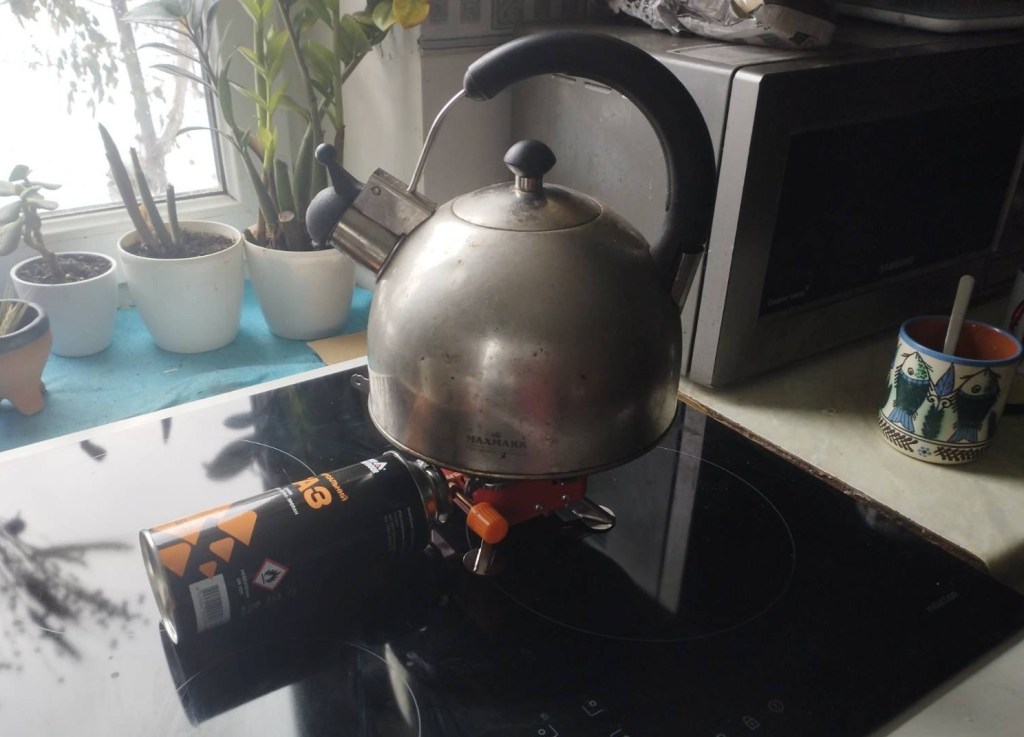
I am heating water for my coffee on a gas burner because there is no electricity.

Kyiv, the Kyiv region, Odesa region, and the Dnipropetrovsk region are in a total blackout — the result of Russia systematically destroying Ukraine’s energy system over the past months.

The Kyiv metro has stopped. There is no water anywhere.

At the same time, Russia’s State Duma Speaker Volodin, speaking on behalf of Russian deputies, openly calls for genocide — urging new strikes on Ukraine’s already devastated energy and heating infrastructure in order to cause mass civilian deaths.

This weekend the temperature drops sharply. Next week, it is expected to reach –30°C.

Meanwhile, ordinary Russians are celebrating on social media that Ukrainians are freezing.

We know this logic well. Their aspiration is simple: to make life here “like it is for them.”

In Russia, even without war, power outages in entire regions are normal.

In a gas-rich country, it is normal for many regions to have no gas at all.

This is exactly what the so-called Russian world aims for — to make us like them, if not through conquest, then through the destruction of our critical infrastructure and the physical extermination of Ukrainians.

Source: Lyuba Yakimchuk (Facebook), 31 January 2026


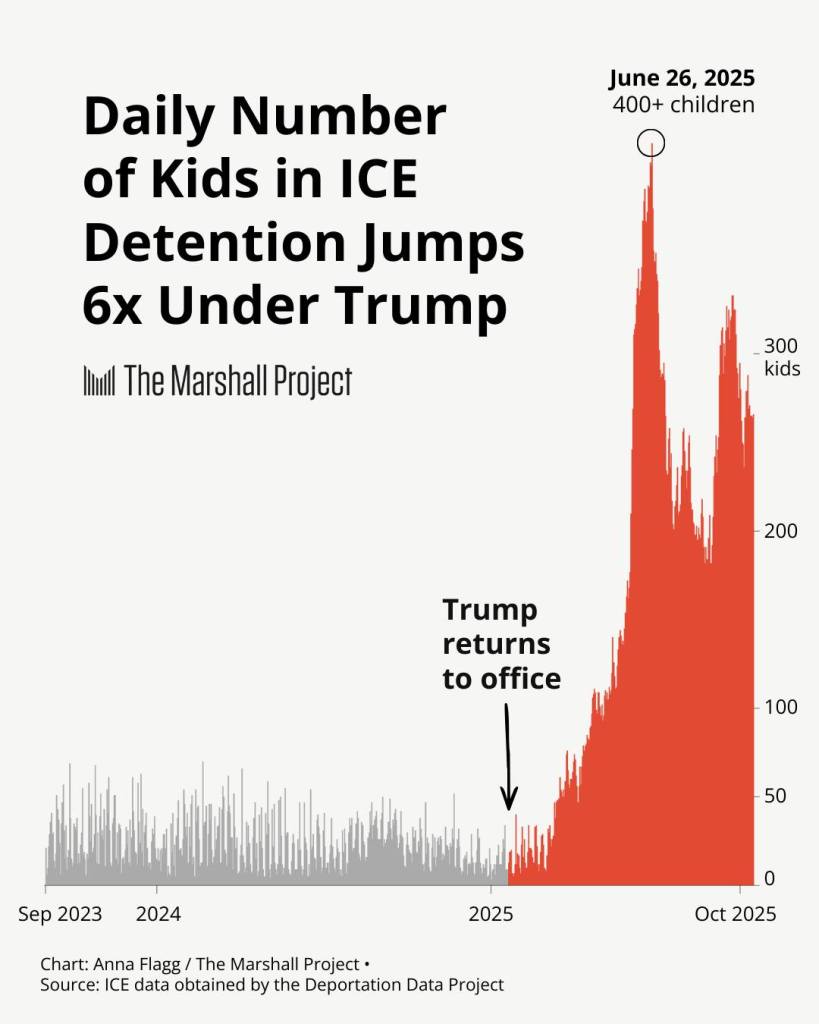
The number of children in Immigration and Customs Enforcement detention on a given day has skyrocketed, jumping more than sixfold since the start of the second Trump administration. The Marshall Project analyzed data obtained by the Deportation Data Project and found that ICE held around 170 children on an average day under Trump. During the last 16 months of the Biden administration, ICE held around 25 children a day.

The Marshall Project’s analysis found that on some days, ICE held 400 children or more. The data covers September 2023 to mid-October 2025, meaning it does not include the surge of arrests from recent immigration enforcement operations in Minnesota. Nor does the data include children in the custody of the Border Patrol or the Office of Refugee Resettlement, where children are held without a guardian.

The Dilley Immigration Processing Center in Texas is the main facility for family detention. U.S. Rep. Joaquin Castro spent two-and-a-half hours inside Dilley on Wednesday, visiting parents and children. He said that the 1,100 detainees housed at the facility included a 2-month-old infant. “They are literally being treated as prisoners,” said Castro, a Democrat from San Antonio, in a live-streamed video. “This is a monstrous machine.”

In 2021, Biden largely halted the practice of family detention, and the Dilley facility, which had mostly housed families, closed in 2024. But the Trump administration revived the practice last year, and the facility, which is located about 75 miles outside of San Antonio, reopened.

The detainment of children by ICE has led to protests in recent weeks, both inside and outside Dilley. On Wednesday, state police used pepper spray on people protesting outside.

Immigration attorney Eric Lee was visiting clients at the facility on Saturday when staff abruptly told him to leave. Outside, he could hear a large group of children and women detained inside chanting, “Let us out.” Lee said he later learned that families inside the detention center had gotten news that people across the country were protesting the detainment of 5-year-old Liam Conejo Ramos, whose story went viral amid the backlash against the Trump administration’s recent immigration enforcement surge in Minnesota.

The Marshall Project (YouTube), 28 January 2026

Javier Hidalgo, legal director at the Texas-based immigration advocacy group RAICES said he’s seen many young children like Liam in Dilley. “That’s very much the norm,” Hidalgo said. “That’s what the government is spending taxpayer money on.”

A previous Marshall Project analysis found that ICE has booked at least 3,800 children into detention since Trump took office last year. At least 1,000 children were held longer than 20 days, a court-ordered limit on child detention.

“Every single day that a kid is in a place like this, they deteriorate,” Hidalgo said. “I’ve seen [them] withdraw. They lose weight; they just get physically worse.”

Children being detained with their families as part of immigration raids has become a common occurrence across the country. According to school officials in Columbia Heights, Minnesota, four children, including Liam, have been detained from their district during recent raids.

A 7-year-old in Portland, Oregon, was taken from a hospital parking lot in January with her family, after her parents took her to the emergency room, according to Oregon Live. As ProPublica reported, a 6-year-old boy in Chicago was detained with his mother in a large apartment raid during “Operation Midway Blitz.”

The Marshall Project spoke with three different lawyers representing children who were held with their families at Dilley. They said their clients were often taken into detention during in-person check-ins and had pending cases that could result in them remaining in the country legally. The lawyers believe their clients were detained not because of any danger they posed, but because the Trump administration is trying to deport as many people as possible.

“They’re probably the easiest catch for a lot of immigration officials,” said Veronica Franco Salazar, a Houston-based immigration lawyer.

In court documents, families have described horrific conditions while detained with their children in Dilley. They reported moldy, worm-filled food and foul-tasting, undrinkable water. With little for children to do, some resorted to playing with rocks. Parents worried about the psychological toll of detention, describing children hitting themselves in their faces or wetting themselves despite being potty-trained.

During his visit, Castro said that he heard many families talk about the psychological toll of detention. He spent half an hour with Liam, and said Liam’s father, Adrian Conejo Arias, told him Liam has been depressed and sleeping a lot. Liam remained asleep in his father’s arms during the visit with Castro. Arias said Liam had been asking about his classmates and the bunny hat he was wearing when detained. The congressman said he told the father that children at Liam’s school were still saving a spot for him at his desk.

CoreCivic, the private company running the Dilley facility, declined to answer a detailed list of questions. “Our responsibility is to care for each person respectfully and humanely while they receive the legal due process that they are entitled to,” Brian Todd, a public affairs employee at CoreCivic, told The Marshall Project in an emailed statement. Todd referred all questions to ICE, which did not respond to emails.

Kristin Kumpf, coordinator for the National Coalition to End Family and Child Detention, explained that the public may see videos or photos of the moments people are taken from their homes or snatched off the street, but there is less attention to the conditions children endure in the black box of detention.

“It’s only a matter of time before we see a child die within Dilley or another facility,” Kumpf said.

Hayam El-Gamal and her five children, including 5-year-old twins, have been locked inside Dilley for eight grueling months. Lee, who represents the family, said they’ve received poor medical care and are suffering from psychological stress.

“They’re calling me crying every day,” Lee said. “It’s an unmitigated horror show, and there’s no other way to put it.”

El-Gamal’s husband, Mohamed Sabry Soliman, is facing charges for attacking people at an event in Colorado supporting Israeli hostages in Gaza. At least 13 people were injured in the attack, and one person died, according to prosecutors. Soliman told detectives his family knew nothing of the attack, according to court documents, and an FBI agent testified they were not involved. The family’s lawyer said they are being unfairly punished for crimes they had no part in.

Lee recounted how one of El-Gamal’s children had appendicitis while in detention and “was left writhing on the floor of the facility screaming and in pain.” Lee said facility staff just gave him Tylenol, and it was only when he started vomiting that the child was taken to urgent care.

“Why is this happening to us?” El-Gamal’s eldest daughter, 18-year-old Habiba Soliman, asked in a handwritten statement provided to The Marshall Project by Lee. “It’s very easy to see the truth about this place and about us. The people need to be truthful to themselves and follow the facts.”

Lee said he believes ICE is retaliating against Habiba Soliman for speaking out about her family’s long detention. She was recently moved to a different area of the facility. Lee said the timing of the move, many months after her 18th birthday, but shortly after she spoke to the press about her long detainment, suggested it was punishment. ICE did not respond to questions about the reason for the separation. Lee said she has faced threats of being moved to a different facility altogether if she didn’t behave.

“I will never forget the look of fear and helplessness on my mother’s face as she watched me being taken away and couldn’t do anything to prevent it,” Habiba Soliman wrote in her statement. “We need everyone to step up and say that detaining families for indefinitely long periods should be illegal.”

Source: Anna Flagg and Shannon Heffernan, “‘Why Is This Happening to Us?’ Daily Number of Kids in ICE Detention Jumps 6x Under Trump,” The Marshall Project, 29 January 2026. Thanks to White Rose Resistance for the heads-up.

The Buryats Made Them Do It

This is Vladimir Kara-Murza, speaking at the French Senate:

There is another reason why the Russian Defense Ministry recruits so many members of ethnic minorities [to fight in the war against Ukraine]: as it turns out, because it is psychologically really difficult for [ethnic] Russians to kill Ukrainians. Because we are one people. We are very close peoples, as everybody knows. We have nearly the same language, the same religion, and centuries of history in common. But if it’s someone from another culture, allegedly it’s easier [for them to kill Ukrainians]. I hadn’t really thought about it before. I thought the reasons were primarily economic. But after what [a colleague who spoke about the Buryats] said, I started thinking about it too.

A screenshot of the video Ms. Khazagaeva cites in her Facebook post

You did get that, friends? It’s so difficult, so unbearable for ethnic Russians to kill you Ukrainians that Buryats and Chechens have been doing all the work for them — because [Buryats and Chechens] are beasts and savages. That makes sense, doesn’t it?

By the way, [Kara-Murza] refers to Buryats and Chechens as “those ethnic minorities.”

In other words, all eleven years [of Russia’s war against Ukraine], the Buryats, who number under four hundred and fifty thousand people, including children and the elderly, have been attempting to kill the forty million Ukrainians. It transpires, however, that the hundred million ethnic Russians have had it “psychologically difficult” all those eleven years. They are mere victims of this war, which is something “those [other] ethnic groups” want. Don’t get them wrong: ethnic Russians love you Ukrainians like brothers!

You have explained everything so clearly, Mr. Kara-Murza. I have literally just a couple of follow-up questions. Excuse me, has it also been the Buryats who have been launching missiles at Ukrainian cities? And the creatures who on Russian television rejoice at the deaths of Ukrainian children in Kryvyi Rih, are they also members of these same ethnic minorities?

I’m sorry, but I have another question. The whole world knows what the Pskov paratroopers did in Bucha. Do you have any ideas how to repaint them as Buryats? Although it would probably be a bit difficult, since “your lads” have already been testifying.

One more question. The other day, 7 April, was the thirtieth anniversary of the Samashki massacre. Eighty people, mostly children, women and old people, were burned alive in Samashki, and hundreds of people were killed in total. This is not to mention the forty thousand Chechen children killed in the two [Chechen] wars. Excuse me, did the Chechens shell themselves? Ethnic Russians are totally incapable of that, aren’t they? To hell with what Tolstoy wrote in Hadji Murat. Tolstoy was a renegade.

Oh, I’ve gotten a little carried away. Two million people were killed in the Soviet invasion of Afghanistan. They say that’s where the notorious practice of “mopping up” villages, leaving mass graves in their wake, originated. I’m sorry, who did the killing in Afghanistan? Was that the Buryats too?

Good Lord, where do you get so many of them?

The only thing I don’t understand is how the idea of the “Russian world” could have emerged, since you ethnic Russians live in love and friendship with all countries. It must have been the Chukchi who overdid it on that front.

I also don’t understand why it is the ethnic Russians who do ballet, but it is the non-Russians who make war.

P.S. Thanks to the lovely Olga Arles for her [translation] of Kara-Murza’s full speech.

///

Updated, 13 April. I have replaced the picture originally below the post with a video featuring the entire quotation by Kara-Murza. Thanks to the good people who provided the AI translation. It shows that Kara-Murza’s words, whether presented in expanded or abridged form, bear the same message: ethnic Russians don’t want to kill Ukrainians, and it’s easier for non-Russians to do it. Because we ethnic Russians and the Ukrainians are one and the same, but we’re not the same as those non-Russians. It matters not a whit that Kara-Murza referenced someone else’s observation. What matters is that he voiced this idea personally and voluntarily, and that he confirmed his commitment to it by saying that it has given him pause for thought too. Think about it. A Russian politician (as Kara-Murza fancies himself), while visiting the parliament of a major European country, says that it is mainly Buryats who want the war. He says this on the record in a place where every word uttered potentially has legal force. He said it not in a bar, not on a beach, but in the French Senate, where decisions on sanctions are made.

I have not emended the text of my original post, dated 12 April.

Source: Julia Khazagaeva (Facebook), 11 April 2025. Translated by the Russian Reader.


On 10 April 2025, the Senate Foreign Affairs Committee heard the testimony of Vladimir Kara-Murza, vice-president of the Free Russia Foundation and a former Russian political prisoner. A Russian politician and opponent of Vladimir Putin, Kara-Murza survived two poisoning attempts, in 2015 and 2017. In April 2023, he was sentenced to 25 years in a penal colony by the Russian justice system after criticizing Russia’s invasion of Ukraine. He was released on 1 August 2024 in a prisoner exchange. In his testimony to the senators, he stressed the autocratic and violent nature of Putin’s regime. He called on the European Union to maintain its sanctions against Russia, and to bring its weight to bear on peace negotiations in Ukraine. He maintains the hope that the country will soon become democratic.

Source: Public Sénat (YouTube), 10 April 2025. Annotation translated, from the French, by the Russian Reader

Yesterday’s Top Stories

Good evening, friends. Here are the main news of the day:

— The Gulf of Finland has turned green. What is happening and how is it related to the heat? https://t.me/paperpaper_ru/27596

— Supplies of premium headphones manufactured by Sennheiser, Marshall, Sony and JBL are running out in Russia, Kommersant writes. Here is the rundown on supplies in St. Petersburg: https://ppr.today/9MGEytX

— [Russian online retailer] Wildberries has changed the name on the main page of its website. It now calls itself Yagodki [“Berries”]: https://t.me/paperpaper_ru/27604

iStories talked to [Russian] soldiers traced to shootings and robberies in the Kyiv region. One confessed to everything: https://ppr.today/e3hRqev

— There are 24 free beds for coronavirus patients in St. Petersburg. The authorities will convert two more hospitals to covid wards: https://t.me/paperpaper_ru/27611

— Petersburgers are getting “subpoenas” and telephone calls recruiting them to fight in Ukraine. Those who do not want to fight are asked to sign a “waiver”: https://ppr.today/rY0KrCX

Photo caption: see what the Perseid meteor shower looks like in the countryside near Petersburg: https://ppr.today/GChPNeX

Source: Bumaga (Telegram), 15 August 2022. Translated by the Russian Reader