о Божий
в творении Облика из Ничего
зримо пробивший
и неумолкающий
РАЗ
в образе Поля
Source: Gennady Aygi, Razgovory na rasstoianii (St. Petersburg: Limbus Press, 2001), p. 36
ANCIENT FIELD
o Divine
conjuring Countenance from Nothing
visibly pierced
and indefatigable
ONCE
in the image of the Field
Translated by the Russian Reader. Thanks to KKML for the suggestion and Comrade Koganzon for the assistance.
Gennady Aygi (Marina Razbezhkina, director, 2001)
Gennady Aygi (1934–2006), one of the most original of modern Russian poets, was born in the village of Shaymurzino, in the Chuvash Autonomous Republic, some 450 miles east of Moscow. His father was a village schoolteacher, his maternal grandfather a priest of the ancient Chuvash religion. Although he wrote mainly in Russian, he eventually became the national poet of Chuvashia, having published volumes of Chuvash poetry, translations from French, Polish, Russian and other languages, and an Anthology of Chuvash Poetry.
Expelled from the Gorky Literary Institute for his links with Pasternak, Aygi found a society of like-minded artists in the creative Moscow underground. For ten years he worked at the Mayakovsky Museum, organizing exhibitions of modern art, but generally he led a life of poverty, constantly harassed by officialdom; only with the advent of perestroika did he begin to be published in the Soviet Union and to accept numerous invitations to travel to the West. But from the 1960s onwards his Russian-language poetry was published and acclaimed throughout the world, being translated into more than twenty languages. Living mainly in Moscow, he was married four times and left seven children.
ever more westerly the distance
footsteps steadily darken,
the stars still do not suffice
to think about the water,
but the first bridges —
predawn bridges as it were —
fracture the night
brilliantly nowhere.
child, let’s bid farewell here,
in the coldness of this line
the word’s color is forever white,
only meaning is not eternal.
the february water
is even blacker than the light
looming over it,
more unheard of than the darkness
Vladimir Kazakov, Selected Works, vol. 3: Poems (Moscow: Hylaea, 1995), p. 106. Source: LitMir. Photo and translation by the Russian Reader. Thanks to KKML for the suggestion.
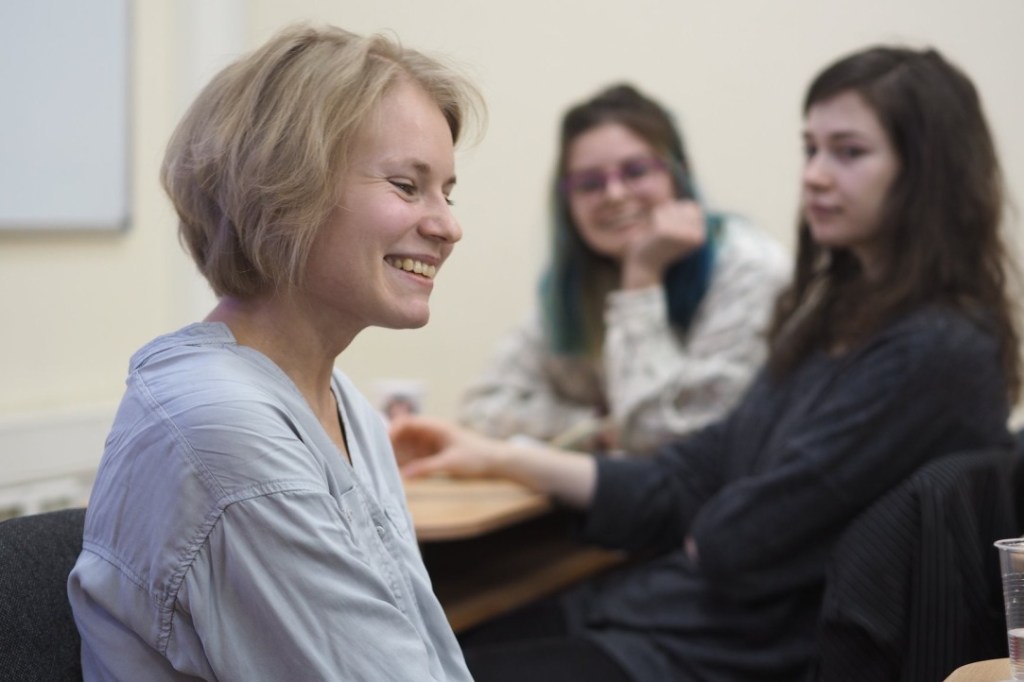
In many ways, Ekaterina Zakharkiv is my favorite contemporary Russophone poet. While her verse is manifestly avant-garde, there is something about the way she combines different lexical and stylistic registers into a seamless and, one could say, “collectivist” idiom that always reminds me of Alexander Pushkin and the revolution he led in Russian poetic discourse. Born in Magadan, Zakharkiv graduated from the Gorky Literary Institute in Moscow and is currently a graduate student at the Institute of Linguistics of the Russian Academy of Sciences. She is an editor at F-Writing, Dream, and the new Almanac Fire, which focuses on the intersection of writing and music.
Ekaterina Zakharkiv
These three translations were published last year in Lana Turner #12. The issue is now available for free as a pdf, so I decided to put them up here as well, hopefully bringing Zakharkiv’s work to a broader audience online.
*** strange weapon of the body, promising to assemble under the targeting apparatus of itself into the composite noun of the square, the collision of adversaries without confusion of sides —this is touching openness, you say that love is touching openness don’t love me then
separation opening division of po lice bu dget re lations trucks for an incomplete project last shots on the national TV stations last mechanisms last montage right here, atop the wreckage of the signal, I touch the dust of our collective text move my fingers over your skin mottled with italics “in the failure of time”
under the smoke-filled sky of an invisible Orleans, doubled maidens unfurl their banners in the heart’s murky fissures
on the squares of our city the long since melted schedule of movements, instants of matter surmounting information
at the crossing of places in a sundered embrace, a gold lord looks back at the eye the cool mouth of rose sor rows of speech can’t close even night even the thin air of night
*** [you’ll forgive me, won’t you, especially if you recognize] how crooked flames rise and fall from the black sky into the mowed carpet of the conference room the endless weight that takes the bandages off voids of armchairs, sheets of A4 paper and the exits if you recognize the fear that buildings stand in, immersed in the hypnosis of context and the tall aquarium building in spreading cracks, artificial landscapes through the rolled back ceilings of the music hall, washed out in rays of cold light especially if you recognize how the constantly changing architecture of hybrid groups is quietly penetrated by catastrophic panoramas
colonnades, metro tunnels, auditoriums, houses of culture, an agalma of reinforced plastic
a boarded-up door on the outskirts of language, torn down by a construction brigade they see thresholds, taste dust fix the flowing water of the day, a concrete mass, object number 446 everything seems to recoil somewhere, they hear only the deaf breath of the smog above the construction site, leaning on steel railings only the long peal of this floating, a wind of rubbish, turned inside out you’ll forgive me this elusive idiom in the flickering of a uniform, especially if you see the aerial views of history’s treachery, if you can stop the wire and roses, ripping up the wrappings
*** I catch the blood of the tags by the dim coat check and walk to the ancient academic rows exercises in freedom of the approach of one hundred and forty people, among whom а seeing wolf calls: you know, they’re asking for you
name a sharpened grammar and, hesitating, become a smoldering heap of broken translation —everything whipped up into living smoke, steel-grey, impersonal a floor crumbling in the sky above us, yet one particle of the murky front, fed with a spoon of nuclear structure, asks: where are the centuries that took my younger sky?
others—biological colonies— endure, no longer being a large insect pollinates zero which must be plucked despite certain stalks of long sadness it’s better if he roam the web links
when we’re trying to sleep and we touch nothing, resisting nothing fallen body convulsive like speech, murdered measure not stanzas but nervous fire more often than not during the extortionate night
basically, what Nikita’s saying is that you have to capture the moment when you begin to be the text, and at the same time the not-text and hold it then you will attain equality well, he doesn’t say that so much, or not exactly that and also I read: the beginning is the negation of what it begins I would like to capture this moment and touch the plainness of equality in our given historical paradigm instead of a splicing of two autonomies instead of economized language, instead of brotherhood, brother sister, instead of sisterhood, instead of this very gesture of “stand down.”
Source: Ekaterina Zakharkiv, Felicity Conditions (M.: ARGO-RISK, 2017), pp. 7-8, 5-6, 13-14. Photo courtesy of HSE. Translation and commentary by JoanBrooks. If you would like to support the author’s work, please consider donating. Any amount helps. Please include “Zakharkiv” in the memo line of your contribution.