As you know, the so-called Yarovaya package, a series of flagrantly repressive amendments to the Russian Federal Criminal Code, whose official aim is combating terrorism, was passed today by the State Duma in its third and final reading.
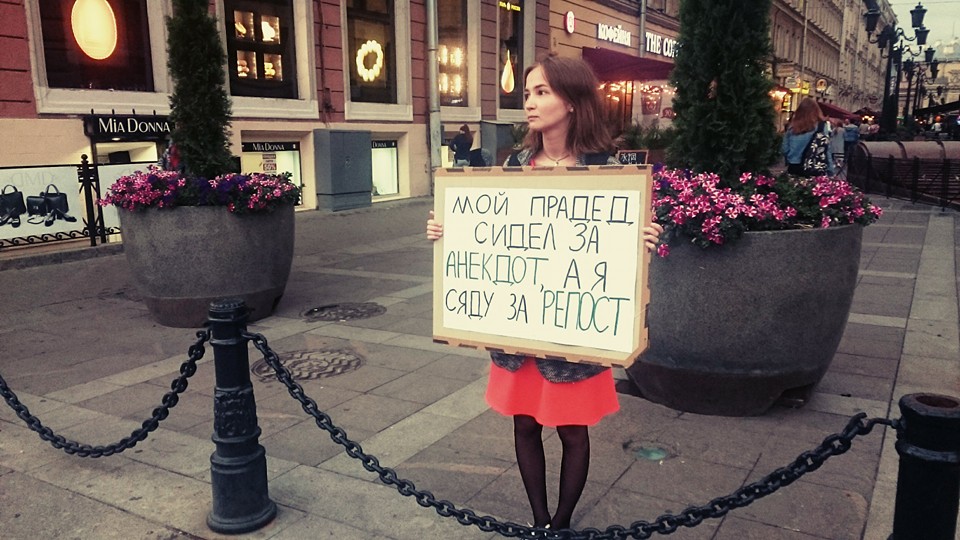
Aleksandra Ermilova and I summarized the worst things about these amendments and went to Nevsky Prospect to hand out leaflets. Or rather, I handed out the leaflets, while Sasha stood holding a remarkable autobiographical placard [pictured, above].
This is what we wrote in the leaflets:
IF YOU DON’T INFORM YOU’LL GO TO JAIL
An article on non-informing has been added to the Criminal Code. “Failure to report a crime” will entail a sentence of up to one year in prison. This law applies to such crimes as terrorism, seizure of power, and attempts on the life of a public official.
ALL YOUR COMMUNICATIONS WILL BE SAVED AND READ
Monitoring of correspondence has been toughened. Records of all your telephone calls, SMS messages, and emails will be saved for six months, and the security forces will be provided with the means to decode encrypted communications.
YOUR PACKAGES WILL BE VETTED
Postal workers will now be obliged to search vigorously for prohibited items in our packages: money, narcotics, weapons, explosives, and “other devices that pose a threat to human life and health.”
YOU INVITED A FRIEND TO A PROTEST RALLY, YOU GO TO JAIL
The Criminal Code will now include an article on “inducing, recruiting or otherwise involving” someone in organizing a “riot.” The law stipulates a penalty of 300,000 to 700,000 rubles or a prison sentence of five to ten years.
YOU REPOST THE “WRONG” THING, YOU GO TO JAIL
The punishments for “extremist” entries, reposts, and comments on the web have been toughened. Despite the fact that freedom of speech is guaranteed by the Russian Constitution, you can now be fined from 300,000 to 500,000 rubles or sent to prison for two to five years for making certain statements. By the way, 369 people were convicted of “enciting hatred by means of the Internet” in 2015.
YOU’RE STILL A KID? YOU’RE GOING TO JAIL ANYWAY
14-year-olds will now be tried as adults not only for serious crimes but also for involvement in riots and non-informing.
Women in Petersburg Celebrated February 23 by Paving the Way to a Church with “Dead” Bodies Rosbalt
February 24, 2016
Photo courtesy of protest organizers
A protest action against discrimination and the [proposed decriminalization of] battery and homicide threats took place outside St. Nicholas Maritime Cathedral in Petersburg. Feminists thus marked Fatherland Defenders Day.
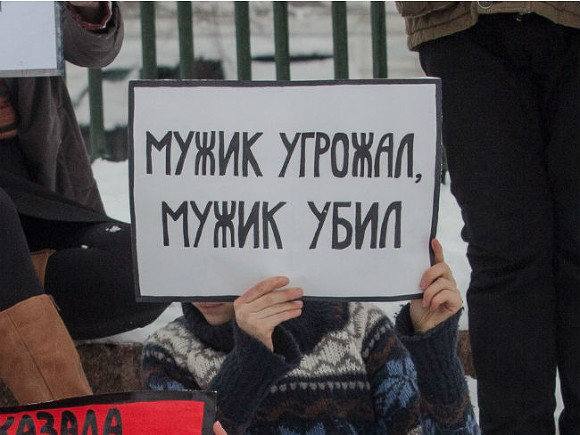
During the performance, two men laid out young women, who depicted the fatal victims of beatings, on the steps leading to the church. At the end of the protest action, the protesters raised placards bearing slogans such as “My man made threats, my man killed me,” “Who will defend us from the defenders of the fatherlands?” “I said no: he broke my arm,” “97% of abuse cases never make it to court,” and “Thank you, legislators, for our happy deaths.”
Photo courtesy of protest organizers“My man threatened me, my man killed me.” Photo courtesy of protest organizers
The organizers told Rosbalt they were protesting against the [proposed] removal of battery and homicide threats from the Russian Criminal Code.
“The decision as to whether women can find protection from law enforcement agencies or not is being made by legislators and priests who do not suffer from beatings by their partners. How is this possible? Do the lives and health of the country’s citizens not interest the government? Every fourth woman in Russia faces domestic violence,” the organizers noted.
According to them, it is extremely difficult for women to file battery complaints. And most often the perpetrator is not duly published: the charges are limited to a misdemeanor.
Whereas “women put up with violence their whole lives and often die at the hands of their partners.”
“We believe such a law is a crime,” noted the organizers.
Photo courtesy of protest organizer
The Way to the Church
Russian women marked February 23 by paving the way to a church with dead bodies.
The women were thus protesting the [proposed] exclusion of battery and homicide threats from the Criminal Code, a measure actively lobbied by the Russian Orthodox Church.
[President Putin] urged [lawmakers] not to delay passage of the law, which would decriminalize such articles of the Criminal Code as battery, homicide threats, and willful failure to pay alimony. (Kommersant, February 16, 2016)
Translated by the Russian Reader. Thanks to Comrade SJ and the Nihilist for the heads-up
__________
Russian Supreme Court proposes to decriminalize minor offences RAPSI
July 31, 2015
MOSCOW, July 31 (RAPSI) – Russia’s Supreme Court suggested decriminalizing minor offenses such as battery, the threat of homicide, failure to pay alimony or child support, RAPSI learnt in the court on Friday.
In a meeting with President Vladimir Putin, Supreme Court Chairman Vyacheslav Lebedev proposed that minor crimes such as battery and petty theft be decriminalized and classified as administrative offenses [misdemeanors]. He said this would reduce the number of cases sent to court by 300,000 annually.
A bill, which the Supreme Court has drafted, would decriminalize petty crimes such as battery, the use of forged documents, the threat of homicide and failure to pay alimony or child support. Penalties for these offenses would only include fines, correctional labor or community service.
Justice Vladimir Davydov said at the plenary meeting that this would free up half of all investigators to deal with serious crimes and would help over 300,000 people avoid criminal penalties and negative consequences for employment, education and the issuance of passports or loans.
A deputy prosecutor general said he supported the idea, adding that approval would allow investigators, who claim to be too busy with petty crimes, to investigate more serious crimes.
Petty crimes accounted for 46 percent of all cases sent to court last year.
__________
Putin suggests decriminalization of Russian Penal Code TASS
December 3, 2015
Russian President Vladimir Putin has asked Russian lawmakers to support a proposal to decriminalize a number of articles of the Russian Penal Code.
“I am asking the Russian State Duma to support the proposal of the Russian Supreme Court to decriminalize some articles of the Russian Penal Code and transfer some of the crimes that pose no great threat to the public or society to the category of administrative offenses but with one major reservation: the offense will be classified as a crime if it is committed for a second time,” Putin said in the annual state of the nation address to the Russian Federal Assembly (parliament) on Thursday.
The head of state clarified that practically every second criminal case, which is taken to court today, is linked to minor and inconsiderable offenses while people, including youth, are sent to prison.
“The confinement and the fact of criminal conviction affect their future fate and often encourage them to commit further crimes,” the president concluded.
Russian penitentiaries have around 660,000 inmates. According to the Federal Penitentiary Service, 55% of them are recidivists. Approximately 25% of the offenders serve prison sentences for minor offenses and crimes of medium gravity; 1,800 people have been convicted for terrorism and extremism.
Excessive acts of law enforcement agencies destroy business climate in Russia
Putin said excessive acts of law enforcement agencies destroy the business climate in Russia.
“That is a direct destruction of the business climate. I am asking the investigation and prosecution authorities to pay a special attention to it,” he said.
The President said that in 2014 nearly 200,000 criminal cases on economic crimes were initiated in Russia. Of this number 46,000 reached the court and 15,000 cases “collapsed” in courts.
“It turns out that only 15% of cases ended with verdicts,” Putin said.
He added that most of the defendants in these cases – about 83% – fully or partially lost their businesses.
“That means that there were bullied, robbed and released,” the head of state said.
He called on prosecutors to make a wider use of their authorities to monitor the quality of the investigation.
The president also recalled the discussions on additional powers of prosecutors.
Today, a supervisory authority has the authority to cancel decisions on initiation of criminal proceedings, to dismiss indictments or not to uphold the charges in court.
“We need to use what we have more intensively. After that we will be able to analyze what is happening in practice,” he said.
According to Putin, detention at the stage of investigation of economic crimes should be used as a last resort and preference should be given to such methods as pledge, subscription on parole and house arrest.
“One Must Serve the Motherland, I Say!” Basmanny District Court Extends the Arrest of Bolotnaya Case Suspect and Anti-Fascist Alexei Gaskarov
October 3, 2013
Yegor Skovoroda Russkaya Planeta
Alexei Gaskarov in court, June 26, 2013. Photo: Ilya Pitalyov / RIA Novosti
On Tuesday, October 1, Moscow’s Basmanny District Court extended until February 6, 2014, the arrest of Alexei Gaskarov, whom police investigators suspect of involvement in the “mass riots” on Bolotnaya Square on May 6, 2012. Gaskarov has been charged with violating Article 212, Section 2 (participation in mass riots) and Article 318, Section 1 (use of violence against authorities) of the Russian Federal Criminal Code.
February 6, 2014, is the date to which the investigation of the events on Bolotnaya Square has now been officially extended. Earlier this week, the court extended the arrests of the other defendants whose cases have not yet been submitted to the court. Ilya Gushchin, Alexander Margolin, Dmitry Rukavishnikov, Sergei Udaltsov and Leonid Razvozzhayev will also remain in pre-trial custody until February 6.
Another defendant, pensioner Elena Kokhtareva, has been released under her own recognizance. The case of Udaltsov and Razvozzhayev, whom investigators have accused of organizing the “mass riots” (a violation of Article 212, Section 1 of the Criminal Code), has been separated from that of the other defendants.
Investigator Alexei Chistyakov asked the Basmanny District Court to extend Gaskarov’s arrest for another four months, as the investigators have established that Gaskarov “used violence” against Igor Ibatulin, an officer with the Second Tactical Regiment of the Moscow Police, and a soldier by the name of Bulychev.
“In defiance of society’s moral norms, Gaskarov committed the crime in the presence of a significant number of people, taking advantage of numerical and physical superiority, and showing a clear disregard for the authorities. Moreover, his role in this case was particularly active and most aggressive,” Chistyakov read aloud to the court.
According to Chistyakov, Gaskarov presented a flight risk, since before his arrest “he did not live at his registered domicile, led a secretive lifestyle, spent the night at different locations and used various conspiratorial techniques.” Gaskarov should, therefore, be kept in a pre-trial detention facility.
During the hearing, Svetlana Sidorkina, Gaskarov’s lawyer, asked the court to enter character references submitted by the newspaper Zhukovskie Vesti and the Zhukovsky People’s Council into the record, as well as screenshots of a video recording from the case file. These stills show a police officer kicking Gaskarov in the face as Gaskarov lies on the ground.
Chistyakov and the prosecutor, Karasev, did not object to the character references being entered into the record, but they strongly objected to the shot breakdown of the video.
“The actions of law enforcement officers are not at issue in this hearing,” said Chistyakov.
Judge Artur Karpov, a man with a bald skull, agreed with their arguments and refused to enter the images into the record.
“And why is that you were found only partly fit for military service?” Judge Karpov asked, suddenly digressing from the tedious review of the case file.
“For medical reasons, but I can’t remember what exactly,” Gaskarov replied.
“How is it you don’t remember? Everyone remembers the reason they didn’t go into the army, but you don’t?”
“It was ten years ago. It had something to do with my eyesight, with intracranial pressure and something else. But now I just—“
“You just got over all those things? When did that happen? Before you turned twenty-eight?”*
“I wasn’t keeping track.”
“You weren’t keeping track. . . You should have served the Motherland,” the judge muttered.
“I wouldn’t object to serving in the army in exchange for being released from jail,” the defendant laughed.
“In exchange for working as a journalist?” After reading the character reference from the Zhukovskie Vesti newspaper, Judge Karpov had for some reason decided that Gaskarov works there. “One needs to serve in the army. Anyone can be a journalist, but probably not just everyone can serve the Motherland. Why this ‘in exchange for’ right off the bat? One must serve the Motherland, I say!”
Judge Karpov was unrelenting.
“Down in Dagestan, there is a waiting list to get into the army. Being a journalist is easy. You get up when you like, go to sleep when you like, go to work when you like.”
After this emotional outburst, lawyer Svetlana Sidorkina moved that the court change Gaskarov’s measure of restraint to one not involving deprivation of liberty—to house arrest or release on bail.
“Yes, I think this would be possible,” Gaskarov replied, smiling, to the judge’s question about what he thought about the motion.
Karasev and Chistyakov categorically stated that only if Gaskarov were in a pre-trial detention facility could the investigation proceed unhindered. Judge Karpov agreed with the prosecution on this point as well and, after a recess, ordered Gaskarov’s arrest extended until February 6.
When Gaskarov spoke to the court arguing against his arrest, Chistyakov sat motionless, his hands folded in front of him, like a sphinx.
_____
Alexei Gaskarov’s argument in the Basmanny District Court:
I do not agree with the extension of my arrest and wanted to draw attention to the following things. First, I am being charged with violating Articles 212 and 318. Article 318 belongs to the category of moderately severe crimes for which the period of pre-trial detention may not exceed six months. Article 212, which criminalizes “involvement in mass riots,” stipulates more stringent sanctions, up to a year in pre-trial detention. I have a copy of my indictment, dated April 28. As of today, there has been no other indictment. According to this indictment, all the [criminal] actions that the investigator has just listed were then deemed violations of Article 318 by him.
Since the extension the investigator is now requesting means that I will have spent nine months in detention, that is, more than the statutory period of six months, I do not agree with this extension.
With regard to Article 212, I would like to return to the question of the grounds for charging me with violating it. Because even if you go by my indictment in the case file, it turns out I am accused of participation in mass riots. However, if you look at Article 212 itself, it covers mass riots “attended by violence, pogroms, arson, the destruction of property, the use of firearms, explosives, or explosive devices, and also armed resistance to government representatives.”
There is also Article 8 of the Criminal Code, which clearly states that a deed can be deemed criminal if it is fully consistent with “all the elements” of a crime, as described in one or another article in the Code. Accordingly, not all the elements of the crime, as indicated in Article 212, are included in my indictment. The article does not say that only one element or half the elements are enough. “All the elements” must be present.
Furthermore, the investigation finds that there was violence, arsons, and pogroms there [on Bolotnaya Square on May 6, 2012], but I have not been charged with arson and pogroms. I have been charged only with violence against police officers. But Article 318 already covers these actions, and it is unclear how one and the same action can be deemed to constitute now one crime, now another.
On the other hand, if you look at the article dealing with mass riots, it does indeed say that resisting police officers is a constituent element of the crime, but there it stipulates that this must be armed resistance. But there is nothing in the charges brought against me indicating that I used a weapon or objects that could be used as a weapon.
I ask the court to take note of this indictment, because it serves as the grounds for the decision to extend or change the measures of restraint.
There are different sorts of evidence in the indictment and the criminal case file, but they only touch on Article 318, not Article 212. There is no clear indication there which of my actions could be deemed a violation of Article 212.
Moreover, why did we want to enter these photographs [of Gaskarov being beaten by riot police on May 6, 2012 — Russkaya Planeta] into the record? They simply indicate that the situation was quite complicated. The way the indictment is worded implies that if you see a uniformed police officer, he is absolutely within the law and cannot do anything illegal. By entering these photographs into the record, we want to show that the situation was complicated.
As for the actions committed there, I don’t even deny that I pulled one officer by the leg, and another by the arm. But only Article 318 covers all these actions. And so I ask the court not to extend [my arrest] for more than six months.
That is all I have to say.
* In Russia, men are subject to military conscription between the ages of eighteen and twenty-seven —Translator.