
Journalist and politician Yekaterina Duntsova, whose candidacy in the upcoming presidential election was rejected by the Russian Central Election Commission (the Russian Supreme Court later upheld this decision), released a New Year’s address on Instagram.
“I promise you that I will do everything that depends on me to return our country’s life to a normal direction without special operations and political crackdowns, with a government accountable to us that will work to grow the economy and improve the well-being of ordinary families,” she said, wishing that 2024 would bring Russians “self-confidence, long-awaited peace, and more basic human happiness.”
Duntsova said that the New Year is “when we live in peace with ourselves and our neighbors,” and people who are dear to us are with us, and not “somewhere far away, risking their lives performing missions whose purpose cannot be explained to us.”
Duntzova also promised that the new political party she announced earlier would be “an association of people who just want to live peacefully.”
Source: Deutsche Welle Russian Service. Translated by the Russian Reader. This post was made possible by a generous donation from Sumanth Gopinath.
On 27 December 2023, the Supreme Court of the Russian Federation dismissed the suit filed by Yekaterina Duntsova, a journalist from Rzhev, against the Russian Central Election Commission (CEC), which had refused to register Duntsova’s initiative group for collecting signatures in support of her run as an independent candidate for the Russian presidency.
Duntsova was thus practically left with no chance to run in next year’s presidential elections as an independent. DW has compiled all the most important facts we know about her.
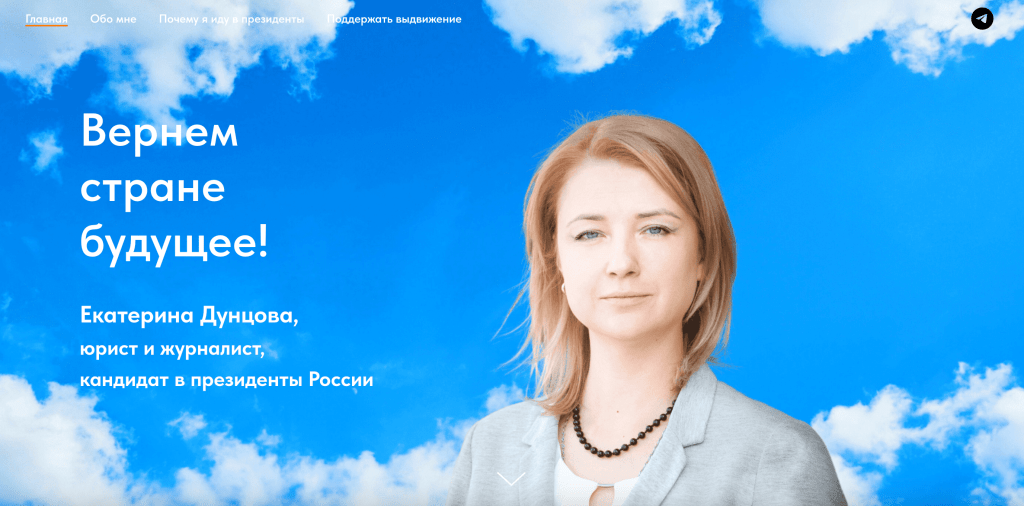
What we know about Yekaterina Duntsova
Ekaterina Duntsova is forty years old. She was born in Krasnoyarsk. She graduated from high school in Rzhev, Tver Region. She has two university degrees, in law and journalism. Duntsova studied law at Tver State University and also studied directing at the St. Petersburg State Institute of Cinema and Television. Russian state media note that she studied at both universities by correspondence.
Duntsova works as a journalist and is the coordinator of the Sova (“Owl”) volunteer search and rescue team in Rzhev. On the Web, many people refer to her as “radio operator Kat” — that’s Duntzova’s call sign on the team. Many liberal internet users have compared her with ex-Belarusian presidential candidate Svetlana Tikhanovskaya. State media have dubbed Duntsova “the fugitive oligarch Mikhail Khodorkovsky’s pet project.”
In 2003, Duntsova worked for about a year at the Rzhev municipal television company, then for many years headed the school television studio Friday the 13th and was editor-in-chief at RIT Independent Studio, a television company founded in 2003 by Duntsova’s husband Roman Nagoryansky. RIT closed in 2022. Duntsova has three children: two daughters and a son. The eldest daughter is studying in Tokyo. Duntsova and her husband separated in 2021.
In 2014, Duntsova ran as an independent for a seat in the sixth Rzhev City Duma but failed to win. Duntsova served in the seventh Rzhev City Duma, which sat between 2019 and 2022.
How Duntsova announced her run for the Russian presidency
On 16 November 2023, Duntsova announced on VKontakte that she would run as a candidate in the Russian presidential election and unveiled her campaign website, duntsova2024.ru. At the time of her nomination, she was the only woman to declare her desire to compete for the Russian presidency.
Duntsova’s candidacy was supported by Our Headquarters, a project created by the staff of Ark, a support group for Russians who have left the country over the war with Ukraine (in cooperation with the Russian Anti-War Committee). Posts about Duntsova’s nomination went out on many Telegram channels.
Duntsova explained her decision to run for president by arguing that “for the last ten years the country has been moving in the wrong direction: we have been pursuing a policy not of growth but of self-destruction.” Duntsova said she favors an end to the war in Ukraine, democratic reforms, and the release of political prisoners, particularly Alexei Navalny. “We have to abolish all inhumane laws and restore relations with the outside world. We have to change budget priorities by spending money on improving the lives of citizens, not on new tanks,” she noted.
At the same time, the journalist was cautious in her comments about Russia’s invasion of Ukraine. “Unfortunately, I cannot afford to delve deeply into this topic while I am in Russia,” she said. In order to remain on the right side of the law, she said that she would refer to the fighting in Ukraine as the “special military operation.” For the same reason, Duntsova declined to comment on the fate of the annexed territories in a future possible peace deal between Russia and Ukraine.
And yet, Duntsova argued that Russians should shed their “collective guilt complex.” She also avoided direct criticism of Vladimir Putin, stressing that she did not want to get personal, adding, however, that “it is possible to criticize the policies of the current government, it is possible to criticize certain laws and decisions made.”
Duntsova’s nomination campaign
On November 20, Duntsova was summoned to the prosecutor’s office in Rzhev to discuss the social media post about her intentions to run for the Russian presidency. “They asked what I thought about the [special military operation]. I invoked Article 51 of the Russian Constitution [which stipulates that no one is obliged to give evidence against themselves]. Apparently, they also wanted to find whether my intentions were real,” the journalist said at the time in a conversation with DW. In early December, Duntsova reported that VTB Bank had blocked transfers to her account after she appealed to supporters to back her campaign financially.
On December 20, Duntsova submitted the paperwork to the CEC to register her initiative group, which had to have at least 500 people. As an independent candidate, she also needed to gather 300,000 signatures in at least forty regions of the Russian Federation. The Central Election Commission had to review the package of documents and make a decision within five days. There were no grounds for refusing to register the initiative group, Duntsova argued.
However, on December 23, the CEC did not register the group, claiming that it had uncovered more than one hundred errors in Duntsova’s paperwork. As an example, it cited a document in which the patronymic “Valeryevna” had been written “Valerievna.” In addition, the CEC claimed that the notary who certified the documents, in particular, erroneously reported the [internal] passport number of the organizer of the initiative group’s meeting. Earlier, inspectors from Russian Justice Ministry paid this notary a visit.
On December 25, Duntsova appealed the CEC’s refusal to allow her to collect signatures in support of her campaign for the Russian presidency by filing suit with the Supreme Court. According to Duntsova, the CEC supported its arguments “solely with an internal memo. The law does not stipulate the use of such a document in principle, so it cannot be used as the basis for the decision.”
On December 27, the Russian Supreme Court dismissed the journalist’s lawsuit against the CEC, thus making it practically impossible for Duntsova to register as a candidate for the presidential election. Theoretically, she could ran as some party’s candidate. Duntsova has already called on the Yabloko Party to hold a congress and nominate her as their presidential candidate. The party responded that they do not nominate “random individuals about whom nothing is known.”
Duntsova said she intends to consider nominations from other parties as well. She also declared her plans to create her own political party: “The party I propose to create is not the Yekaterina Duntsova party. It will be the party of all those who are in favor of peace, freedom and democracy. My goal is to launch our self-organization [sic], which will be built around many new faces, around people who share our views. In the near future we will publish a program and work on it together.” Earlier, the journalist also spoke about her willingness to join forces with presidential contender Boris Nadezhdin.
Whose candidates have been nominated to run in the presidential election
The presidential election in Russia will be held 15–17 March 2024. The incumbent head of state Vladimir Putin is running as an independent. The Liberal Democratic Party of Russia (LDPR) nominated its leader Leonid Slutsky as a candidate for the highest state office. The Communist Party of the Russian Federation (CPRF) nominated Nikolai Kharitonov, while Civic Initiative nominated Moscow Region MP Boris Nadezhdin, and New People nominated State Duma deputy speaker Vladislav Davankov.
The conservative Russian All-People’s Union decided to nominate its leader Sergei Baburin as a candidate in the upcoming presidential election. In addition, a meeting was held in Moscow to nominate Igor Strelkov (Girkin), a reserve FSB colonel and former “defense minister” of the Donetsk separatists, who has been in pretrial detention since July 2023 on charges of calling for extremist activity. Strelkov’s initiative group gathered 566 signatures from nomination meeting attendees, but the notaries did not arrive to certify them.
Source: Natalya Pozdnyakova, “What you need to know about Yekaterina Duntsova, who wanted to become president of the Russian Federation,” Deutsche Welle Russian Service, 27 December 2023. Translated by the Russian Reader. This post was made possible by a generous donation from Sumanth Gopinath.
Independent Russian presidential candidate Yekaterina Duntsova will not be permitted to appear on the ballot in the March 2024 vote after the Central Election Commission (CEC) rejected her nomination documents.
Duntsova, 40, a journalist and local politician from the Tver region northwest of Moscow, announced her bid for the presidency in November on a pro-peace, pro-democracy platform.
This week, she secured the endorsement of an initiative group of more than 500 supporters as is required for candidates not running as part of a political party.
At a meeting Saturday, the Central Election Commission (CEC) rejected her documents, saying it found over 100 typos and other errors, the Ostorozhno Novosti Telegram news channel reported.
“We have carefully studied the documents, and we have the impression that they were filled out in haste without complying with legal standards,” the BBC’s Russian service quoted CEC member Yevgeny Shevchenko as saying at the commission’s meeting.
If the CEC had accepted her documents, she would have then needed to collect 300,000 unique voter signatures from at least 40 regions of Russia to be able to appear on the ballot.
Following the meeting, Duntsova said she plans to appeal the commission’s decision in court and intends to ask the liberal Yabloko party to nominate her as a candidate.
“I want us all to believe that we will be able to take another chance. Don’t lose faith, don’t lose hope,” she said.
Duntsova’s campaign has reported several instances of pressure since she announced her bid for the presidency.
She was summoned to the prosecutor’s office to discuss her campaign and attitude toward Russia’s actions in Ukraine shortly after announcing her campaign.
One of Duntsova’s supporters was detained in the Siberian city of Krasnoyarsk after returning from the nomination meeting, according to women’s activist group Myagkaya Sila (Soft Power). The supporter, who is also a member of Myagkaya Sila, was reportedly accused of falsely filing a complaint against a police officer.
She has also faced speculation that she could be a Kremlin-endorsed spoiler candidate.
The state-run RIA Novosti news agency claimed this week without evidence that Duntsova had the financial backing of Mikhail Khodorkovsky, a former oligarch turned exiled Kremlin critic.
President Vladimir Putin, 71, is expected to handily win re-election to a fifth term — keeping him in power until at least 2030 — in the March 2024 vote after the elimination of virtually all opposition.
“Yekaterina Sergeyevna, you are a young woman, you still have everything ahead of you. Any minus can always be turned into a plus. Any experience is still experience,” CEC chief Ella Pamfilova told Duntsova at the end of Saturday’s meeting.
Source: “Pro-Peace Putin Challenger Blocked from Ballot,” Moscow Times, 23 December 2023. This post was made possible by a generous donation from Sumanth Gopinath.


 “Precinct Election Commission for Polling Station No. 2218.” This is the innocent-looking sign the leviathan that has strangled democracy, including free elections, in Russia puts out to signal its presence. It achieves victory over earnest voters and honest election observers, some of whom valiantly serve on such commissions, by killing them with a hundred thousand cuts. Writ large, the flagrant tricks and shady practices used by neighborhood and local election officials add up to national elections that are rigged from top to bottom. Although this trickery has been well documented by independent observers, Russian reporters, and researchers, the sheer weight of it somehow has never made an impression on western journalists, who continue to write as if Putin’s popularity were a scientifically proven fact instead of carefully crafted mixture of massive coercion and hoodwinking. Photo by the Russian Reader