The Mote and the Beam

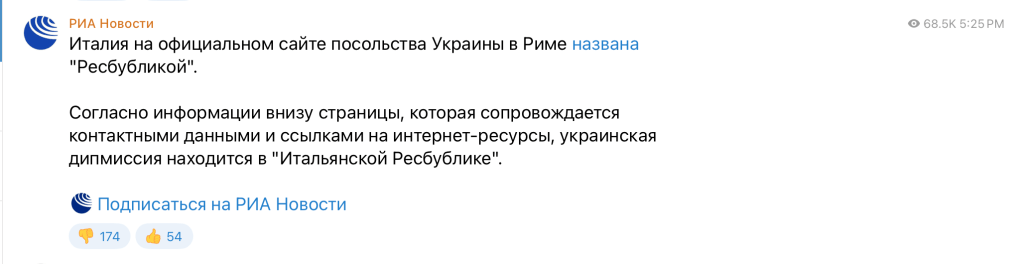
The same “gotcha!” news item (as below) on RIA Novosti’s Telegram channel

ROME, March 18 — RIA Novosti. Our correspondent has discovered that the Ukrainian Embassy in Italy has made a typo on its official website, misspelling the name of its host country.

According to the information at the bottom of the web page (which includes contact details and links to online resources), the Ukrainian diplomatic mission is located in the “Italian Rebublic.” The Italian word Repubblica is spelled with a b instead of a pRebubblica.

Source: “Italy referred to as ‘Rebubblica’ on official website of Ukrainian Embassy in Rome,” RIA Novosti, 18 March 2026. Translated by the Russian Reader


Anton, a 44-year-old Russian soldier who heads a workshop responsible for repairing and supplying drones, was at his kitchen table when he learned last month that Elon Musk’s SpaceX had cut off access to Starlink terminals used by Russian forces. He scrambled for alternatives, but none offered unlimited internet, data plans were restrictive, and coverage did not extend to the areas of Ukraine where his unit operated.

It’s not only American tech executives who are narrowing communications options for Russians. Days later, Russian authorities began slowing down access nationwide to the messaging app Telegram, the service that frontline troops use to coordinate directly with one another and bypass slower chains of command.

“All military work goes through Telegram — all communication,” Anton, whose name has been changed because he fears government reprisal, told POLITICO in voice messages sent via the app. “That would be like shooting the entire Russian army in the head.”

Telegram would be joining a home screen’s worth of apps that have become useless to Russians. Kremlin policymakers have already blocked or limited access to WhatsApp, along with parent company Meta’s Facebook and Instagram, Microsoft’s LinkedIn, Google’s YouTube, Apple’s FaceTime, Snapchat and X, which like SpaceX is owned by Musk. Encrypted messaging apps Signal and Discord, as well as Japanese-owned Viber, have been inaccessible since 2024.

Last month, President Vladimir Putin signed a law requiring telecom operators to block cellular and fixed internet access at the request of the Federal Security Service. Shortly after it took effect on March 3, Moscow residents reported widespread problems with mobile internet, calls and text messages across all major operators for several days, with outages affecting mobile service and Wi-Fi even inside the State Duma.

Those decisions have left Russians increasingly cut off from both the outside world and one another, complicating battlefield coordination and disrupting online communities that organize volunteer aid, fundraising and discussion of the war effort. Deepening digital isolation could turn Russia into something akin to “a large, nuclear-armed North Korea and a junior partner to China,” according to Alexander Gabuev, the Berlin-based director of the Carnegie Russia Eurasia Center.

In April, the Kremlin is expected to escalate its campaign against Telegram — already one of Russia’s most popular messaging platforms, but now in the absence of other social-media options, a central hub for news, business and entertainment. It may block the platform altogether. That is likely to fuel an escalating struggle between state censorship and the tools people use to evade it, with Russia’s place in the world hanging in the balance.

“It’s turned into a war,” said Mikhail Klimarev, executive director of the internet Protection Society, a digital rights group that monitors Russia’s censorship infrastructure. “A guerrilla war. They hunt down the VPNs they can see, they block them — and the ‘partisans’ run, build new bunkers, and come back.”

The app that runs the war

On Feb. 4, SpaceX tightened the authentication system that Starlink terminals use to connect to its satellite network, introducing stricter verification for registered devices. The change effectively blocked many terminals operated by Russian units relying on unauthorized connections, cutting Starlink traffic inside Ukraine by roughly 75 percent, according to internet traffic analysis by Doug Madory, an analyst at the U.S. network monitoring firm Kentik.

The move threw Russian operations into disarray, allowing Ukraine to make battlefield gains. Russia has turned to a workaround widely used before satellite internet was an option: laying fiber-optic lines, from rear areas toward frontline battlefield positions.

Until then, Starlink terminals had allowed drone operators to stream live video through platforms such as Discord, which is officially blocked in Russia but still sometimes used by the Russian military via VPNs, to commanders at multiple levels. A battalion commander could watch an assault unfold in real time and issue corrections — “enemy ahead” or “turn left” — via radio or Telegram. What once required layers of approval could now happen in minutes. Satellite-connected messaging apps became the fastest way to transmit coordinates, imagery and targeting data.

But on Feb. 10, Roskomnadzor, the Russian communications regulator, began slowing down Telegram for users across Russia, citing alleged violations of Russian law. Russian news outlet RBC reported, citing two sources, that authorities plan to shut down Telegram in early April — though not on the front line.

In mid-February, Digital Development Minister Maksut Shadayev said the government did not yet intend to restrict Telegram at the front but hoped servicemen would gradually transition to other platforms. Kremlin spokesperson Dmitry Peskov said this week the company could avoid a full ban by complying with Russian legislation and maintaining what he described as “flexible contact” with authorities.

Roskomnadzor has accused Telegram of failing to protect personal data, combat fraud and prevent its use by terrorists and criminals. Similar accusations have been directed at other foreign tech platforms. In 2022, a Russian court designated Meta an “extremist organization” after the company said it would temporarily allow posts calling for violence against Russian soldiers in the context of the Ukraine war — a decision authorities used to justify blocking Facebook and Instagram in Russia and increasing pressure on the company’s other services, including WhatsApp.

Telegram founder Pavel Durov, a Russian-born entrepreneur now based in the United Arab Emirates, says the throttling is being used as a pretext to push Russians toward a government-controlled messaging app designed for surveillance and political censorship.

That app is MAX, which was launched in March 2025 and has been compared to China’s WeChat in its ambition to anchor a domestic digital ecosystem. Authorities are increasingly steering Russians toward MAX through employers, neighborhood chats and the government services portal Gosuslugi — where citizens retrieve documents, pay fines and book appointments — as well as through banks and retailers. The app’s developer, VK, reports rapid user growth, though those figures are difficult to independently verify.

“They didn’t just leave people to fend for themselves — you could say they led them by the hand through that adaptation by offering alternatives,” said Levada Center pollster Denis Volkov, who has studied Russian attitudes toward technology use. The strategy, he said, has been to provide a Russian or state-backed alternative for the majority, while stopping short of fully criminalizing workarounds for more technologically savvy users who do not want to switch.

Elena, a 38-year-old Yekaterinburg resident whose surname has been withheld because she fears government reprisal, said her daughter’s primary school moved official communication from WhatsApp to MAX without consulting parents. She keeps MAX installed on a separate tablet that remains mostly in a drawer — a version of what some Russians call a “MAXophone,” gadgets solely for that app, without any other data being left on those phones for the (very real) fear the government could access it.

“It works badly. Messages are delayed. Notifications don’t come,” she said. “I don’t trust it … And this whole situation just makes people angry.”

The VPN arms race

Unlike China’s centralized “Great Firewall,” which filters traffic at the country’s digital borders, Russia’s system operates internally. Internet providers are required to route traffic through state-installed deep packet inspection equipment capable of controlling and analyzing data flows in real time.

“It’s not one wall,” Klimarev said. “It’s thousands of fences. You climb one, then there’s another.”

The architecture allows authorities to slow services without formally banning them — a tactic used against YouTube before its web address was removed from government-run domain-name servers last month. Russian law explicitly provides government authority for blocking websites on grounds such as extremism, terrorism, illegal content or violations of data regulations, but it does not clearly define throttling — slowing traffic rather than blocking it outright — as a formal enforcement mechanism. “The slowdown isn’t described anywhere in legislation,” Klimarev said. “It’s pressure without procedure.”

In September, Russia banned advertising for virtual private network services that citizens use to bypass government-imposed restrictions on certain apps or sites. By Klimarev’s estimate, roughly half of Russian internet users now know what a VPN is, and millions pay for one. Polling last year by the Levada Center, Russia’s only major independent pollster, suggests regular use is lower, finding about one-quarter of Russians said they have used VPN services.

Russian courts can treat the use of anonymization tools as an aggravating factor in certain crimes — steps that signal growing pressure on circumvention technologies without formally outlawing them. In February, the Federal Antimonopoly Service opened what appears to be the first case against a media outlet for promoting a VPN after the regional publication Serditaya Chuvashiya advertised such a service on its Telegram channel.

Surveys in recent years have shown that many Russians, particularly older citizens, support tighter internet regulation, often citing fraud, extremism and online safety. That sentiment gives authorities political space to tighten controls even when the restrictions are unpopular among more technologically savvy users.

Even so, the slowdown of Telegram drew criticism from unlikely quarters, including Sergei Mironov, a longtime Kremlin ally and leader of the Just Russia party. In a statement posted on his Telegram channel on Feb. 11, he blasted the regulators behind the move as “idiots,” accusing them of undermining soldiers at the front. He said troops rely on the app to communicate with relatives and organize fundraising for the war effort, warning that restricting it could cost lives. While praising the state-backed messaging app MAX, he argued that Russians should be free to choose which platforms they use.

Pro-war Telegram channels frame the government’s blocking techniques as sabotage of the war effort. Ivan Philippov, who tracks Russia’s influential military bloggers, said the reaction inside that ecosystem to news about Telegram has been visceral “rage.”

Unlike Starlink, whose cutoff could be blamed on a foreign company, restrictions on Telegram are viewed as self-inflicted. Bloggers accuse regulators of undermining the war effort. Telegram is used not only for battlefield coordination but also for volunteer fundraising networks that provide basic logistics the state does not reliably cover — from transport vehicles and fuel to body armor, trench materials and even evacuation equipment. Telegram serves as the primary hub for donations and reporting back to supporters.

“If you break Telegram inside Russia, you break fundraising,” Philippov said. “And without fundraising, a lot of units simply don’t function.”

Few in that community trust MAX, citing technical flaws and privacy concerns. Because MAX operates under Russian data-retention laws and is integrated with state services, many assume their communications would be accessible to authorities.

Philippov said the app’s prominent defenders are largely figures tied to state media or the presidential administration. “Among independent military bloggers, I haven’t seen a single person who supports it,” he said.

Small groups of activists attempted to organize rallies in at least 11 Russian cities, including Moscow, Irkutsk and Novosibirsk, in defense of Telegram. Authorities rejected or obstructed most of the proposed demonstrations — in some cases citing pandemic-era restrictions, weather conditions or vague security concerns — and in several cases revoked previously issued permits. In Novosibirsk, police detained around 15 people ahead of a planned rally. Although a small number of protests were formally approved, no large-scale demonstrations ultimately took place.

The power to pull the plug

The new law signed last month allows Russia’s Federal Security Service to order telecom operators to block cellular and fixed internet access. Peskov, the Kremlin spokesman, said subsequent shutdowns of service in Moscow were linked to security measures aimed at protecting critical infrastructure and countering drone threats, adding that such limitations would remain in place “for as long as necessary.”

In practice, the disruptions rarely amount to a total communications blackout. Most target mobile internet rather than all services, while voice calls and SMS often continue to function. Some domestic websites and apps — including government portals or banking services — may remain accessible through “whitelists,” meaning authorities allow certain services to keep operating even while broader internet access is restricted. The restrictions are typically localized and temporary, affecting specific regions or parts of cities rather than the entire country.

Internet disruptions have increasingly become a tool of control beyond individual platforms. Research by the independent outlet Meduza and the monitoring project Na Svyazi has documented dozens of regional internet shutdowns and mobile network restrictions across Russia, with disruptions occurring regularly since May 2025.

The communications shutdown, and uncertainty around where it will go next, is affecting life for citizens of all kinds, from the elderly struggling to contact family members abroad to tech-savvy users who juggle SIM cards and secondary phones to stay connected. Demand has risen for dated communication devices — including walkie-talkies, pagers and landline phones — along with paper maps as mobile networks become less reliable, according to retailers interviewed by RBC.

“It feels like we’re isolating ourselves,” said Dmitry, 35, who splits his time between Moscow and Dubai and whose surname has been withheld to protect his identity under fear of governmental reprisal. “Like building a sovereign grave.”

Those who track Russian public opinion say the pattern is consistent: irritation followed by adaptation. When Instagram and YouTube were blocked or slowed in recent years, their audiences shrank rapidly as users migrated to alternative services rather than mobilizing against the restrictions.

For now, Russia’s digital tightening resembles managed escalation rather than total isolation. Officials deny plans for a full shutdown, and even critics say a complete severing would cripple banking, logistics and foreign trade.

“It’s possible,” Klimarev said. “But if they do that, the internet won’t be the main problem anymore.”
Source: Ekaterina Bodyagana, “Inside the race to cut Russia off from the global internet,” Business Insider, 16 March 2026

Brazil

brazil.jpegJonathan Pryce and Terry McKeown in Brazil (1985). Courtesy of imdb.com

Authorized to Remain Silent
Why We Know Nothing about the Outcome of Most Criminal Cases and Verdicts against People Who, According to the Russian Secret Services, Planned or Attempted to Carry Out Terrorist Attacks 
Alexandra Taranova
Novaya Gazeta
April 27, 2018

High-ranking officials from the Russian Federal Security Service (FSB), the Russian Interior Ministry (MVD), and the Russian National Anti-Terrorist Committee (NAK) regularly report on the effective measures against terrorism undertaken by their agencies. If we add reports of constant counter-terrorist operations in the North Caucasus, especially in Dagestan and Chechnya, operations involving shootouts and the storming of houses, we might get the impression the level of terrorism in Russia is close to critical, resembling the circumstances somewhere in Afghanistan, the only difference being that Afghanistan does not have the FSB, the MVD, and the NAK to protect it.

Over the past two weeks, there were at least two such stories in the news.

A few days ago, the FSB reported it had “impeded the criminal activity of supporters of the international terrorist organization Islamic State, who […] had begun planning high-profile terrorist attacks using firearms and improvised explosive devices.”

The FSB’s Public Relations Office specified the terrorist attacks were to be carried out in goverment buildings in Stavropol Territory.

Earlier, TASS, citing the FSB’s Public Relations Office, reported that, since the beginning of the 2018, six terrorist attacks had been prevented (including attacks in Ufa, Saratov, and Ingushetia), while three crimes of a terrorist nature had been committed (in Khabarovsk Territory, Dagestan, and Sakhalin Region), and this had been discussed at a meeting of the NAK. Other media outlets quoted FSB director Alexander Bortnikov, who claimed that last year the security services had prevented twenty-five terrorist attacks, but four attacks, alas, had gone ahead.

For the most part, however, it is impossible to verify these reports, because, with rare exceptions, the terrorists, either potential terrorists or those who, allegedly, carried out terrorist attacks, are identified by name. Neither the Russian Investigative Committee (SKR) nor the FSB informs Russians about subsequent investigations, about whether all the terrorists and their accomplices have been rounded up. Likewise, with rare exceptions, we know nothing either about court trials or verdicts handed down in those trials.

Novaya Gazeta monitored reports about prevented terrorist attacks from November 2015 to November 2017. We analyzed all the media publications on this score: the outcome of our analysis has been summarized in the table, below. The veil of secrecy makes it extremely hard to figure out what reports merely repeat each other, that is, what reports relate to one and the same events, and we have thus arrived at an overall figure for the number of such reports. Subsequently, by using media reports and court sentencing databases, we have counted the number of cases that officially resulted in court sentences.

Most news reports about prevented terrorist attacks in Russia are not followed up. For example, at one point it was reported (see below) that five people with ties to Islamic State had been apprehended in Moscow and Ingushetia for planning terrorist attacks, and this same news report mentioned that a criminal case had been launched. But only the surname of the alleged band’s leader was identified, and he was supposedly killed while he was apprehended. There is no more information about the case. Over a year later, we have no idea how the investigation ended, whether the case went to trial, and whether the trial resulted in convictions and verdicts.

Other trends also emerged.

During the two-year period we monitored, reports about prevented terrorist attacks and apprehended terrorists encompassed a particular group of Russian regions: Moscow, Crimea, Petersburg, Kazan, Rostov, Baskortostan, Volgograd, Yekaterinburg, and Krasnoyarsk. When we turn to verdicts handed down in such cases, this list narrows even further. Rostov leads the country, followed by Crimea. There are two reports each from Krasnoyarsk and Kazan, and several isolated incidents. The largest number of news reports about terrorist attacks and acts of sabotage, i.e., 30% of all the reports we compiled and analyzed, originated in Crimea.

  FSB MVD NAK Russian Security Council (Sovbez)
Number of reports of prevented terrorists, November 2015–November 2017 3,505 reports (18,560 identical reports in the media) 1,702 reports

(3,571 identical reports in the media)

492 reports

(852 identical reports in the media)

236 reports

(1,122 identical reports in the media)

Outcomes: arrests, criminal charges, verdicts, etc. 13 verdicts,

14 arrests

3 verdicts,

2 arrests

2 incidents: in one case, it was reported that all the detainees had been killed; in the other, that the detainees awaited trial, but were not identified by name. It is impossible to find out what happened to any detainees, since no information was provided about them. The exception is Lenur Islyamov, who is currently at large and vigorously pursuing his objectives.

The Triumps of the Special Services with No Follow-Up
Here are the most revealing examples.

On November 12, 2016, RBC reported the security services had apprehended a group of ten terrorists, migrants from Central Asia. According to the FSB, they planned “high-profile terrorist attacks” in heavily congested areas of Moscow and Petersburg. Officials confiscated four homemade bombs, firearms, ammunition, and communications devices from the militants. The FSB claimed all the detainees had confessed to their crimes.

In the same news report, the FSB was quoted as having reported that on October 23, 2016 “there occurred an attack on police officers, during which two alleged terrorists were shot dead” in Nizhny Novgorod. The report stressed that, three days later, the banned group ISIL claimed responsibility for the attack, just as it had taken responsibility for an attack on a traffic police post in Moscow Region on August 18, 2016.

There were no names and no details. The outcomes of the investigations, the plight of the detainees, and judicial rulings were never made public, nor did state investigators or defense counsel share any information.

This same RBC article mentions that, four days before the alleged incident in Nizhny Novgorod, the SKR had reported the apprehension of an ISIL supporter who had been planning a terrorist attack at a factory in Kazan, while Interfax‘s sources reported the apprehension of a man who had been planning a terrorist attack in Samara.  It was also reported that in early May 2016 the FSB had reported the apprehension of Russian nationals in Krasnoyarsk who were “linked to international terrorist organizations and had planned a terrorist attack during the May holidays.”

No names were mentioned at the time. Later, however, details of the case were made public.

Thus, on April 7, 2017, Tatar Inform News Agency reported that the Volga District Military Court in Kazan had handed down a verdict in the case of Robert Sakhiyev. He was found guilty of attempting to establish a terrorist cell in Kazan. The first report that a terrorist attack had been planned at an aviation plant in Kazan was supplied by Artyom Khokhorin, Interior Minister of Tatarstan, during a meeting of MVD heads. According to police investigators, Sakhiyev had been in close contact with a certain Sukhrob Baltabayev, who was allegedly on the international wanted list for involvement in an illegal armed group. Using a smartphone, Sakhiyev had supposedly studied the plant’s layout via a satellite image.

On August 2, 2017, RIA Novosti reported that a visting collegium of judges from the Far East District Military Court in Krasnoyarsk had sentenced Zh.Zh. Mirzayev, M.M. Abdullayev, and Zh.A. Abdusamatov for planning a terrorist attack in Krasnoyarsk in May 2016 during Victory Day celebrations. Mirzayev was sentenced to 18 years in prison; Abdullayev, to 11 years in prison; and Abdusamatov, to 11 years in a maximum security penal colony. According to investigators, Mirzayev worked as a shuttle bus driver in Krasnoyarsk and maintained contact with Islamic State via the internet. Mirzayev decided to carry out a terrorist attack by blowing up a shuttle bus.

On January 26, 2017, TASS reported the police and FSB had identified a group of eight people planning terrorist attacks in Moscow in the run-up to State Duma elections. Oleg Baranov, chief of the Moscow police, had reported on the incident at an expanded collegium of the MVD’s Main Moscow Directorate.

We know nothing more about what happened to the “identified” would-be terrorists.

On January 31, 2017, RBC issued a bulletin that the Russian secret services had prevented an attempt to carry out terrorist attacks in Moscow during the 2016 Ice Hockey World Championships. The source of the news was Igor Kulyagin, deputy head of staff at the NAK. The militants were allegedly detained on May 2.

“We succeed in catching them as a result of a vigorous investigative and search operation in the city of Moscow,” the FSB added.

The names of the militants were not reported nor was there any news about an investigation and trial.

In the same news item, Mr. Kulyagin is quoted as saying, “In total, Russian special services prevented around [sic] 40 terrorist attacks, liquidated [sic] about [sic] 140 militants and 24 underground leaders, and apprehended about [sic] 900 people in 2016.”

According to Mr. Kulyagin, in Ingushetia on November 14, 2016, the authorities uncovered five militants who “had been planning terrorist attacks in crowded places during the New Year’s holidays, including near the French Embassy in Moscow.”

Again, the reading public was not provided with any names or information about the progress of the investigation. The only alleged terrorist who was identified was Rustam Aselderov, who had been murdered.

“According to the special services, [Aselderov] was involved in terrorist attacks in Volgograd in 2013 and Makhachkala in 2011.”

We have no idea whether an official investigation of his murder was ever carried out.

Lenta.Ru reported on February 1, 2017, that FSB officers in Krasnodar Territory had prevented a terrorist attack. The supposed terrorists had planned an explosion at New Year’s celebrations. A possible perpetrator of the terrorist attack, a 38-year-old native of a Northern Caucasus republic, was apprehended. No other particulars of the incident were reported, and they still have not been made public to this day.

On October 2, 2017, Russia Today, citing the FSB, reported an IS cell had been apprehended in Moscow Region. Its members has allegedly planned to carry out “high-profile terrorist attacks” in crowded places, including public transport. The FSB added that foreign emissaries had led the cell, whose members had included Russian nationals.

No names or details were subsequently provided to the public.

The same article reported that, on August 31, 2017, the FSB had apprehended two migrants from Central Asia, who had been planning terrorist attacks in congested places in Moscow and Moscow Region on September 1. RIA Novosti reported the same “news” in August 2017. The detainees were, allegedly, members of IS.

According to the FSB, one of the men had “planned to attack people with knives.” His comrade had planned to become a suicide bomber and blow himself up in a crowd. Supposedly, he had made a confession.

We know nothing about what happened to the two men and the criminal case against them.

On November 7, 2017, Izvestia reported MVD head Vladimir Kolokoltsev’s claim that a Kyrgyzstani national had been apprehended in the Moscow Region town of Khimki. The man had, allegedly, been planning to carry out a terrorist attack outside a subway station using a KamAZ truck. The detained man was not identified. We know nothing about what has happened to him or whether the investigation of the case has been completed.

Trials of Terrorists
On July 19, 2016, RIA Novosti reported the Russian Supreme Court had reduced the sentence (from 16 years to 15.5 years) of one of two radical Islamists convicted of plotting a terrorist attack in the mosque in the town of Pyt-Yakh in the Khanty-Mansi Autonomous Okrug. 

“The panel of judges has decided the verdict of the court, which sentenced Rizvan Agashirinov and Abdul Magomedaliyev to prison terms of 16 and 20 years, respectively, should be mitigated in the case of Agashirinov, and left in force in the case Magomedaliyev.”

On August 31, 2016, TASS reported the North Caucasus District Military Court had sentenced Russian national Rashid Yevloyev, a militant with the so-called Caucasus Emirate, to six years in a penal colony for planning terrorist attacks.

On February 15, 2017, Moskovsky Komsomolets reported the Moscow District Military Court had sentenced Aslan Baysultanov, Mokhmad Mezhidov, and Elman Ashayev. According to investigators, after returning in 2015 from Syria, where they had fought on the side of ISIL, Baysultanov and his accomplices had manufactured a homemade explosive device in order to carry out a terrorist attack on public transport in Moscow.

Baysultanov was sentenced to 14 years in prison; Ashayev, to 12 years, and Mezhidov, to 3 years.

On May 10, 2017, Interfax reported the North Caucasus District Military Court in Rostov-on-Don had sentenced ISIL recruiters who had been apprehended in Volgograd Region. The alleged ringleader, Raman Radzhabov, was sentenced to 4 years in prison after being found guilty of recruiting residents of Volgograd Region. His accomplices—Azamat Kurkumgaliyev, Gayrat Abdurasulov, Nurken Akhetov, and Idris Umarov—were found guilty of aiding and abetting Radzhabov, and given sentences of of 2 to 2.5 years in prison.

On May 30, 2017, RIA Novosti reported the ringleader of a failed terrorist attack in Kabardino-Balkaria, Adam Berezgov, had been sentenced to 7 years in prison. The defendant was found guilty of “planning a terrorist attack, illegally acquiring and carrying explosive substances or devices, and illegally manufacturing an explosive device.”

On July 27, 2017, TV Rain reported the Russian Supreme Court had increased by three years the sentence handed down to Ruslan Zeytullayev, who had been convicted and sentenced to 12 years for organizing in Crimea a cell of Hizb ut-Tahrir, an Islamist group banned in Russia. Zeytullayev’s sentence is now 15 years in prison.

On July 31, 2017, RIA Novosti reported the North Caucasus District Military Court had sentenced Ukrainian national Alexei Sizonovich to 12 years in a penal colony for involvement in planning a terrorist attack that was to have taken place in September 2016. The court ruled the 61-year-old defendant and an “unidentifed person” had, allegedly, established a group in Kyiv “for the commission of bombings and terrorist attacks in Ukraine and the Russian Federation.” It was reported the defendant “repented.”

On August 11, 2017, Lenta.Ru reported the North Caucasus District Military Court had sentenced 19-year-old Ukrainian national Artur Panov to 8 years in a medium-security penal colony for terrorism. Panov was found guilty of facilitating terrorism, planning a terrorist attack, and illegally manufacturing explosive substances. His accomplice, Maxim Smyshlayev, was sentenced to 10 years in a maximum-security penal colony.

At the trial, Panov pled guilty to calling for terrorism, and manufacturing and possessing explosives, but pled innocent to inducement to terrorism. Smyshlayev pled innocent to all charges.

On September 18, 2017, RIA Novosti reported a court in Rostov-on-Don had convicted defendants Tatyana Karpenko and Natalya Grishina, who were found guilty of planning a terrorist attack in a shopping mall. Karpenko was sentenced to 14.5 years in prison, while Grishina was sentenced to 9 years.

“The investigation and the court established Karpenko and Grishina were supporters of radical Islamist movements. […] From October 2015 to January 2016, the defendants planned to commit a terrorist attack in the guise of a religious suicide,” the Investigative Directorate of the SKR reported.

Fakes
On April 17, 2017, Memorial Human Rights Center issued a press release stating the case of the planned terrorist attack in the Moscow movie theater Kirghizia had been a frame-up. The human rights activists declared the 15 people convicted in the case political prisoners. It was a high-profile case. Novaya Gazeta wrote at the time that the MVD and FSB had insisted on pursuing terrorism charges, while the SKR had avoided charging the suspects with planning a terrorist attacking, accusing them only of possession of weapons in a multi-room apartment inhabited by several people who barely knew each other. It was then the case was taken away from the SKR.

Whatever the explanation for the trends we have identified, it is vital to note that Russian society is exceedingly poorly informed about the progress of the war on terrorism conducted by Russia’s special services, despite the huge number of reports about planned terrorist attacks. Due to the fact the names of the accused are hidden for some reason, and the court sentences that have been handed down are not made public in due form (even on specially designated official websites), it is impossible to evaluate the scale of the threat and the effectiveness of the special services, and to separate actual criminal cases from those that never went to court because the charges were trumped-up. Meanwhile, using media reports on prevented terrorist attacks for propaganda purposes contributes to an increase in aggressiveness and anxiety among the populace, who has no way of knowing whether all the apprehended terrorists have been punished, and whether this punishment was deserved.

Thanks to George Losev for the heads-up. Translated by the Russian Reader