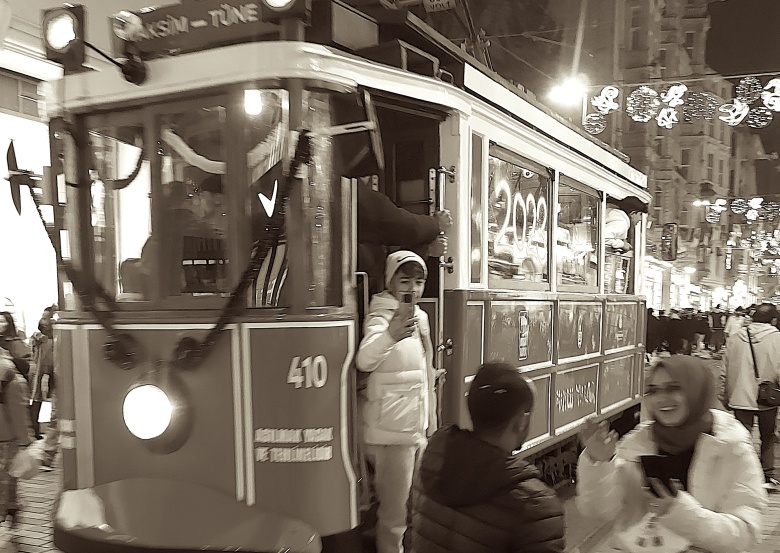
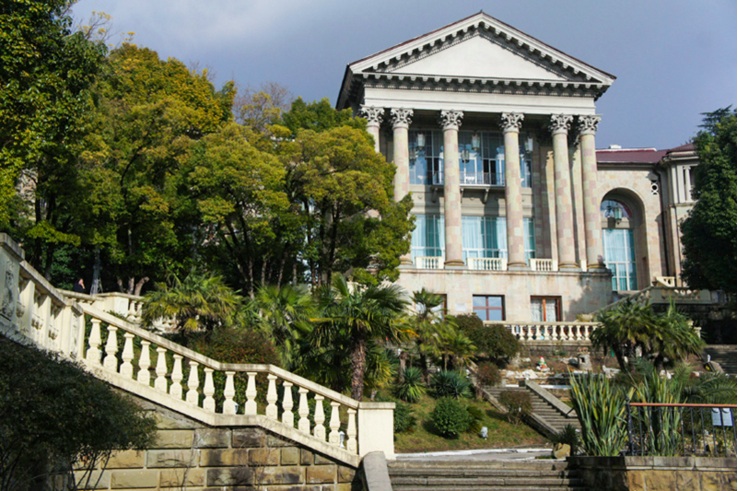
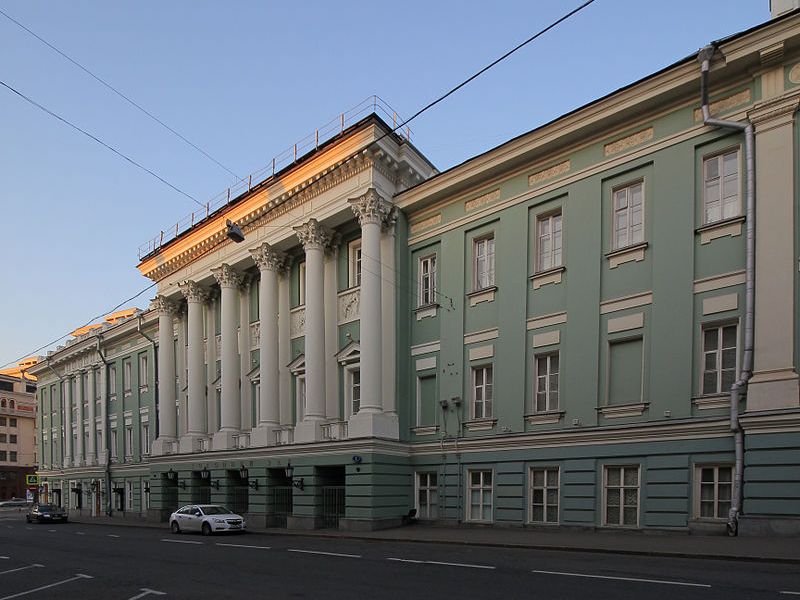
Istanbul, December 2022. Photo courtesy of Republic
[…]
500 vacancies for military registration specialists were advertised from late September to last December last year, according to HeadHunter. Previously, this specialization was considered a rather rare and generally not very sought-after profile in the personnel departments of Russian organizations (private and public). For comparison: only 145 such vacancies were advertised in the whole of 2021. The military mobilization has changed the situation: since September — that is, in just three months — the number of such offers on the labor market has increased by about two and a half times (Superjob’s data also show the same thing). The reasons? One of them (apparently, the main one) is an increase in fines for lapses in paperwork: to avoid them, employers are willing to pay applicants for the popular vacancy 70-80 thousand rubles a month. And this is despite the fact that there is a shortage of a number of other specialists on the labor market (and, presumably, they are no less valuable than SMO-era personnel officers). The number of vacancies on Avito Jobs alone, according to a recent company study, increased by 69% in 2022. Most likely, the trend will continue, serving as a natural continuation of the outflow of people and, ultimately, personnel.
50% — the percentage of last year’s sales of existing housing in the Russian Federation made through a notarized power of attorney. This record figure for the entire observable history of the market, as calculated by investment company Flip, who were commissioned by Kommersant, clearly indicates that the sales trend was primarily shaped by property owners who had emigrated. The high volume of such transactions seems to be an anomalous phenomenon. In 2021, a power of attorney was the basis for sale in no more than 20% of deals. In 2020, this figure was 15%. It was 8% in 2019, and 5% in 2018. You ain’t seen nothing yet, though: the ongoing controversy over whether to confiscate the property of openly anti-war Russians who have left the country must be making an additional contribution to the process of selling apartments and houses, which was gaining momentum as it was.
$81.69 billion — the total amount of deposits by Russian nationals in foreign banks as of the end of November of last year, according to the latest data from the Russian Central Bank. (4.989 trillion rubles were recalculated at the exchange rate in effect on that date.) Over the past eleven months, the amount has more than doubled — and this is even if we rely entirely on the statistics of the Central Bank, which may not have a complete picture of what is happening. (Russian laws oblige citizens to report when they open accounts in foreign banks and move funds in them, but we cannot be absolutely sure that everyone strictly obeys them.) While one part of these funds remains in these bank accounts, the other goes to the purchase of real estate that, for the most part, is also located outside the Russian Federation.
16,300 houses and apartments in Turkey were purchased by Russian nationals in 2022, according to data published by the Turkish Statistical Institute (TurkStat), as studied by RBC. This is not just three times more than in 2021 (when Russian nationals purchased 5,400 housing units in the Turkish Republic), but also more than the total volume of such transactions over the past six years (16,200). It is not surprising that last year, for the first time, Russians took first place among foreigners in buying housing in Turkey, producing almost a quarter of the corresponding demand with their money. Earlier, we wrote that our compatriots purchased two thousand houses and apartments in Turkey in October 2022 alone, overtaking all other foreign home buyers in that country, as reported by TurkStat.
At first glance, the advantages of investing in Turkey are not entire obvious. Inflation in the country, according to TurkStat, exceeded 84% in November, once again breaking records previously established in the autumn of 1998. The Inflation Analysis Group, an independent Turkish entity, estimated that inflation had reached a whopping 170.7% . In addition, prices for real estate, which have rising robustly, can at any moment just as vigorously drop, taking into account, in particular, the rather murky prospects for “Erdonomics,” depending on the results of the upcoming presidential and parliamentary elections. According to Endeksa, in September, the average price for one square meter of housing in Turkey was about 12 thousand Turkish lira (approx. $644), while the average price per housing unit was just over 1.5 million Turkish lira (approx. $83,700). The term of return on investment in housing is estimated at nineteen years, although in the summer this figure was recalculated to seventeen years.
The intense interest on the part of Russian nationals in buying real estate in Turkey is primarily related to the prospect of obtaining Turkish citizenship, Anna Larina, head of the foreign real estate department at NF Group, explained to Republic. (In turn, having a Turkish passport makes it possible to obtain an American E-2 visa, which speeds up the process of immigrating to the United States.) In this sense, it is logical that Russians have become leaders in terms of the number of residence permits issued in Turkey — 153,000, of which, however, as the Turkish Ministry of Migration clarified, 132,000 are short-term tourist residence permits, which are valid for two years.
Turkey is one of the few countries (but not the only country) that is still open to Russian nationals and their private capital. Thus, as 2022 came to a close, Russian citizens took first place among non-residents in buying real estate in Dubai, Bloomberg recently reported, citing figures provided by the brokerage firm Betterhomes.
Withdrawing funds and setting up a new life abroad eloquently testify to the sentiments prevailing among the Russian urban middle class, primarily. Not all people who sell Russian real estate and buy foreign real estate are necessarily irreconcilable opponents of the regime. And yet, it is clear that the vast majority of these people do not want to live and raise children in Putin’s version of the future, which is practically incompatible with modern civilization. In its own way, it is symptomatic that Russians who support the government and dutifully follow it into its deadly adventures are also dissatisfied with what is happening. If it were possible, they would rather return to the past, to a point in time thirty, forty, or fifty years ago.
63% — the percentage of Russians, according to a December poll conducted by the Public Opinion Foundation (FOM), who regret the collapse of the USSR — that is, more than three decades after the event known in Kremlin mythology as “the greatest geopolitical catastrophe of the twentieth century.” Strictly speaking, the current longing for Soviet times cannot be considered a record: after the August 1998 ruble default, there were noticeably more Russians nostalgic for the Soviet Union — 85%. Nevertheless, an important indicator of public attitudes (as recorded, we should underscore, by a quasi-state polling service) is on the rise again, having increased by twelve percentage points since 2011.
It is clear that this sentiment is primarily voiced by the 46–60 age group (88% of whom are “nostalgic”) and to some extent, people aged 31–45 years (79% of whom are “nostalgic”), assuming that a considerable portion of these people associate the late USSR with their happy childhoods and wild youths. However, according to the poll, even today’s Russian youth, that is, people aged 18–30, mostly (64%) consider the Soviet era “generally a good time.” Of course, their judgments are based on the stories of older generations, and most importantly, on the inevitable comparison with what is happening with the largest post-Soviet country right now.
“Peace, Labor, Putin.” The Federation of Independent Trade Unions of Russia (FNPR) has 22.7 million members, who annually pay out almost 68 billion rubles to fund their trade union associations. (The FNPR has 122 such affiliated organizations nationwide). At best, only 140 million rubles make it to Moscow. The rest stays at the local level. Photo courtesy of vestnikburi.com
An RBC Investigative Report: How Russian Trade Unions Make Money
Vyacheslav Kozlov RBC
April 29, 2016
The Federation of Independent Trade Unions of Russia (FNPR) will celebrate May Day with a march in support of workers. As RBC has found out, the budget of the country’s largest trade union organization runs in the billions of rubles, much of it earned from real estate it freely inherited from the Soviet Union.
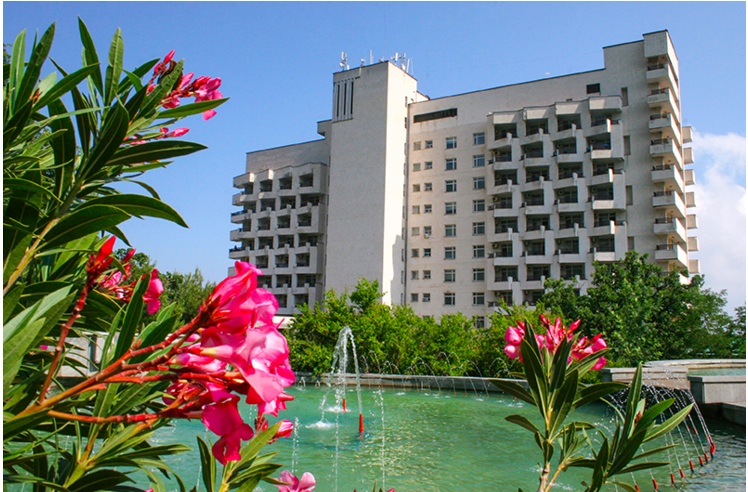
In February 2016, Crimea’s most famous resort got a new owner. The Foros Spa, right down the road from the residence where Soviet President Mikhail Gorbachev was held captive during the 1991 coup attempt, was purchased for 1.4 billion rubles by the Federation of Trade Unions of Tatarstan.
Even their bosses in Moscow could not understand where a little-known noncommercial organization from Kazan had got its hands on that kind of money.
“When we saw the news, we didn’t even reprint it at first. We called and checked whether it was true,” an employee at the FNPR’s central office told RBC. (The Federation of Trade Unions of Tatarstan is an affiliated member of FNPR.)
The folks in Kazan reassured the trade union bosses in Moscow. The organization, which is mainly funded by membership dues paid by workers, really did not have that kind of money. It had acted as a middleman in the purchase of Foros, getting the money from major regional companies.
“There are such companies there: KamAZ, Tatneft, petrochemical plants [part of the TAIF Group — RBC],” said FNPR leader Mikhail Shmakov, bending his fingers back as he listed off the companies.
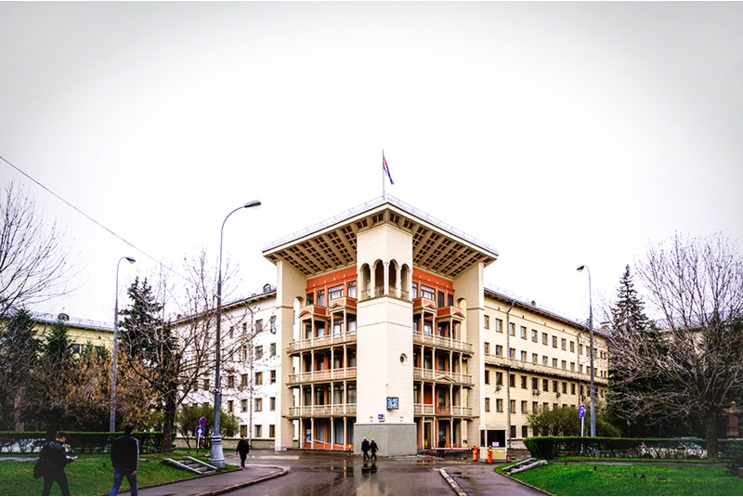
Shmakov spoke with RBC in his office on Leninsky Prospekt, 42, in Moscow. In keeping with Soviet tradition, the building is even nowadays called the Trade Unions Palace of Labor.
Ukrainian billionaire Igor Kolomoisky, who owned the property before the peninsula was annexed by Russia, could have insisted on imposing sanctions on the buyers of the famous Crimean spa Foros. The scheme for buying Foros, involving the Tatarstan trade unions, made the deal less risky, sources told RBC. The view, above, is of the government dacha Zarya (Dawn), where the coup plotters held Mikhail Gorbachev in 1991. Courtesy of Mikhail Pavlishak/TASS
Shmakov could not conceal his satisfaction with the deal, calling it “brilliant.” RBC’s source in the FNPR executive committee and another source, close to the Tatarstan government, said the scheme for buying Foros, involving trade union bosses, was employed so the real buyer would not end up on the sanctions lists of the European Union and the US.
“To act as a middleman in such deals you have to have good connections with the authorities and big business. They have to consider you one of their own. You have to be a loyal organization,” a source close to the FNPR leadership explained to RBC.
The FNPR has long been cooperating with the authorities and business. Heir to the All-Union Central Council of Trade Unions (VTsSPS), the federation is proud of the fact it is the largest labor union in Russia, with 122 affiliates and over 20 million members.
How does the country’s largest trade union organization make its money?
Budget
Despite its federal scale, the FNPR is an extremely closed organization. It does not publish financial statements.
“This information is available only to members of the executive committee, and even then documents containing specific figures are not distributed to everyone. Some are given documents without any figures,” said an employee in the central office.
RBC has obtained a document describing the FNPR’s budget in terms of percentages. From this document it follows that the federation has only two sources of income, membership dues and “other income,” a phrase that mainly conceals revenue from commercial operations.
FNPR chair Mikhail Shmakov (pictured above) has remained at the helm of the country’s largest trade union organization for all 25 years of its existence. Photo courtesy of Oleg Yakovlev/RBC
The document reveals that membership dues make up 70% of the FNPR’s revenues, while “other income” amounts to 30%.
Expenses are more complicated. 40.5% is spent on organizational and business operations, and 46.6%, on subsidizing FNPR institutions. Six percent goes to the so-called solidarity fund (for holding protests, paying wages of workers during downtime on the job, and making one-time payments to members involved in work-related accidents), while another 6.3% pays for dues in the international organizations of which the FNPR is a member, and 0.4% is spent on maintaing the auditing commission. In other words, nearly 90% of expenses go towards maintaining the organization itself.
Shmakov confirmed the income percentages in conversation with RBC. (He said nothing about expenses.) In 2016, the FNPR’s budget was 200 million rubles, according to Shmakov. An RBC source close to the Kremlin, who was well acquainted with the operations of the trade unions, confirmed that the FNPR’s annual budget was comparatively small.
“A few years ago, it did not exceed one million dollars,” he said.
The amount looks strange when you consider the number of people paying membership dues nationwide. The income of FNPR’s various affiliated trade unions, from factory locals to central committees, is incomparably greater than the parent organization’s budget.
Membership dues in most Russian trade unions are one percent of wages. If we take the official membership figures (according to Shmakov, the FNPR has around 20.7 million dues-paying members, plus another three to four million students and pensioners who do not pay dues) and the national average monthly wage (according to Rosstat, it was 33,900 rubles in February 2016), the dues paid by all FNPR-affilated trade unions should come to approximately 5.7 billion rubles monthly or 67.9 billion rubles a year.
But not all that money makes it to Moscow.
“The money is spread around the entire organization,” said an employee in the central office.
Locals keep from fifty to ninety-five percent of collected dues, explained our source. The rest is split among central and regional organizations.
How are these billions of rubles spent?
Expenditures
“Exempt trade unionists” is the Soviet-era legal term for trade union employees, from executives to secretaries, who are exempt from working directly at a particular enterprise. Their salaries are usually paid by the trade union itself. Trade union association executives surveyed by RBC confirmed that up to half of an organization’s budget can go to paying exempted workers. For example, the Pskov Federation of Trade Unions spent nearly 30 million rubles of its 2015 budget of 66 million rubles on the salaries and bonuses of over sixty exempt employees, says the federation’s head, Ulyana Mikhailova.
RBC asked the FNPR to provide it with the number of exempt employees nationwide but our request was turned down. Open sources mention the number of elected trade union officials. According to a 2011 FNPR executive committee decision, there were 13,500 such officials.
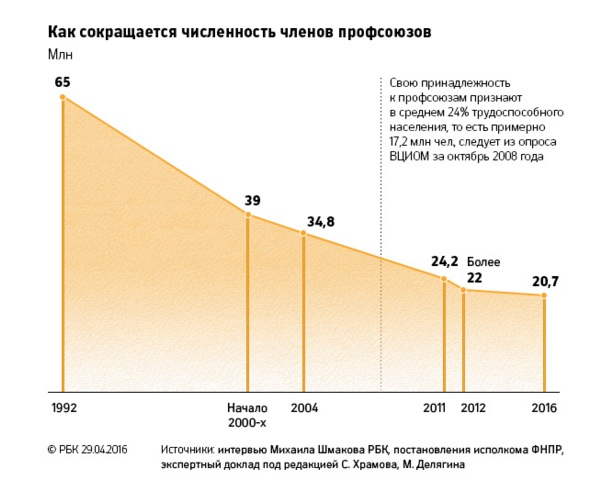
How Union Membership Has Declined. [According to the graph, union membership in Russia has declined from 65 million in 1992 (the first full year of independence) to 20.7 million in 2016. – TRR.] Sources: RBC interview with Mikhail Shmakov; decisions of the FNPR executive committee; white paper edited by Sergei Khramov and Mikhail Delyagin. Inserted text reads: “On average, 24% of the able-bodied population, i.e., approximately 17.2 million people, admit they are trade union members, according to an October 2008 poll conducted by the Russian Public Opinion Research Center (VTsIOM).” Courtesy RBC
But this is only a small part of the trade union army. According to figures for 2011, there were 191,000 trade union locals in Russia.
“At least one exempt worker emerges in a local with no less than three hundred members,” said Yuri Milovidov, director of Proftsentr, which assists trade union activists. “By my calculations, at least a quarter of these locals have at least one trade union worker. Some have several. There are fifty to seventy thousand such workers countrywide.”
A source in the FNPR executive committee said there were fewer trade union employees, around forty thousand. But even if we take this figure at face value, it turns out that the FNPR is one of the country’s major employers. (By way of comparison, AvtoVAZ, Russia’s largest auto manufacturer, employed around fifty thousand people as of late 2015.)
According to the FNPR employees surveyed by RBC, the average monthly salary among trade union employees is around 25,000 rubles, a little lower than the national average. The payroll bill for professional trade unionists across the country thus might be as much as one billion rubles a month.
Known as the Trade Unions Palace of Labor since Soviet times, the FNPR’s headquarters on Leninsky Prospekt in Moscow is of the most well-known pieces of real estate managed by the federation. Photo courtesy of Oleg Yakovlev/RBC
The exact number of employees in the FNPR central office is unknown. The federation declined to answer this question when asked by RBC. A source in the central office said there were no more than 120 employees. Another source said their salary was small but higher than the national average: around 60,000 to 70,000 rubles a month.
Shmakov declined to disclose his salary.
28 Kilometers from Moscow
In the village of Chigasovo, in an elite neighborhood on the Rublyovskoye Highway in the Moscow suburbs, there is a house and plot of land (516.2 square meters and 1,798 square meters large, respectively) owned by a Viktor Shmakov, which is the exact same name as that of Mikhail Shmakov’s son. The FNPR chair’s son does business. According to SPARK, he is the director of Art Mix LLC, which organizes celebrations and events. As ads on the real estate and property rentals website CIAN.ru indicate, several five-hundred-square-meter cottages sited on fifteen-acre plots in Chigasovo are valued at around 36 million rubles. Mikhail Shmakov forwarded our questions about the house and land’s ownership to the proprietor, as listed in the Unified State Register of Real Estates Rights and Transactions (EGPR).
The Russian Federation of Spas
The FNPR acquired property amid the turmoil of the early 1990s, when familiar institutions of Soviet power crumbled. It was then that the young trade union leader Mikhail Shmakov, previously employed as a rocket engineer, managed to gain standing among Russian leaders and head the new organization, which immediately declared itself the VTsSPS’s legal successor. In legal terms, its property was transferred to the FNPR in 1992 through a special agreement. This property is now the source of the “other income,” mentioned above, the revenues the trade unions generate from commercial operations.
The exact number of real estate properties and land plots that were donated to the FNPR is contained in the appendices to the 1992 agreement, which the federation keeps secret. During the twenty-five years of its existence, the agreement has never been published. (The FNPR also refused to provide a copy to RBC.)
Milovidov, who worked for the FNPR for many years, claimed that 2,582 properties were transferred to the federation: 678 health spas, 131 hotels, 568 stadiums, and over 500 Young Pioneer camps. It is unclear how many of these properties are still managed by the federation, but informally, sources there said the trade unions had lost around sixty percent of the property belonging to the VTsSPS when the Soviet Union collapsed.
According to Profkurort, the main trade union tourist agency, the trade unions now run exactly 374 resorts (health spas, boarding houses, vacation retreats, and children’s summer camps) in sixty-five regions from the Russian Far East to Kaliningrad.
The FNPR’s most profitable properties are in the southern Russia and Moscow. The trade unions particularly cherish their properties in the Caucasian Mineral Waters area. Their health spas account for over a quarter of so-called bed capacity among all the resorts in the area. Annually, they can take in 160,000 guests.
“Shmakov personally handles the Caucasian Mineral Waters. It’s his project,” RBC’s source in the federation’s central office explained.
To manage all its properties in the Caucasian Mineral Waters area, the federation founded Spa Management (Holding) LLC in 2005, which runs twenty-two health spas, including balneo baths and mud baths, mineral water drinking rooms, three boiler plant companies, a kindergarten, a library, a repair and construction company, and a car and truck pool. The federation’s share in the holding is nearly 85%, while over 15% belongs to the Stavropol Territory Association of Trade Unions, also affiliated with the FNPR. In 2015, the holding’s total revenue was 5.4 billion rubles, and its net profit was 294 millions rubles, Yulia Korogodova, Spa Management’s director, told RBC.
The FNPR’s other claim to fame are its hotels and health spas in Sochi. (According to RBC’s calculations, the FNPR and its subsidiaries own twenty-six buildings and seven lots there.) Sochi was the site of the FNPR’s biggest project in recent years, the reconstruction of three hotels for the Winter Olympics.
“Everyone was surprised that Shmakov had decided to get involved in the reconstruction of Sochi along with billionaires Vladimir Potanin and Oleg Deripaska, and other big businessmen. The authorities set them the harsh task of finishing in time for the Olympics at all costs, and this led to the fact that the poor FNPR was almost among the first to deliver its sites,” a source close to the federation’s central office told RBC.
Steelworker Spa in Sochi is one of three properties reconstructed by the FNPR for the 2014 Sochi Winter Olympics. The federation borrowed two billion rubles from Vnesheconombank to finance the work. The trade unions are now attempting to restructure their debt. Photo courtesy of PhotoXPress
The trade unions had no money of their own, said our source, so they took out a loan from state-owned Vnesheconombank, which was the main source of funding for the Olympic projects, another source close to the FNPR told RBC. Shmakov confirmed that there was a loan. RBC found out from Vnesheconombank that the funds had been allocated to three joint-stock companies: Adler Spa, Steelworker Clinical Spa, and Trade Union Spas (Svetlana Spa). These companies all manage trade union properties in Sochi.
According to Shmakov, the loan amounted to 1.5 billion rubles. Spa Management, however, clarified that 2 billion rubles had been borrowed. The total investment in the Olympic hotels was 2.7 billion rubles, according to Spa Management, although they did not explain the source of the additional 700 million rubles. Shmakov said the FNPR was forced to put up Adler Spa as collateral for the loan. He confirmed that all revenues from the reconstructed hotels now have to go towards paying off the loan. In the current circumstances, however, the FNPR would rather not have to pay. According to sources at Vnesheconombank, the FNPR has sent them a request to restructure the loan.
Vnesheconombank’s money was used to rebuild the Svetlana Health Resort as the Sea Galaxy Hotel Congress & Spa and renovate the Steelworker Spa and one wing of the Adler Spa. There are 690 beds in the 18-story Sea Galaxy. In high season, a standard single room, according to the hotel’s price list, costs 5,300 rubles a night. In 2014, Profkurorty (Svetlana Spa) JSC, which manages the reconstructed hotel, recorded revenues of nearly 197.3 million rubles and a net profit of over 178.6 million rubles.
The ownership of trade union real estate is extremely confusing and opaque. Without engaging in commercial operations itself, the FNPR has founded dozens of companies to manage its properties nationwide. (The Krasnodar Territory Trade Unions Council alone has registered 74 subsidiaries at various times.) However, as analysis shows, many of the spa companies in the Caucasian Mineral Waters areas and Kuban are closed organizations: over thirty of them are closed joint-stock companies, while the rest are private legal entities. From 2010 to 2014, these companies earned nearly 45 billion rubles.
From One Funeral to the Next
In late June 2015, the latest memorial service took place in the House of the Unions on Bolshaya Dmitrovka in Moscow, a building that belongs to the trade unions. People came to pay their last respects to former Russian Prime Minister Yevgeny Primakov. Even President Putin attended the ceremony. Almost three weeks later, Alexander Bulgakov, perennial director of the House of Unions, was arrested by police investigators right in his office, next door to the State Duma.
The Investigative Committee reported that Bulgakov had been detained as he was receiving 308,000 rubles from the director of another commercial entity, House of the Unions Refreshments LLC. Allegedly, Bulgakov had extorted the money, which was ten percent of the cost of the banquets and receptions catered by House of the Unions Refreshments. A year later, Bulgakov was sentenced to four years in prison.
The House of the Unions, adjacent to the State Duma building in Moscow, has long been considered the country’s primary venue for paying last respects to famous politicians and public figures. Along with the Trade Unions Palace of Labor, it is the most popular architectural landmark belonging to the trade unions. Photo courtesy of Wikipedia
An RBC source, close to the FNPR, did not rule out a link between the two events, the memorial service for Primakov and Bulgakov’s arrest.
The service’s organizer, the Presidential Property Management Directorate, was, allegedly, displeased with the original fee Bulgakov had asked for holding the ceremony, said the source. (According to the state procurements site, the event’s final cost was 1.222 million rubles.) Complaints against Bulgakov were made to law enforcement authorities. RBC’s source in the FNPR’s central office confirmed he had heard this hypothesis.
Shmakov also acknowledged he had heard the story about dissatisfaction with the price of the memorial service, but he said it was not confirmed in the end. According to him, when negotiating the arrangements for Primakov’s service, Bulgakov had quoted the usual rate for such an event.
“It all started with the memorial service for Shvetsova [former State Duma deputy and former Moscow deputy mayor Ludmila Shvetsova — RBC]. It cost four million rubles. Moscow city hall paid this money, because that is how much such events cost. It was this price that he [Bulgakov] offered,” Shmakov said now.
Like most of the trade union properties in the capital, the House of the Unions belongs to the Moscow Federation of Trade Unions (MFP), which is part of the FNPR. The MFP also owns the Izmailovo Hotel Complex, Krylatskoye Velodrome, Znamensky Brothers Olympic Center, Trud Swimming Pool, Sokolniki and Peredelkino Spas, and Planernaya Olympic Center in Khimki.
The Izmailovo Commercial and Hotel Complex in Moscow is trade union property like, for example, the Sputnik Hotel on Leninsky Prospekt. In contrast to the Sputnik, however, which is owned directly by the FNPR, the Moscow Federation of Trade Unions holds the controlling stake in the Izmailovo complex. Photo courtesy of top10hm.net
The most profitable asset in Moscow is the Izmailovo Hotel Complex. The Moscow Trade Unions Property Fund owns 75% of the shares in Izmailovo Commercial and Hotel Complex JSC, which manages the Gamma, Beta, Delta, and Vega buildings, while the FNPR holds a seven-percent share. (The remaining shares are owned by members of the board of directors.)
In 2014, the total revenue generated by the hotels in the Izmailovo holding was over 3.25 billion rubles, with a net profit of over 240 million rubles. The MFP wholly owns the Alpha Commercial and Hotel Complex, which manages one more of the Izmailovo hotels, which is not part of eponymous joint-stock company. In 2014, Alpha’s gross profits were over 770 million rubles; its net profits, over 33 million rubles.
The FNPR does not own so much property directly in Moscow. It owns the Trade Unions Palace of Labor on Leninsky Prospekt, where the organization has its central office; the nearby Sputnik Hotel; a motorpool near Kaluzhskaya subway station; the building of the Academy of Labor and Social Relations, in western Moscow; and its own tailor’s shop and primary care clinic.
At Public Expense
People who began their careers in Soviet times know the terrifying sounding word sotsstrakh (“social insurance”). These were payments made by the Social Insurance Fund (FSS), which was managed by the trade unions until the early 2000s. Sotsstrakh paid for children’s trips to Young Pioneer summer camps, and for workers and pensioners to go to health spas. Then the FSS was taken over by the state, but the health spas were left to the trade unions, providing them with yet another way of making money.
“When the state lacks enough of its own health spas to provide treatment for everyone who has a legal right to it, it refers people to trade union spas,” explained Nikolai Murashko, director of the FNPR’s Spa Directorate.
Judging by public procurement records, government contracts are a serious source of revenue for the trade unions. Over a period of six years, from 2010 to 2016, FNPR’s Resort Holding implemented government contracts worth more than 4.8 billion rubles. During the same period, the spas owned by the Krasnodar Territory Trade Unions Council sold holiday packages worth a total of approximately four billion rubles.
The FNPR’s affiliated trade unions also make money on government contracts. The MFP and its member organizations, for example, were awarded government contracts worth more than 617 million rubles during the same six-year period. The Federation of Trade Unions of Saint Petersburg and Leningrad Region earned 242 million rubles, while the FNPR earned 32 million rubles itself.
What does the FNPR give the state in return?
A Necessary Organization
Shmakov had no doubt the federation fulfilled its main functions: protecting labor rights and controlling the propertied classes. For sixteen years, the government has convened a special tripartite commission for regulating social and labor relations. Government ministers, employers (e.g., the Russian Union of Industrialists and Entrepreneurs and Opora Russia), and trade unions officials sit at the same table. A Kremlin official, however, warned against exaggerating the commission’s role.
“The minutes from some of the meetings are long, but that is where it ends: in the minutes. The state conducts its own policy,” he said.
He was echoed by someone who had been involved in the meetings.
“A trade union that, for example, is capable of getting people onto the streets can have a real impact on social and economic policy. Because of this, when it comes to the FNPR’s bread-and-butter issues, pensions, for example, the federation finds it quite hard to pound its fist on the table and say things will be the way it says.”
Rosstat’s data suggests that while in the 1990s there were several hundred or even thousands of labor strikes recorded annually, the numbers slumped to several strikes a year in the 2000s. One of the causes was the tightening of procedures for striking, as described in the new Labor Code, which took effect in 2002. One of the authors of the new Labor Code was current State Duma deputy speaker Andrei Isayev, formerly a secretary of the FNPR.
“The law on strikes is prohibitive,” said Boris Kravchenko, chair of the Confederation of Labor of Russia (KTR).
The KTR, like a number of other independent trade unions, such as the locals at AvtoVAZ and the Ford plant outside Petersburg, emerged in the late 2000s as a counterweight to the the FNPR, which cooperates with the authorities.
The Kremlin appreciates the fact that the FNPR does not go on strike and cooperates with the United Russia Party. [Isayev is a member of the party’s general council — RBC.]
“The FNPR are constructive critics. The goal of certain other organizations is to get people protesting on the streets. The FNPR has a different stance: solving a problem before people take to the streets,” says an official in the presidential administration.
* * *
In May 2011, the FNPR was one of several organizations that joined together to establish the Russian People’s Front (ONF), headed by Vladimir Putin. The ONF is now the only public organization in Russia comparable to the FNPR in terms of numbers of regional offices. And, like the FNPR, the ONF does not disclose its budget.
With additional reporting by Mikhail Rybin, Anastasia Napalkova, Maria Zholobova, and Yevgenia Glazova.
Translated by the Russian Reader. Thanks to Sean Guillory for the heads-up. NB. Because of the sheer quantity of figures given in rubles in this article, I have foregone my usual practice of converting them into euros for ease of comprehension. Current and historical currency rate conversion tables, however, are eminently accessible on the web, so knock yourselves out. TRR