Zhenya Berkovich: “Rate This Year in Terms of Its Nineteenthirtysevenness”

Zhenya Berkovich
Open Telegram and keep up with the news.
Rate this year in terms of its nineteenthirtysevenness.
Take a look at it, at its wooden hands,
At its iron cheeks, splotched with new partings.
This is a theater being demolished, a theater in which there is neither audience nor actors.
This is a theater being demolished, a theater in which there are only fishes and corpses.
Take a look at it and set aside your New Year's fun.
Rate the extent of this city's Stalingraditude.
Wave to the harlequins, dragons, and princesses,
And look at it, monitor the process without blinking.
Hang on to it: it will be both lamentation and reward.
Preserve its shadow if you like.
On second thought, forget it.
The Mariupol Drama Theater

Source: “A work by theater director Zhenya Berkovich about the Mariupol Drama Theater, which was first bombed with people inside, and now is being demolished by the occupiers,” Salidarnast, 23 December 2022. Thanks to Imaginary Island for the suggestion. The images, above, were part of the original article. Translated by the Russian Reader


A video of a read-through of “Finist the Brave Falcon,” the play for which Russian theatrical director and poet Zhenya Berkovich was detained in Moscow earlier today on suspicion of “condoning terrorism.” Here is a link to a website where you can download the (Russian) text of the play, by Svetlana Petriichuk, who was also detained today. Thanks to Sergey Abashin for the heads-up.

Many have nearly forgotten the criminal case against the theater director Kirill Serebrennikov and his colleagues, who were tried several years ago. That affair was dubbed the Theater Case. Apparently, there will be another Theater Case in Russia: director Zhenya Berkovich (a former student of Serebrennikov’s, by the way) and playwright Svetlana Petriichuk have been detained in Moscow.

The criminal investigation is centered on the theatrical production Finist the Brave Falcon, which premiered in 2020. The play was staged as part of the theater project SOSO Daughters, which is run by Berkovich. It is based on the criminal trials of [Russian] women who married radical Islamists. They came to know the men online and, having never met them in person, went to live with them in Syria.

“Zhenya Berkovich’s staging of Svetlana Petriichuk’s provocative, documentary style play, tells the story of a Russian woman who befriends and is seduced by a member of an Islamic radical sect online, goes to Syria, marries him, and upon her eventual return to Russia is tried as a terrorist. In recent years, there have been hundreds, if not thousands of such cases in Russia, Kazakhstan and Uzbekistan. From what are these women running? What is driving them to abandon their friends, relatives, universities and workplaces for the promise of some shadowy paradise? All this takes place in the metaphysical space of the Russian fairy tale “Finist the Brave Falcon,” in which the heroine Maryushka seeks and cannot find her betrothed, the mysterious hero, whose face she has never seen and will never see, but is ready to sacrifice everything in order to meet him.”
[This annotation has been edited slightly to make it more readable.]

The Investigative Committee claims that the production “publicly justified terrorism,” which is a criminal offense per Article 205.2 of the Criminal Code and punishable by up to seven years in prison. The details of the case are still unknown. Berkovich and Petriichuk spent the entire day undergoing interrogation as witnesses in the case, and it had seemed that they might be released, but as of evening both were still in police custody.

Last year, Finist the Brave Falcon won two Golden Mask Awards—for best playwright and for best costumes. Costume designer Ksenia Sorokina handed over her award to Petersburg artist Sasha Skochilenko, who has been in jail since April 2022, charged with disseminating “fake news” about the Russian army. (Skochilenko is alleged to have replace price tags in a grocery store with information about the war.)

Zhenya Berkovich has also not made a secret of her anti-war views, including in her poetry. A collection of her poems was published in Israel earlier this month.

“Open Telegram and keep up with the news. / Rate this year in terms of its nineteen-thirty-seven-ness,” one of them begins.

According to Berkovich, her grandmother, the 88-year-old writer Nina Katerli, was worried about her granddaughter, even going so far as to tell her, “Zhenya, be quiet for a while.” Actually, the director explained that she had decided to stay in Russia, no matter what, because she had to take care of her sick grandmother.

“It is to a large extent a necessity, due to all sorts of family obligations,” Berkovich said in December. “If it were now a question of going to prison or taking care of my grandmother, then of course I would leave, because I wouldn’t be able to take care of my grandmother from prison. But right now this is not the choice I’m facing.”

“Zhenya Berkovich: Why I have stayed in Russia and how to go on living”:
Berkovich interviewed by journalist Liza Lazerson, as posted in on YouTube in December 2022 (in Russian)

This morning, the security forces searched Berkovich’s grandmother’s apartment. Berkovich and Petriichuk will spend the night at a temporary detention facility, and tomorrow a court will decide whether to remand them in custody or subject them to other restrictions.

Source: I Don’t Get It email newsletter (Mediazona), 4 May 2023. Translated by the Russian Reader
We Have Stricken the Word “Syria” from Our Vocabulary

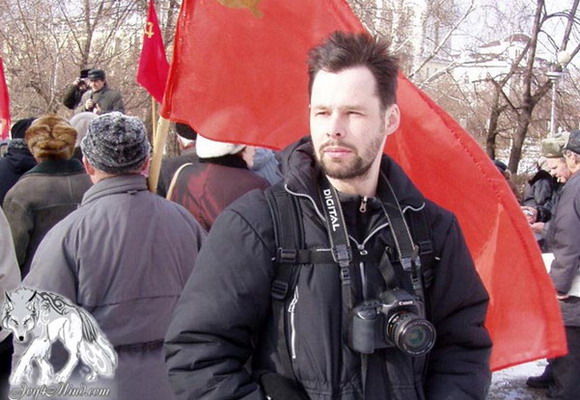
Alexei Kungurov. Photo courtesy of the New Chronicle of Current Events

Tyumen Blogger Sentenced to Two and a Half Years in Prison for Post on Syria
Anastasiya Yuditskaya, Dmitry Nosonov & Yegor Gubernatorov
RBC
December 20, 2016

A court has sentenced Tyumen blogger Alexei Kungurov to two and a half years in a work-release penal colony for “public justification of terrorism.” A LiveJournal post entitled “Who Putin’s falcons are really bombing” triggered the charges.

Tyumen blogger Alexei Kungurov was charged under Russian Federal Criminal Code Article 205.2.1 (“public calls for terrorism or public justification of it”). A visiting panel of judges from the Volga District Military Court found him guilty and sentenced him to two and a half years’ imprisonment in a work-release penal colony, Asiya Bayshikhina, Kungurov’s wife, has informed RBC.

“There is very little information right now. I know only he has been sentenced to two [sic] years in a work-release penal colony. Alexei was on his recognizance from February, but in June he was placed in a pre-trial detention facility. He has been in Pre-Trial Detention Facility No. 1 in Tyumen the whole time,” Bayshikhina told RBC.

Kungurov’s attorney, Alexander Zyryanov, told RBC the defense planned to appeal the verdict.

“We are going to lodge an appeal with the Military Collegium of the Supreme Court. We plan to do this at the beginning of next week. We have ten days to do it.”

Criminal charges were filed against Kungurov in March over a LiveJournal post, entitled “Who Putin’s falcons are really bombing,” in which the blogger criticized the actions of the Russian armed forces in Syria.

In August, the Prosecutor General’s Office reported that terrorist crimes had increased by 73% in the first six months of 2016 compared to the same period last years. The office reported then that it had solved a total of 1,313 terrorist crimes and 830 extremist crimes.

Deputy Prosecutor General Alexander Buksman noted that the increasing numbers of such crimes were “the outcome of preventive work by law enforcement agencies in surveilling the Internet for banned publications and bringing to justice leaders and members of the armed underground in the North Caucasus and their accomplices, and persons who are fighting in Syria as part of terrorist groups.”

Translated by the Russian Reader

The Testimonial Imperative

Alexei Kungurov. Photo courtesy of the New Chronicle of Current Events

Amendment from “Yarovaya Package” Applied for First Time in Tyumen
FSB Asks Reporters to Help Prove Blogger Kungurov’s Guilt
Georgy Borodyansky
Novaya Gazeta
October 13, 2016

The FSB’s Tyumen Regional Office has asked a number of Urals region media to help it find evidence against blogger Alexei Kungurov, in particular, “to provide the investigation with articles of his that contain public insults to the authorities and other information worthy of the attention of law enforcement and regulatory authorities.”

The request could also be considered a demand. As Anton Yulayev, a reporter for Znak.com and one of the people who received the letter from the FSB, told Novaya Gazeta, the letter contains a reference to the legal norm obliging recipients to respond to it.

“Our lawyers are now trying to solve this dilemma: how to respond without harming Alexei, and in such a way that the FSB has no beef with us,” explained Yulayev.

The appeal made by the FSB’s Tyumen Region Office is a new legal norm [sic] introduced by the so-called Yarovaya package. Alexei Zyryanov, Kungurov’s attorney, explained the implications to Novaya Gazeta.

“Previously, you could ignore a letter like this, but now you can’t. Basically, the law has introduced criminal liability for the failure to inform,” said Zyryanov.

The liability is spelled out in Russian Federal Criminal Code Article 206.6, which entered into force on July 20, 2016. It says that “non-reporting of terrorist crimes” is punishable by a fine of 100,000 rubles or by up to one year in prison. If individuals know something about another individual who is planning to commit such a crime or has committed such a crime, but do not report their information to law enforcement agencies, they can be found guilty.

Blogger Alexei Kungurov has been held for five months in pre-trial detention facility on charges of “public justification of terrorism.” Investigators found evidence of such a crime in a post the blogger published on his LiveJournal page in October of last years. Entitled “Who Putin’s falcons are really bombing,” the post is still in the public domain.

On October 11, 2016, Tyumen’s Central District Court extended Kungurov’s arrest another two months, until December 15. Investigators motivated their request for the extension on the grounds that they had not managed “to carry all necessary [investigative] actions” over the previous four months. According to Zyryanov, they had not carried out any actions at all. They had been waiting the whole time for the outcome of the linguistic forensic investigation.

Why has the linguistic forensic investigation taken so long? Zyryanov surmises that the forensic experts were faced with a tough job: proving that Kungurov’s argument that Islamic State (an organization banned in Russia) “is hardly the most terrible and crazy [organization]” somehow justifies terrorism.

On October 13, the lead investigator informed the lawyer that the findings from the forensic examination had finally arrived.

“I haven’t examined them in detail yet,” said Zyryanov, “but the conclusion is predictable: there is evidence of a crime in Alexei’s article.”

It would have been difficult to hope for another outcome, because the forensic examination was performed by a bureau of the very same agency that has charged the blogger, the FSB’s Sverdlovsk Regional Office, rather than its Tyumen Regional Office.

The results of another forensic examination are still pending. It will determine the originality of Kungurov’s article that, allegedly, “justifies terrorism,” whether it was written wholly by Kungurov, or whether he borrowed it, wholly or partly, from someone else. Then the case will be sent to trial, apparently.

Why do the secret services need the media’s help? According to Zyryanov, investigators do not have conclusive proof of Kungurov’s guilt, and they are attempting the shore up their case. But it is also possible the FSB has decided to test the new law out on the journalistic community by forcing independent periodicals, which can be counted on one hand in the Urals (the others simply could not afford to publish Kungurov’s articles), into giving “testimony.”

Translated by the Russian Reader. Thanks to Alexander Verkhovsky for the heads-up