“If the growth of anti-Americanism testifies to anything, then only to the success of Russian propaganda”
Olga Serebryanaya
February 19, 2015 online812.ru
There is a new trend on Facebook: folks complain to President Obama about the mess and collapse in Russia. Exemplary in this sense is a post written by Oleg Bulgak.
“Why the fuck, Mr. President, is there no seat on the toilet and no toilet paper in the only bathroom for younger visitors at Children’s Clinic No. 133 in northern Moscow? Have you shed your last shred of conscience back there in America? You are personally to blame for the fact the children have to climb onto the toilet bowl, although they could fall off it! Why are you taking such ingenious revenge on us? You make me mad, Barak Obama! Stop playing your little tricks!”
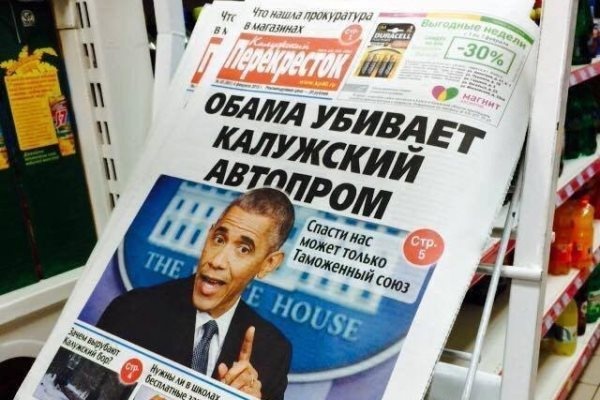
There are many such posts on Facebook, and yes, they are parodies, parodies by sane “outsiders” on the majority opinion, announced last week by Levada Center. According to the pollsters, 81% of Russians have a negative view of the US. Do I need to spell out the fact that if the growth of anti-Americanism testifies to anything, then only to the success of Russian propaganda?
The aim is clear: to shift attention from domestic to foreign issues. At first, this was done by means of a news agenda consisting wholly of events in Ukraine. Now, on the contrary, Russian events are served up only with a foreign connection.
“Environment Minister Sergei Donskoitold RIA Novosti that the insects destroying boxwoods and palms in Sochi could have been brought into the resort city deliberately on the eve of the Olympics. ‘We have asked the prosecutor general’s office to establish who introduced the pests. I would like law enforcement agencies to get to the bottom of it,’ said the minister.”
“[The project] is called ‘legalizing repression.’ The idea is inure the public to arrests ‘for treason.’ The arrestees will be weirdos, people around whom there is no consensus in society, and with whom the ‘majority’ finds it hard to identify. The guidelines suggest that the number of arrests that go public should be between twenty and thirty. Then the chief executive will come out and say that the excesses trouble him. […] After this statement, which will be widely publicized, within a month, approximately, the intensity of the arrests will increase tenfold.”
Rogov’s hypothesis is confirmed by the fact that the spy mania has already been substantiated historically. Literaturnaya gazeta made a breakthrough on this front last week. Responding to a question posed by a reader from Stavropol, Nikita Chaldymov, Ph.D., explained that Russia’s woes had begun with Peter the Great’s modernization. Peter badly tarnished the country’s mores, сaused the subsequent persecution of Russian scientist Mikhail Lomonosov, and cut out that very same window through which “crowds of foreign adventurers began infiltrating” Russia. How could it have happened? The answer is clear: the sovereign was switched with someone else during the Grand Embassy.
“Could the tsar, being an Orthodox man, have so quickly turned into an alcoholic and libertine who dispatched his wife to a convent and married a Baltic washerwoman?” Chaldymov asks readers.
It stands to reason the real Peter could not have done these things. Foreigners had planted a spy on the throne.
There is only one hitch with this spy strategy. Another question might occur to the reader from Stavropol. Who occupies the Kremlin now? The real president? Or, God forbid, a changeling?
Journalists at Petersburg Channel Five have endorsed the idea of a number of western leaders of moving the WWII Victory Parade to Poland.
In her program, TV presenter Nika Strizhak said that Russian tanks could easily reach not only Warsaw but also Washington.
According to the broadcast segment, it is only 1,300 kilometers from Moscow to Warsaw, so the T-90 tank could enter the suburbs in less than twenty-four hours. During this time, airborne troops, who need only two hours for redeployment, would be able to rehearse the parade, rest, iron their parade uniforms, and cook a festive meal of buckwheat porridge and stewed meat.
The TV journalists also reminded viewers that it is only 1,800 kilometers to Berlin: “For a modern army, that is no distance, all the more so because many Russian officers know their way around the city.” Well, and Prague, Helsinki, and Vilnius are all very close, so the Russian Army could go there on foot, the journalists added.
Channel Five also pondered more distant routes, such as London and Washington.
“Planning for them would have to be done well in advance, and here one cannot do without the air force and navy. But there is still time, and applications are being accepted,” it says in the segment.
The new Russia doesn’t just deal in the petty disinformation, forgeries, lies, leaks, and cyber-sabotage usually associated with information warfare. It reinvents reality, creating mass hallucinations that then translate into political action. Take Novorossiya, the name Vladimir Putin has given to the huge wedge of southeastern Ukraine he might, or might not, consider annexing. The term is plucked from tsarist history, when it represented a different geographical space. Nobody who lives in that part of the world today ever thought of themselves as living in Novorossiya and bearing allegiance to it—at least until several months ago. Now, Novorossiya is being imagined into being: Russian media are showing maps of its ‘geography,’ while Kremlin-backed politicians are writing its ‘history’ into school textbooks. There’s a flag and even a news agency (in English and Russian). There are several Twitterfeeds. It’s like something out of a Borges story—except for the very real casualties of the war conducted in its name.
[…]
“If previous authoritarian regimes were three parts violence and one part propaganda,” argues Igor Yakovenko, a professor of journalism at the Moscow State Institute of International Relations, “this one is virtually all propaganda and relatively little violence. Putin only needs to make a few arrests—and then amplify the message through his total control of television.”
[…]
Ultimately, many people in Russia and around the world understand that Russian political parties are hollow and Russian news outlets are churning out fantasies. But insisting on the lie, the Kremlin intimidates others by showing that it is in control of defining ‘reality.’ This is why it’s so important for Moscow to do away with truth. If nothing is true, then anything is possible. We are left with the sense that we don’t know what Putin will do next—that he’s unpredictable and thus dangerous. We’re rendered stunned, spun, and flummoxed by the Kremlin’s weaponization of absurdity and unreality.
Here is a tiny illustration of how reality really is up for grabs in the Kremlin’s increasingly hot “cold civil war” against Russian society and, now, the rest of the world:
As I stand in the courtyard of a Moscow arts and craft center, a dark-haired, 20-something woman turns to me and asks: “Is this the venue for the ‘Is Vladimir Putin God?’ lecture?”
She smiles nervously, seemingly worried that I’ll think she’s crazy.
She’s not. The title of the lecture is actually “Will Putin Become God by Divine Grace?” but I decide not to correct her. Instead, I nod and show her the way to one of the oddest events in the Russian capital this year.
The lecture took place on Sunday and was first advertised by well-known radical Russian Orthodox activist Dmitry Enteo on VK, the Russian version of Facebook. In the post, Enteo promised to reveal the answers to the following questions:
“Is it possible to bow down to Vladimir Putin as God on earth?
“Will Vladimir Putin’s will fuse with the will of God?”
“Will Vladimir Putin receive endless pleasure through the completeness of the knowledge gifted to him by God?”
Not surprisingly, the lecture stirred up controversy online, as some Internet users accused Enteo of blasphemy, while others suggested he’d lost his mind.
“Let’s get this straight, Dmitry,” one VK user wrote. “Do you believe Putin will sit at the right-hand side of God’s throne when he dies?”
“Possibly,” replied Enteo.
The lecture kicks off with a hip-hop track by an African rap duo now based in Russia. The title: “I Go Hard Like Vladimir Putin.” When the song ends, Enteo fiddles with his laptop until Putin’s face appears on the screen behind him.
The Orthodox activist then addresses the audience of roughly 80 or so Muscovites, an apparent mixture of curious hipsters and true believers. (There’s also a middle-aged man in a suit that a fellow journalist immediately suspects of being an agent of the FSB, Russia’s principal security agency.)
“I’ll keep it brief, in the style of the subject of today’s lecture,” Enteo says.
At times his voice is barely audible, but when he quotes Putin, he makes sure to speak louder.
The hipsters behind me erupt in ironic applause. Enteo presses a button on his laptop, and the photo of Putin is replaced by swirling psychedelic images and low-volume break-beats. He proceeds to read a poem by Vladislav Surkov, the mysterious Kremlin ideologue. The overall effect is an atmosphere reminiscent of a secret cult meeting held at a nightclub.
Enteo then takes us through the history of Putin’s apparent transformation from hard-nosed KGB officer to Orthodox Christian believer. “Putin realized that his goal in life was God, and the Almighty entered into the body of Vladimir Putin,” Enteo says. “Then Vladimir Putin began to do good deeds, like break up opposition meetings.”
At one point, the activist curiously declares: “We disappoint Vladimir Putin. While he tearfully prays for us at night, we smoke hashish.”
The lecture lasts about an hour, before Enteo builds on a final riff in which he determines that, yes, Putin will transform into a godlike being, and like all good Orthodox believers, eventually grow a beard.
After a brief Q&A, the crowd files out. “That was creepy,” says one attendee.
Others seem puzzled by the whole affair.
“It’s a response, in many ways an ironic one, to Putin’s de facto domination of everything from the economy to the media,” says Anna Arutunyan, author of The Putin Mystique, who attended the lecture.
“Most of it, of course, is just Enteo publicizing himself, but some of it is also taking what we see around us to its grotesque logical conclusion.”
Russians have a long history of venerating their leaders, from the reverence of the czars to the terrifying cult of personality that developed around Soviet dictator Joseph Stalin. While Enteo didn’t directly say that Putin was God, he felt comfortable posing the question, which shows just how powerful the Russian president has become.
Not everyone, of course, sees the hand of God in Putin’s politics. In Ukraine, where a Kremlin-backed separatist movement is slowly tearing the ex-Soviet state apart, the country’s spiritual leader, Patriarch Filaret, recently suggested the Russian leader was possessed by the devil.
“Like Judas, Satan has entered into him,” Filaret declared, as he accused Putin of turning the two Slavic countries against each other. “Like the first brother-killer, Cain, he has fallen under a demonic influence.”
Regardless of which side you take in the “Putin: God or Satan?” debate, it’s a remarkable development in the life of this former, low-ranking KGB operative. From serving the officially atheist Soviet state in Cold War-era East Germany to being compared to God and the devil, it’s been a long, strange road for Vladimir Putin. And it’s not over yet.
Dmitry Enteo, a Russian Orthodox activist known for his controversial and sometimes violent public stunts, will hold a lecture and roundtable Sunday in Moscow about President Vladimir Putin and his connection to God.
“You will understand the secret of secrets, after which your life will never be the same. You will receive direct answers to questions that face Russia today,” reads an advertisement for the event posted on the VKontakte social networking website.
One of the questions due to be addressed in the lecture is whether Putin will become God “by grace.”
As of Tuesday evening, 1,429 people had signed up for the event, according to the website.
Enteo is head of the God’s Will movement, which has earned notoriety for its public campaigns targeting what it sees as blasphemy against the Russian Orthodox Church.
In November, Enteo and a female accomplice disrupted a performance of a contemporary play based on Oscar Wilde’s “An Ideal Husband” at the prestigious Chekhov Moscow Art Theater. In an outburst that many audience members believed was part of the performance, they shouted that the play “mocks our faith” and admonished the audience for not protesting.
Enteo’s group has also previously assaulted LGBT activists and Pussy Riot supporters. They have never been charged by law enforcement agencies.
Here are four reasons why, despite my affection for Kirill Medvedev’s work, I found his recent appeal to the “intelligentsia,” the “youth,” and all other Russians of good will a little odd. He should be honest enough to know he is appealing to what is, increasingly, thin air. Fifteen years of Putinism have decimated “public discourse” and intellectual life in Russia, and now it seems the regime wants to finish the once-mighty Russian mind off once and for all.
Which is not to say that the pro-Putin “euphoria” described in the first two snapshots is not a stage-managed affair to a huge degree, as obliquely suggested by the fourth snapshot.
1. According to a survey published this week by the respected independent pollster Levada Centre, 82% of Russians believe MH17 was brought down by either a Ukrainian army fighter plane or missile. Just 3% thought the insurgents were to blame. Given these kind of figures, the prospect of Putin facing a backlash of public anger over suspected weapons supplies to separatist gunmen is virtually zero. Ironically, Putin probably faces more danger from Russians disappointed by his failure to provide more assistance to the rebels. “Many people feel cheated by his refusal to use military force [in east Ukraine],” Alexander Dugin, an ultranationalist thinker whose ideas are reported to have influenced recent Kremlin policy, told me recently.
Western officials may be hoping economic sanctions will force Russians to rethink their support for Putin, but in reality such measures will achieve little more than an entrenchment of a growing fortress mentality. State media’s routine and increasingly vitriolic attacks on the west’s “decadent” morals mean Russians are likely to accept any economic and social hardships brought about by US and European sanctions. Tellingly, in another Levada Centre poll this week, 61% of Russians said they were unconcerned by the threat of sanctions, while 58% were similarly unfazed by the looming possibility of political isolation over the Kremlin’s stance on Ukraine.
These head-in-the-sand attitudes are bolstered by what the director of Levada Centre, Lev Gudkov, calls a “patriotic and chauvinistic euphoria”rooted in the almost bloodless annexation of Crimea in March, which was popular among Russians across the political spectrum. It’s alsoworth noting that many “ordinary” Russians are uninterested in politics and have only scant knowledge of the issues at hand.
2. MOSCOW, July 31 (RIA Novosti) – Life satisfaction and social optimism indices in Russia skyrocketed, reaching all-time highs despite political challenges according to polls conducted by the Russian Public Opinion Research Center (VCIOM).
“Within the last three months, indices of social well-being have shown unprecedented growth, stabilizing at extremely high levels. In June the satisfaction index reached its all-time high of 79 points and the indices of financial self-assessment and social optimism, now at 76 and 77 points respectively, have also risen and stabilized at new highs,” says the poll.
The economic sanctions imposed by the US and EU over the crisis in Ukraine seem to have little effect on Russians. According to the polls, Russians are now far less concerned with the future of their country than they were last year.
The number of Russians who have not ruled out the possibility of a war with neighboring countries is now 23 percent of the population, up from just 10 percent last year. However, the number of those concerned about a Western military threat has held steady at 13 percent for the past eight years.
The VCIOM opinion poll was conducted in 2014, interviewing 1,600 respondents in 130 communities in 42 regions of Russia. Data are weighted by gender, age, education, working status and type of settlement. The polls have margins of error of no more than 3.4%.
3. It’s bad news for Russian bloggers, then, that starting today, anyone who attracts more than 3,000 daily readers to his blog is considered a de facto journalist and must register. (In a largely symbolic gesture, LiveJournal has already stopped reporting blog subscribers beyond the 2,500 mark.) Registration entails turning over your personal details to the government—including, of course, your name, meaning anonymous blogging is now illegal for many. (By the way, the law applies to any blog written in Russian for Russians; a post you write from a Brooklyn cafe could face censorship from Moscow.) Bloggers will also be held liable for any alleged misinformation they publish, even in comments written by somebody else. And, insult to injury, bloggers aren’t even allowed to use profanity; a single naughty word would put them in violation of the law. Failure to comply results in a $280 to $1,400 fine as well as a ban on your blog.
The new legislation represents a rather obvious attempt by the Russian government to shut down all criticism of the Kremlin, particularly from the left. The government has already granted itself the authority to shut down any website and used this power to crush popular left-leaning news sites. With this next step, the Kremlin clearly hopes to scare the smaller fish into complying with the official party line. And Russia’s insane Internet crackdown won’t stop with blogs: Starting in 2016, all websites that store data on Russian citizens will have to move their servers to Russian soil—a blatant attempt to assert control over social networks and search engines.
4. The application of [the new law on compulsory registration of NGOs receiving foreign funding as “foreign agents”] against scientific institutions, in fact, constitutes a professional ban on sociologists. Sociology that does not affect public opinion (directly or indirectly) is nonsense. Sociology that does not raise sensitive issues or suggest original answers that run counter to public opinion is intellectually bankrupt. Sociology that does not affect management decisions is as defective as governance that does not use the opportunities of independent social research. Sociology that is deprived of critical analysis of different “policies” loses connections with social science and turns into political technology. Sociology that does not succeed in the competitiveinternational research grant market is devoid of incentives for growth and is doomed to extinction.
In the modern world, any science that exists in isolation from the global context loses its ability to develop. All attempts to control global processes of scientific exchange only lead to the bureaucratization of science, the flourishing of pseudoscientific theories, and talented and open-minded scholars leaving the country. The persecution of independent researchers and research organizations puts an end to the development of a full-fledged scientific community and leads to the degradation of the humanities in Russia, which will ultimately result in a deficit of ideas and strategies for the future of our country.
The law on “foreign agents” is not the only sign of the long-standing crisis of the Russian administrative and political system. It is embedded in a series of decisions that aim to expand state control over various aspects of society and their submission to the bureaucratic logic of the “vertical” power. We can see this in the introduction of censorship and persecution of disloyal media, financial and administrative pressure on public (and especially human rights) organizations, the sterilization of historical memory (pressure on the “Memorial” and ”Perm 36”), criminal and administrative persecution for political reasons and independent (not controlled by the state) activism, dismissal of leading high school teachers for being disloyal touniversity superiors and many other cases. Self-censorship is booming in this society, for which survival has become the main motivation for its members. Overt or non-obvious subjection of one’s own activity to the goals of the “vertical” power is turning into the most effective model of behavior.
It is obvious for us that an independent social science is crucial for a society whose interests are not limited to maintaining stability and “unity” at any costs. An authoritarian state does not need reflection that a professional independent research can provide. It is satisfied with VCIOM polls and various ratings that allow the maintenance of “vertical” tension and promotion of “patriotism”. Such a regime will inevitably degrade and become obsolete, but during its heyday it manages to destroy much of what came before it and exists in spite of it.
We believe that the lack of interest towards the professional opinion of independent sociological community, which often oppose bureaucratic perspectives, points to the incompetence of the Russian administration. The pressure exerted on NGOs and non-governmental scientific centers indicates that the political administration of our country no longer needs feedback and has no interest in the actual state of affairs in Russia. This means it condemns our country to the harsh effects of unreasoned political and economic decisions.
From an interview with Russian federal deputy communications minister Alexei Volin, broadcast on the TV Rain program “Hard Day’s Night” yesterday:
TV Rain: Among [Russian] TV channels who provides an alternative viewpoint in your opinion?
Volin: Among the general access channels, probably no one provides a strongly alternative viewpoint due to the fact that they think about their ratings. A TV channel or mass media outlet that today adopts a unpatriotic viewpoint will simply be economically unsuccessful because the audience will turn away from it.
TV Rain: Excuse me, I seem to be a little confused about terms. We asked you about alternatives, but you talked about being unpatriotic. You mean that an alternative viewpoint is a priori unpatriotic?
Volin: I don’t have the slightest doubt about this.
(A transcript of the interview can be read, in Russian, on journalist Andrei Amalgin’s blog.)
__________
Deputy minister Volin is no stranger to brutal authoritarian “honesty.” This is what he said in his keynote address at a conference held at Moscow State University’s journalism department in February 2013:
A journalist is tasked with making money for those who hired him. And you can only do that by making your resource interesting for your readers, viewers or listeners. The question, then, is, Do mass media serve a propaganda function? Of course they do, to the extent their owners believe appropriate. […] Propaganda should not be obvious; propaganda should be hidden — then and only then can it be effective. We need to make it clear to students that when they leave this building, they are going to go work for The Man. And The Man is going to tell them what to write and what not to write, and how to write about this or that. And The Man has a right to do this because he is paying them. […] You may like what I have told you or not, but it’s objective reality. It’s life. And it’s not like you are ever going to see a different life.

 Alexei Volin. Photo courtesy of