Passing Through

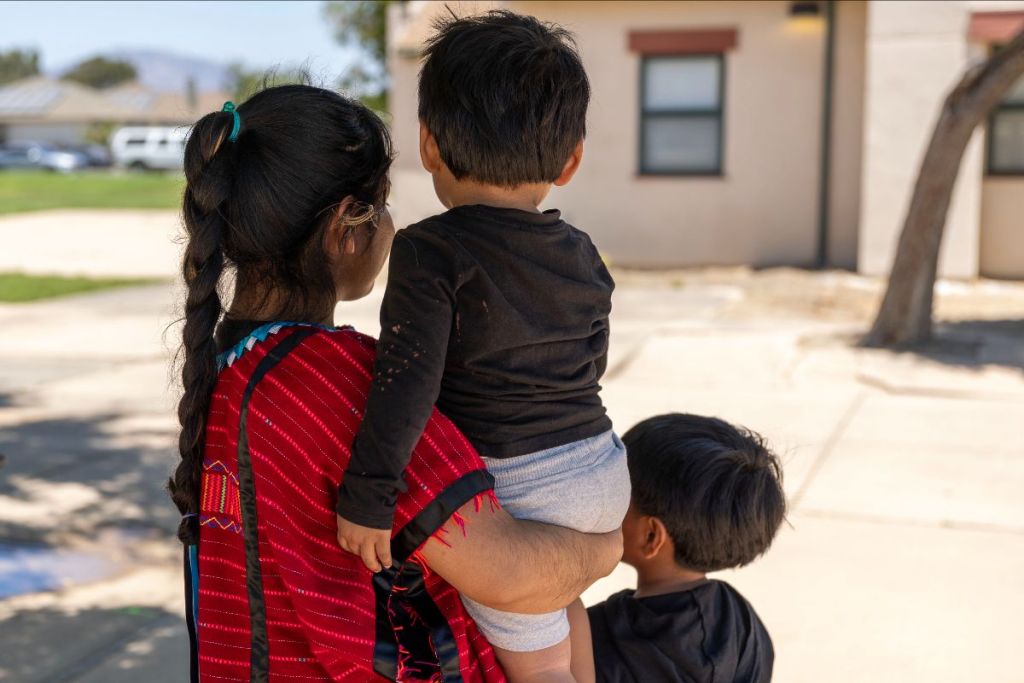
Isabel, a Triqui farmworker who lives in Greenfield, with her two sons. She and her husband prefer to keep their family close to home and are limiting their time outdoors because they fear an encounter with ICE agents could lead to the family being separated. Photo by Celia Jiménez.

Immigrants are living in fear. But this is nothing new in this country’s history.

Good morning.

Celia Jiménez here, thinking about the cover story I wrote for this week’s edition of the Weekly about immigration and how current policies have impacted people’s lives.

This story took me down memory lane. From my mom’s immigration story (she obtained her legal permanent residency during the Reagan Administration), to the anxiety and panic we felt in the early 2010s, when immigration enforcement was active in San Diego, to how outspoken people were about immigration before and during President Donald Trump’s first term when I was a student journalist at San Diego City College, this is on one level a personal story for me.

The latter is what strikes me the most. Why? Because in this country, freedom of speech is a quintessential element of our identity as a nation.

As a student journalist years ago, I interviewed students and professionals, many of them DACA recipients, and they were outspoken about the threats against the DACA program and their immigration status. Reporting on this story, I encountered the opposite. Several people, regardless of their immigration status, are afraid of retaliation or harassment. (As such, in the cover story, we protected the identities of those who trusted us with their stories and helped us uncover how the current immigration narrative is impacting their everyday lives.)

I find myself wondering if this country is moving forward, or falling backward into a past where immigrants and U.S.-born citizens were subjected to xenophobic policies.

Thousands of Japanese and Japanese Americans were locked up during World War II because they were considered a security threat. Over a million of Mexican Americans were deported to Mexico during the Great Depression during the so-called Mexican Repatriation. The reason? They were allegedly taking away resources and jobs from white Americans (sound familiar?).

Even now, people of color, especially Latinos, are being detained and reportedly racially profiled by ICE agents and some U.S. citizens have spent days to years incarcerated at a detention center.

These actions are the reason why everyone, whether you agree or disagree with the current immigration policies, should make sure the law is being followed every step of the way.

In announcing proposed immigration legislation, U.S. Rep. Zoe Lofgren, D-San Jose, pointed out that agriculture, the largest industry in Monterey County, would crumble without an immigrant workforce. “The Central Coast economy is rooted in agriculture. More than half the farmworkers are undocumented. If they are disappeared, the economy of this area will collapse,” she told me.

If you still don’t believe that, industry leaders can fill you in.

Immigrants are key individuals in our communities. This isn’t a personal belief, but a fact—and there is data to back it up.

-Celia Jiménez, staff writer, celia@montereycountynow.com

Source: Monterey County NOW newsletter, 10 August 2025


Passing Through
Stanley Kunitz

—on my seventy-ninth birthday

Nobody in the widow’s household
ever celebrated anniversaries.
In the secrecy of my room
I would not admit I cared
that my friends were given parties.
Before I left town for school
my birthday went up in smoke
in a fire at City Hall that gutted
the Department of Vital Statistics.
If it weren’t for a census report
of a five-year-old White Male
sharing my mother’s address
at the Green Street tenement in Worcester
I’d have no documentary proof
that I exist. You are the first,
my dear, to bully me
into these festive occasions.

Sometimes, you say, I wear
an abstracted look that drives you
up the wall, as though it signified
distress or disaffection.
Don’t take it so to heart.
Maybe I enjoy not-being as much
as being who I am. Maybe
it’s time for me to practice
growing old. The way I look
at it, I’m passing through a phase:
gradually I’m changing to a word.
Whatever you choose to claim
of me is always yours;
nothing is truly mine
except my name. I only
borrowed this dust.

About this Poem

“Passing Through” originally appeared in Next-to-Last Things: New Poems and Essays (Atlantic Monthly Press, 1985) and later in Passing Through: The Later Poems, New and Selected (W. W. Norton, 1995). In his 1995 introductory essay for Passing Through, Kunitz wrote: “Poets are always ready to talk about the difficulties of their art. I want to say something about its rewards and joys. The poem comes in the form of a blessing— ‘like rapture breaking on the mind,’ as I tried to phrase it in my youth. Through the years I have found this gift of poetry to be life-sustaining, life-enhancing, and absolutely unpredictable. Does one live, therefore, for the sake of poetry? No, the reverse is true: poetry is for the sake of the life.” 

Source: Poem-a-Day newsletter, 10 August 2025. Courtesy of poets.org (American Academy of Poets)
Know Your Rights: A California Story

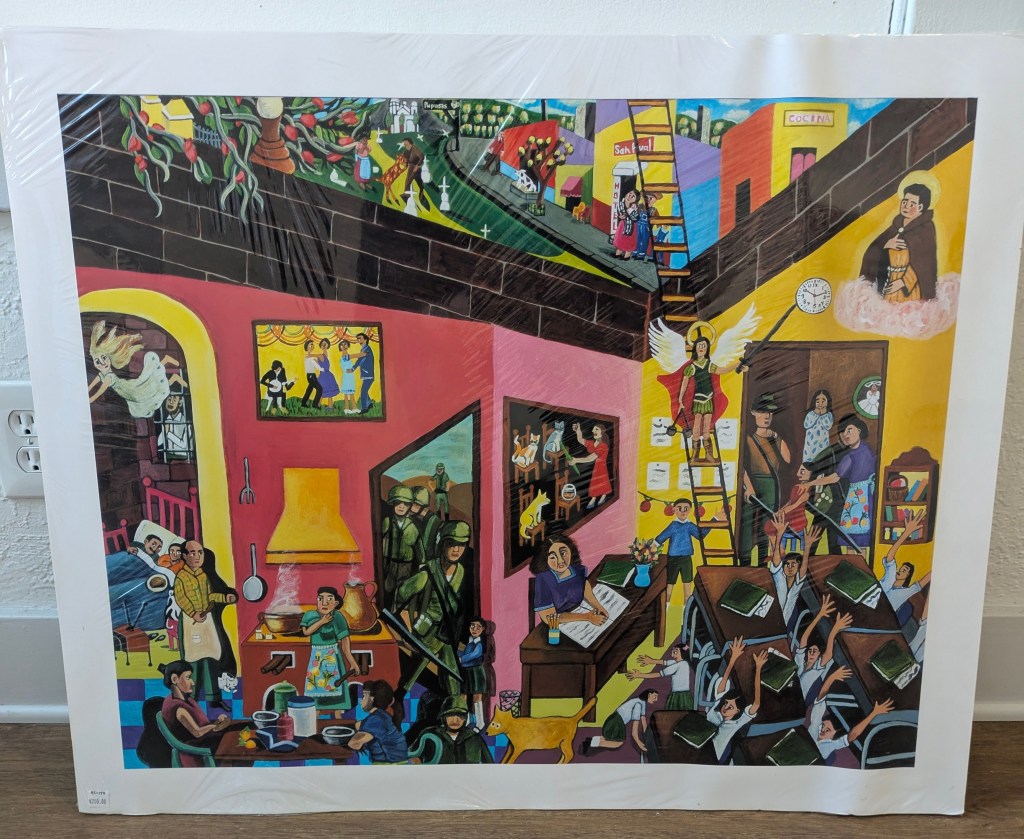
Myra Eastman, “The Great Migration: El Salvador to Santa Cruz — Classroom”
Pajaro Vallery Arts, Watsonville, Calif., 26 January 2025

Know Your Rights: Cards, Graphic Lit, Educational Resources, and CA State Ed  

pdf | bit.ly/uscit-kyr 

Know Your Rights / I Speak CARDS
Asian Task Force “I Speak” Cards

Disability Rights Group

CLINIC “I Am Exercising My Rights” card

DHS Indigenous Language Identification Sticker

Immigrant Legal Resource Center

Limited English Proficiency

USDA Food and Nutrition Services I Speak Statement Cards

 
Online KYR Graphic Literature
Carnegie Corporation of New York: Great Immigrants, Great Americans comic series

Federal Trade Commission Consumer Advice “How Pedro and Miriam Learned About Notario Fraud” 

Immigration Legal Resource Center: Anti-Fraud Comics https://www.ilrc.org/resources/anti-fraud-comics
Immigrant Defense Project Shareable Infographics https://www.immigrantdefenseproject.org/infographics/#0-know-your-rights
Midnight Special Law Collective: KYR Comix

New York Immigration Coalition “I’m Speaking” comic book

Resilience Force: A Guide for The Resilience Worker

 
Know Your Rights Education Resources
ACLU of Southern California KYR: My School, My Rights

Colorin Colorado How to Support Immigrant Students and Families: Strategies for Schools and Early Childhood Programs

iAmerica Know Your Rights

Immigrant Legal Resource Center

Immigration Institute of the Bay Area

KQED

Immigrant Justice

Immigrant Defense Project

Informed Immigrant

Intercultural Development Research Association: 10 Strategies for How Schools Should Respond to Help Children Impacted by ICE Raids

National Education Association: Know Your Rights: Immigration & Schools     

National Immigration Law Center

New York Immigration Coalition

US Committee for Refugees and Immigrants


California State Education Resources
California Department of Education: Chief Deputy Superintendent: David Schapira
Reminder of Obligation to Protect Immigrant Families’ Rights to Access Public Education

  • The letter from the California Department of Education (CDE) reminds schools of their obligation to protect the rights of immigrant families to access free public education, regardless of immigration status. It highlights the U.S. Supreme Court’s Plyler v. Doe ruling and California laws ensuring non-discrimination and safe school environments. The letter includes resources for training staff, legal guidance, and mental health support.
  • https://drive.google.com/file/d/1Gc-Oki1v_07XznU0UBWNW85gqX7rjEG_/view

CA Office of the Attorney General:
Promoting a Safe and Secure Learning Environment for All: Guidance and Model Policies to Assist California’s K-12 Schools in Responding to Immigration Issues

What to do if an immigration-enforcement officer comes to your school?

Cal School News: Safe Haven Districts

Santa Clara County Office of Education: Know Your Rights Education & Immigration Resource Guide for Staff, Educators & Principals

Source: CATESOL Discussion Board, 27 January 2025


With the inauguration of President Trump at hand, Monterey County officials and community stakeholders showed a united front in their support of all immigrants who live, work and attend school in the region at a press conference.

On Jan. 15, Salinas Mayor Dennis Donohue, Monterey County Sheriff Tina Nieto and Monterey County Supervisors Luis Alejo, Kate Daniels and Chris Lopez joined leaders in education, agriculture, hospitality, health and social services to announce the passage of a resolution on Tuesday affirming the county’s commitment to protecting immigrants’ rights and launch a public “Know Your Rights” campaign.

The resolution reestablished the county as a “Welcoming County” for immigrants and refugees, reaffirming key provisions of various state laws including the California Values Act (Senate Bill 54) and is the product of an Ad Hoc Committee formed by the board of supervisors in December.

Monterey County’s resolution came the same day the Salinas City Council, at their first meeting of 2025, issued a statement reminding residents the city has been a “Welcoming City” since June 2017.

The city “is steadfast in our dedication to serving the entire community, ensuring public safety and fostering trust regardless of immigration status, citizenship status or nationality, said Mayor Dennis Donohue at the Tuesday council meeting.

The majority of immigrants in California are documented residents, according to California’s Public Policy Institute, in 2022, 83% of immigrants were either citizens or had some other legal residency status.

While California has 1.8 million immigrants that were undocumented in 2022, according to Pew Research, it is down from 2.8 million in 2007.

Many undocumented individuals live in “mixed-status” households, which includes people with legal status.

According to the California Immigration Data Portal, in 2021, more than 3.3 million people in California and one in five children lived in such “mixed-status” households.

After recent immigration enforcement in Kern County spurred online rumors of similar activity occurring locally that turned out to be false, Sheriff Nieto told the crowd outside the Monterey County Government Center on Wednesday, that her office had been fielding phone calls from concerned residents.

“My family’s afraid to go to the store, my family’s afraid to send their children to school, my family’s afraid to go outside of the house,” said Nieto, describing some of the calls to law enforcement. “I want to assure you that here in Monterey County, the sheriff’s office and your chiefs of police know what the rules are and understand with the Trust Act is, and we’re going to follow those rules.”

Enacted in 2014, the Transparency and Responsibility Using State Tools (TRUST) Act (AB 4) defines the circumstances in which local law enforcement agencies may comply with immigration detainer requests.

Monterey County Office of Education Superintendent Deneen Guss said she wanted to reassure parents that schools are safe spaces for students.

“Our administrators, our educators, and our school staff are dedicated to creating welcoming environments where students and their families feel seen, heard and safe,” Guss said. “I want to assure parents that under current federal laws, schools are considered protected areas and are generally prohibited from voluntarily granting access to campus, by immigration officers, in the absence of a judicial warrant or a court order.”

“I urge you to please keep sending your children to school every day and to also create an emergency plan, including designating someone who can care for your child if needed,” she added.

During the pandemic, workers in agriculture and the service industry were lauded as “essential workers” as many continued to work onsite while workers in other industries got to work remotely and shelter-in-place.

Executive Director for the Monterey County Farm Bureau Norm Groot said local workers in the county’s $4.3 billion agriculture industry should still be considered essential.

“Our fresh food supply and local economy are fully dependent on this workforce and we consider this a national security priority in a time of agricultural labor shortages — farming depends on a stable and reliable workforce not one under threat,” Groot said. “[The county agriculture industry] depends on 55,000 farm workers to harvest our crops each year — primarily immigrants.”

“We appreciate the farmworkers’ vital contributions to the national food supply as essential workers,” he said.

The second largest industry in the county, hospitality, employs 25,000 people.

Rick Aldinger from the Monterey County Hospitality Association said the local immigrant workforce are “hardworking individuals” and “part of the fabric of our local communities” and thanked Supervisors Alejo and Lopez for spearheading the county’s Ad-Hoc Committee.

“Huge progress has been made in a very brief period of time,” Aldinger said. “Avenues of communication have been established among key players and industry leaders and a comprehensive portfolio of resources has been put together that will help our workforce navigate, whatever might lie ahead.”

Individual rights under state and federal law is also something employers with an immigrant workforce must also understand.

“We are trying to not only educate our immigrant workforce but also trying to educate the employers and what their rights are,” Groot said. “It’s a much larger circle than just saying we need to inform immigrants what their rights are.”

“We are trying to work through that and understand how much information we have to push out at this point — it really depends on what happens after next Monday,” Groot said, referring to President Trump’s inauguration, “and how many Executive Orders we’re going to start seeing.”

Source: Roseann Cattani, “‘Know Your Rights’: Salinas, Monterey County officials show united front for immigrants,” The Californian (Salinas, Calif.), 20 January 2025