Trump says Russia is being “fine” on Ukraine
Writing in the New York Times, David Sanger highlights the extent to which Donald Trump is going all out to support Vladimir Putin’s war of aggression in Ukraine:
President Trump’s intensifying effort in the past few weeks to rehabilitate Russia and usher President Vladimir V. Putin back into diplomatic society is remarkable for its speed, its characterization of Mr. Zelensky as the primary obstacle to peace, and its brazen denial that Russia is continuing the war that Mr. Trump says he is trying to end.
“Russia, frankly, has been fine on Ukraine,” Mr. Trump said on Monday, speaking to reporters outside the White House as he left for a campaign rally. “They haven’t been doing much,” he said, making no mention of the Russian missiles and jet-powered drones that have been targeting apartment buildings in Kyiv and Ukraine’s surviving electricity grid.
In contrast, he said, “We’ve given a lot to Ukraine. They’ve given nothing to us. Remember that.”
As Sanger notes, Trump’s support for Putin is unique in American history. Previous administrations have made deals with erstwhile adversaries, as Nixon did with China, and given up on support for failing allies, as the U.S. did in Vietnam and Afghanistan. But never before have we outright switched sides, let alone supported an aggressor while vilifying that aggressor’s victim.
What makes Trump’s support for Putin even more remarkable is that Russia has, by many accounts, been actively aiding Iran against America in the war Trump started. Who says so? Well, among others, Dan Caine, chairman of the Joint Chiefs of Staff. And the aid goes beyond intelligence sharing that has helped Iran target U.S. forces. Russia has also reportedly been sending Iran explosives and weapons components.
What would Republicans be saying if a Democratic president were supporting a foreign dictator even as that dictator was helping another nation kill American troops? They would be crying “treason.” But this is all apparently “fine” with Trump.
What’s going on here? It’s important to understand that — as Phillips O’Brien documents — Trump hasn’t “pivoted” away from Ukraine toward Russia. He has been a Putin supporter all along.
Thus when Trump says that “We’ve given a lot to Ukraine,” who, exactly, does he mean by “we”? He cut off all economic and military aid to Ukraine as soon as he took office. Here’s total support for Ukraine, by country, since January 2025:
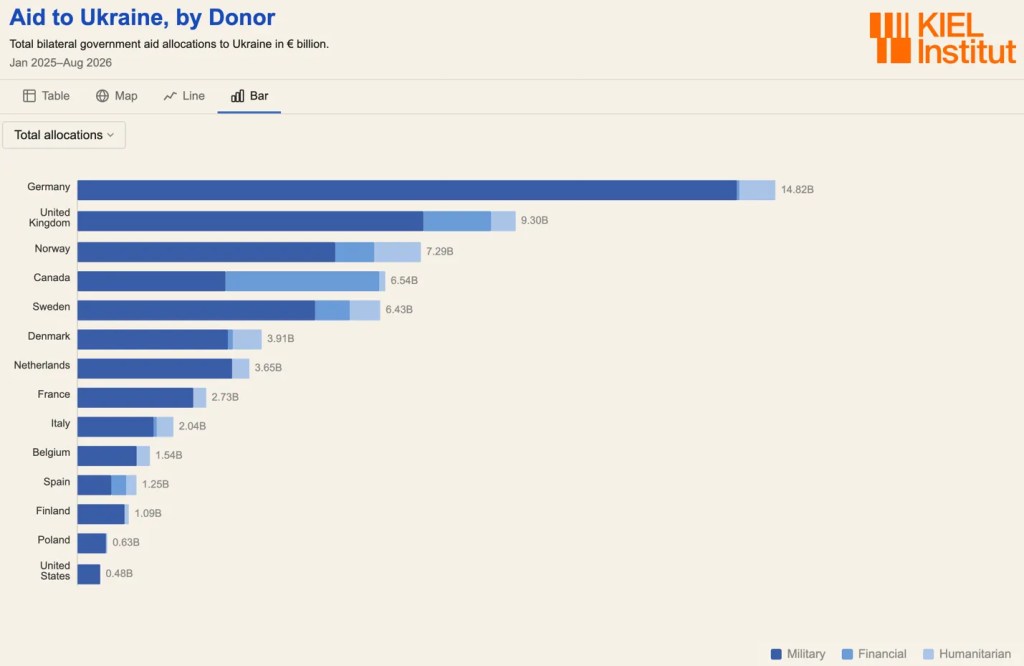
True, the U.S. continued to share military intelligence with Ukraine while allowing Ukraine to use Elon Musk’s Starshield and permitting European nations to transfer some U.S. weapons to Ukraine. But these actions cost America nothing. The most you can say is that until recently Trump shied away from actively sabotaging Ukraine’s ability to defend itself.
And now even that restraint is gone. According to Volodymyr Zelenskyy, U.S. intelligence sharing was blocked “for some period of time,” although it appears to have resumed for now. Ukraine’s access to Starshield has been limited. And the Washington Post reports that the U.S. has been holding up European transfers of Patriot missiles to Ukraine.
There are two questions here. First, why does Trump love Putin and hate Zelenskyy? Second, why has he ripped off the mask and gone full pro-Russia in the past few weeks?
On the first question, Zelenskyy gave a blunt answer in a recent interview with the Financial Times: Trump, he asserted, has an instinctive affinity for autocrats and the super wealthy: “He speaks about it openly that he loves such people and he respects such people.” That’s clearly right.
I would add three points. First, Trump and his inner circle don’t just love autocrats. They hate democracy and rule of law — which means that they hate America and American values.
Second, Putin-worship was widespread on the authoritarian right even before Trump entered the picture, with many celebrating Russia’s anti-wokeness and perceived masculinity. Remarkably, the valorization of Russia’s supposed toughness has survived despite Russia’s repeated military humiliations. So Trump has been following a well-trodden path.
Finally, whatever else you may say about Zelenskyy, he’s a genuine hero, who showed great personal courage by staying in Kyiv when Russia invaded. And Trump surely resents the fact that Zelenskyy is everything he is not.
The second question is, why now? Why has Trump chosen this moment to switch from covert, deniable support for Putin to overtly, explicitly taking Russia’s side?
As I suggested yesterday, the answer lies precisely in Trump’s collapsing support at home. Nothing he does now is likely to avert Republican catastrophe in the midterms. Republican politicians have been going out of their way to avoid being seen with him on the campaign trail. Trump officials are already lawyering up in preparation for the probes a Democratic Congress will launch.
At this point, then, Trump effectively has nothing left to lose on the political front — and his political bankruptcy has freed him to become his worst self, indulging himself by doing what he always wanted to do — which includes supporting corrupt, murderous dictators.
And there will be much more of this to come. Trump can’t and won’t make America great again. But he can betray everything America stands for, and he’s doing it as we speak.
SOURCE: Paul Krugman (Substack), 20 October 2026. I subscribe to Mr. Krugman’s Substack, and I’m happy to share it occasionally with my own readers. }}}}}trr
Donald Trump claims Russia has been “fine” in Ukraine, and Michael Weiss, who has witnessed Russian atrocities firsthand, is furious. Weiss and former CIA officer Marc Polymeropoulos examine Trump’s increasingly alarming alignment with Putin, reports that Elon Musk interfered with Ukraine’s satellite defenses, Pete Hegseth’s refusal to release desperately needed Patriot missiles, and whether Trump now fits the intelligence definition of a Russian agent of influence.
“Russia, frankly, has been fine on Ukraine. They haven’t been doing much,” U.S. President Donald Trump remarked to a group of journalists outside the White House on Oct. 19.
The comments came as tensions between Kyiv and Washington are rising after reports that the U.S. stopped warning Kyiv of incoming Russian ballistic missiles and limited the use of Starshield, a military version of Elon Musk’s Starlink, for Ukraine, making it difficult to intercept Russian attacks on Ukraine.
While Russia wages its war with no regard for civilian lives or human dignity, these are just some of the things that Trump seemingly considers “fine.”
The U.S. president spoke only hours after Russia had launched another deadly attack on the people of Ukraine a few hours before he made his comments. A Russian drone struck a park in the town of Nova Vodolaha, Kharkiv Oblast, killing six and injuring at least 15 others.
Inna Mariukhna, a 28-year-old teacher at a local school, was one of those killed in the attack. She was pushing her 1-year-old daughter, Anhelina, in a stroller when the Russian jet-powered drone struck them both. Anhelina was killed instantly, while Inna succumbed to her injuries in hospital.
Pictures showing Anhelina’s bloodied and lifeless body, still strapped in her stroller, her small shoes still perfectly tied, were posted on social media by many including President Volodymyr Zelensky.
Arina Koval, an 8-year-old girl, was also killed in the drone strike, as were 34-year-old Yulia Spichak, 36-year-old Marianna Tsymbal, and a sixth victim who has not been named.
Zelensky described the attack as an “absolute atrocity.” Trump thinks this is “fine.”
In the morning hours of Oct. 20, at least three people were killed and four people injured after a Russian drone struck early morning commuter traffic in the Holosiivskyi District of Kyiv.
Ukraine’s State Emergency Service reported Russia’s drone strike, saying: “The enemy is once again cynically attacking civilians. Behind each such blow are human lives, pain, and ruined destinies.”
This was but one of hundreds of continuous Russian strikes on Ukraine’s capital and dozens of other cities and communities across the country, as the Kremlin is pursuing another theory of victory — attempting to bomb Ukrainian cities into submission.
“328 civilians were killed and 2,105 injured in September 2026.”
According to the U.N. Human Rights Monitoring Mission in Ukraine, at least 328 civilians were killed and 2,105 injured in September 2026, an 85% increase from September 2025. The deadly trend is continuing into October, according to the mission. “The first two weeks of October were among the deadliest periods for civilians in years,” Danielle Bell, head of the U.N. Human Rights Monitoring Mission in Ukraine, said.
Recent U.S. actions have increased the threat for Ukrainian civilians. Ukraine’s Starshield satellite internet terminals, which Ukraine uses to control anti-drone interceptors, have been impeded, while deliveries of vital Patriot interceptors have been deliberately delayed by the Pentagon, Zelensky said on Oct. 18, an allegation corroborated by reporting in the Kyiv Independent and the Washington Post.
The New York Times, meanwhile, reported a Russian plan, presented to the publication by Ukrainian authorities, to destroy Ukraine’s beleaguered energy system once and for all. While Russia’s attacks on Ukraine’s energy system have been ongoing throughout the year at a low level, Moscow has recently ramped up mass attacks to wipe out power plants, substations, and gas infrastructure for its fifth winter offensive during the full-scale invasion.
At a recent official event of Russia’s International People’s Unity Club in Moscow, Russian Lt. Col. Alexey Selivano said: “Wherever Russian troops arrive, Ukrainians cease to exist.”
From the beginning of Russia’s full-scale invasion, Russian forces have inflicted countless atrocities against Ukraine.
In March 2022, Russian forces carried out a massacre of Ukrainian civilians and prisoners of war in Bucha, a suburb to the west of Kyiv, after their failed attempt to take the Ukrainian capital. Liberating Ukrainian forces found the bodies of victims, some with their hands tied, lying in the streets. The bodies of 458 people were eventually recovered from Bucha. The majority of them had been shot, tortured or bludgeoned.
From the opening days of Russia’s full-scale invasion, the people of Mariupol suffered horrifically during the 86-day Russian siege. To this day, the exact number of Ukrainian civilians killed in Russia’s assault on the city is unknown. According to preliminary estimates by Ukraine’s Center for the Study of Occupation, at least 22,000 civilians were killed during the siege. The true figure might never be known, as Russia has deliberately destroyed graves and cremated bodies in an attempt to conceal the true death toll in Mariupol. Some estimates put the actual figure as high as 87,000.
A Russian airstrike on March 16, 2022, likely killed 300 to 900 people hiding inside the Mariupol Drama Theater, according to different estimates, including an Associated Press investigation and figures by exiled local authorities. They were awaiting evacuation from the then-besieged Mariupol amid heavy Russian bombardment. Footage of the theater shows that the word “Children” in Russian was written in large letters on the square in front of the theater. Russia bombed the building regardless.
Across Ukraine’s occupied territories, Russia has been kidnapping Ukrainian children. Russia’s forcible transfer of children constitutes crimes against humanity, according to a probe by an U.N.-mandated independent commission.
“Based on new evidence, the Commission has now concluded that the Russian authorities committed two types of crimes against humanity: deportation and forcible transfer of children, as well as their enforced disappearance,” Erik Mose, chair of the Independent International Commission of Inquiry on Ukraine, said in a statement on March 12.
This was an issue the White House at least appeared to care about previously, with the U.S. State Department allocating $25 million in funding in March 2026 to help trace and rehabilitate Ukrainian children abducted by Russia.
In May, the United Nations also blacklisted Russian armed and security forces for carrying out systematic sexual assaults, rape, and widespread torture of Ukrainian prisoners. Despite Russia’s refusal to grant access to U.N. human rights investigators, they were still able to independently verify 310 cases of conflict-related sexual violence in Russia and Russian-occupied Ukrainian territory. The victims were prisoners of war and civilian detainees, the vast majority of them men.
SOURCE: Jimmy Rushton and Jonas Heins, “Things Russia has done to Ukraine that Trump thinks are ‘fine,'” Kyiv Independent, 20 October 2026. As a paid-up supporter, I’m happy to share the Kyiv Independent’s excellent journalism with my readers occasionally. }}}}}trr
Though they deny any involvement, the Trump administration and Elon Musk are apparently helping Putin escalate his campaign of terror against Ukraine. Civilian casualties across Ukraine are rising—including women and children—but Trump said Monday that Russia “has been fine on Ukraine.” At the same time, Team Trump looks to be lining up business deals with Russian energy companies. And Marco’s whitewashing of it all is sickening. Plus: Zelensky is tired of Trump’s games, China is playing a curious role on both sides of the war, and JD has another whopper to add to his stack of lies. Former Amb. Michael McFaul joins Tim Miller.