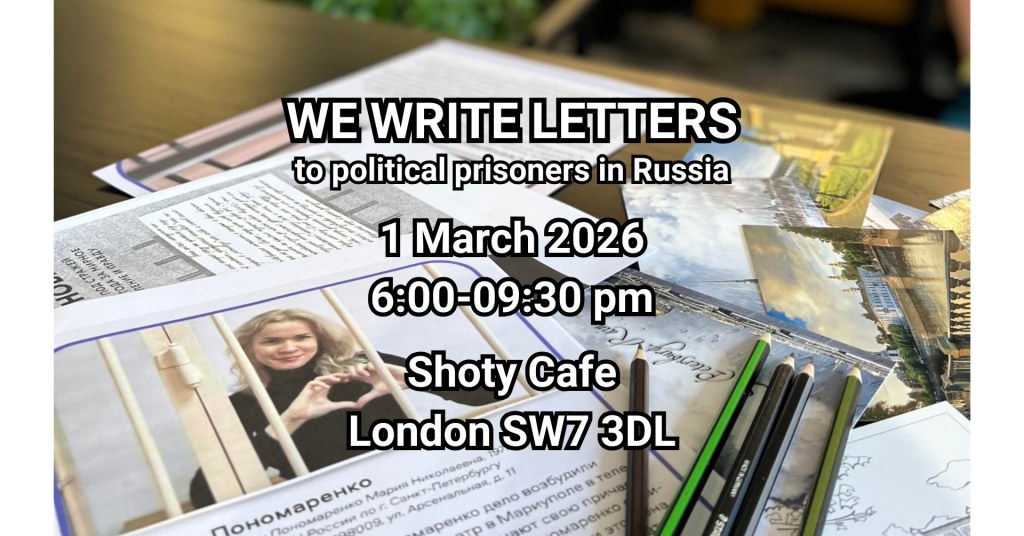
We Write Letters to Political Prisoners in Russia

Hundreds have been unlawfully imprisoned by the Russian authorities for opposing the war and dictatorship.

Join us to write letters to Russia’s political prisoners and support them!

1 March 2026 (Sun), 6:00-09:30 pm • Shoty Georgian Cafe & Restaurant (upper ground), 30 Old Brompton Road, London SW7 3DL

No knowledge of Russian is required.

All materials and guidance will be provided.

Why do we write letters? In the words of Maria Ponomarenko, sentenced to six years in prison for anti-war posts:

I’ve already explained it multiple times that the letters are highly valuable to all of us who are unjustly imprisoned. But I’m ready to repeat it again and again, even 1000 times!

Your letters inspire us, give us strength and confidence that there will be a dawn and the changes are inevitable.

Your letters serve as a support — solid ground beneath our feet.

Your letters are uplifting and help distract us from the unpleasant realities of the Russian penitentiary system.

Write letters to political prisoners! Write, even in the absence of feedback!

The letters are also very important because they demonstrate to the authorities and other inmates that the political prisoner has support outside the prison and is not alone. That we have not been abandoned and have not been forgotten!

#RussiansAgainstWar #RussiansAgainstPutin

Source: Facebook. Thanks to News from Ukraine Bulletin for the heads-up.


Why it’s crucial

Political prisoners find themselves in physical, social and informational isolation. Thanks to the letters, prisoners feel supported and that they are not alone. In pre-trial detention centres, prisons and colonies, it is not often possible to find like-minded people, but letters give prisoners a chance to be heard and a much-needed connection with one another.

In addition, in prison a person quickly ceases to understand what is happening on the outside, so letters are also a way to stay informed about external events: they can be about big news or something less significant, but important for the political prisoner himself (for example, about changes in countries or what is happening in his work\interest spheres, and so on).

Finally, when prisoners receive regular letters, it is an indicator to prison and colony staff that the world outside is paying attention to them, so the risks of pressure are reduced.

This is safe

It is legal and safe to send letters to political prisoners. It is important to remember that all letters go through a censor, but if you follow certain rules you will be safe.

However, there is a list of topics to avoid. 

– Do not write about war and combat, such letters will almost certainly not pass the censor. 

– Do not write about the details of their criminal case: this may be a painful topic for discussion, but on the other hand, such correspondence may harm them legally.

– Do not write anything about LGBTQ+ people, as based on the history of cases this may harm the political prisoner in the eyes of homophobic prisoners and prison staff. 

– Do not write direct insults to the authorities and their representatives or calls to overthrow the government.

– Avoid any topics related to what law enforcement agencies may consider extremism and terrorism.

– In addition, do not use obscure abbreviations, ciphers, foreign words – anything that the censor may not understand or find suspicious. Finally, do not use foul language in your letters.

Where to start 

First, you need to decide who you want to write to. You can write to political prisoners whose stories you already know from the news, but it is important that not only media figures receive letters: there are many lesser-known prisoners who need support just as much. You can find their names and stories on our website (general list and religious list of political prisoners), and you can also find addresses where you can write to them. A great reason to start a correspondence would be, for example, a birthday greeting. 

What to write about in the first letter

Introduce yourself and tell about your experiences, so that the political prisoner understands who he is communicating with. If you do not want to use your real name, you can sign with a pseudonym – the main thing is that your addressee can later recognize you among other interlocutors. 

In an interview with Novaya Gazeta, Elena Efros – founder of the letter-writing project “Tales for Political Prisoners” says: “It’s just the way to write it, a standard text like: Hi, I learned about your case from the media or the Internet, do you want to correspond with me, if yes, what topics are interesting to you. And don’t worry – if you don’t get a reply, just write to someone else.”

How to send letters

The fastest way would be to send one online. Our colleagues from ‘Memorial France’ have launched a service for sending letters to political prisoners in Russia and Belarus. 

The website itself is still only available in French, but you can write to political prisoners in different languages: French, English, Belarusian, Russian, and any other are also accepted for translation. 

  • Go to the Mémorial France website
  • Choose any political prisoner from the lists of Mémorial or Viasna.
  • Write a letter and paste it into the online form
  • Our colleagues will translate the text and send it to the addressee
  • When and if the inmate responds, they will send you their letter

The service has more detailed instructions for each step, as well as recommendations on what to talk about and what to avoid in letters. 

You can also use one of the following services available in English:

  • Letters Across Borders is an OVD-Info project to collect letters to Russian political prisoners in English (or other languages) and translate them for free. You can support the project with a donation.
  • PrisonMail (payment with international bank cards)

In Russian:

  • F-letter – payment by Russian bank cards only;
  • ZT – payment by Russian card only, but the service works in more colonies;
  • RosUznik – a volunteer project that sends letters in Russian for free or for a donation (you can write from abroad if you translate your letter yourself).

You can also send a paper letter and put something that will please the prisoner: photos, printed pictures, extracts from a magazine, herbarium and so on. You can put unsigned postcards so that the prisoner can send them to their loved ones. Please note that the weight of the letter mustn’t exceed 99 grams and letters in languages other than Russian are highly unlikely to reach the recipient.

Write legibly so that your handwriting can be understood by both the addressee and the censor. When sending a letter, put not only the address but also the full name of the institution on the envelope and write the year of birth after the addressee’s name. If you want a reply, put a blank sheet of paper, another envelope and stamps in the envelope with the letter. 

To receive a reply letter, a reply form must be paid for. Usually, the censor sends a scan of the letter to the email address you specify, but it is worth bearing in mind that Prisonmail does not cooperate online with all colonies – then the website when you send the letter will say that you can only receive a reply in paper form.

Source: “How to write letters,” Memorial Human Rights Center Support Program for Political Prisoners
A Milestone (Nadezhda Buyanova)

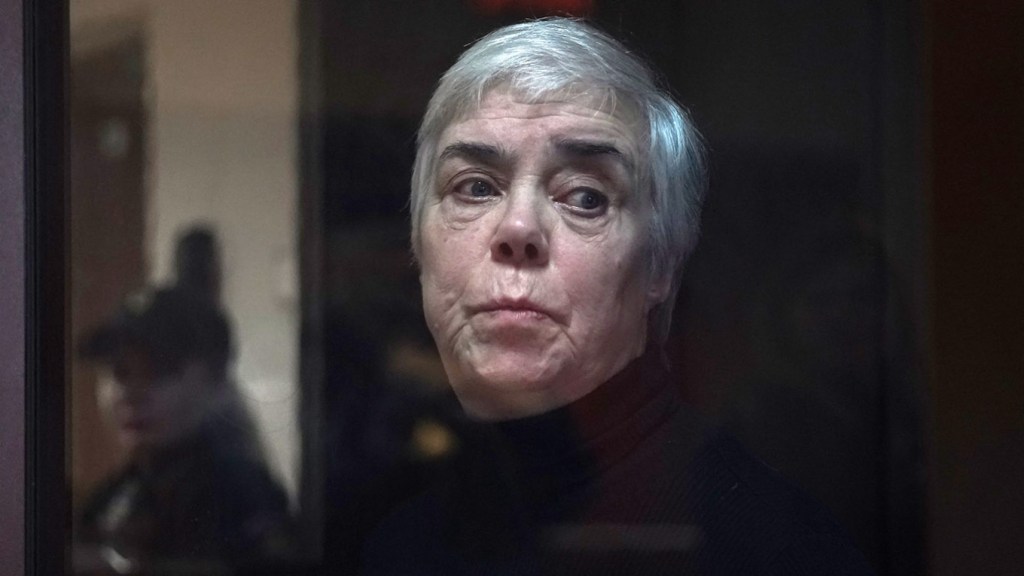
Nadezhda Buyanova. Photo: Tatyana Makeyeva/AFP, via Moscow Times

A pediatrician has been imprisoned on the strength of a denunciation by her patient’s mother. The pediatrician allegedly insulted the boy’s father, who had been killed in the war. There were no witnesses to the conversation, and it seems that the decisive factor in the verdict was the pediatrician’s birthplace — Lviv. Only recently I published the file of the criminal case against my great-uncle, who had allegedly spread rumors about the fall of Soviet regime among children at an orphanage. There, too, the accused’s background was an important point of the accusation: the arrested man’s father had once been a prosperous peasant. It was obvious to the investigators (and this was explicitly stated in the verdict) that the status of “kulak’s son” was in itself proof that the charges were true.

Lo and behold we’re back where we started: a person born in Lviv is guilty of course and must have said what they have been accused of saying.

I don’t know why we should measure things off in terms of milestones on the road to a familiar hell, but this is certainly a milestone.

Source: Natalia Vvedenskaya (Facebook), 13 November 2024. Translated by the Russian Reader


A Moscow court on Tuesday sentenced a pediatrician to five and a half years in prison for criticizing the war in Ukraine during a patient visit earlier this year.

Nadezhda Buyanova, 68, was found guilty of spreading “fake” information on the Russian army under wartime laws used to silence dissent.

“I believe this is absurd,” she said in court Tuesday, moments before Judge Olga Fedina announced her sentence.

Buyanova was arrested in February after the ex-wife of a soldier who was killed in Ukraine, Anastasia Akinshina, said she had criticized Russia’s role in the conflict during an appointment.

Several of Buyanova’s supporters, mostly medical professionals, shouted “Shame on you!” in the court as the sentence was announced.

“We must empathize with one another and love others,” Buyanova said in court. “But there is no paradise on earth, there is no peace on earth.”

She protested her innocence throughout the trial.

“I am a pediatrician. I do not regret a single day,” Buyanova said.

Buyanova was prosecuted despite there being no public evidence that she criticized the war. Akinshina’s seven-year-old son testified against Buyanova in court.

Source: AFP, “Russian Doctor Jailed 5.5 Years for Criticizing War During Patient Visit,” Moscow Times, 12 November 2024


Monday, 18 November, 6 p.m.  “Political prisoners in Russia and the Occupied Territories of Ukraine”. 

Panel discussion with Sergei Davidis (Memorial), Evgeny Zakharov (Kharkhiv Human Rights Protection Group), Bill Bowring (Birkbeck, University of London) and Judith Pallot (Gulag Echoes research project / University of Oxford).

At: Montague Lecture Centre, Graduate Centre, Queen Mary University of London, 327 Mile End Road, London E1 4NS. Also on line, via Zoom.

All welcome. Event organised by the Queen Mary University, London, Centre for Eurasian, Russian and East European Studies. Register on Eventbrite here.

Source: Ukraine Information Group

1001 Letters for Azat Miftakhov

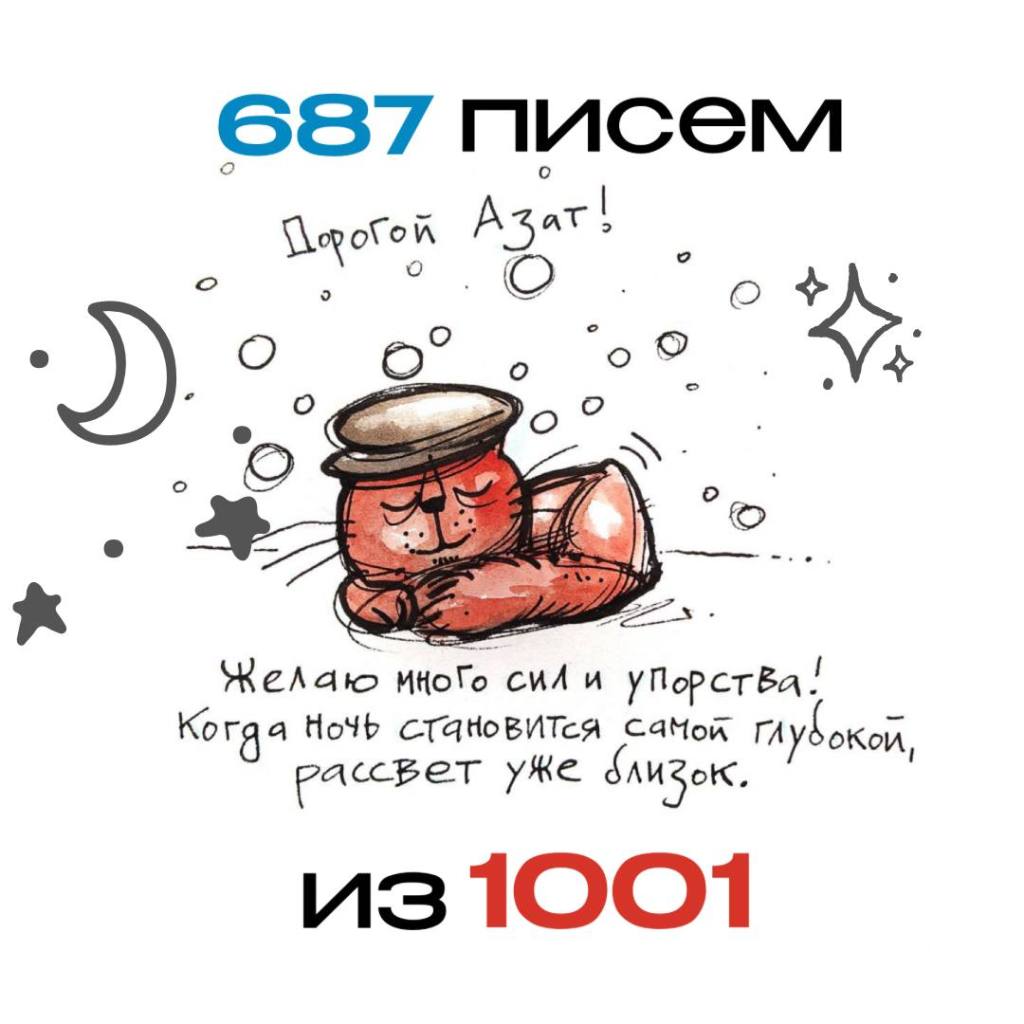
687 letters out of 1,001. “I wish [you] much strength and determination. It’s always darkest before the dawn.”

💌The Azat Miftakhov letter writing campaign continues!

🔥 Since the last appeal to write to Azat, the Solidarité FreeAzat Association has received 687 letters out of its goal of 1,001 letters!

✈️ We received letters from a huge number of countries. Azat is supported by people in France, Russia, Belgium, Nicaragua, Mexico, Germany, Lithuania, the UK, Switzerland, Italy, Poland, Canada, Finland, Australia, Brazil, Côte d’Ivoire, Mali, Georgia, South Korea, Armenia, New Zealand….

Fifty countries in all!

🫠Today we learned that the military court’s first hearing in Azat’s case has been scheduled for February 12 in Yekaterinburg. We have even less time than we thought. There is one week left to get all the letters.

🫶 We urge everyone who hasn’t written yet to write a letter to Azat Miftakhov before February 12, to show solidarity with and verbal support for a person who has been imprisoned for no particular reason.

😳You can write to the Association’s e-mail—libertepourazat@gmail.com—or use the Google form.

😳We would like to remind you that Solidarité FreeAzat Association is going to send the letters via Zonatelecom, an electronic service for dispatching letters to Russian inmates, and therefore we need your full support.

😳You can make a donation to offset the cost of sending the letters.

🤮 If you have a Russian bank card, send money to:

Mastercard 5469 3800 5929 3380 (Sberbank)
Elena Gorban

🤮 If you want to donate using a non-Russian bank card you can use this payment service:

https://www.helloasso.com/associations/solidarite-freeazat/formulaires/3

Please note that the service will charge a commission on the payment, and you need to manually lower the amount of the commission to 0 euros.

Write letters to those who need them so much now!

❣️*The postcard [above] was drawn by Hans, an artist from Germany.

Source: FreeAzat! (Telegram), 5 February 2024. Translated by the Russian Reader. Thanks to Posle for the heads-up. Please note that the Google letter-writing form, linked to above, is in Russian not least because the correspondence received by Russian inmates must be in Russian in order to pass censorship. If you need help negotiating this, don’t hesitate to write to me at avvakum@protonmail.com.


Azat Miftakhov

We’re launching a fundraiser to pay for mathematician Azat Miftakhov’s lawyer

Azat Miftakhov is a political prisoner, anarchist and mathematician convicted in 2019 on charges of disorderly conduct for allegedly breaking a window at a United Russia party office. In 2023, Azat was detained when he was released from prson and charged with “condoning terrorism.” According to police investigators, Miftakhov “deliberately in the presence of two convicts publicly condoned terrorism” while serving his sentence for disorderly conduct in Penal Colony No. 17.

According to the testimony of the other inmates, while watching the evening news on TV in May 2023, Miftakhov said that he would “avenge” a friend who had been killed while fighting for the Ukrainian army. The principal testimony in Azat’s new case was given by a identity-protected witness. He claimed that Miftakhov had condoned the actions of Mikhail Zhlobitsky, who carried out a suicide bombing at the Arkhangelsk offices of the Federal Security Service (FSB).

We are now raising 500,000 rubles [approx. 5,100 euros] to pay the lawyer defending Miftakhov against the new charges of violating Article 205.2.2 of the Russian Federal Criminal Code.

You can click the link, below, to support the fundraiser using a non-Russian bank card [via Stripe].

I want to help!

You can send a transfer in Russian rubles to Tinkoff card 5536 9140 9963 7302, tied to phone number +7 (991) 938-0181, Roman Vyacheslavovich P. (Mark the reason for payment as “mathematics.”)

Source: Memorial Political Prisoners Support, 9 Februrary 2024. Translated by the Russian Reader. Thanks to Posle for the heads-up.