Petersburgers’ salaries grew by over thirteen percent during the year according to both official stats and hh.ru’s data
Analysts at hh.ru told Bumaga that the average monthly salary advertised to Petersburgers in early October 2024 had increased by nineteen percent compared to last year’s figures — up to 79,300 rubles a month [approx. 750 euros]. Petrostat cites similar dynamics, although it cites different overall numbers. According to the city’s statistical agency, the average monthly salary in St. Petersburg increased by 13.1% in August 2024 compared to last August, amounting to 99,800 rubles.
Top managers enjoyed the biggest increase in their average pay — 20,600 rubles a month — Maria Buzunova, head of hh.ru’s press service for the Northwest Federal District and the Central Federal District, told Bumaga. Consulting and strategy professionals, whose average income increased by 20,000 rubles [approx. 190 euros], came in second place.
“Wages in agriculture, insurance, raw materials extraction, the auto business, and auto repair have also been on the rise. Amid the unfolding personnel deficit, employers are still trying to catch applicants in construction and laborers with the money hook. That said, there is not a single sector where advertised salaries have fallen,” Buzunova says.
According Buzunova, average salaries in agriculture, investment and consulting, the auto business, raw materials extraction, and management have exceeded the 100,000 ruble per month mark. Analysts at hh.ru recorded average monthly salaries of round 100,000 rubles in the information technology, transportation, construction, and real estate fields.
Petrostat’s numbers would lead us to believe that the growth of salaries in the city has already stopped. According to the department’s data, the average monthly salary of Petersburgers was higher in the period from April to June than it is now, amounting to approximately 103,500 rubles [approx. 985]. Data from hh.ru suggest the opposite. The online recruiters told Bumaga in mid April that they had estimated the average advertised salary at 72,500 rubles per month. Thus, in five and a half months, this indicator has increased by 9.4%.
Employers are facing a shortage of employees. Demand for teachers and medics has grown in the city
The experts at hh.ru argue that the main reason for wage growth has been the stable growth of demand for staff on the part of employers. The total number of vacancies in St. Petersburg reached 750,000 from January to early October, which is eighteen percent higher than for the same period in 2023.
“Consequently, the problem of staffing shortages has been deepening. This is confirmed by our survey of employers, which we started a couple of years ago. According to the majority of company reps both in Russia as a whole and in St. Petersburg, staffing shortages remain the fundamental problem of the labor market,” the online recruiters told Bumaga.
Demand for teachers and tutors (up twenty-six percent compared to last year), sales clerks and other retail workers (up twenty-five percent compared to last year), and medical personnel (up twenty-three percent compared to last year) has risen the most in St. Petersburg. One of the reasons for the shortage of teachers and medics is their declining interest in staying in their professions and their leaving for other sectors with better working conditions, hh.ru noted.
However, entrepreneurs from other sectors — for example, owners of restaurants, bars and cafes — have also spoken out about staffing shortages. “There is a shortage of absolutely everyone, both waiters and managers,” Vitaliya Dolinskaya, operations director at the restaurants Chang and Che-Dor, told Bumaga.
According to the heads of the companies surveyed by hh.ru, one of the reasons for the shortage of personnel is the demographic situation in the country. Other factors that negatively impact the labor market are the lack of qualified personnel, the low labor mobility of Russians, and insufficient inflows of foreign migrant workers.
Stricter migration laws may aggravate shortages of sales clerks, drivers and couriers. Companies’ costs will be borne by consumers of their goods and services
The shortage of migrant workers can be explained, among other things, by the actions of the Russian authorities after the terrorist attack on the Crocus City Hall music venue outside of Moscow. The State Duma continues to tighten migration laws, foreign nationals have been increasingly deported from the country, quotas for temporary work-and-residence permits have been reduced, and the police regularly carry out “anti-migrant” raids.
The attitudes of Russians towards labor migrants have also changed. Eighty percent of Petersburgers surveyed by hh.ru believe that there are too many migrants in the city. At the same time, only thirty-six percent of respondents would agree to take “migrant” jobs. Most often this opinion was voiced by workers in the restaurant and hotel business, logistics and transportation, sales, construction, and the retail trade.
Yulia Sakharova, hh.ru’s director for the Northwest Federal District, claims that the upshot of all this is a shortage of people to fill the most high-demand vacancies — for sales clerks, drivers, and couriers.
“The tightening of migration policy may complicate recruitment for companies. In most cases, the depletion of an already scarce resource leads to an increase in its cost. Employers will have higher recruitment costs. They will be forced to compete against each other by raising wages, and further shift the increased costs onto the price of their services, a price that will be paid by the end consumer,” Sakharova explained to Bumaga.
Factories are looking for young skilled workers, and IT salaries have stabilized. A few more trends in the labor market
Here are five more trends in the Petersburg labor market:
- St. Petersburg has become less attractive for employment. In the fourth quarter of 2024, the city dropped from fourteenth to twenty-sixth place in hh.ru’s ratings. This happened due to increased competition and an increase in the number of Petersburgers willing to move to other regions. “This does not mean that the city has become a worse place to work. It means that labor conditions have not improved so dynamically in St. Petersburg compared to other regions,” Maria Buzunova.
- Petersburg enterprises have been forty-nine percent more likely to offer jobs to young skilled workers than in 2023. Since the beginning of the year, the city’s factories and other production facilities have posted more than 14,000 vacancies which are open to recent graduates and personnel without work experience.
- There were about one thousand vacancies for cab drivers in St. Petersburg in August 2024, which was fifty percent more than a year earlier. And yet, there are fewer applicants: on average, one or two people apply for each vacancy (the lower limit is four people per vacancy), hh.ru noted. This circumstance also affects the price of cab rides, which we examined in more detail here.
- In 2023, the salaries of IT workers in St. Petersburg decreased for the first time in several years. In 2024, incomes in the IT sector increased again, according to hh.ru. For example, the salaries of developers have grown by seven percent, while those of analysts have risen by fifteen percent. “However, we have also seen a transition from a jobseeker’s market to an employer’s market. According to our research, the overheated market for IT professionals has reached its limit and will gradually stabilize as more and more companies refuse to give employees dynamic salary increases,” hh.ru explained.
- Petersburgers are more and more often quitting stressful jobs that negatively affect their emotional state. Given these conditions, employers are forced to introduce practices for handling their employees with care and patience, hh.ru noted.
Source: “Companies compete by raising wages as Petersburg’s personnel shortage grows. Which sectors have the fewest skilled workers,” Bumaga, 4 November 2024. Translated by the Russian Reader
Russian casualties in Vladimir Putin‘s full-scale invasion of Ukraine have surpassed 700,000, according to Kyiv, which trolled Moscow over the round number of such a grim milestone.
In its daily update, Ukraine’s military said on Monday that over the previous day, Russian forces had suffered 1,300 personnel losses, taking the total number since the start of the full-scale invasion to 700,390.
“‘Perfect numbers like perfect men are very rare.’ Rene Descartes,” Ukraine’s defense ministry posted on X referring to the French philosopher.
Newsweek has contacted the Russian defense ministry for comment. An accurate number of casualties, which Ukraine says are “approximate” and include those who are both dead or injured, is difficult to ascertain, with both sides remaining tightlipped over their losses.
Russia has not updated its figures since September 2022 when it said that just under 6,000 had been killed, while Ukraine’s President Volodymyr Zelensky said in February that 31,000 Ukrainian troops had died, although this was lower than Western estimates.
U.S. officials told The New York Times that September was the bloodiest month of the war since its start in February 2022 and that more than 600,000 were dead and wounded, with the spike caused by assaults in the east of Ukraine where Putin’s forces have made slow gains but at a great cost in personnel.
An unnamed U.S. official cited by The New York Times said that more than 57,500 Ukrainian troops had been killed and 250,000 wounded.
Estonian intelligence estimated that Russia may have lost around 40,000 soldiers in October alone, a figure backed up by other estimates and higher than the 30,000 new soldiers that Ukrainian military intelligence believes are being recruited per month.
In its update in mid-October, independent Russian news outlet Mediazona said that 75,382 killed Russian troops had been identified, an increase of 2,483 since the start of the month.
Source: Brendan Cole, “Russia Hits Grim Troop Loss Milestone,” Newsweek, 4 November 2024
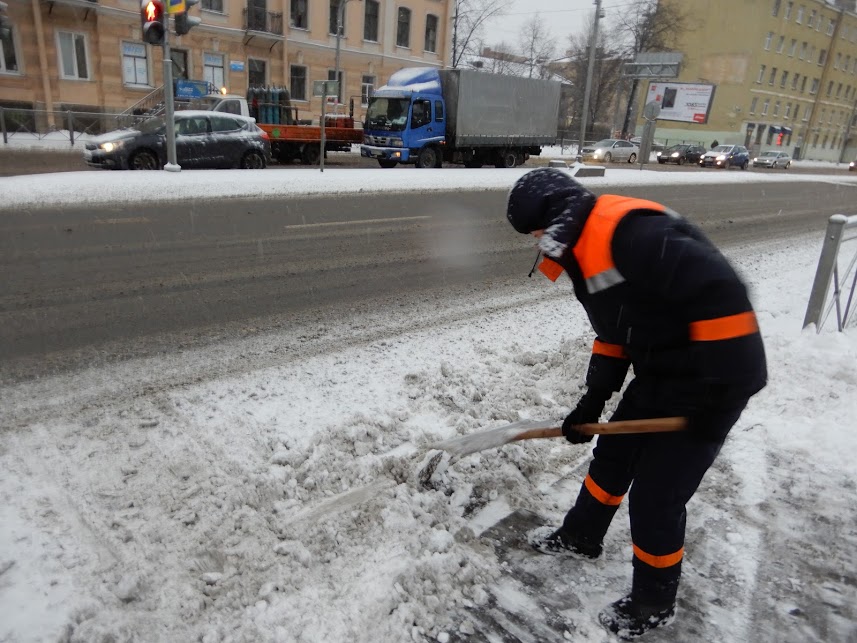 A migrant worker shovels snow and ice in central Petersburg, December 21, 2017