Down in the Hole

Oleg Grigoriev
Pit

Digging a pit? 
I was.
Fell in the pit?
 I fell.
Down in the pit? 
I am.
Need a ladder? 
I do.
Wet in the pit? 
It's wet.
How's the head? 
Intact.
So you are safe?
I'm safe.
Well, okay then, I'm off!

Original text. Translated by the Russian Reader



Putin last week took part in a meeting with the mothers of soldiers killed in the war in Ukraine. The title “soldiers’ mother” carries a lot of influence in Russia — and Putin was famously humiliated by a group of soldiers’ relatives in his early years as president. Unsurprisingly, Friday’s meeting included only those trusted to meet Putin and the gathering passed off without awkward questions. Putin — who now rarely communicates with anyone outside of his inner circle — once again demonstrated a complete detachment from reality.

  • The Russian authorities have been nervous of organizations of soldiers’ mothers since the mid-1990s. During the first Chechen war (1994-1996), in which the Russian army was humiliated, the Committee of Soldiers’ Mothers was one of the country’s leading anti-war forces and held the state and the military to account.
  • For Putin personally, any encounter with soldiers’ mothers stirs unhappy memories of one of the most dramatic incidents of his first year in the Kremlin. In August 2000, the inexperienced president was subjected to a grilling by the wives and mothers of sailors who died in the Kursk submarine disaster. The transcript of the meeting immediately appeared in the press and a recording was played on Channel One, which was then owned by Kremlin eminence grise Boris Berezovsky. Presenter Sergei Dorenko subsequently claimed that, after the broadcast, Putin called the channel and yelled that the widows were not genuine and that Berezovsky’s colleagues “hired whores for $10.” Ever since that encounter, the Russian president has avoided in-person meetings, favoring stage-managed gatherings with hand-picked members of the public.
  • This time, of course, there were no surprises. The Kremlin carefully selected the soldiers’ mothers who were invited to attend. At least half of those at the meeting turned out to be activists from the ruling United Russia party and members of pro-Kremlin organizations. 
  • The most striking speech at the event was close to parody. It was given by Nina Pshenichkina, a woman from Ukraine’s Luhansk Region whose son was killed in 2019. Pshenchkina later became a member of the Public Chamber of the so-called Luhansk People’s Republic and has attended almost every official funeral and official celebration. She told Putin that her son’s last words were: “Let’s go, lads, let’s crop some dill” (in this context, “dill” is an insulting nickname for Ukrainians).
  • Putin’s speech was also striking. First, he told the assembled mothers that Ukrainians were Nazis because they kill mobilized Russians soldiers who did not wish to serve on the front line. Then he embarked on a long, strange discussion about why we should be proud of the dead. “We are all mortal, we all live beneath God and at some point we will all leave this world. It’s inevitable. The question is how we live… after all, how some people live or don’t live, it’s not clear. How they get away from vodka, or something. And then they got away and lived, or did not live, imperceptibly. But your son lived. And he achieved something. This means he did not live his life in vain,” he said to one of the mothers.

Why the world should care

It would be an error to assume that Putin has completely abandoned rational thought. However, it is instructive to watch him at meetings like this, which provide a window onto the sort of information he consumes. At this meeting with fake soldiers’ mothers he quoted fake reports from his Defense Ministry and, seemingly, took it all seriously.

Source: The Bell & The Moscow Times email newsletter, 28 November 2022. Written by Peter Mironenko, translated by Andy Potts, and edited by Howard Amos. Photo, above, by the Russian Reader
Greg Yudin: The Last Circle of Hell

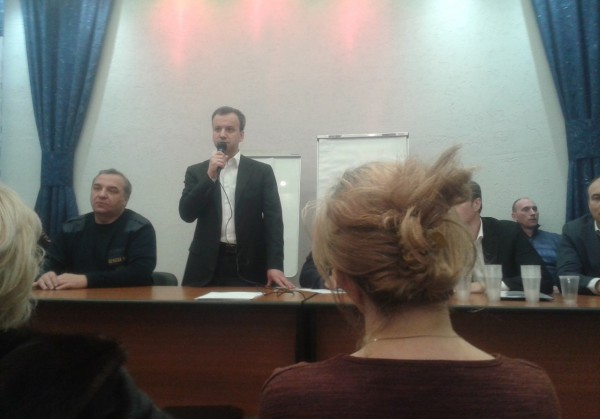
Deputy Prime Minister Arkady Dvorkovich, speaking at meeting with relatives of miners who perished in the Severnaya coal mine in Vorkuta, Komi Republic. Photo courtesy of medialeaks.ru
Russian Deputy Prime Minister Arkady Dvorkovich, speaking at meeting with relatives of miners who perished in the Severnaya coal mine in Vorkuta, Komi Republic. Photo courtesy of medialeaks.ru

Greg Yudin
March 3, 2016
Facebook

The transcript of Deputy Prime Minister Arkady Dvorkovich and Severstal president Alexei Mordashov’s meeting with relatives of miners who perished in the recent coal mine disaster in Vorkuta makes for hellacious reading. It is like the last circle of hell.

I won’t even mention the fact they did not want to take any responsibility for the incident, that it was their incompetence which lead to the deaths of rescuers, and that they covered for a flagrantly brutal system in which miners were forced to turn off sensors and worked like slaves.

But these people really, seriously consider themselves heroes, because they came to the meeting with the unfortunate relatives.

Dvorkovich: You know, many people tried to dissuade me from coming here and traveling here at all, because it is incredibly difficult, really difficult. Nevertheless, my colleagues in the republic and I decided we had to share this grief along with you.

I can just imagine the “many” people who tried to dissuade Dvorkovich.

“Arkady Vladimirovich, what is with you? Why are you going there? There are those stupid widows there. They don’t understand a thing, and they cannot control themselves. How are you going to help them? All the orders have been given already. They will get the money, bawl a bit, and calm down. Dmitry Anatolyevich is not insisting that you go. As it was, we were planning to order a table at a restaurant and drink a toast for the greatness of Russia and our common victory in this difficult time. Well, and we would drink a toast for the dead miners, too, of course.”

“No, I have to go! Of course I know it will be hard for me, very hard. I must show the country’s leadership is mindful of the common people and shares their pain.”

“Oh, Arkady Vladimirovich, what heroism! You’re a hero. It is people like you who make Russia strong.”

You get the sense they flew in from another planet. Why do miners tamper with the sensors? What do you say? They are afraid of losing their jobs? Let them find another job! We have a free labor market. Loans, you say? You cannot afford to buy an engagement ring? So who forced you to take out a loan?

Mordashov: Well, you know, coming to see you all was a personal choice for each of us. Those of us present here made this choice. We cannot force anyone else to make it.

How has it happened that Russian officials and fat cats have come to think they could choose not to come and talk with the relatives of victims, that it is their “personal choice”? I remember quite well how twenty years ago or so Prime Minister Chernomyrdin talked with terrorists to save people’s lives, but nobody reported that it was his “personal choice.” Because it was his job.

But now a billionaire from the Forbes list and a guy who has spent the better part of his life as a government minister say with a straight face that after a disaster involving dozens of victims it is okay not to come and explain themselves, and that basically they are doing people a favor by traveling from Monaco or wherever they live and stopping by this godforsaken mine.

Actually, it isn’t difficult to understand why these bastards consider themselves heroes. Because hiding behind them is a man who sixteen years ago, when the Kursk sunk, was so frightened he went into seclusion for several days, but then called the widows of the drowned submariners “paid whores.”*

Since then the country has been ruled by men and women incapable of sharing the grief of their own people in a way that at least would appear convincing, because they fear and despise the people.

Translated by the Russian Reader

*The new Russian president grew particularly irate early in his tenure when the submarine Kursk sank in the Barents Sea in August 2000 and Russian television aired tough reports about the government’s slow response and dishonest public statements. Even state-controlled Channel One, under Berezovsky’s control, broadcast critical segments, including interviews with the wives of Kursk sailors distraught at the way the situation was being handled

Outraged, Putin called personally to rail about the report and accuse the journalists of faking it. “You hired two whores … in order to push me down,” Putin exclaimed, as former anchor Sergei Dorenko remembered it. Dorenko was taken aback. “They were officers’ widows,” he said, “but Putin was convinced that the truth, the reality, did not actually exist. He only believes in [political] technologies.”

Putin’s anger boiled over at a closed-door meeting with relatives of the crew six days after the submarine sank. When fuming relatives shouted him down, saying they knew from television that the Russian government had initially turned down foreign assistance, Putin bristled.

“Television?” he exclaimed. “They’re lying. Lying. Lying.”

Peter Baker and Susan B. Glasser, “Nuts and Bolts of Project Putin,” Moscow Times, June 8, 2005