
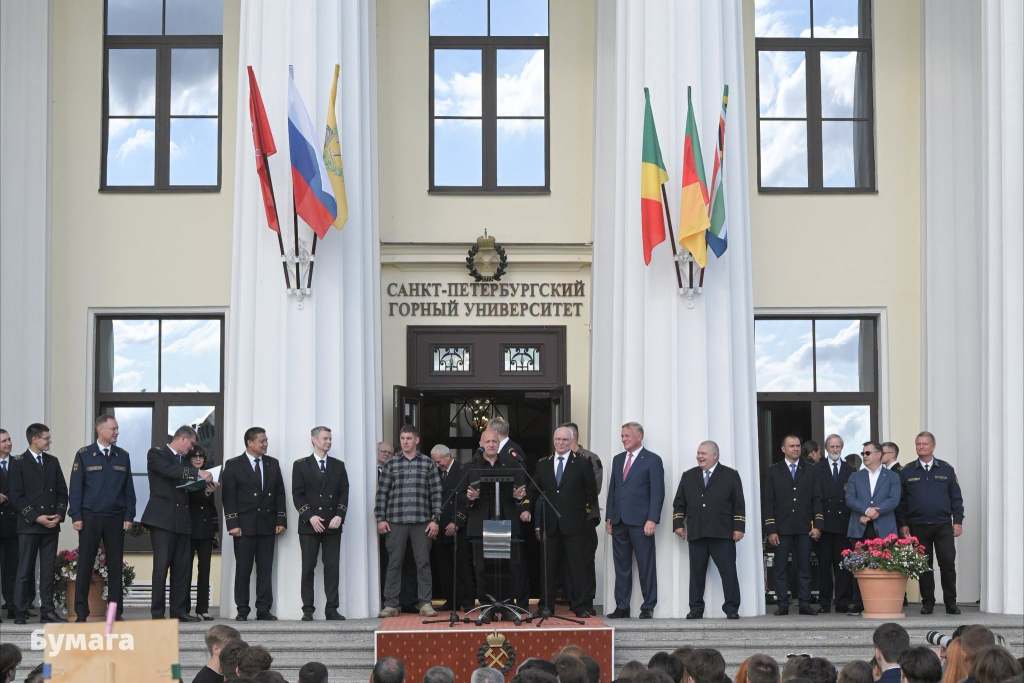
Zakhar Prilepin speaks at Mining University welcome assembly
Zakhar Prilepin was introduced as a “writer and participant in the Special Military Operation,” but was mistakenly referred to as “Prigozhin,” so he corrected the master of ceremonies, our correspondent reports.
Prilepin told the students that emigrating after receiving an education at the Mining University would be an act of treason.
“If you take your knowledge beyond the borders of this country, beyond the bounds of our national science, you will betray all those who stand beside you. I hope there is no one here like this, but some of you might secretly be thinking, ‘I was born so intelligent, I am so wonderful and gorgeous, and basically I’m entitled to everything, that I’ll just pack my bags and go off somewhere where they’ll pay me more for my brains.’ Please understand that this is a treachery against those people who have conquered and cultivated this vast expanse,” Prilepin declared.
Prilepin was the third to speak, after Rector Vladimir Litvinenko and one of his vice-rectors. On stage, the writer stood next to Litvinenko.
Source: Bumaga (Facebook), 1 September 2026. Translated by the Russian Reader
A wave of false bomb threats triggered mass evacuations at schools, kindergartens, hospitals and museums across at least nine Russian regions, local officials and media reported Tuesday.
In the Leningrad region, Governor Alexander Drozdenko said “a dozen” schools, kindergartens and hospitals responded to bomb scares. The hoaxes came amid Day of Knowledge celebrations that mark the start of the new school year every Sept. 1.
“We can’t ignore these threats, even though we understand the enemy’s goal to… ruin the holiday for children and adults,” Drozdenko wrote on Telegram, likely a reference to Ukraine.
St. Petersburg and Leningrad region police told the Fontanka.ru news outlet that “more than 100 institutions” received false threats.
In Moscow, at least four museums, including the Pushkin State Museum of Fine Arts, evacuated visitors or temporarily closed for what they called “technical reasons.”
A government building in the Far Eastern Zabaikalsky region and a number of hospitals in the central republic of Tatarstan were also reportedly evacuated.
Fake bomb threats were also reported across the Ural Mountains, the Yamal-Nenets autonomous district, the Orenburg region and the Krasnoyarsk region.
Mass bomb threats, which the Kremlin referred to as “telephone terrorism,” have periodically plagued Russian cities in the years before and since the full-scale invasion of Ukraine.
Source: “Bomb Threats Force Evacuations at Russian Schools,” Moscow Times, 1 September 2026
Prilepin greeted the 2014 ‘Russian Spring’ with delight as the realisation of long-held hopes for a resurgence of Russian power. He hailed the Crimean annexation as a vital turning point in Russia’s post-Soviet history, marking an end to the dominance of what he called the ‘hysterical’ domestic media coverage of the Russian military campaigns in Chechnya and Georgia, and expressing the hope that ‘the Crimean story will give a kind of super-brutal revolutionary impulse inside the country, so that it undergoes a metamorphosis’. Prilepin has been actively involved in the Donbas conflict, initially as a war correspondent and as an activist organising charity rock concerts in aid of the pro-Russian side and delivering humanitarian supplies to the local population. From 2015 to mid-2018 Prilepin was employed as adviser tothe head of the self-proclaimed Donetsk People’s Republic (DNR), Aleksandr Zakharchenko; in a move that has prompted speculation and conspiracy theorising when, Prilepin, citing health problems, left Zakharchenko’s service a few weeks before the latter was assassinated in August 2018. Apparently on commission from Kremlin ‘grey cardinal’ Vladislav Surkov, Prilepin published a popular biography of Zakharchenko in 2016.
In early 2017 Prilepin’s involvement in the war moved to another level after he announced that he was forming his own battalion to fight in the Donbas for the DNR. This led to his being hailed in the newspaper Moskovskii komsomolets as not just both writer and soldier, but also ‘perhaps, a prophet’; the popular tabloid Komsomol’skaia pravda described him as a ‘hero of our time’ for the 2000s, and the‘Byron of Donetsk’. Other commentators predicted that Prilepin would write ‘the first great novel’ about the war in the Donbas, which ‘our children and grandchildren will use to study the history of the second decade of the 21st Century’. Prilepin followed up his announcement with an online videoclip in which he held up a peace sign and delivered a mock-serious speech about the writer’s duty to oppose war, before tearing up the peace sign and ordering his men to open fire on Ukrainian positions.
Source: Julie Fedor, “Spinning Russia’s 21st Century Wars: Zakhar Prilepin and His ‘Literary Spetsnaz.’” The RUSI Journal, vol. 163, no. 6 (December 2018): 20–21. https://doi.org/10.1080/03071847.2018.1562015.