On 25 July [2026], the Russian Cultural Heritage Festival [sic] took place at Fort Ross[State] Historic Park in California for the first time in six years, with the involvement of [Nina Abramian], cultural attaché from the Russian Embassy, whom the U.S. State Department had authorized to travel from Washington, D.C., to San Francisco for the occasion.
This revived unique celebration, designed to keep alive the historical memory of Russian America, brought together our compatriots and concerned Americans from across the United States, as well as members of Indigenous tribes.
Ninety-nine-year-old Otis Parrish, chief [sic] of the [Kashia Band of Pomo Indians], was invited as guest of honor to the celebration, which featured performances of folk songs, Russian cuisine tasting, displays of arts and crafts, and a round dance set to the music of traditional instruments.
Guests immersed themselves in an atmosphere of unity and a sense of connection to Russian history. The legendary settlement on the coast of Northern California, 140 kilometers north of San Francisco, and founded on 11 September 1812 by the Russian-American Company for fur hunting and trade, was a part of this history.
Ivan Kuskov, an explorer, merchant, and government official, was appointed commandant of the colony. Under his command were twenty-five Russian colonists and eighty Aleuts who had arrived from Russia’s colonies in Alaska. Construction, however, was only possible after Kuskov obtained permission from the indigenous people, the Kashaya Pomo tribe, to use the land for the settlement.
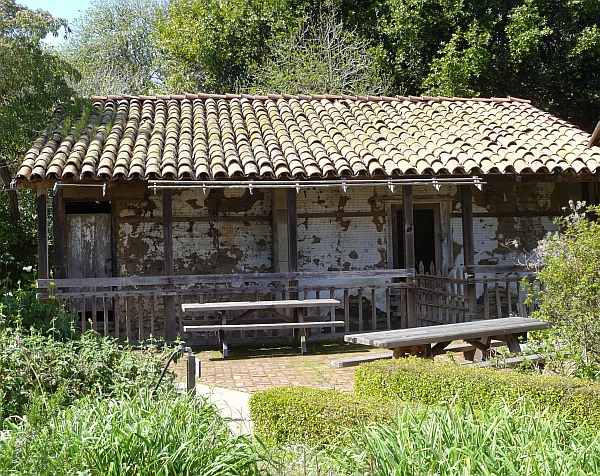
Despite the passage of time and the ocean winds, the fort’s original structures—the administrator’s house, outbuildings, and defensive towers—have survived to this day. In its time, Fort Ross was a hub of innovation: California’s first windmills and shipyards were built there.
These historic sites were at the heart of the plot of Alexey Rybnikov’s renowned [rock] opera Juno and Avos, and they inspired future generations to create works of art, including the famous portrait of Conchita Argüello by the Russian painter Anatoly Sokoloff, which the artist’s family donated to the State Historical Museum in Moscow in September 2001.
As Fort Ross approaches its 215th anniversary, which will be celebrated in September 2027, it remains in operation. It attracts tourists, scholars, historians, and politicians, serving as a reminder of Russia and America’s shared historical and cultural heritage and the significant contribution of our fellow countrymen to the conquest of America, while remaining a vivid example of the intersection and peaceful, harmonious coexistence of diverse cultures, beliefs, and traditions.
We are grateful to everyone who sincerely contributes to the preservation of this unique architectural landmark. Preserving the memory of the shared milestones in the history of Russia and the United States is an important element in restoring an atmosphere of trust and mutual understanding between our nations and peoples.
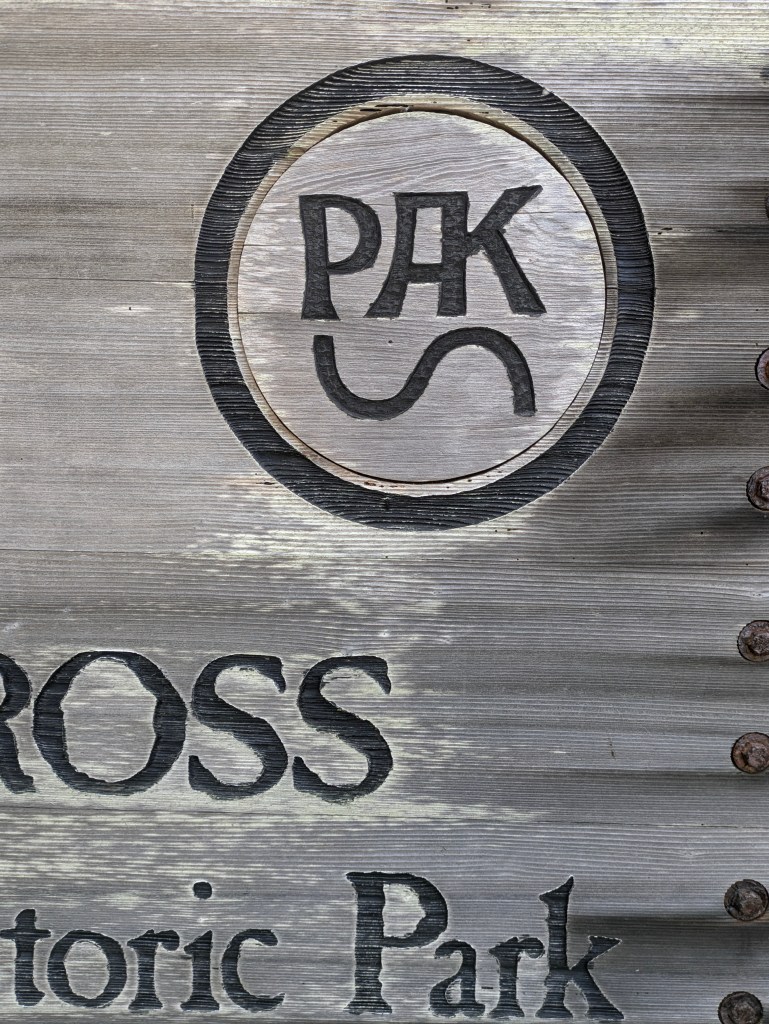
In love, Cancer? The Russian-American Company’s logo (RAK) on signage at Fort Ross State Historic Park in Sonoma County, California. Photo by the Russian Reader
Is it true that not only Alaska, but other huge territories of the American continent were Russian? Yes, its stretched all the way down to Northern California. And Fort Ross, Russian fortress and settlement of the early 19-th century, which still located 90 miles north of San Francisco, on the banks of Russian river at that time marked the southern border of the Russian Empire. At the peak of its power Russia suddenly abandoned its colonies. Why? What happened? In our days, an international TV crew arrived at Fort Ross National [sic] Historic Park to make a documentary. Dmitry-Russian reporter already famous in his country, Margo, long legged sound engineer, very pretty, and very independent American girl in her twenties, and videographer Jeff, the guy from Brighton Beach, Brooklyn, same age as Margo-meet in New York and soon became friends. As a result of the mysterious anomaly, Dmitry was thrown into the past. Into the Fort Ross of 1820s, where he saw a thriving international community of the colonists: Russians, Aleuts, Native Americans, Spaniards. Ripening field of rye, peach orchards, vineyards, flocks of sheep and herds of cattle. In the bay, merchant’s ships at anchor, waiting for the goods to be loaded-paradise and nothing else. To his surprise, he found out that his ability to travel in Time happened because of the strange malfunctioning of his iPhone. How great it would be to take a few real historical shoots from the past! However, soon he will realize that what they have in their hands is much more serious than just an opportunity to make an unprecedented documentary footage. Why not try to change the Future itself? But in favor of what country, Russia or America? It’s not an easy question to answer. Dmitry, taken aback by this unknown to him chapter of Russian history, sees the new opportunities for Mother Russia. Margo, as an American, is very disturbed. She, who has an Indian blood in her veins, knows pretty well what awaits her people. On the other hand, she fascinated by the peaceful coexistence of Russians and local Kashaya tribe. As for Jeff, he is just torn apart between his pledge to his new homeland, his Russian origin, his new friend and his new love for Margo. Not being able to resolve all these issues at once, friends decided to disguise themselves as Franciscan friars and Margo as an Indian girl, and go for the brief exploration into the Past. And return to modern time, as quickly as possible. But Fate had other plans for them. This description may be from another edition of this product.
Native American reaction to the establishment of Ross appears to have been favorable in the initial years of occupation. In 1811, Kuskov arranged for the construction of the settlement adjacent to the Kashaya village of Mettini. Apparently, the Russians purchased rights to the Ross vicinity from a local chief, Pana-cuc-cux, for three blankets, three pairs of trousers, two axes, three hoes, and some beads, although K[i]rill Khlebnikov noted that the Pomo village at Ross was called Mad-shui-nui, and that the chief who ceded it to the Russians was named Chu-chu-san. […] In 1817, Lieutenant Captain Leontii Hagemeister visited Ross in order to extend and formalize the agreement with the Pomo. A number of prominent Pomo and Coast Miwok headmen, including the chiefs Chu chu-san and Vale-lie-lie, met with Hagemeister and agreed to the Russian’s request for a formal agreement. The arrangement that resulted from this effort represents one of the few official treaties ever made by a Euro-American power with a California Indian tribe. In 1825, Governor Muravyov visited Ross and met with Mannel, a local Pomo chief, in order to reconfirm the Russian treaty. The Russians also arranged an agreement with the Bodega Miwok in order to develop Port Rumyantsev on Bodega Bay. Rights to Bodega Bay were purchased from the Bodega chief, Iollo, for an Italian-style cape, a coat, trousers, shirts, arms, three hatchets, five hoes, three files, sugar, and beads.
Source: E. Breck Parkman, “Fort and Settlement: Interpreting the Past at Fort Ross State Historic Park,” California History, 75.4 (Winter 1996/1997), p. 359
Source: Kan, S. (1991). The Khlebnikov Archive: Unpublished Journal (1800-1837) and Travel Notes (1820, 1822, and 1824). Edited, with introduction and notes, by Leonid Shur. American Indian Culture and Research Journal, 15.4. http://dx.doi.org/10.17953
As Mission Santa Cruz developed following its establishment in 1791, the coastal terrace lands to the north as far as Point Año Nuevo became the mission’s main livestock grazing lands. Rancho Arroyo del Matadero (“Stream of the Slaughtering Ground Ranch”) was one of four mission cattle ranches strung along the coast. In 1839, the former ranch lands were granted to the three Castro sisters: María Candida, Jacinta, and María de los Angeles Castro. The three were daughters of José Joaquín Castro (1768–1838), deceased grantee of Rancho San Andrés. Candida Castro married José Antonio Bolcoff in 1822.
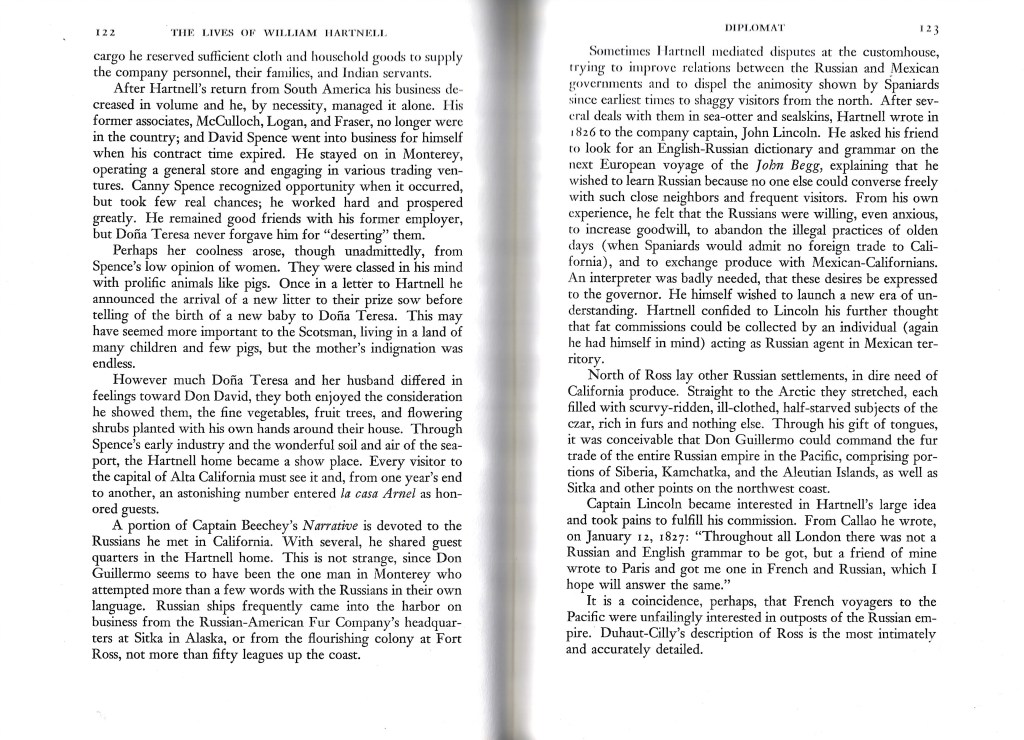
José Antonio Bolcoff (1794–1866) was born Osip Volkov in Petropavlovsk-Kamchatsky, Siberia. Working for a Russian fur trading company, Bolcoff deserted a Russian ship at Monterey in 1815. After arriving in California he quickly assimilated into the Spanish culture, using the Spanish name José Antonio Bolcoff. Bolcoff acted as an interpreter for Governor Pablo Vicente de Solá. In 1822, Bolcoff settled in Branciforte and was alcalde in 1833. In 1833, Bolcoff was granted Rancho San Agustin, which he sold to Joseph Ladd Majors (1806–1868) in 1839. Majors married Bolcoff’s sister-in-law, María de los Angeles Castro (1818–1903). Jacinta Castro lived with the Bolcoff family before joining the convent at Monterey. In 1839, Bolcoff replaced Francisco Soto as administrator of Mission Santa Cruz.
Bolcoff’s name is not mentioned in the original grant, but he took control of Rancho Refugio in 1841. Bolcoff transferred the title to Rancho Refugio to his two sons, Francisco Bolcoff and Juan Bolcoff.
With the cession of California to the United States following the Mexican-American War, the 1848 Treaty of Guadalupe Hidalgo provided that the land grants would be honored. As required by the Land Act of 1851, a claim for Rancho Refugio was filed with the Public Land Commission in 1852, and the grant was patented to Francisco and Juan Bolcoff in 1860. A claim by Joseph Ladd Majors and his wife, María de los Angeles Castro, for one-third of Rancho Refugio filed with the Land Commission in 1852 was rejected.
Here we must name the people on the Ilmena who were captured along with Elliot and who were mentioned in the journal: Fyodor Sokolov, Dmitry Shushkov, Pyotr Druzhinin, “the American-Bostonian Lisa Cole,” Osip Volkov, and Afanasy Klimovsky. Klimovsky was obviously the future famous explorer of Alaska. As for Osip (aka Joseph and José) Volkov, he was a well-known figure in California, where he found his second home and lived a long life (he died in 1866). The Russian administration ultimately took a lenient view of Volkov’s sojourn in California, where he could be useful to the RAK. Governor Yanovsky, using Volkov’s case as a pretext for Khlebnikov’s visit to Monterey in 1820, enabled Volkov to be issued a “residence permit.” The report in the journal refutes the widespread misconception that Volkov jumped a Russian ship.
Elliot reports that “Afanasy and Osip” lived in Lieutenant Gomez’s house. The order in which Antipater Baranov lists the captured prisoners may indicate their ethno-social status: first come the Russians, then the American, and then Klimovsky and Volkov, both Creoles. The fact that Volkov was a “Creole” who also had a poor command of Russian (“little knowledge of the Russian language”) is reported by L[eonty] Hagemeister, who spoke with him directly during a visit to San Francisco in 1817.