Russian Colonizers and Indigenous Siberian Women

GLC@Lunch: “Trade in Women, Concubinage, and Marriage: Relations Between Russian Colonizers and Indigenous Women in 17th-Century Eastern Siberia”

Rosenkranz Hall • 115 Prospect Street, New Haven CT, 06511 • Room 241

Register for this event

Wednesday, April 29, 2026, 12:30—1:45pm | Hybrid

In person at Yale University, Rosenkranz Hall, Room 241, 115 Prospect Street, New Haven

Online via Zoom

Note: In-person seating is limited and available on a first-come, first-served basis.

Angelina Kalashnikova (GLC Visiting Fellow; Kiel Training for Excellence Fellow, Christian-Albrechts-Universität zu Kiel)

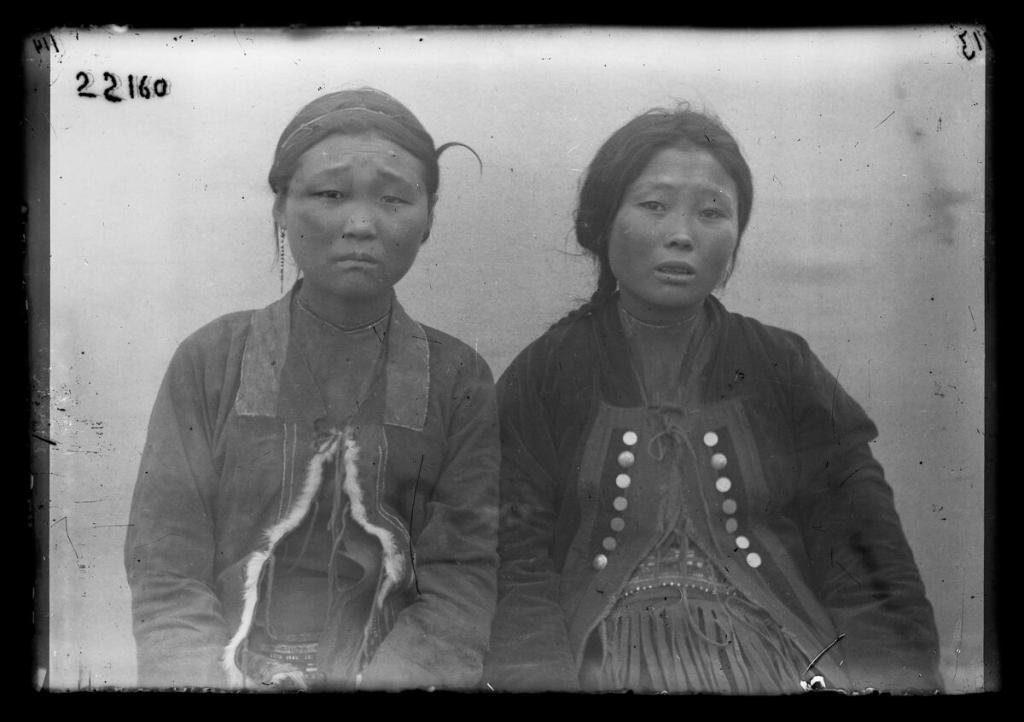
This presentation introduces a book project on the first decades of Russian colonization in Eastern Siberia, present-day Yakutia. Rather than framing colonization solely as a process of conquest and political alliance-building, the project foregrounds intimate and gendered entanglements between Russian newcomers and Indigenous communities. Russian fur traders, trappers, and military servitors typically arrived in the region without families and encountered Yakut, Tungus, Yukaghir, and Even populations. The resulting gender imbalance among settlers quickly made the trade in Indigenous women a profitable enterprise. At the same time, commercial transactions sometimes culminated in Orthodox marriages, blurring the boundaries between coercion, commerce, and social integration. By examining these practices, the study explores how racial, cultural, and religious boundaries were negotiated in everyday interactions between Russian colonizers and Indigenous societies in seventeenth-century Eastern Siberia.

Source: Gilder Lehrman Center for the Study of Slavery, Resistance, and Abolition at Yale University


How did Russians obtain local women?

There were three ways to acquire women in Eastern Siberia. The first was as the outcome of military expeditions, sometimes referred to as ‘pogroms’ in the documents. When Russian troops attacked local settlements or nomadic camps and emerged victorious, they would seize women, children, and cattle as spoils of war. Enslavement of women during times of conflict had deep roots in Siberian history. Historical documents provide numerous accounts of inter-ethnic military clashes that resulted in the plundering of the defeated, particularly involving the capture of women, children, and cattle.

A petition from 1642 for the baptism of a Yakut woman named Katok includes Katok’s explanation of why she desired to convert to Orthodoxy where she shares her life story. She recounts that she could not recall her father’s name as she was taken by Russians during a ‘pogrom’ when she was only a child. She further explained that she had previously lived ‘among Russians,’ but that she now has nothing to eat or drink and was starving to death. In short, Katok was forcibly captured from her community as a child, likely being one of those taken as trophies from the defeated local community.

Another form of enslavement in Siberia involved trafficking, where local people would sell their relatives to Russians. Sometimes the locals would sell their women to combat poverty. Gurvich mentioned that the Yukaghirs of Yana River sold their maidens and children to Russians because of hunger in 1659. However, the women sold to Russians were not always orphans or from poor families. There are documented cases where individuals of higher social status willingly sold their daughters. For instance, local prince Orgui sold his daughter Mychak to a Russian serviceman for a cow.

Russians did not necessarily purchase or capture local women in battle; sometimes they acquired them without any effort or payment. One such case is preserved in historical documents. It tells the story of Ladchka, a Yakut woman who was abandoned by her husband and left with no means of support. She sought refuge in the Russian camp and resided there for two years before eventually being brought to Yakutsk with her child in 1643. During her interrogation, Ladchka revealed that she had been a slave (‘yasyr’) of the fur trader Oderka Martemyanov. She had a child with him and expressed her desire to be baptised. It appears that Martemyanov acquired this woman without any cost, lived with her for a period, and then seemingly cast her aside.

Source: Angelina Kalashnikova, “Trafficking of Women in 17th-Century Siberia,” in Daniel Domingues da Silva, Hans Hägerdal, Angelina Kalashnikova, and Filipa Ribeiro da Silva, eds., Colonial Encounters and Slavery in Early Modern Asia, Leiden University Press, 2025, pp. 32–33

Free Sergei Nikiforov!

Free Sergei Nikiforov!
Natalya Kalinina
November 6, 2015
Amur.Info

On November 5, 2015, a public event in support of a political prisoner was held in Blagoveshchensk, administrative center of the Amur Region. It took place a week after Russia commemorated the Day of Remembrance of the Victims of Political Repression, a week after Amur Regional Governor Alexander Kozlov had told the region’s residents, “Today’s date reminds us of the innocent victims of injustice, false accusations, and ideological wars. Our duty is to preserve the memory of the victims of insane political terror so that such things never happen again.”

No, today’s subject is not a rally in memory of the martyred victims of political repression in the Gulag during the distant 1930s, 1940s, and 1950s.

It is more trivial and terrible. Evenki leader Sergei Nikiforov has been thrown in prison after leading a protest movement of his tiny people in the Selemdzhinsk District. As village head, he had been organizing resistance to the expansion of gold mining companies attempting to take over tribal reindeer pastures and hunting grounds.

Sergei Nikiforov. Photo: Ampravda.Ru

Earlier, attempts by district and regional officials to close the village’s Evenki ethnic kindergarten were thwarted. Of course, without the unanimous support of his fellow villagers, Sergei Nikiforov could not have done this. But officials understood they would be unable to quietly seize Evenki lands, a real Klondike for miners, while the Evenki had such a “chief.”

Blagoveshchensk City Court sentenced Nikiforov, the father of five adopted children, to five years in a maximum security prison and a fine of 16 million rubles [approx. 232,000 euros] for bribery and embezzlement. The fellow villagers who were present in the courtroom have reached their own conclusions about the court’s bias. The court disregarded all the particulars that pointed to the defendant’s innocence, for example, the fact that at the time the bribe was made in Blagoveshchensk, Nikiforov was in Ekimchan, administrative center of the Selemdzhinsk District, hundreds of kilometers away, and the fact that the only witness was unable to identify Nikiforov in court and testified she did not know the man. Nor was the bribegiver arraigned. According to the Evenki, the trial was clearly a frame-up.

Nikiforov was convicted in Blagoveshchensk in late October of this year. On October 3, all the residents of his native village of Ivanovskoye who were not out on the hunt attended a protest rally in defense of Sergei Nikiforov.

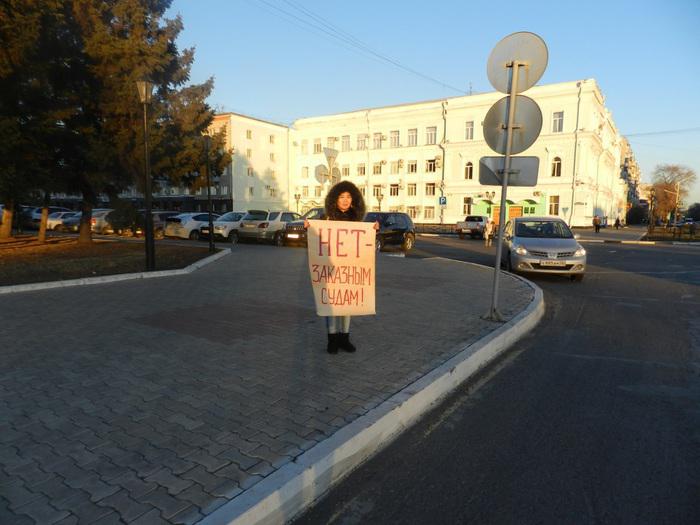
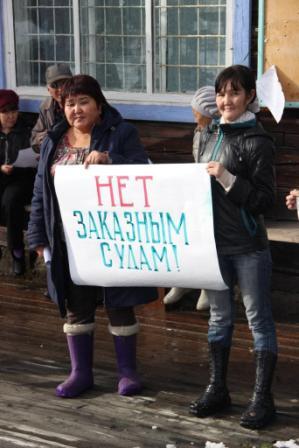
"No to kangaroo courts!" Residents of the village of Ivanovskoye demonstrate in support of Sergei Nikiforov
“No to kangaroo courts!” Residents of the village of Ivanovskoye demonstrating in support of Sergei Nikiforov, October 3, 2015

You cannot fool the people. If the village head had really been stealing money from the already meager village budget, who would have come out to support him?! You cannot hoodwink villagers, as people who have lived there would know.

After the protest, the regional authorities kept a low profile. Nowhere in the media did anyone comment on the trial of the disgraced village head. A small group of Evenki woman managed to travel to the regional center, overcoming hundreds of kilometers of bumpy roads on an UAZ off-road vehicle.

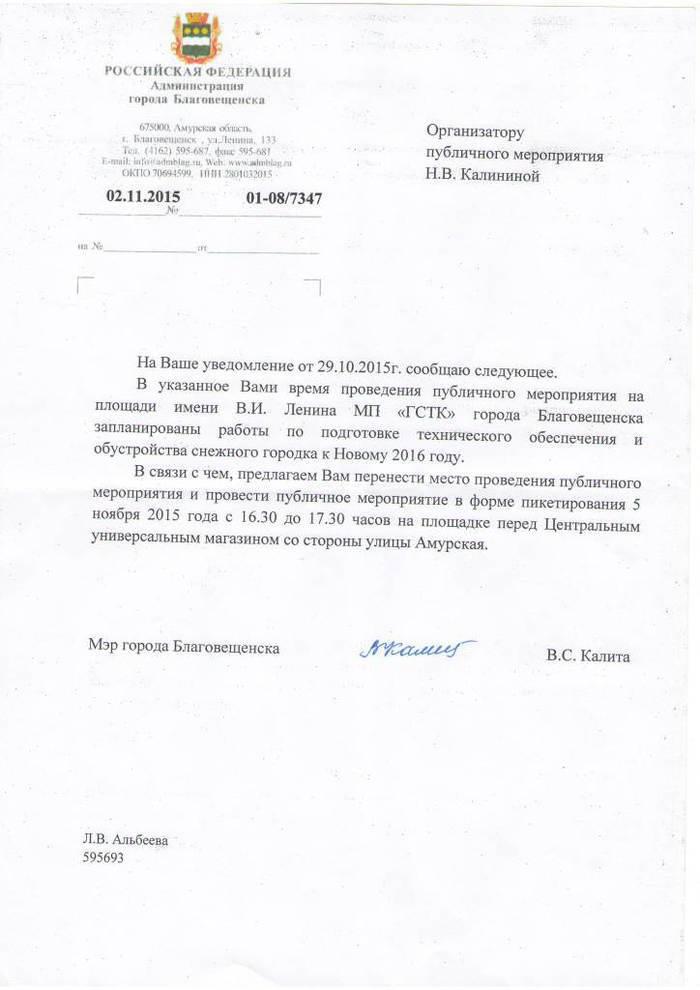
The Amur branch of the Yabl0ko Party gave due notice of plans for a protest rally on Lenin Square. Officials made a fuss. None of them wanted to see Evenki waving placards under the windows of the regional government house. I was contacted and asked to move the protest behind a department store, “out of sight of the authorities.” Clearly, it would have been pointless to protest behind a department store. So we were forced to to alter the format of the protest, but not the purpose and place.

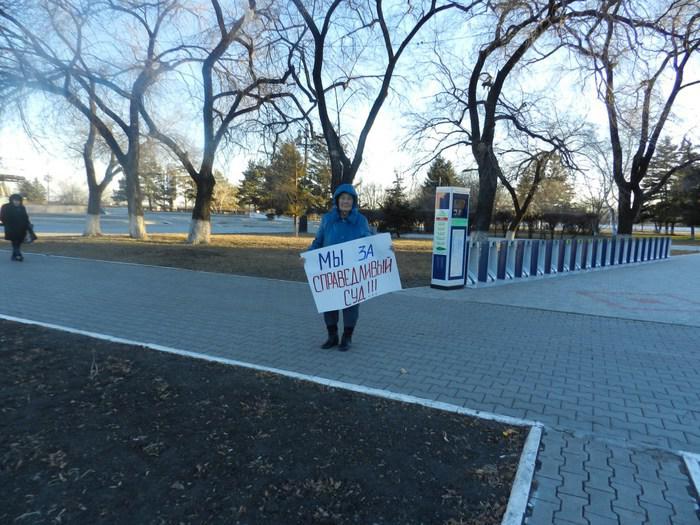
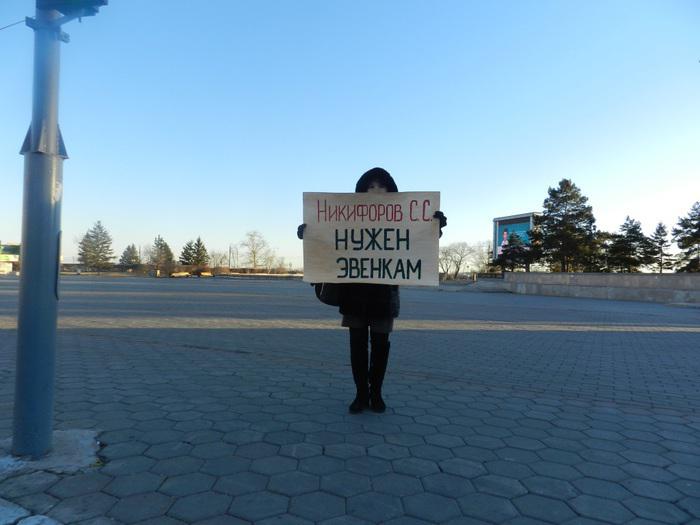
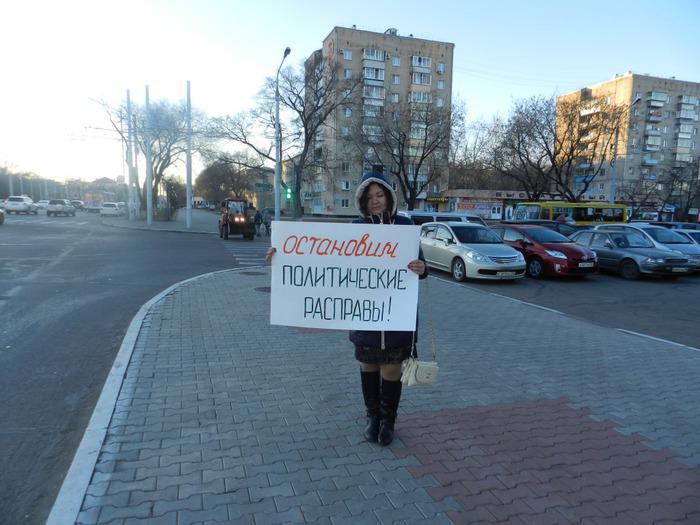
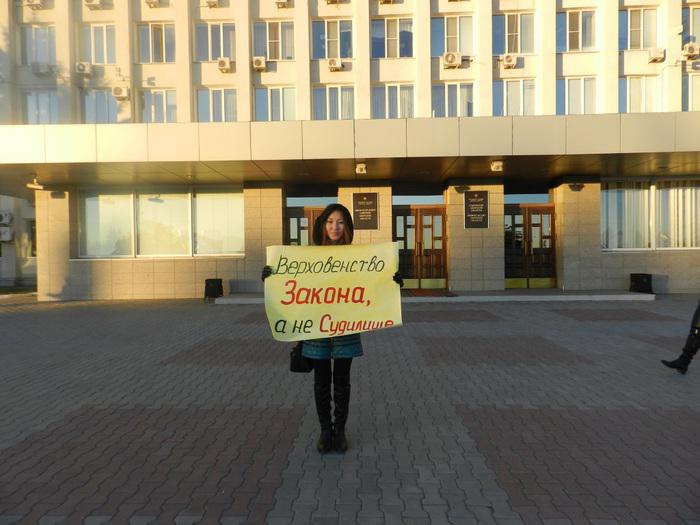
We held a series of solo pickets in downtown Blagoveshchensk. People stood alone at a distance of a several dozen meters from each other on both sides on Lenin Street in the vicinity of the eponymous square. Just opposite the windows of the regional government house, legislative assembly, and the public reception office of the Russian President stood women (wives and daughters of hunters and reindeer herders) holding placards with the slogans “The Evenki need S.S. Nikiforov,” “Free Sergei Nikiforov,” “Sergei Savelyevich, we are with you!” “We ask the Russian federal authorities to pay attention to the criminal case of S.S. Nikiforov,” “We want a fair trial!!!” “No to kangaroo courts!” “The rule of law, not a tribunal!” and “Put an end to political reprisals.” They hoped to attract the attention of authorities to the injustice perpetuated in the Amur Region.

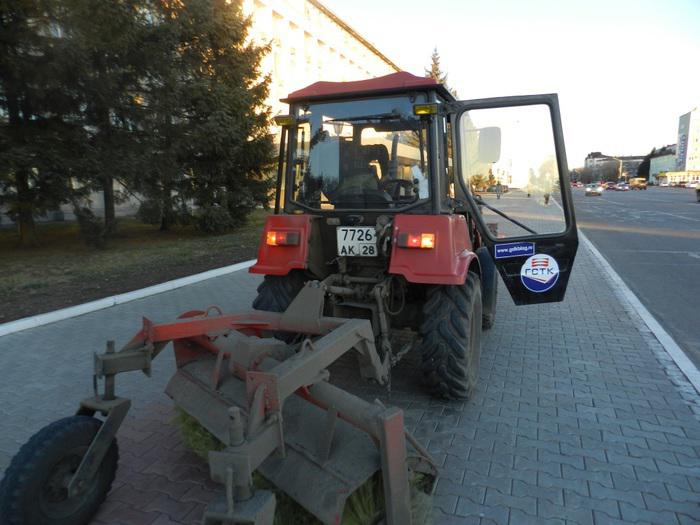
The reaction of officials was unexpected. No, neither the governor nor lawmakers came out to meet with their constituents. Nor did the chair of the regional court or the prosecutor show up. No, it was much more tedious. Frightened by the female protesters, the officials summoned several pieces of maintenance equipment from the City and Trade Services Center Municipal Enterprise (MP “GSTK”). A tractor drove on the sidewalk back and forth exactly where the protesters were standing. At times we imagined that the driver (a young chap with a brazen face) was defiantly trying to run over the small, fragile women, who would barely dodge out of his way. The oldest protester later said that she had physically sensed the tractor was about to run her over. It was noticeable that the moron behind the wheel was clearly getting some kind of sadistic thrill from his attacks on the defenseless women. Despite the fact the tractor was driving on the sidewalk, no special warning signs had been set up to this effect.

As soon as the picket ended, and the protesters left the square, the special maintenance equipment hastily turned around and drove away. By the way, the policemen on the square were quite polite. They were not at all keen to detain us “protestants,” apparently supporting us in their hearts.

Of course, it is too early to say that a protest rally was held and Nikiforov will be released tomorrow. Of course, that will not happen. We need to do much more. Maybe the next item on the agenda is a trip by Evenki to the capital and pickets on Red Square? In any case, people are becoming citizens and learning to assert their rights in practice. That is worth a lot!

"We want a fair trial!"
“We want a fair trial!”

amur-2
“We ask the Russian federal authorities to pay attention to the criminal case of S.S. Nikiforov.”

amur-3
“The Evenki need S.S. Nikiforov.”

amur-4
“Sergei Savelyevich, we are with you!”

amur-5
“Put an end to political reprisals!”

amur-6
“The rule of law, not a tribunal!”

amur-7
“No to kangaroo courts!”

amur-8
“Free Sergei Nikiforov!”

N.B.  I wish to inform Valentina Kalita, mayor of Blagoveshchensk, and MP “GSTK” head Igor Banin, United Russian party members and partners of ex-mayor Alexander Migulya, now under investigation, that actions aimed at disrupting a public event (to which every citizen of Russia has a constitutional right!) are covered by Article 149 of the Russian Federal Criminal Code (“Obstruction of assemblies, rallies, demonstrations, marches, and pickets or involvement in them”).

Finally, Igor Banin, the driver of the tractor, who spread dust and rubbish over the square today, deserves a bonus. The lad tried really hard to carry out your orders (which had nothing to do with the cleaning the sidewalk, as you know).wink

The wild municipal services tractor
The wild Blagoveshchensk municipal services tractor and street sweeper

letter
A letter from Blagoveshchensk Mayor Valentina Kalita, dated November 2, 2015, and addressed to protest rally organizer Natalya Kalinina, stating that MP “GSTK” had planned to carry out preparatory work for building a “snow fortress” [sic] on Lenin Square for 2016 New Year’s celebrations at the same time as Kalinina and her group had informed the authorities they would be protesting there. Mayor Kalita therefore asks that the venue be switched to the area in front of the Central Shopping Center on the Amur Street side, and that the rally be turned into a series of pickets from 4:30 p.m. to 5:30 p.m. on November 5, 2015.

Translated by the Russian Reader. Thanks to Comrade AD for the heads-up