Independence Day

A roadside fireworks stand in Soledad, California, 28 June 2023. Photo by the Russian Reader

When issuing diplomas, colleges in Ingushetia now require graduates to sign a summons to the army or refuse to accept the conscription notice and face possible administrative and criminal charges, Fortanga was told by a source close to one college.

“To get a diploma, you need to sign a conscription notice. Otherwise, you will not receive a diploma no way no how. Either you accept the conscription notice, or you sign a waiver . That is, accepting the notice means you have to join the army, while turning it down means saying ‘Hello, prison, here I come,'” the source said.

According to the source, the practice was introduced after the director of the college in Nizhnie Achaluki reported, at a meeting involving the head of the republic Mahmud-Ali Kalimatov, that thirty students had been drafted from his institution into the army. Subsequently, military enlistment officers and government officials “jumped on the bandwagon,” the source claims.

Students are being forced to come to colleges in person to get their diplomas, the source added. That is, young men cannot receive them by mail or ask that they be handed over to a family member or a proxy.

When the graduate refuses to sign the conscription notice, a report is immediately drawn up and signed by witnesses. First-time offenders face administrative charges under Article 21.5 of the Administrative Offenses Code (i.e., “Non-fulfillment of military registration duties by citizens”) and a fine of 500 to 3,000 rubles. Repeat offenders face criminal charges under Article 328 of the Russian Federal Criminal Code (i.e., “Evasion of military and alternative civil service”) and a fine of up to 200,000 rubles, forced labor, arrest, or imprisonment for up to two years.

Ingush lawyer Kaloy Akhilgov noted that the legality of such a practice “depends on the procedure for issuing a summons.”

“Educational institutions can only serve conscription notices, not issue them themselves. That is, first the military enlistment office must send the notice to a specific citizen, and after that the organization can hand it to the student,” he explained.

For those who want to avoid receiving a military conscription notice , the lawyer recommended that after completing their bachelor’s or master’s degree, they take postgraduate leave until August 31 and file the relevant paperwork with the military enlistment office. “Then they should not be bothered during the [current] spring conscription drive. And such ‘automatic’ draft notices issued along with diplomas lose their significance,” he added.

Source: “Colleges in Ingushetia only issue diplomas with a summons to the army,” Fortanga, 3 July 2023. Translated by the Russian Reader. Thanks to Marina Ken for the heads-up.


[…]

Mark, 26 years old: a former engineer turned waiter in Yerevan
Before I left Russia I was building a career: I was a senior fire and security systems engineer. Such people are needed everywhere: it’s a fairly good position. I worked in government agencies, so I was served my conscription notice directly at work. However, I had never served in the military: I had a deferment due to health reasons.

That was October seventh: I usually have a hard time remembering dates, but this was like in a movie since it divided my whole life into before and after. At night, I packed all my things and moved to another apartment, then I flew to Turkey and from there to Armenia.

It’s amazing: my grandfather is Armenian, but I had never been to Armenia before then. The authorities have even confirmed that I can get citizenship. But if I get it while I’m still eligible for military service, I will have to serve in the Armenian army for two years. And if you evade military service you can be banned from leaving the country or imprisoned. I went to the local draft board, and they told me straight up: come back in a year to get your citizenship. So that’s what I’ll do.

A short time before the mobilization, I was offered the chance to rent an apartment near Rybatskoye subway station in Petersburg for fifteen thousand rubles a month. I was sitting at the dacha, thinking about how I would rent this apartment, how I would invite friends over to my place—everything was good. But the next day the mobilization was announced, and my parents said to me, “Maybe you should leave?” I thought it over for a long time, and didn’t talk to anyone for several days. Then the conscription notice was delivered. Almost all of my friends supported me [in my decision to leave]. I had this conversation in the smoking room with a colleague, who told me, “I’m not going anywhere, I’ll sue. If push comes to shove, I’ll fight within the system.” In the end, he was drafted.

I had savings, so I didn’t work for six months. I tried to get a job as a technician or engineer in my field, but the old boys network is quite strong in Armenia: it is unlikely that they would hire a person off the street, and one who isn’t Armenian at that. And you need to know Armenian for any serious job. For a while I was depressed that I couldn’t find a job, that I had had everything squared away, but here I was nobody. I was a highly qualified specialist, but now I was unemployed. It was a big blow to my pride. At my old job, they waited another six months for me to return.

At first I went to work as a courier at Yandex Delivery. Maybe it is still possible to do the job on scooters and bicycles, but it is absolutely impossible. I had to walk 40-50 kilometers a day. I came home on the third day, soaked my feet in a basin, and sat there for several hours. There is an inadequate system of fines and impotent support staff that knows nothing. All couriers want to protest, both in Yerevan and in Moscow.

The delivery job was so hard on me that I even wanted to go home. I was in such a depressed state that the part of my brain that is responsible for the comfort zone was activated: “Yes, everything is fine, everything has already quieted down, and I have a home there.” I know several people who have returned [to Russia] after working such jobs. I even called my boss in Petersburg and asked if they’d hired someone to replace me, but they already had.

When you’re getting started in a country, I advise everyone to go to work as waiters. You have to carry plates and interact with people, but we all know how to do that. And you have to memorize the menu. I speak to foreign tourists in English or Russian, and I tell Armenians that I am learning the language, and they are always understanding. I tell them, “Come back in six months, and we’ll chat,” and they’re happy that I’m learning their language. Sometimes even Armenians who don’t know Armenian themselves come in and ask for a Russian menu. I even asked once, “How’s that?”

I think I lucked out: I’m treated well, we have a very friendly atmosphere, the cooks teach me Armenian, and everyone is always supportive and understanding. The money is enough to live on. And they treat me well as a Russian. Today, a client, a friend of the owner, gave me a teach yourself Armenian book in a beautiful paper bag printed with Armenian letters.

Very many young researchers and decent specialists have left Russia. This is sad, of course, but it is natural after such actions on the part of the state. It was pretty hard to swallow the whole thing. You can say it was pride, that, like, you’re going have to work in completely different jobs. I don’t like the buzzword “relocatees”—we are all migrants.

I am learning the language and I can already make myself understood: Armenian is not as difficult as it seems. When I learn the language, I will return to my profession, because it will stand me in good stead wherever I go. Naturally, emigration is not at all what I’d imagined. But this is our new home, and we have to learn to live here. Remarque has a book about emigration, Shadows in Paradise. A lot of people who also moved after wars became very strong personalities: it is an incredible experience. It is so intense that when you look through time into the past, you feel so much more mature, so different as a person, that you regard everything differently. So I’m even grateful to fate for these changes.

Source: Masha Koltsova, “‘I recommend everyone become a waiter after moving to a new country’: men who left Russia due to mobilization on changing professions and living a new life,” Current Time (Radio Svoboda), 3 July 2023. Translated by the Russian Reader


A farewell ceremony was held at the Serafimovskoe Cemetery in St. Petersburg for four soldiers of the Neva Battalion who perished during the special military operation, the governor’s press service reported on July 3. The funeral was attended by the city’s head, Alexander Beglov, and the speaker of the St. Petersburg Legislative Assembly, Alexander Belsky.

The deceased men—Mikhail Sokolov, Roman Galinsky, Mikhail Manushkin, and Sergei Isayko—were posthumously awarded the Order of Courage. In his speech, Beglov said that the men had been killed in heavy fighting.

“They are continuers of Russia’s military glory. We are proud of our fellow townsmen. Petersburg shall cherish their memory,” the governor said.

After the start of the special operation, the Smolny’s press service began publishing news about the deaths of Petersburgers in the Donbas, accompanying them with a mention of the condolences expressed by Beglov. Later, the release of such reports was abandoned for a long time. In December, Beglov unveiled a plaque on the facade of School No. 369 in memory of army officer Alexander Zhikharev, who perished in the SMO. In February, the governor and education minister Sergei Kravtsov met with Zhikharev’s relatives, and in March the school was named in his memory.

Source: “Petersburg says goodbye to four volunteers killed in SMO,” ZAKS.ru, 3 July 2023. Translated by the Russian Reader


In the wake of Zhenya and Sveta’s kangaroo court hearing, what I’ve been thinking about for several days is that we forget the golden rule of all convicts—“Don’t believe, don’t be afraid, don’t ask”—and thus hand them the tool for coercing us.

You can’t show them your vulnerabilities or reveal your desires and fears. (Don’t ask!) This information will be used to intimidate and torture you. (Don’t be afraid!) Or it will be used for bargaining: they will promise to go lighter on you in exchange for your cooperation and will certainly deceive you. (Don’t believe!)

Source: Elena Efros (Facebook), 4 July 2023. Translated by the Russian Reader. Ms. Efros, a well-known human rights activist, is the mother of imprisoned theater director Zhenya Berkovich. Thanks to Ivan Astashin for the heads-up.

How Russians Are Forcibly Conscripted


The Russian security forces have been increasingly organizing dragnets to sweep up potential army recruits. This is occurring amidst a full-scale war with Ukraine in which the Russian army has suffered heavy losses.

There are more and more accounts of these roundups. Mediazona, for example, details how a 25-year-old Muscovite, employed in the IT business in Moscow City, was lured to a meeting with police officers and military enlistment officers through the classified ads website Avito, on which the young man was selling headphones. He was quickly sent to serve in the Moscow Region, despite being diagnosed with bronchial asthma.

The Movement of Conscientious Objectors recounts how the police simply broke into the apartment of conscripts Yevgeny Komarov and Ivan Dubenko and sent them to the assembly point. Dubenko was first strangled, and then, threatened with rape, forced to sign his military service card, as required for conscription.

Another story relayed by the Movement involves a young man with hypertension and anxiety-depressive disorder who went to the military enlistment office to undergo a medical examination and get a postponement, but instead was sent to the assembly point the very same day. Mahmudjon Nurov, on the contrary, was simply detained at the Izmailovskaya metro station and immediately sent to the military enlistment office. In the Kursk Region, the military commissars took an even simpler approach: they allegedly assembled everyone whom the medical commission had declared unfit for service, confiscated their telephones, and sent them off to serve in the army.

The Russian army needs conscripts: during this draft, which lasts until July 15, the authorities have been charged with drafting 150,000 thousand men, and so the military enlistment officers have teamed up with the police to go out and catch potential recruits. The practice is, in fact, illegal, and the prosecutor’s office has repeatedly confirmed this, but the law has not prevented police officers from going to factories and shops in search of young men allegedly fit for service. Fortunately, so far no one has received electronic draft notices through Gosuslugi [the Russian state services website]: they should begin to be issued during the next conscription campaign.

Here is how you can protect yourself as much as possible in the current circumstances:

• Do not go to the military enlistment office in person. Everything you need to learn from them can be done by mail or by an acquaintance with a power of attorney.

• If you are served a draft summons in person (military enlistment offices retain this right), refuse to take it.

• Don’t sign anything and seek legal assistance. You can file a lawsuit appealing mobilization and conscription orders through the bot “I’m Not Going!” While the court is considering your suit, you cannot be inducted into the army.

• Fill out an application for alternative civilian service in advance. Both those who have been served with draft notices and those who have been mobilized have such an opportunity.

Source: “How are Russians forcibly enlisted in the army? What should you do if they try to enlist you?” I Don’t Get It newsletter (Mediazona), 29 June 2023. Translated by the Russian Reader


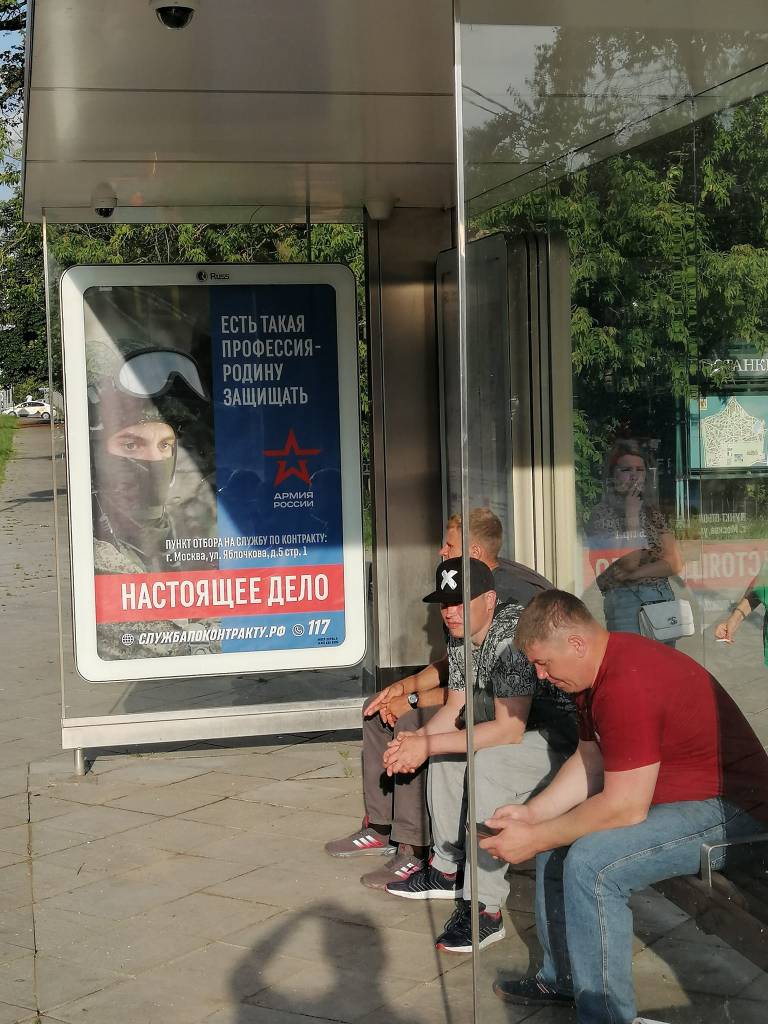
“Defending the Motherland is a profession — a real job.” Frequent TRR contributor Sergey Abashin photographed this Russian army recruiting poster (and several others) in Moscow earlier today.

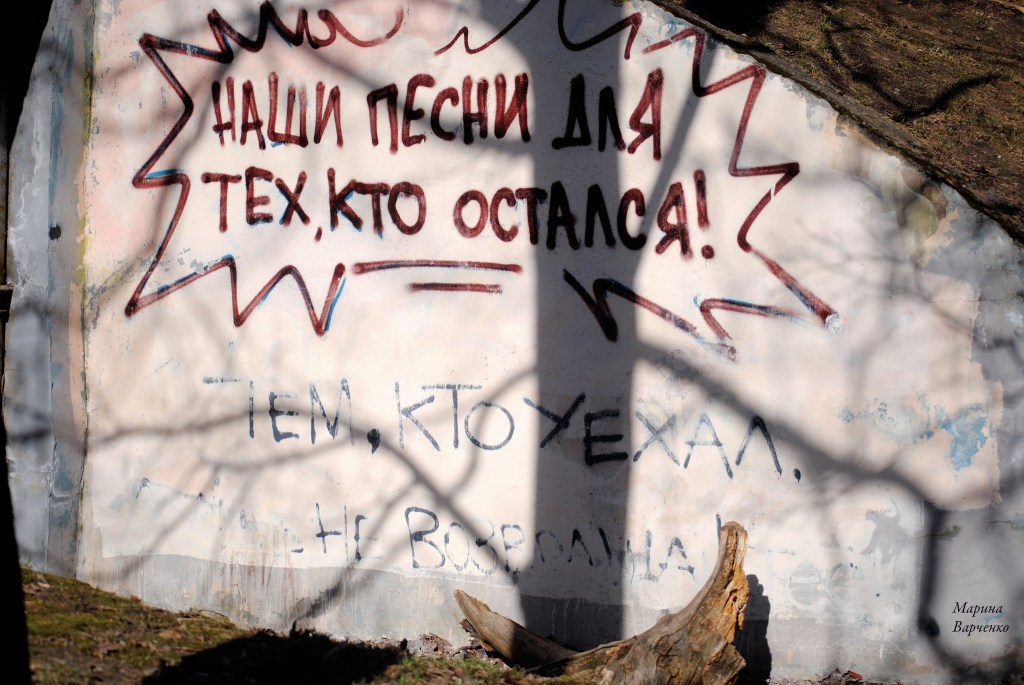
“Our Songs Are For Those Who Have Stayed” (The Russian Draft Goes Online)

“Our songs are for those who have stayed [in Russia]. To those who have left: don’t come back.”
Photographed by Marina Varchenko on Vasilyevsky Island in Petersburg, 13 April 2023

Today, coming out of the front door of my building, I saw the following tableau. A neighbor from the third floor, who is somewhere between thirty-five and forty, was, on the contrary, coming in the front door. Judging by the bag he was carrying, he had just been grocery shopping. He doffed his baseball cap, clamped it under his arm, and crossed himself three times as he looked at the mailboxes. Then he peered into his own mailbox and let out a sigh of relief. His draft notice had not yet arrived, apparently. To be honest, it took a while for the meaning of his maneuvers to dawn on me. Of course, I pretended that I hadn’t noticed any of it.

Source: Marina Varchenko (Facebook), 13 April 2023. Translated by TRR


On Wednesday, April 12, Samara journalist Sergei Podsytnik posted on the website Change.org a petition calling for the repeal of amendments paving the way for the introduction of electronic military draft notices, as passed the previous day by the State Duma and the Federation Council.

“These amendments violate our rights. A citizen cannot be stripped of their rights without a trial, but now this right has been given to the staff of military enlistment offices,” the petition says. Podsytnik draws attention to the fact that the public services portal Gosuslugi, through which it is planned to serve draft notices to Russians, has a number of vulnerabilities. In addition, not all residents of the country have access to their accounts on the portal, and almost thirty percent of Russians over thirty are not active internet users.

According to the amendments as adopted, if a conscript did not receive a paper summons and did not log into his Gosuslugi account, the summons will still be considered delivered within seven days after it was entered into the register of draft notices. He will then be banned from leaving the country. After twenty days, new bans will come into effect: those who failed to report to a military enlistment office will not be able to work as individual entrepreneurs, manage real estate, drive a car, or take out loans.

“To deprive people of the ability to sell real estate, drive a car, or travel abroad at the request of a person with no specialized legal education is an outrage against our rights and freedoms,” the petition says. At the time this story went to press, the petition had been signed by more than thirty thousand people, and their number was growing rapidly. For the amendments to go into effect, they must be signed by Vladimir Putin and published.

Source: Dmitry Vadchenin, “Tens of thousands sign petition against electronic draft notices,” Deutsche Welle, 12 April 2023. Translated by TRR. As of 11:54 p.m. Moscow time on April 13, the petition had been signed by over 94,453 people.


[…]

The legislative changes mean that once a Russian citizen has received a military summons online, they will be automatically forbidden from leaving the country, and therefore avoiding the call-up.

If they fail to appear at a draft office within 20 days, they will face a range of restrictions, including a ban on using their own vehicle, selling property or receiving a loan. They also face a fine of between 500 and 3,000 rubles (£5 to £29).

The head of Russia’s parliamentary committee on defence claimed that these measures will only come into force during the next conscription campaign.

The new system also anticipates a unified database where personal data about Russian reserve personnel can be collated by a range of government institutions, such as the tax service, law enforcement, the pension fund and medical facilities.

Such a database will make it “practically impossible” for reservists to avoid being called up, anti-conscription lawyer Alexey Tabalov told independent Russian media outlet Verstka, because military registration offices will have more detailed information about an individual’s home and work address.

This changes the advice he has been giving people who want to avoid mobilisation, Tabalov says.

Whereas he previously recommended that people avoid receiving the physical summons document, that “recommendation has lost all meaning” now, he said. “If you don’t want to serve, don’t go to the military registration office, but you’ll still face restrictive measures,” Tabalov said.

[…]

Source: Thomas Rowley, “Russia plans crackdown on men avoiding the draft,” openDemocracy, 11 April 2023


[…]

Andrei Kartopolov, head of the State Duma defense committee, spelled out tough penalties for those who do not respond to electronic summonses, including potential bans on driving, registering a company, working as a self-employed individual, obtaining credit or loans, selling apartments, buying property or securing social benefits. These penalties could apply to the thousands of men who are already outside the country.

The electronic summons will be issued via a government services portal, Gosuslugi, used for all manner of state payments and services including taxes, passports, housing services, social benefits, transport documents, medical appointments, employee insurance and countless other matters.

Under the law, personal data of conscripts including identity documents, personal tax numbers, driver’s license details, phone numbers and other information will be transferred by Gosuslugi to military enlistment offices. Universities, business employers, hospitals and clinics, government ministries, law enforcement agencies, the electoral commission and the tax authority are also required to transmit data to the military.

[…]

Source: Robyn Dixon, “Russia moves to tighten conscription law, pressing more men to fight,” Washington Post, 11 April 2023

The Fire in Uryupinsk and Elsewhere

Guryanov Sergei @Segozavr
A man backed his car up to the building housing the draft board [conscription office] and began tossing Molotov cocktails. 100 square meters were destroyed by fire. Uryupinsk, Volgograd Region, Russia, 26.09.2022
.

Source: Twitter. Translated by the Russian Reader. “The name of this town is known to many Russian people as a synonym for ‘backwater town.’ This usage became widespread after the popular Soviet film Destiny of a Man. The film was based on a short story by Mikhail Sholokhov, and Uryupinsk was the place of the action, shown as an inconspicuous provincial town.”


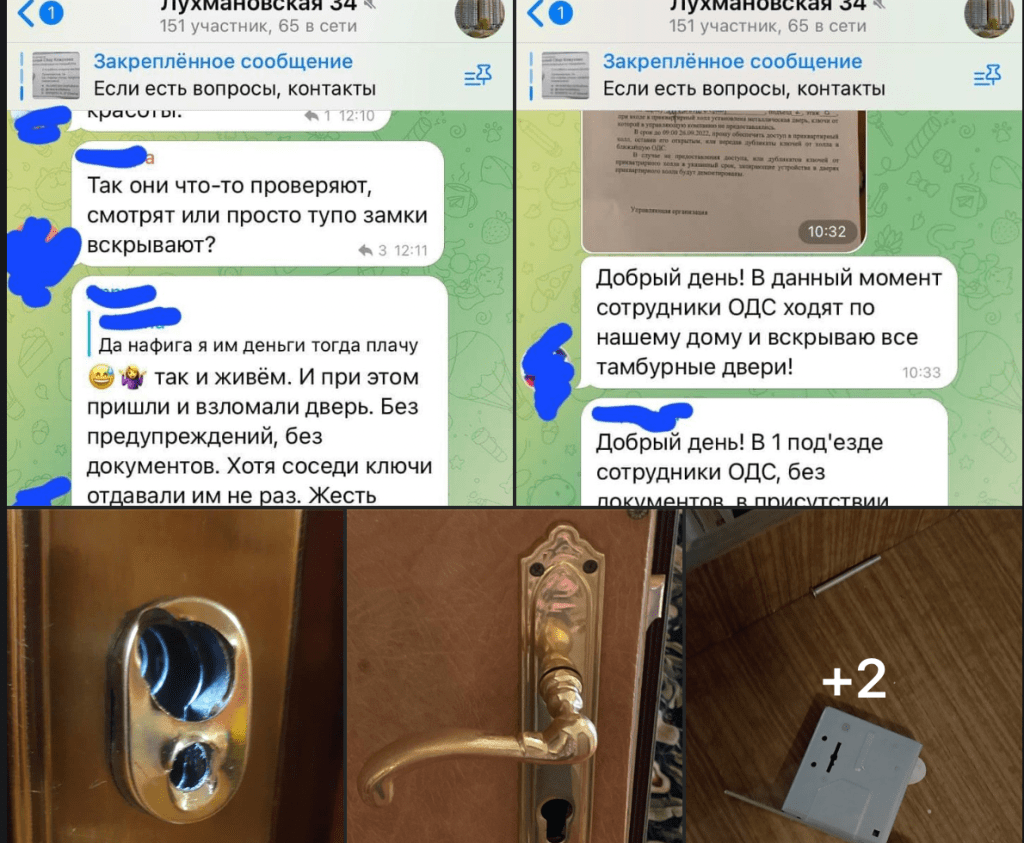
A screenshot of the visuals in Mr. Stupin’s original post

In Moscow’s Kosino-Ukhtomsky district, housing authority employees and police officers, without showing their IDs, have been breaking open front doors in the staircases of residential buildings in order to serve residents with summonses to the military enlistment office! Some residents have already been issued threats that the electrical wires to their apartments will be cut if the men do not open the door to receive a summons!

Source: Yevgeny Stupin, Facebook, 26 September 2022. Thanks to Alexander Kynev for the heads-up. Translated by the Russian Reader


A telephone call I got yesterday from a female acquaintance has made me think about the economic consequences of the “mogilization” [literally, “grave-ization,” a play on the word “mobilization”]. I confirmed her fears that her son would be among the first to be mobilized. And that they would come looking for him first at his registered address, then at his workplace. Consequently, the solution to his problem would be to quit his job and go live somewhere in the boondocks for a year, even if there was no work there.

And now look — not only those who are called up will vanish from workplaces, but also those who dodge the draft. To get the three hundred thousand men declared [by Putin as the goal of his “partial mobilization”], they have to slap the asses of at least a million men with draft notices and dragnets. I’m not an economist and I cannot even estimate numerically what kind of blow to the country’s GDP will be caused by the withdrawal of at least half a million employees.

By the way, the mobilized must be fired [by law]. It is not very clear whether their jobs will be kept for them in any way. But [officially] they will not be listed as on leave, but as having been called up from the reserves to military training camps. They will simply be dismissed from their jobs, and they will have to be paid in full.

Really simple vacancies can be filled by migrants from Central Asia, but it is another matter whether they will go and fill them. Currently, the exchange rate has been maintained at a level that is favorable to migrant workers, but as soon as the volume of imports grows (and it will grow: there will be other sources, gray market goods/parallel imports, and so on), this rate will inevitably begin to sink. Consequently, the economy will take a simultaneous triple hit around December:

1) On December 5, a complete ban on the delivery of Russian crude oil to the EU will come into effect;
2) hundreds of thousands of people will be laid off in October, November, and December;
3) and the exchange rate will go crazy.

By the way, state-funded and quasi-state-funded organizations will face the biggest problems. Petersburgers are no stranger to it, but the snow will definitely not be removed this year, either.

That’s my economic forecast for you. It’s going to be a clusterfuck, my fellow Russians.

Source: Vladimir Volokhonsky, Facebook, 22 September 2022. Translated by the Russian Reader


Yesterday, Vladimir Putin announced a “partial” mobilization, which is actually a total mobilization. His decree sets no restrictions on age, qualifications, regions, and the number of people mobilized. Already today, we see that everyone is being called up.

Source: Navalny LIVE, YouTube, 22 September 2022. Annotation translated by the Russian Reader. The video has already been viewed over 2.6 million times since it was posted. It has no subtitles in English, but the message from the lawyer in the video is clear and simple: there is no such thing as a “partial” mobilization, so all draft-age men must avoid being called up and serving at all costs, especially since Russia’s “special operation” in Ukraine is illegal and criminal.