The War on Poverty

Russia spent approximately 10.9 trillion rubles [approx. 118 billion euros] on military operations against Ukraine in 2025: this is five times the combined income of all Russians living below the poverty line. This estimation is based on Rosstat’s data (as of Saturday, March 14) on the country’s GDP (213.5 trillion rubles), as well as on a statement by Defense Minister Andrei Belousov, who reported at a Defense Ministry meeting that expenditures “directly related to the special military operation” (as the Russian Federation refers to its armed aggression against its neighbor) amounted to 5.1% of GDP. The combined income of all Russians living below the poverty line was less than two trillion rubles.

According to Rosstat, 9.8 million Russians lived below the poverty line in 2025; this is the first time the figure has fallen below ten million. Their percentage of the country’s total population thus decreased from 7.1% to 6.7%. The poverty line, as calculated by Russia’s federal statistics agency, stood at 16,903 rubles [approx. 183 euros] per month.

One-fifth of the cost of the war against Ukraine would thus technically suffice to completely eradicate poverty in Russia—simply by raising the incomes of the poorest Russians to the official poverty line.

Inflation for the poor

The methodology used to define the poverty line raises questions among experts. The index is based on the minimum subsistence level for the fourth quarter of 2020, adjusted for official inflation. For low-income citizens, however, real inflation is generally higher than the average.

TsMAKP (Center for Macroeconomic Analysis and Short-Term Forecasting), a think tank with close ties to the Russian government, calculates a separate metric,“inflation for the poor.” It is based on a simplified consumer goods basket which includes a minimal assortment of food, medicines, cleaning products, and housing and utility services, but excludes hotels and transportation. This metric regularly exceeds the average inflation rate for Russia.

TsMAKP calculates that that last year’s actual poverty line stood at 18,311 rubles per month for working-age Russians, 16,621 rubles per month for children, and 13,947 rubles per month for pensioners—which is sixty percent lower than last year’s average pension of 23,425 rubles per month.

Source: Sergei Romashenko, “Russia spent five times as much on the war as the combined income of all its poor people,” Deutsche Welle Russian Service, 14 March 2026. Translated by the Russian Reader
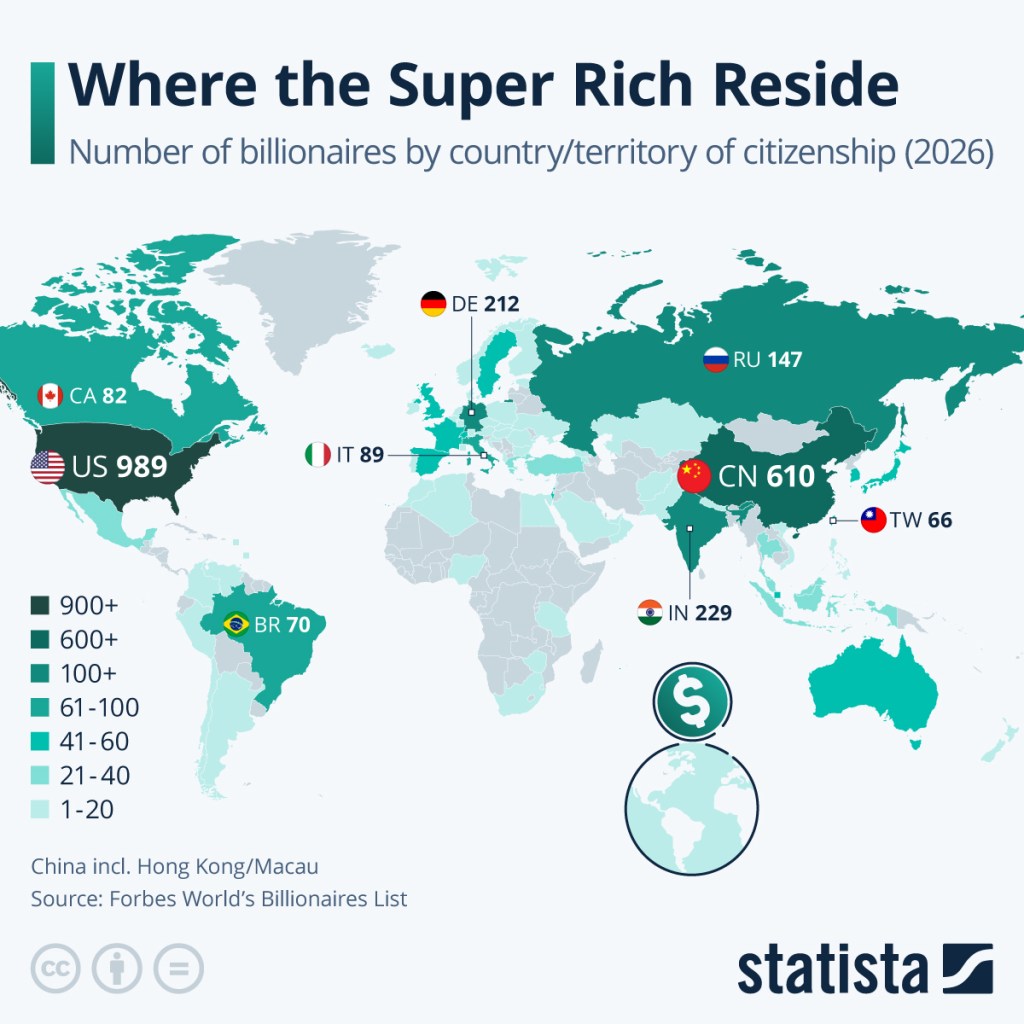

Source: Katharina Buchholz, “Where the Super Rich Reside,” Statista, 11 March 2026


Income inequality in Russia has reached its highest level in more than a decade, according to an analysis by the independent research group Yesli Byt Tochnim.

The state statistics agency Rosstat initially published and later removed the inequality measure known as the Gini Index from its January 2026 social and economic report, Yesli Byt Tochnim said.

The group said it was able to reconstruct the indicator using other publicly available data on income distribution.

According to its analysis, Russia’s Gini Index rose 2.2% over the past year, from 0.410 in 2024 to 0.419 in 2025, the highest level since 2012. On the scale, 0 represents perfect equality while 1 represents maximum inequality.

Income inequality in Russia has risen for four consecutive years and is now approaching the record highs of 0.421-0.422 recorded between 2007 and 2010, Yesli Byt Tochnim said.

President Vladimir Putin has set targets to reduce Russia’s Gini Index to 0.37 by 2030 and to 0.33 by 2036 — the final year he could remain in power under constitutional changes that reset presidential term limits.

Other data in Rosstat’s report also point to a widening wealth gap.

The share of total income going to the richest 20% of Russians rose from 46.9% to 47.6% over the past year, while the share earned by the poorest 20% fell from 5.3% to 5.2%.

The average income of the wealthiest 10% of Russians is now 15.8 times higher than that of the poorest 10%, up from 15.5 times a year earlier.

This week, Forbes included a record 155 Russians in its annual ranking of the world’s billionaires, marking the fourth straight year that the number of Russians on the list has increased. Their combined net worth was estimated at $695.5 billion.
Source: “Income Inequality in Russia Approaching Record Highs, Research Group Says,” Moscow Times, 13 March 2026

Falling

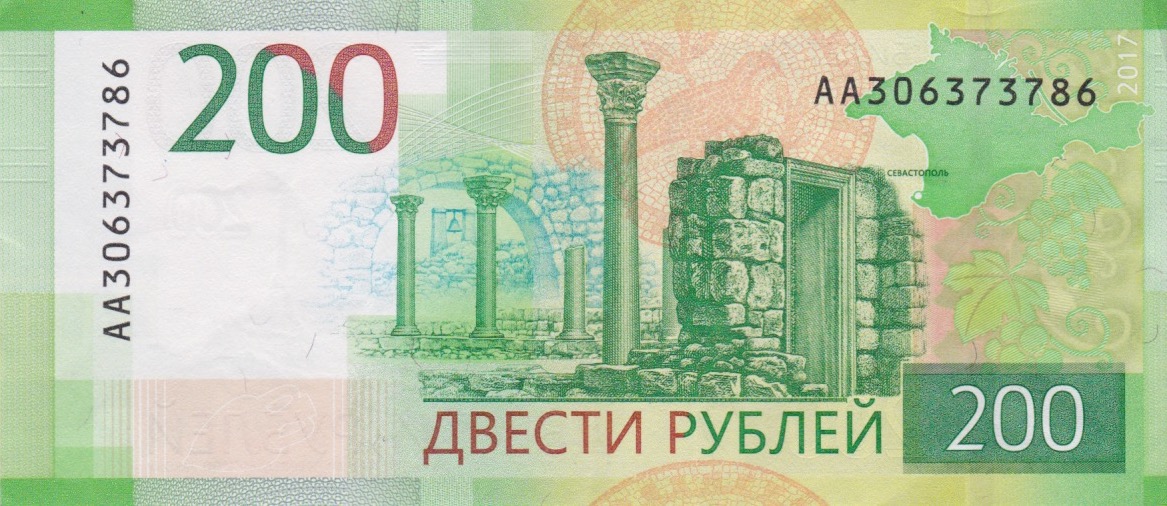
200 ruble note-1

200 ruble note-2A year ago, Russian Central Bank chief Elvira Nabiullina triumphantly introduced the new Crimea-themed two hundred ruble banknote into circulation. Since the economy is shaped more by flows of goods, resources, people, services, knowledge, and money, and the actions of ordinary people, decision makers, and the snake oil salesmen known as capitalists, and less by puerile revanchist neo-imperalist symbolism, the new banknote, pegged at €2.90 by Deutsche Welle only a year ago, is now worth a mere €2.65. I am keeping my specimen as a souvenir of the current bad times until better days arrive. Image by the Russian Reader

Fall in Real Incomes of Russians Accelerated Sharply in September
Economists Say Government’s Forecast No Longer Realistic
Tatyana Lomskaya
Vedomosti
October 17, 2018

Real incomes of Russians have declined for a second month in a row, Rosstat has reported. Their decline accelerated in September to 1.5% in annual terms after falling by 0.9% in August. Prior to that, they had grown for seven months, from the start of the year, by 1.7%. (This figure excludes the one-time 5,000-ruble payments made to pensioners in January 2017.) Real wages accelerated their growth in September, from 7.2% to 6.8% in the previous month.

Incomes of ordinary Russian had been falling for four years in a row, from 2014 to 2017, resuming growth only this year. In the first half of the year, they increased by 2.6%, mainly due to wage increases, notes Igor Polyakov from the Center for Macroeconomic Analysis and Short-Term Forecasting (TsMAKP). Business income increased only by 0.7%, while social transfers (excluding the one-time payment to pensioners) increased by 1.2%, which was significantly weaker than all incomes generally. Other sources of income decreased. There was a slight increase in incomes derived from property, but incomes received from securities and deposits decreased, as did, apparently, incomes from unreported activity, says Mr. Polyakov. He argues it is unlikely circumstances have changed considerably in recent months.

But the anxiety of Russians caused by the volatility of financial markets has increased, says Mr. Polyakov. People have taken to withdrawing cash from foreign currency accounts and transferring it to safe deposit boxes, as well as spending it abroad on holiday. Rosstat cannot register these expenditures and thus reduces its assessment of miscellaneous income. In August, the public’s net demand for US dollars grew by comparison with July from $0.8 billion to $1.7 billion, an increase of nearly 53%, the Central Bank reported.

Retail growth slowed in September to 2.2% in annual terms from 2.8% a month earlier. It is likely the public preferred buying foreign currency while curtailing consumption, argues Mr. Polyakov.

The drop in incomes combined with the serious increase in wages [sic] remains a mystery, writes Dmitry Polevoy, chief economist at the Russian Direct Investment Fund. The growth in real incomes in the first half of 2018 was mainly due to the presidential election campaign, notes Vladimir Tikhomirov, chief economist at BCS Global Markets. Salaries in the public sector and pensions increased rapidly. [That is, the Kremlin bribed Russians directly dependent on its largesse to get out the vote for President-for-Life Vladimir Putin—TRR.] After the election, growth stalled. And, after a palpable devaluation of the ruble in April and accelerating inflation, a dip in incomes was anticipated, argues Mr. Tikhomirov. In September, prices for imported goods rose. In addition, the seasonal discount on fruits and vegetables ended, and the July increase in utilities rates made itself felt, explains Mr. Tikhomirov.

By the end of the year, the incomes of Russians will gradually decline a little, while overall incomes will grow less than 1% on the year, predicts Mr. Tikhomirov. Real incomes might grow by 2% on the year, counters Mr. Polyakov. In any case, this is noticeably lower than official forecasts. The Russian Economic Development Ministry anticipated a 3.4% growth in real incomes in 2018.

Real incomes of ordinary Russians fell by 1.7% in 2017, although the government had forecast a 1.3% increase, the Federal Audit Chamber noted in its opinion on the draft federal budget for 2019–2021. When the forecast was corrected, incomes had decline dsteadily from the beginning of the year, and there were no preconditions for rapid growth by year’s end, the auditors write.

Income growth depends on whether private enterprise will increase wages, argues Mr. Polyakov, but thos wages will be subject to the planned rise in the VAT to 20% in 2019.

President Putin has set a goal of halving poverty by 2024. (The official poverty rate last year was 13.2% of the populace.) The Economic Development Ministry’s forecast significantly increased the growth rate of real wages and anticipated higher growth rates for real incomes, which has raised doubts at the Audit Chamber. There is no wage increase for public sector employees planned in 2019, while the growth of wages in the private sector will depend on growths in productivity.

Rank-and-file Russians have been forced into debt, write analysts from RANEPA and the Gaidar Institute in their opinion on the draft budget. By mid 2018, Russians owed banks 13.7 trillion rubles (approx. 181 billion euros), an increase of 19% from the previous year, they write, and an amount that significantly outpaces the increase in nominal incomes. It is an alarming trend that means an increase in the amounts of money ordinary Russians spend servicing loans, experts warn.

Translated by the Russian Reader