Who Whom

OLYMPUS DIGITAL CAMERA
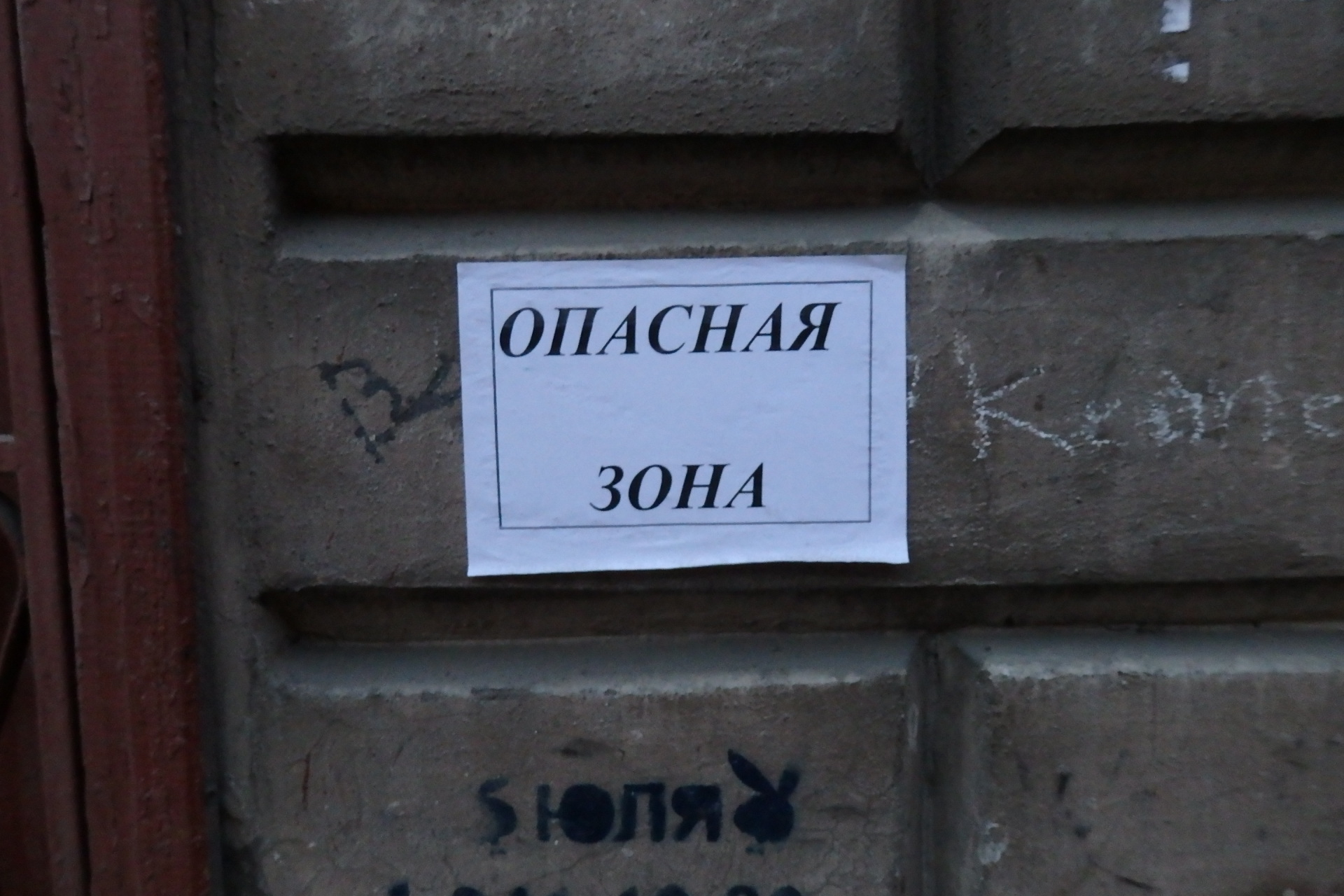
“DANGER ZONE,” Petrograd, December 15, 2015. Photo by the Russian Reader

Leonid Volkov
December 29, 2015
Facebook

According to the official (i.e., government) investigation, driver Ruslan Muhudinov ordered the killing of Boris Nemtsov.

Meaning that Ramzan Kadyrov has not been hurt in any way. Not only did he not surrender [State Duma deputy] Adam Delimkhanov and [Federation council member] Suleiman Geremeyev, he did not even surrender Ruslan Geremeyev.

This is just by way of understanding the hierarchy of the people in power in Russia.

The political wrangling went on for ten months. In March, Putin “went to ground” for a couple of weeks when the siloviki were demanding he surrender Kadyrov. It was clear he would not give up Kadyrov. Then for several months they demanded Geremeyev and his high-ranking relatives, but ultimately they did not get him, either.

This is what it basically comes down to.

The toughest guy in the real table of ranks in Russia is Ramzan Kadyrov.

The second rank includes Vladimir Putin, the selfsame Chechen elite, and members of the State Duma and Federation Council.

The third rank includes Bastrykin, Patrushev, Bortnikov, Chaika, and Geremeyev, whose degree of untouchability is the same. Any of them can steal anything and kill anyone, and he will get off scot-free.

The fourth rank includes any general in the Investigative Committee and Federal Security Service (FSB), and somewhere in there as well is Ruslan Muhudinov, driver of the deputy commander of the North Battalion [i.e., Ruslan Geremeyev].

Leonid Volkov is a project manager for opposition politician and anti-corruption campaigner Alexei Navalny. Translated by the Russian Reader

__________

Zhanna Nemstova
Moving Backwards: Russia’s Moral Decay
December 28, 2015
The Moscow Times

The Public Opinion Foundation conducted a survey this month asking Russians two questions: “What was the main event of the year in Russia?” and “What was the main global event of the year?” 

Noteworthy is that fully 40% of the respondents had trouble answering either question. And the most brutal political murder in modern Russia – the assassination of my father – did not even figure in the responses. State-controlled television hardly mentions it, with the exception of the first few days after the killing, when commentators spoke of him in contemptuous tones.

But the problem is not only the silence of the Kremlin’s official propaganda. The problem is the condition of Russian society. A Levada Center survey conducted in March of this year found that one-third of all Russians are indifferent to my father’s murder. That is a moral numbness best conveyed by the popular Russian sentiments of “It does not concern me” and “That does not affect me.” The well-known military journalist Arkady Babchenko refers to that type of thinking by his countrymen as “infantilism.” Perhaps he is right. 

This attitude finds expression not only in widespread apathy, but also in people’s inability to recognize even obvious causal relationships. It is understandable why some people cannot see the medium-term and long-term negative consequences of the annexation of Crimea, but it was not so difficult to predict that consumer prices would rise as a result of Moscow’s food embargo and the hefty tolls imposed on trucks traveling on federal highways. 

The political system that President Vladimir Putin has built robs the Russian people of the ability to think, analyze, ask questions, formulate positions or remember the past. It offers no stimulus for that: Putin’s Russia has no need of people who think for themselves. It has reduced competition to a minimum in all areas, including the political field. And it is not always the smartest that succeed in this system

It is a sad and potentially dangerous situation when the political playing field lies decimated and debates and discussions have been replaced with sometimes violent pressure from the authorities. That has also compromised the quality of the opposition itself and made it a truly heroic feat to even take part in the opposition movement in Russia. There are no democratic institutions and the activists are fighting for survival. Under such conditions, opposition figures have no chance to become public figures and the public has no way of knowing who is who.

People have short memories, and that makes life easier for Putin and his inner circle, who are constantly confusing their facts. First they claim there are no Russian soldiers in Crimea and eastern Ukraine, and then they admit to their presence. First they promise not to raise taxes and fees, and then they impose new tariffs on long-haul truckers. Forgetfulness is a handy human tendency, and the Kremlin’s television propaganda exploits it to the fullest. 

This explains why leaders have no personal reputations and remain unaccountable before the public. Perhaps the social apathy and the public’s lack of interest in politics is a defense mechanism, people’s way of responding to the flood of lies and aggression from the authorities. Nobody can figure out where the truth lies, and so it is best not to even go looking for it

All politics in Russia are situational and as volatile as oil prices. Even loyal politicians and officials do not always manage to fall into line exactly as they should. For example, it is amusing to see how famed film director and die-hard Putin fan Nikita Mikhalkov gets outraged over the way his own patriotic show on state-controlled television is subjected to censorship. 

The authorities and the ruling elite are out for their own survival. That end justifies all means, including the tactic of keeping military tensions high at all times. As a result, Russia is increasingly moving away from humanistic values and toward a confrontational relationship with the world. But perhaps that is not putting it strongly enough: maybe Russia is moving toward total apathy. However, war is becoming the context for all other issues in life. 

Russian journalists often ask me why I fight for a fair and impartial investigation into my father’s murder. For me, the very wording of that question is sickening because it shows that medieval values now reign supreme in Russia: nobody understands that it is not just I who needs such an investigation, but all Russians if this country is to ever move forward

We must wage a long and grueling fight for human rights. If we simply give up that struggle and accept the fact that, in Russia, someone can just go and kill a prominent public figure, a statesman and leader of the opposition with absolute impunity, then we must also come to terms with the fact that the same thing could one day happen to any of us. 

Today’s opposition members are now at greater risk than ever before. I see the condescending attitude shown toward the small handful of people who continue to struggle for democracy in Russia. I have grown accustomed to the eternal question: “What do they offer?” But just imagine if one day even that small group would no longer exist. Who, then, would conduct anti-corruption investigations, participate in even nominal elections, initiate investigations into wrongdoings by Duma deputies or provide support for political prisoners? No one, that’s who

My father long experienced that condescending attitude from others who behaved as if they were looking down on him from on high. And now he has been murdered – for his views, for daring to express his position, for his unwillingness to be indifferent or apathetic. And suddenly, his absence is sorely felt. 

Putin’s Russia has not brought a revival of spiritual values, as state-controlled TV tries to convince us. It has caused Russia’s moral decay. And as long as Russians approach every problem through the filter of whether it will affect them personally, this country can move in only one direction – backward.

Zhanna Nemtsova is a Deutsche Welle reporter and the founder of Boris Nemtsov Foundation For Freedom.

Yelena Osipova: “Russia Is a Bird, Not a Bear”


OLYMPUS DIGITAL CAMERA
Russia wants to be a bird: peaceful, honest, kind.  Russia: kind and hardworking. 2011: The bear can no longer be cured. Vote for the bird. Although it is wounded, if it is treated well, it can fly high. Vote for the hardworking bird

“Russia is a bird, not a bear”
Tatyana Voltskaya
November 21, 2015
Radio Svoboda

Yelena Osipova’s “naïve” posters remind us of the link between politics and street protests

A cozy basement with uncomfortable pictures: that is how one might describe in a nutshell the exhibition of paintings and posters by Petersburg artist Yelena Osipova currently underway in the Petersburg office of Open Russia, which shares the space with the Petersburg office of the Parnas party.

Elena Osipova
Yelena Osipova

The exhibition marks a milestone—Osipova has turned seventy—but it is her debut exhibition. She has never been a member of any artist unions and groups, but she has stood outside in the rain, frost, and heat at nearly all the protest rallies that have taken place in Petersburg in recent years. The striking posters that Osipova holds at these rallies expose the latest injustices or crimes, warn of dangers, and empathize with the plight of others, whether they have been victims of terrorist attacks, natural disasters, dishonest elections or civil rights violations.

The exhibition was not easy to put together. The organizers set out to show not only Osipova’s best political posters but also her paintings, mainly portraits and landscapes. The show also includes two large genre scenes, the first featuring an ordinary Soviet beer hall, the second, a group of punks. Perhaps they are the link to the posters, which call to mind not only the tradition of political satire but also primitivist painting.

We are all hostages of violent, provocative imperialist politics.
We are all hostages of violent, provocative imperialist politics

“This exhibition is the first in my life,” says Yelena Osipova. “And I love the room and these vaulted ceilings and the fact you can see how my paintings segue into the posters. The latest poster, showing a mother with a dead infant, is about the dead Tajik boy Umarali Nazarov, while the first was prompted by the Nord-Ost tragedy in 2002. Then I went to the Mariinsky Palace [seat of the Saint Petersburg Legislative Assembly] with a simple lettered poster, handwritten on a sheet of wove paper. I just could not understand why no one took to the streets then, why everyone was silent. On the fortieth day after the deaths of the hostages, I made a poster in which I painted a picture in acrylics on fabric.

OLYMPUS DIGITAL CAMERA
In an Andersen story, a girl sold matches in Denmark in the nineteenth century: matches. (Read Andersen’s fairytales to children.) 2012, the twenty-first century. Children are commodities. This is the end of the world. Adoption should be free. Foster care should be free. In Russia, children sell narcotics: narcotics.

You are a professional artist. Where did you study?

“I graduated from an art school. It was then called the Tauride Art School, now it is the Roerich Art School. Marc Chagall had studied there in his day, though not for long. I had then wanted to apply to the monumental painting program at the Mukhina Academy. I had been influenced by the frescoes of Andrei Rublev and Dionisius, by the size of their figures and their schematic manner. But young women were just not admitted to the monumental painting program, and I have no regrets about it now. What would I have done? Painted murals in the subway? I am an artist and educator. I taught for over thirty years. We organized three art schools from scratch.”

Umarali
Umarali

So you mostly painted landscapes and posters, then Nord-Ost happened and you turned to posters. What exactly happened after Nord-Ost?

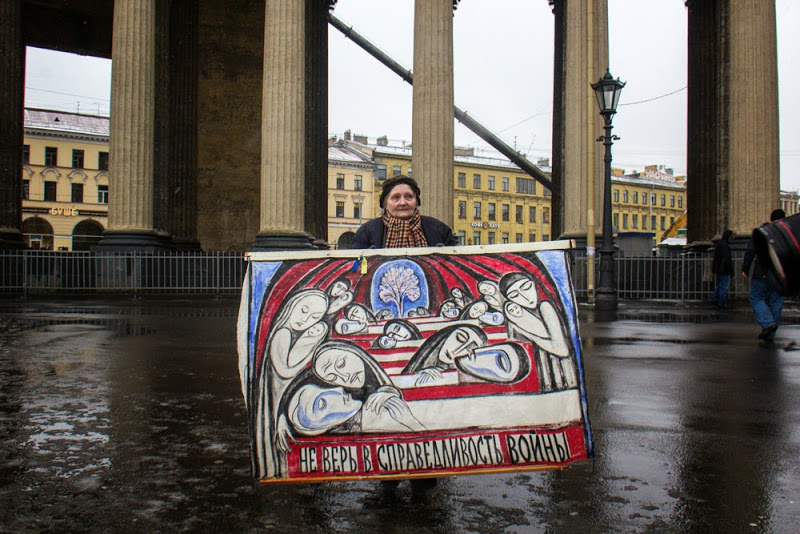
“An ever more horrible event: Beslan. No conclusions had been drawn! I had two posters: one was lost, while the other version is exhibited here. The lost version was two-sided. On the reverse side, the slogan “Moms of the world, give birth to little princes. They will save the world!” was written on a blue background. I made the next poster, “Don’t believe in the justice of war!” when the war in Iraq began. I stood outside the American consulate, the British consulate, outside the consulates of all the governments who had supported sending troops into Iraq. There was no reaction. When it was the anniversary of the Beslan tragedy, the mothers of the dead came to Petersburg and wanted to walk down Nevsky Prospect to the Russian Museum holding icons and candles. Ultimately, no one joined them. Just one other woman went with the Beslan moms, plus me with my poster. So we marched alone, amidst the general indifference.”

Anti-war-0089
Artist Yelena Osipova holds a poster that reads, “Don’t believe in the justice of war,” during an unauthorized anti-war protest outside Kazan Cathedral in Petersburg on March 15, 2014. Photo by Sergey Chernov

But this indifference has continued. Look how many people came to the rally protesting the death of the Tajik baby Umarali Nazarov, who was taken away from his mother.

“Yes, but more people are coming than before. Civil society is slowly emerging. We have had the Marches for Peace, and certain rallies have drawn a good number of people. It used to be that no one came to these things at all.”

OLYMPUS DIGITAL CAMERA
Yelena Osipova, Portrait of an Artist, 1975. Oil on canvas

Have you been detained at protests?

“Of course I have been detained. There was a G20 summit here one summer. I went there with two posters: Don’t believe in the justice of war! and another one about the disposal of nuclear waste. The police detained me then, and I have been detained many times since, sometimes quite roughly. There were unpleasant incidents outside the Mariinsky Palace on St. Isaac’s Square when the war with Ukraine began. Yet the people who go to these events think like you do, and that is quite important. You feel you are not alone with your thoughts, that there are other people who think the same way. Okay, so there are not so many of them, but they are out there.

Free political prisoners!

“Now, perhaps, it will become more difficult, and people will retreat to their apartments, as they did in Soviet times. The laws that have been passed [restricting public protests] are tough to deal with even financially. It used to be that the biggest fine I got was five thousand rubles. People collected the money on the web, and later I sent it on to the Bolotnaya Square prisoners. But the fines now are so high that you cannot pay them. It is too bad that society resigned itself from the outset and did not oppose these laws. After all, they could have resisted and taken to the streets, but, unfortunately, when people have begun to live better, they become indifferent.”

Are there any landmark works, works important to you at this exhibition?

“Yes, for example, Theater Entrance. I painted it during my fourth year at art school. I was really into the theater then, and my thesis painting had a theatrical motif. There are also three paintings here from my Vologda series, pictures of fields in Vologda. There is a landscape painting of Gurzuf, in Crimea. The big painting shows a beer hall that was behind the Nekrasov Market. It had these big round arches, and the beer was poured straight from a tap. You could meet professors and students and artists there. I have painted Russia there with a halo, looking sad. It was the nineties, a very complicated time. And my other painting on this subject is Punks in the Subway. I knew all those kids.

OLYMPUS DIGITAL CAMERA
The musical Nord-Ost, October 25, 2002. Stop the war, people! Learn the truth!

And what is Oh mania, oh mummy of war…, featuring two crows?

“It’s an anti-war poster. I drew it after Boris Nemtsov’s murder. I used a poem by Marina Tsvetayeva. She wrote it in Germany, and I saw the resemblance with our circumstances. The poster Not everyone who is naked is needy is about the death of Berezovsky. I play on the birch motif [Berezovsky’s name is derived from the Russian word for birch tree, berëza], and there are funereal crows.

OLYMPUS DIGITAL CAMERA
Artist Yelena Osipova at the opening of her exhibition on November 14, 2015. She stands next to posters that read, “August 6, 1945. August 9, 1945. Moms of the world against atomic energy,” and “Ukraine, forgive us: we let it happen.”

Do you appreciate some of your posters more than others?

Maybe this one, Don’t believe in the justice of war!, and the Beslan poster. In fact, the political posters about tragedies I always rendered in the three colors of the Russian flag.”

Will you continue to make new posters and freeze on the streets?

“At one point I though that maybe there was no need for this and I wanted to quit, but people said I should do it and told me I gave them hope.”

At the entrance to the exhibition is a small poster, Vote for the bird. At the bottom of the poster is a heavy United Russia, pumped full of oil; on the top is a bird.

“The bird has always been the symbol of Russia,” argues Yelena Osipova.

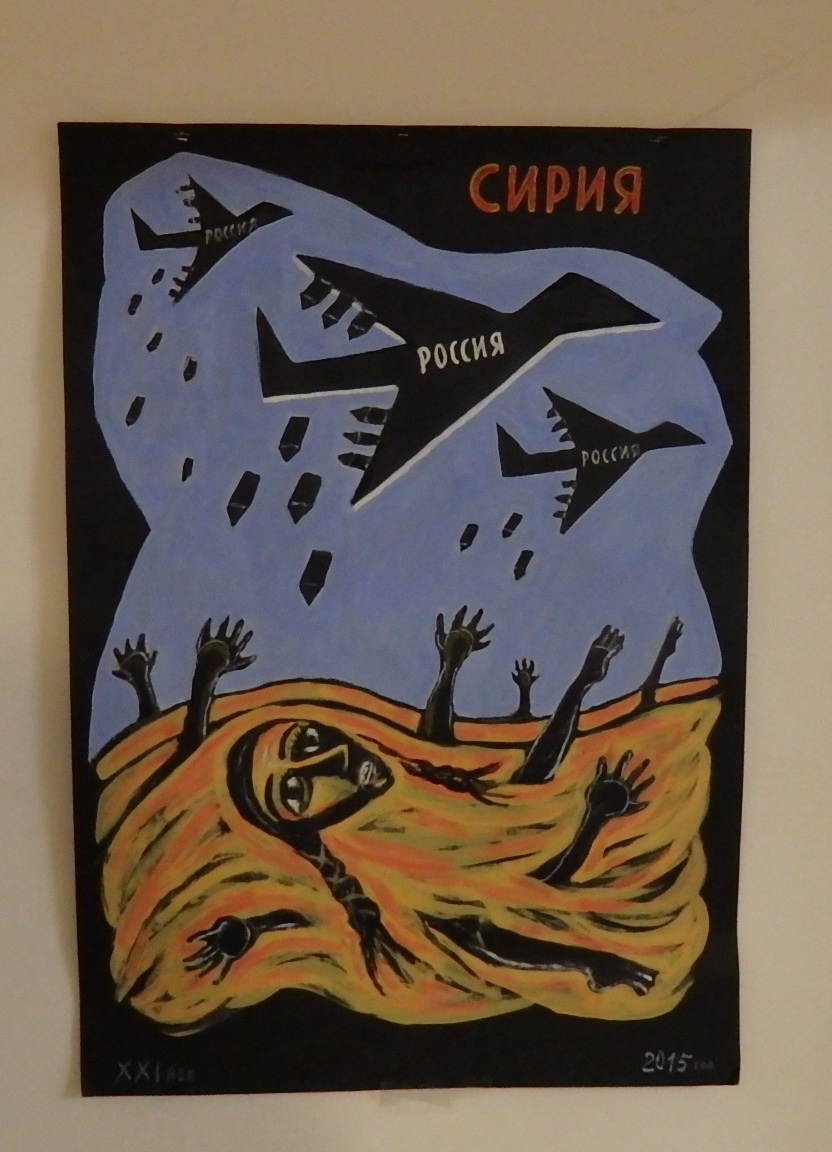
Syria. Russia
Syria, Russia, Russia (2015)

And to her mind, Russia’s color is blue, as in a certain painting by her beloved Wassily Kandinsky. True, Osipova now sees less and less of the color in her homeland’s plumage.

Translated by the Russian Reader. All photos by the Russian Reader except where otherwise indicated. Yelena Osipova’s work will be on view at 19 Fontanka Embankment until November 25, 2015.