
Gennady Shpalikov and Guy Debord were nearly the same age, and their popularity peaked at the same time. But is this the only thing that unites the French philosopher and the Russian writer? Alexander Ivanov, founder of the publishing house Ad Marginem, will show that these two figures were connected not only by the time in which they worked but also by the very spirit of the time, which they saw, felt and were able to convey to others.
Debord’s adage “Love is possible only on the eve of a revolution” could well have been endorsed by Shpalikov.
Debord was the founder of Situationism.
An amazing poet, screenwriter, and director, Shpalikov was the Soviet Guy Debord. Like Debord, Shpalikov had an explicitly spatial mind: he understood space not as a receptacle for bodies but as a way of assembling the soul in the gaps, intervals, and flashes of aimless, unprogrammed, slippery movements around the urban environment. Debord called this mode of movement détournement — a deviation, an illegitimate, reverse appropriation in which the spaces and cultural signs captured by other people’s meanings are reappropriated by turning them inside out semantically or simple shifting their meaning. This was exactly how Shpalikov dealt with the anonymous, official space of the Soviet city: by romanticizing its most banal corners and nooks. Both of these artists conjured the mood of an entire epoch in the late 50s and early 60s.
0:00 Teaser
0:18 Why Gennady Shpalikov is the Russian Guy Debord, and what Soviet existentialism has to do with it
3:32 Guy Debord as the founder of Situationism: “Never work”
6:34 Henri Murger, Guy Debord and Gennady Shpalikov’s characters as bohemians
8:32 Guy Debord’s psychogeography: the drift as a practice for discovering a city’s atmosphere
9:55 Debord’s Paris and Shpalikov’s Moscow
10:50 Alexandria as the capital of memories
12:32 Shpalikov’s poetics and Debord’s Paris: between the real world and the imaginary world
14:07 Sartre’s nothingness as the key to understanding Shpalikov’s poetics
16:20 Sartre’s being-in-itself and being-for-itself, or predetermination and consciousness
18:38 The philosophy of existentialism: existing in a situation as in the fabric of life, which is not defined by personal qualities
20:25 Non-narrative shots from Shpalikov’s films: scenes from I Walk Around Moscow
21:56 Situationist form as a link between Shpalikov’s poetics and the philosophy of existentialism
25:52 Existentialism in cinema: the atmosphere of the movie Breathless
27:08 Shpalikov’s psychogeography for Moscow
30:45 How to reprise Shpalikov’s existential know-how in today’s Moscow
31:45 Détournement: reverse appropriation and distortion of meaning for reclaiming the poetry of urban space
33:28 How Shpalikov rejects Soviet Moscow and appropriates the space of the city in the movie I Walk Around Moscow
37:03 The transformation of Shpalikov’s natural charm into poetry
38:45 The poetic eternity of Nikita Mikhalkov’s character in the movie I Walk Around Moscow
40:42 The dream of an imaginary West as the driver of Soviet existentialism
Source: Peredelkino Dom Tvorchestva (YouTube), 10 October 2024
November 1 is the fiftieth anniversary of the death of Gennady Shpalikov, the screenwriter, filmmaker, and poet, one of the symbols of the Thaw era, an extremely popular writer and yet one whose work has been poorly read. Igor Gulin explains how Shpalikov looked for an answer to the question of where good people end up, and how the drama of his characters reprised his own.

Screenwriting was an honorable profession in the Soviet Union. Screenwriters were not considered to be craftsmen consigned to the sidelines, but serious writers, and so the screenwriter’s name was listed first in the credits, before the director’s. Nevertheless, not even the best of them were stars. Gennady Shpalikov was an exception. From his very first efforts in cinema, his name was a symbol of the new art of the Thaw — first among his fellow filmmakers, then for a relatively wide swath of the intelligentsia. His death in 1974 was a token of the sixties generation’s demise.
The cinematic Thaw was already in full swing by the time Shpalikov joined the profession. Marlen Khutsiev and Felix Mironer’s Spring on Zarechnaya Street (1956), Mikhail Schweitzer’s The Tight Knot (1957), Mikhail Kalatozov’s The Cranes Are Flying (1957), and Grigory Chukhrai’s The Ballad of a Soldier (1959) had been released, but these beautiful pictures still lacked something that would instill a sense of decisive reform and renewal. Shpalikov carried out a tiny revolution in Soviet cinema — not alone, of course, but he was its leader. He contributed an open sense of form, showing that a movie could be something other than an itinerary from point A to point B. It could be a stroll, a stroll with no clear goals, from one impression to another, from one funny and touching incident to another.
Almost all of Shpalikov’s scripts from the 1960s are just such cinematic walkabouts: A Streetcar to Other Cities (1962), directed by his friend Yuli Fait (1962); The Star on the Buckle (1962) and I’m from Childhood (1966), written for Viktor Turov; I Walk Around Moscow (1963) directed by Georgiy Daneliya; The Wharf and Summer Holiday, which were never made into films; A Long Happy Life (1966), of course; and Ilyich’s Gate (1962–1964) to a great extent. This film was more complicated, however. Khutsiev’s lofty idealism counterbalanced Shpalikov’s nimble gifts, and it was their confrontation and, at times, conflict that gave birth to a masterpiece. This later worked with Larisa Shepitko, when she and Shpalikov agonizingly co-wrote You and I (1971). To produce something truly significant, Shpalikov needed a co-writer-slash-director — a collaborator and an opponent, not a faithful executor of his ideas.
The stroll was the genre not only of Shpalikov’s creative work but also of his life. He existed in the same way, charming everyone he met, traipsing from one crowd to another, from one idea to another. He wrote the same way: on telegram blanks and napkins, not bothering with punctuation and spelling, and often not worrying whether the text was coherent, paying mind to its intonation and pacing, rather than to the idea and the logic of form. His scripts and songs, poems and prose experiments often seem sloppy to a sober eye. But their sloppiness never irritates: it comes across as organic, as a hallmark of authenticity.
Dozens of memoirs have been written about Shpalikov. Their authors constantly wonder aloud how it happened that this carefree, lively man took to drinking heavily and eventually committed suicide. They often blame the era. There is some truth to this, but it is a little different than is commonly thought. The Stagnation was not only a time of disillusionment after the upswing of the Thaw. It was also a time of complication. The members of the Sixties generation who continued to create and grow learned to resist better. It required them to mobilize their inner strength, making them more reflective and deeper. Shpalikov was a genius of splendid superficiality, of drifting and gliding. He understood this perfectly well. The drama of his art kicked off long before the frosts of the Brezhnev era set in.

The same disturbing intuition — sometimes well concealed, sometimes voiced as directly as possible — was evident in everything Shpalikov wrote. Surprisingly, this anxiety was hardly detected by his contemporaries, who remained under the hypnosis of the myth they had created themselves. It concerns the central figure of Shpalikov’s entire oeuvre. What to do with the fact that the “good man,” about whom he always wrote, so easily goes to the bad? What to do with the fact that charming frivolity quickly turns into grim irresponsibility, moral freedom into immorality, the freewheeling life of the tumbleweed into pathetic escapism, and nonstop wittiness into nauseating clownishness? Committed to the utmost sincerity, Shpalikov had an absolute ear for falsity and from the very beginning heard the rudiments of falsity in himself. Perhaps that is why he seemed doomed (and suicidal notes appear in his texts very early on). Drunkenness, however, made it easier for him to accept his fate.
This intuition is almost nonexistent in Ilyich’s Gate, in which the romantics and the bastards are delineated from each other. But it is already present (for the time being, as a quite vague hint) in I Walk Around Moscow (the young Nikita Mikhalkov’s ambiguous charisma works perfectly in this regard). It is also palpable in The Wharf, Shpalikov’s first major feature. (Its director, Vladimir Kitaysky, committed suicide while working on the picture, and the movie was never completed.) The script of The Wharf is an enchanting, airy text centered on a rather savage deed. Coming to Moscow for a single evening, the main character, a barge captain, decides to kidnap his son from his mother, wanders around nighttime Moscow with the boy for a long while, and when he falls asleep on a bench, simply runs away to his barge. A good guy’s transformation into a scoundrel is amped up to wholly Dostoevskyean cruelty in Summer Holiday and A Charming Man’s Day (another script that was never produced). This trajectory devolves into total despair in You and I, in which a Thawnik’s romantic flight to the Far North is played out as an egoistic escape from his own worthless life, frittered-away talent, ruined romance, and lost friendship.
Shpalikov never judges his characters: their meannesses and downfalls just happen. There is no reflection at all in his art. There is only movement, and this movement has its own laws. At the beginning of the trajectory there is a good, harmonious man, but once chosen, the freewheeling life gradually whittles him down to the ugly figure of a cynic, a vulgarian, a scoundrel. Shpalikov has a very frank poem about this:
Аh the streets, the only refuge
Not for the homeless, but for those who live in the city.
The streets pester and haunt me,
They are my comrades and my adversaries.
I don’t feel as if I am walking them,
I obey them, I move my feet,
And the streets guide me, they lead me
Through a sequence set once upon a time,
A sequence of cherished back alleys,
A sequence of jaunty notions and good intentions.
The same thing happens in Shpalikov’s only directorial work. A Long Happy Life is usually remembered as a light, lyrical picture, but actually it is chockablock with contempt for oneself and one’s kind. It is a movie about how a typical man of the 1960s, a charming unshaven geologist, runs off into nowhere and away from a beautiful woman, and at the same time from any future, from that selfsame long happy life, simply because he cannot help but run. A lighter note is generated by the finale: the famous five-minute scene of a barge on a river is Shpalikov’s homage to Jean Vigo’s L’Atalante, his favorite film.
This is Shpalikov’s main gimmick. As intoxication relieves a hangover, so the shame of escape is relieved by yet another escape. And if the body can no longer escape, there remain flights of fantasy. Distracted from the protagonist’s mediocre fate, the gaze follows the barge and loses itself in this marvelous tracking shot. All of Shpalikov’s best poems are about the same thing: not about the joy of life, but about the desire to escape from it to a place that is obviously impossible, somewhere “where mother is young and father is alive.” To leave, but not by sinking into drunkenness, illness, and rows, but to disappear gently, to be weathered away from the world. “My head is vacant, / Like a deserted place. / I’m flying off somewhere, / Like a tree from a leaf.”
Source: Igor Gulin, “Elusive simplicity: how Gennady Shpalikov found no place for himself in the Stagnation,” Kommersant Weekend, 1 November 2024. Translated by the Russian Reader
Source: Mosfilm (YouTube)
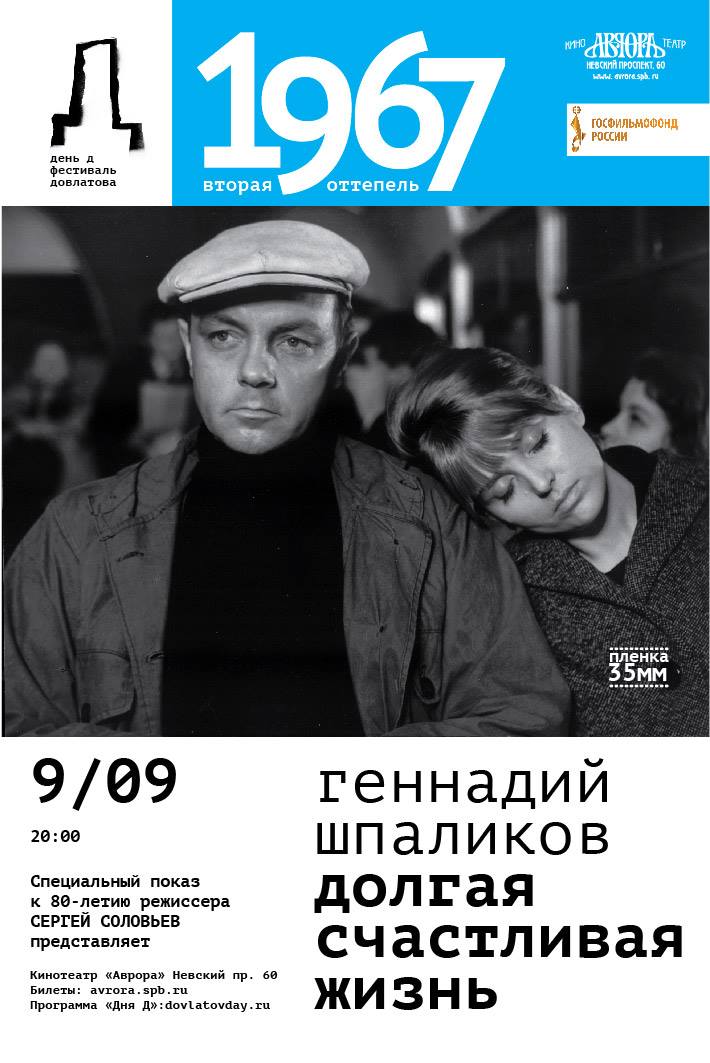
 “Grazhdanskaya Oborona (Civil Defense). A Long Happy Life.” Images courtesy of