“Yevgeny Zhumabekov, 96 kilograms” is how he introduces himself. Yevgeny is the person who came up with the idea of replacing Last Address plaques that had been torn down with homemade copies and who did this work incognito for almost a year. Now he can identify himself.
Bumaga has detailed the struggle that erupted over the plaques in December 2023. They began to disappear en masse, but copies subsequently appeared in place of the ones that had been torn down. These copies were also removed, after which a plaque appeared on the 14th Line on Vasilyevsky Island bearing the following message: “Plaques [memorializing] people who had been politically repressed in this place were repressed eight times.”
Here you can read Yevgeny’s own account of how the [Stalinist] crackdowns touched his family, what shaped his views, how his wife and children got involved in the fight for historical justice, why the Zhumabekovs had to leave the country, and who continues to install the plaques in their wake.
How the repressions touched Yevgeny’s family
I was born in the Sverdlovsk Region, in the town of Kushva, which has gradually been turning into a village. It’s a depressing place. Two of the industrial enterprises that supported the town have shut down. People have been leaving, while the old people are dying off.
It so happened that my history teacher at school was a good friend of my grandfather’s. He would come to my grandfather’s house, and they would drink hard alcohol together, play chess, and talk a lot. I often visited my grandmother and grandfather and heard these conversations. That’s how I learned that my grandfather came from a family of a person who had been politically repressed.
His parents had come from the Perm Region. My great-grandmother and great-grandfather were completely ordinary peasants. It was forbidden in their house to drink alcohol, [and because they were teetotalers] they harvested large crops. In 1931 or 1932, they were dekulakized and exiled far beyond the Arctic Circle, while their children were sent to orphanages. After a while great-grandmother and great-grandfather managed to escape, but great-grandmother had fallen ill in exile and died soon after returning home, while great-grandfather had to hide out in remote villages all the rest of his life.
I know that my grandfather also had a hard time as a member of a politically repressed family, but he never told me about it, although I tried to find out. It was such a profound trauma for him that he could discuss it only when he got drunk with his sole friend.
How the FSB visited Yevgeny’s workplace
In 2006, I moved to St. Petersburg, where I worked for a time in the car business. I held various positions: sales manager, head of the customer engagement department, manager of a car showroom. Then, before the war, I transferred to a construction company, where I sold real estate.
In 2021, I went to a rally in support of Alexei Navalny after he had returned from Germany. Then there was the protest action with flashlights and others. Not only did I attend these events but I also talked about them with my colleagues at work. I was just sharing my pain, not encouraging them to do anything.
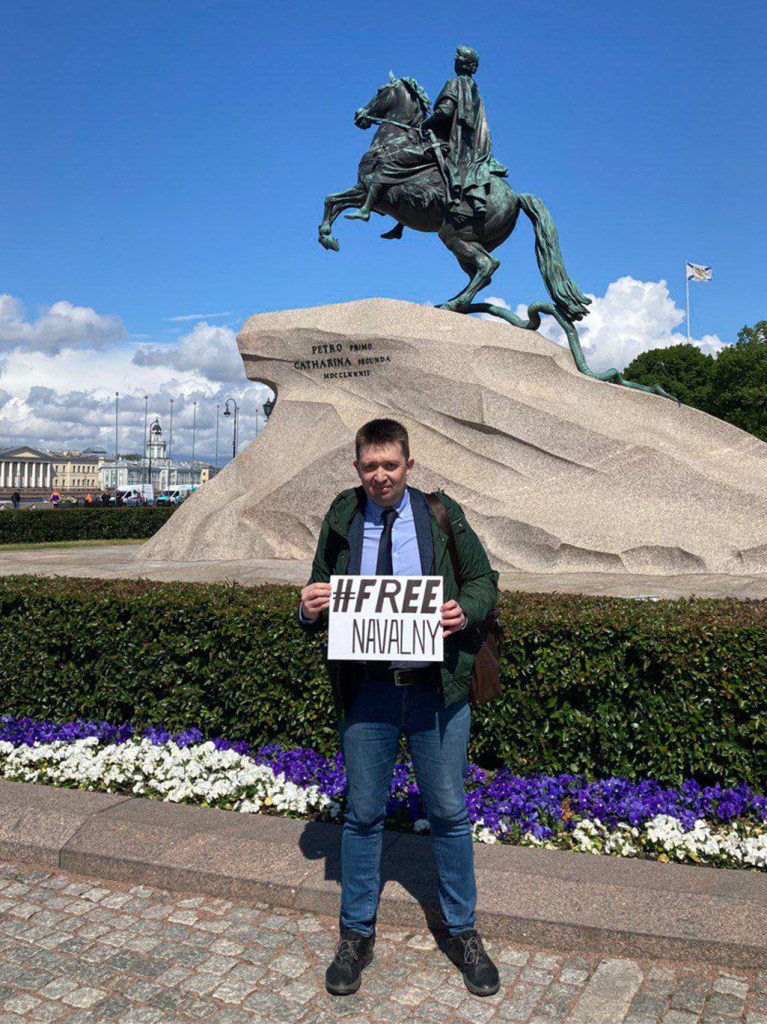
Photo courtesy of Mr. Zhumabekov (via Bumaga)
It transpired that my employer (Yevgeny does not name the company for safety reasons —Bumaga) had been reviewing the security camera footage and listening to all our conversations, and had apparently decided that I was politically agitating the employees. At some point, I was forced to make various written statements, such as why I had been accessing Memorial’s website during working hours. (Bumaga has a copy of this request from the company’s management.)
Just before the war started, I was summoned to our security office, where an FSB officer was sitting. He introduced himself and said that our general director cooperates with the FSB and if I didn’t resign, I would be in big trouble. He said, “We realize that this is your political stance, but it is completely unacceptable.” He pressured me, shouted at me, and tried to force me to write a resignation letter. I took out my phone and filmed the conversation (Bumaga also has a copy of this video recording), after which the FSB dude stopped yelling. I tried to flee this office, but the guard blocked the door. He was a huge man.
The tension was unbelievable, but I still managed to get out of there. I immediately went to the police station, where they listened to me and said that a police investigator would call me right away, but for the time being I should go home. They said I would have to file a statement with the police investigator. A young woman called me back and listened to my whole story. Then she contacted me again after a while and said, “No, you know, this is a political case and the FSB is involved, so if you insist on making a statement, we will charge you ourselves.”
Surprisingly, although I haven’t gone to work since then, I’m still officially employed at that company, and I even get paid for sick leave. They don’t pay my wages, though.
Later, I had other problems, which were probably related to that incident. For example, I had a parking lot. I tried to sell it, but I was told by the tax office that the FSB had impounded it. The tax officials told me that they didn’t know how to cancel the impoundment and that it was the first time they had dealt with a case like this. (There is no official confirmation of the impoundment, as the FSB did not respond to our request for information — Bumaga.)
How Yevgeny got interested in politics
I think that (my interest in politics) emerged back in the 90s, when I was in middle and high school. We were lucky, because it was the freest time in our country’s history. For example, we studied history in textbooks published with funds from the Soros Foundation (the foundation established by U.S. businessman George Soros, which supported educational and social projects in Russia starting in the early 90s — Bumaga).
Then gradually my interest grew. I was very much influenced by the Bolotnaya Square protests (over election fraud in 2011–2012 — Bumaga), by Alexei Navalny and his LiveJournal blog. But when “Crimea is ours” (Russia’s annexation of Crimea in 2014 — Bumaga) kicked off, I realized I was the only one of my coworkers who was saying that Crimea was not part of Russia and that it was wrong to attack a neighboring country. All I heard in response was “it’s great we can go to Crimea now” and “now we’ll get up from our knees.” I think the reason was that they were watching TV, while I was getting information from other sources.
When the war broke out in 2022, I realized that the worst thing that could have happened had happened. It was like being told you had stage IV cancer and you were going to die soon. Basically, nothing has changed now in this respect either.
The fact that my thoughts differ from those of the majority is my problem, it has nothing to do with them. If someone’s opinion differs from mine, it doesn’t mean that this person is bad or wrong. I understand that in their world Crimea belongs to Russia and Ukraine is a land of Nazis. I understand and accept that they have the right to think this.
There are some things that are completely impossible to beat — for example, the force of gravity. There are certain laws of nature that shape our lives. No matter what you dream up, you, as homo sapiens, can’t do anything about them. It’s the same with the people who support the war. No matter what you say, no matter what you do, nothing will move them. They’re like gravity. Like snow in winter. Fighting them is like jousting at windmills.
How Yevgeny’s family was involved in his activism
I have three children and one wife. The five of us would put up plaques together. My youngest son is three years old, and he was actively involved underground work of making and putting up the cardboard plaques.
It started like this. On 2 September 2023, my older son, Andrei, a twelve-year-old, and I went to see the installation of the [Last Address] plaque in memory Konstantin Blagovo. There my son saw Konstantin’s grandson, Nikita Blagovo, who was ninety-two years old at the time. He was so friendly and incredibly well mannered, and he told his grandfather’s story in very beautiful, educated Russian.
It made an impression on me, but it made ten times more of an impression on my son. Can you imagine what it is for a twelve-year-old to talk to a ninety-two-year-old? For him it was a dialogue with a man from another era, with a woolly mammoth. My son was so into it, he was so fascinated that he didn’t want to leave.
When I found out the next day that the plaque had been stolen, I suggested to Andrei that we try to restore it, and he agreed. We then restored the Blagovo plaque and one other plaque at 61 Lesny Prospekt. When we had restored it, Andrei said, “Look, there are thirty-one more [missing] here, let’s restore them too.”
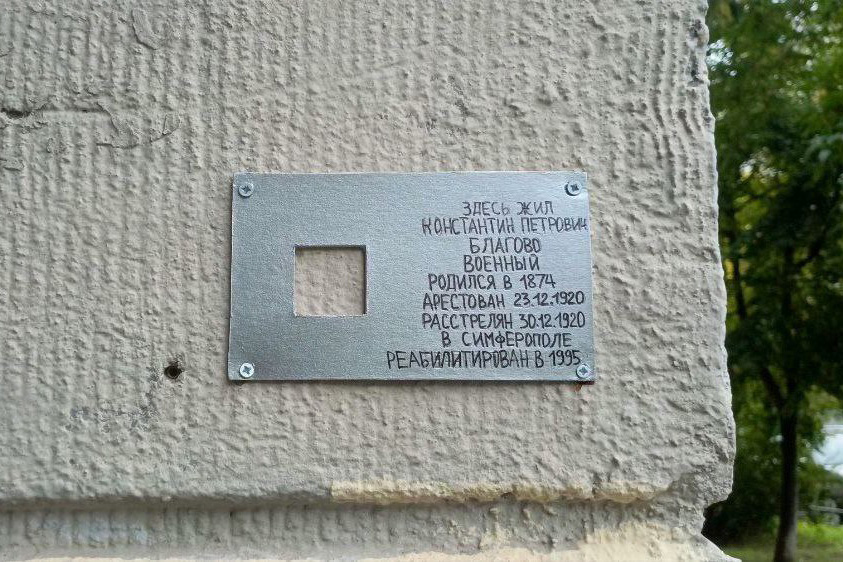
At the time I couldn’t imagine I would be involved in producing cardboard plaques. It was Andrei’s idea to keep going. It wasn’t easy to make thirty-one plaques (it took several days), especially we since we could do it only between his school and boxing practice. Then gradually my middle son and my wife and my youngest joined in.
Why the plaques
There are some people who take responsibility and some who avoid it. I always take responsibility. It’s my life, and it depends on me: why should other people decide what I should do and what I shouldn’t do? There are laws, of course, and certain inhibitions, but when I have to do something big and bold, I do it. I don’t expect others to do it for me.
I won’t commit a crime. Going and throwing a Molotov cocktail at a military recruitment office is not my way — not because I support military recruitment offices but because I’m against all forms of violence. On the other hand, you have to oppose military recruitment somehow.
I cannot say that my grandfather’s story had a profound effect on me, given that he hardly ever talked about it. But it seems to me that everyone in the Russian Federation has a similar story in their family. Absolutely everyone. If someone says they don’t have such a story, it means they just don’t know about it.
As for the plaques, it’s just something that caught my eye. I regularly walked and jogged past the House of Specialists at 61 Lesnoy Prospekt. I saw the number of plaques getting bigger, and I took photos. I saw how this project lived on despite the war, I saw that [historical] memory exists. I sincerely believe that the more memorial sites dedicated to political repression we have, the less political repression there will be in our lives.
When I noticed that the plaques had vanished, I realized something had gone wrong and the plaques would never come back there again. That’s when I went to the shop to get some cardboard.

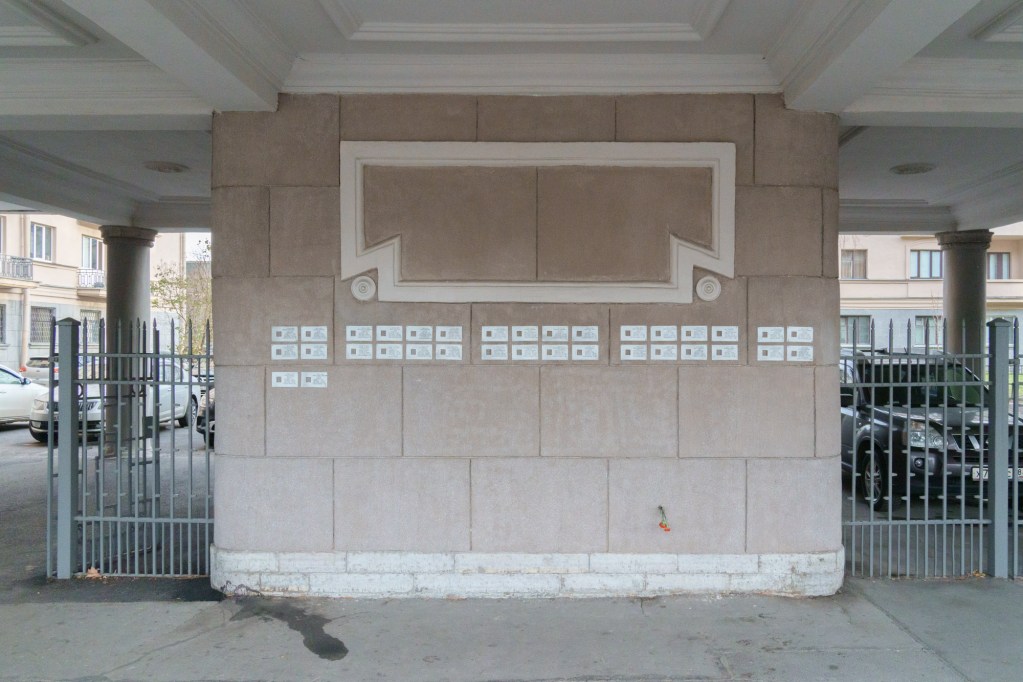
It was my reaction to an injustice. Once upon there were people who were alive, but then they were shot dead. Their relatives were also repressed, albums containing their photos were destroyed, and the survivors abandoned them. These people have no graves — they are buried somewhere in the woods, nobody knows where. The memory of them has been erased as much as possible.
There are those who have not been exonerated yet. Their criminal cases are closed, historians have not found them, or these cases have been destroyed. Such people have nothing left, neither in life nor in death.
Last Address compiles lists of those who have been exonerated, at least. A little hope emerges in the guise of a plaque the size of your hand. The plaques hang there for a while, but then the authorities take them down and throw them away. This is the second time that an injustice has been done. The person has already been killed once, and now they are trying to do it to them a second time.
How people reacted
We were often encouraged by passersby when we would be installing the plaques. For example, when my son and I came to install a plaque to Pyotr Nikolayev and his sister at 13/8 Lesnoy Prospekt, the place where the plaques had been hanging was plastered and painted over. The municipal maintenance workers had tried to destroy all traces of the plaques.
Fortunately, I had a drill with me at the time and so we started drilling the wall, but the wall was made of pre-revolutionary brick, and was as hard as concrete. It was very difficult to drill into this brick, and it was snowing, it was December, and everything got covered in red dust, which looked like blood. I was covered in this “blood” too.
A old man, about sixty-five years old and well-dressed, was passing by and asked what we were doing. We replied that we were putting the Last Address plaques back in place, that hooligans had torn them down.
“And you’re putting this one up to Nikolayev?” he asked.
“Well, yes,” I said.
“He was a deserter,” the man said.
“Well, yes,” I said.
“Attaboy, deserter,” he said. “He fled the army and did the right thing. There was a second plaque there, in memory of his sister, Rogacheva. She should get one too.”
“We’ll put it up,” I said.

Photo courtesy of Mr. Zhumabekov (via Bumaga)
There was another situation. Someone had scrawled “Russophobe, bitch and enemy” in marker on my cardboard plaque for the artist Vera Ermolaeva. I had bought rubbing alcohol at the nearest pharmacy, and was scrubbing the graffiti off when a woman came up to me and asked what was doing.
Hooligans wrote on it, I say, and I’m wiping off what they wrote. What a great job you’re doing, she says, you’re doing the right thing. Vera, she says, lived here on the ground floor, right next to us. There is a local resident who is fighting against [sic] this plaque, she says. Everybody knows him and nobody supports him.
But then she says, But you know, Vera, she was like Navalny. I say, Like Navalny? Is that a good thing or a bad thing? No, Navalny is a bad thing, of course, she says.
I tried to pin her down on this, but she still couldn’t explain to me what she had meant by that.
Why Yevgeny had to leave
I was given to understand, at some point, that the police were looking for me (i.e., for the guy putting up the plaques).
I had had concerns about this from the get-go. I was aware that my activities could tick off law enforcement agencies, since the plaques had been removed by order of district councils, and I was thus acting against them. That’s why, for example, I tried to do my work at night or at dawn.
But later it seemed to me that there was no danger, and so I began to act impudently. For example, at five or six o’clock in the evening, when people were coming home from work, I would go and stick up a couple of signs by the by. I was basically willing to be caught.
Of course I was afraid, but the fear didn’t stop me, it stimulated me. They say that when people do extreme sports, they can’t go without them at a certain point. That’s how it was for me. Fear would make me grab a piece of cardboard and go hang it up. Of course the point was not to get off on the adrenaline rush, but that happened too.
And yet, I understood from the first to the last plaque why I was doing it. Over time, it became a skill: I learned to do it quickly. I also began to treat it as a creative endeavor. In June, I installed the plaque with the inscription “Plaques [memorializing] people who had been repressed in this place were repressed eight times” on Konstantin Blagovo‘s house and two more plaques like it, on the Moika Embankment and on 4th Red Army Street. After I did those, my family and I left for California.

Photo courtesy of Memorial (via Bumaga)
Continuing the cause
I know two people in Petersburg who also make copies [of Last Address memorial plaques that have been removed]. I met one of them by chance on social media. I hung a few plaques together with the other one, a young woman.
There was a Belarusian poet called Yanka Kupala, who wrote these lines: “Sweat blood! Don’t be cattle.” I don’t think that these plaques are “small deeds” at all: they are deeds with a capital d. They are deeds which, I think, will be written about in textbooks. The people who put them up are not cattle. They are fine people doing the best they can do. It is vitally important. Without it there would be no happiness at all. There would only be Mordor, decay, ruin, gloom, sadness, and melancholy.
But one has to be careful, of course. When the situation is such that the risk is justified, then take the risk. But when you have the sense that it’s not worth the effort, then it’s not worth the effort. You know, it’s better to be free than to be imprisoned in some stinking Polar Owl somewhere.
Source: “A Petersburg man spent a year incognito restoring plaques bearing the names of the repressed. Now we can name him and tell his story,” Bumaga, 11 November 2024. Translated by the Russian Reader
