KING CITY, Calif. — A group of men in masks opened fire at an outdoor party in central California, killing four people and injuring three others Sunday evening, police said.
Police responded to a reported shooting around 6 p.m. in King City and found three men with gunshot wounds who were pronounced dead in a front yard, the King City Police Department said in a statement.
Four other people sustained gunshot wounds, including a woman who died after being transported to Mee Memorial Hospital in King City, about 106 miles (170 kilometers) south of San Jose.
The three injured men were transported to Natividad Hospital in Salinas, police said.
Several people were at the party outside a residence when three men with dark masks and clothes got out of a silver car and fired at the group. The suspects, who were not immediately identified, then fled the scene in the car.
The investigation is ongoing, police said.
On Monday French lawmakers will vote on whether to enshrine in the country’s constitution a “guarantee” of women’s “freedom” to have an abortion. They will meet at a joint session of the lower and upper houses of parliament in Versailles, a rarely convened body known as the Congress. A constitutional revision requires three-fifths of the votes.
Such cross-party support is widely expected. Last Wednesday the French senate, which is controlled by the opposition centre-right, voted overwhelmingly in favour of the bill. The revision also enjoys backing from the governing centre and the opposition left. Emmanuel Macron, the president, wants women’s freedom to have an abortion to be made “irreversible”. French politicians of all stripes have worried about the potential for a future rolling-back of such guarantees—especially since America’s [sic] Supreme Court overturned the ruling that protected abortion rights there in 2022.
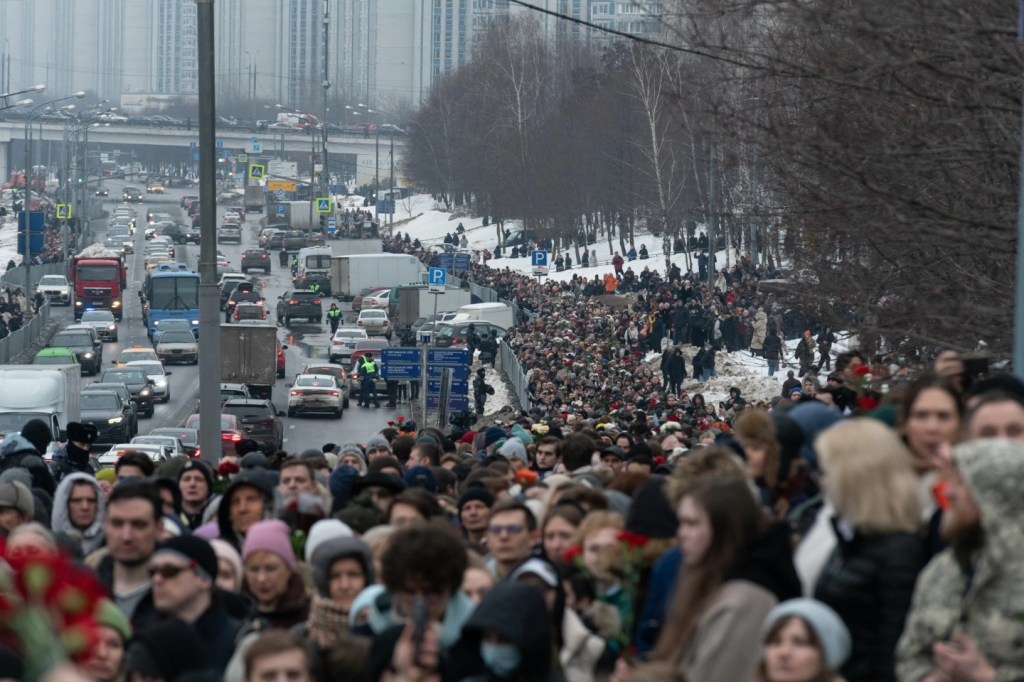
Sources: Spanishdict.com daily newsletter, 4 March 2024; Monterey Herald, 4 March 2024; Time, 4 March 2024; The Economist daily newsletter, 4 March 2024; the YouTube channels of The Insider (“Navalny’s Last Rally”) and Novaya Gazeta (“The Most Emotional Statements of People Who Came to Say Goodbye to Alexei Navalny”), with thanks to Tiina Pasanen; Andrei Bok (Facebook), 2 March 2024; Duolingo; random internet stock image.
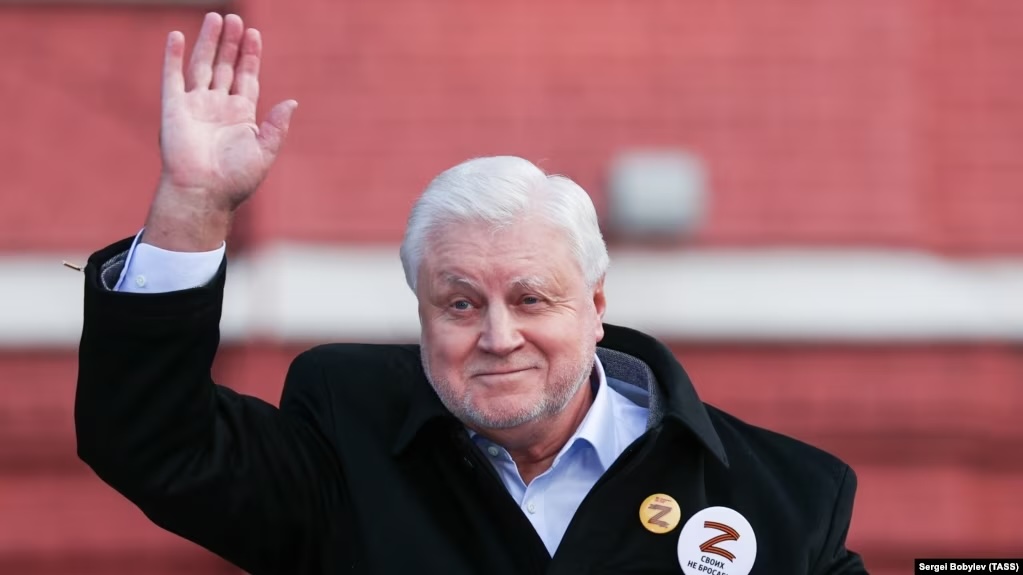
ZZ Top: Russian politician Sergei Mironov and his wife have been accused of kidnapping an infant girl from Ukraine
Sergei Mironov, leader of the party A Just Russia–Patriots–For Truth, and his wife adopted a child taken out of Ukraine. The ten-month-old girl’s personal data was completely changed. Now she bears the surname Mironova, and her birthplace is listed as Podolsk, a city in the Moscow Region, according to an article by Important Stories.
As the Important Stories reporters discovered, in late August 2022, Mironov’s wife, Inna Varlamova, and Mironov’s first deputy in the State Duma, Yana Lantratova, traveled to the Russian-occupied Kherson Region in Ukraine.
In Kherson, the women visited the regional children’s hospital, among other places. They were escorted by the head of the local orphanage, Tatiana Zavalskaya, who had been appointed by the Russian authorities. They examined the children who had been admitted to the hospital from the orphanage and left.
Subsequently, Zavalskaya ordered the hospital to discharge a ten-month-old girl and a two-year-old boy.
When asked by the head of the hospital’s pediatric department why she should discharge sick children (one of them had bronchitis), Zavalskaya said that “that woman chose them and will take them to Moscow.” Doctors tried to delay discharging the children, but Zavalskaya insisted on speeding up the process.
Officially, the children were taken to Moscow for “tests, determination of further treatment options, and rehabilitation.”
The Ukrainian media outlet Hromadskepublished similar information in July 2023.
To adopt a child in Russia, you need to apply to the court. Such cases are heard under a special procedure In November 2022, such a case was heard in the Podolsk City Court in the Moscow Region. Inna Varlamova was listed in the case file as an interested party.
Important Stories claims to have paperwork indicating that in December 2022 Mironov and Varlamova adopted a girl taken out of Kherson. At the request of the adoptive parents, the child’s name and place of birth were changed in official documents.
A source familiar with the situation told the reporters that the girl’s biological mother was deprived of custody and her father had died. And yet, the girl has other blood relatives in Ukraine. The whereabouts of the two-year-old boy taken out of Kherson are still unknown. According to Important Stories, in September 2023, the child was issued a birth certificate that indicates he is in the Moscow Region.
Important Stories notes that this is the first confirmed case of adoption of children taken to Russia from the occupied territories of Ukraine.
Lawyer Maria Chashchilova told Important Stories that adopting Ukrainian children deported to Russia was a crime from the standpoint of international law.
“It is considered genocide. These children often have relatives or guardians in Ukraine who have lost contact with them, and in the case of children from orphanages, their guardians are the officials at these institutions. According to international law, the parties to the conflict must provide relatives and guardians with information about the missing and assist in their search,” the lawyer noted.
It is very difficult to reverse the adoption of a deported child, the journalists say. This can be done only through the court and on serious grounds such as child abuse, alcoholism or drug addiction on the part of the adoptive parents, or the absence of normal conditions for the child’s development and upbringing.
Commenting on the Important Stories article, Mironova called it a fake “by the Ukrainian special services and their western curators.” “They are pursuing a single goal [with all this ‘mudslinging’]—discrediting those who take an irreconcilably patriotic stance today,” the Russian MP wrote on the social network X.
Фейк от украинских спецслужб и их западных кураторов. Я уже привык к информационным атакам. За всем этим стоит одна цель – дискредитация тех, кто занимает сегодня непримиримую патриотическую позицию. Зря стараетесь. Правда всё равно победит. И Россия доведёт СВО до полной победы. https://t.co/nTr39z1Lr2
Sergei Mironov, writing on X earlier today:“A fake by the Ukrainian special services and their western curators. I’m already used to the mudslinging. They are pursuing a single goal with all this—discrediting those who take an irreconcilably patriotic stance today. You’re wasting your time. The truth will win anyway. And Russia will emerge totally victorious in its special military operation.”
Russian children’s rights ombudswoman Maria Lvova-Belova did not respond to a request by Important Stories to comment on the article before it was published. Earlier, she said that children removed from the Ukrainian territories not controlled by Kyiv are not adopted but placed in guardianships.
In March of this year, the International Criminal Court issued an arrest warrant for Vladimir Putin and Lvova-Belova on charges of illegally sending Ukrainian children to Russia. According to the Ukrainian authorities, since the beginning of Russia’s invasion in 2022, about nineteen thousand children have been removed from Ukraine by Russian authorities. Only a few hundred have been able to return to their homeland. Russian authorities claim that they rescued the children from the fighting and are ready to return those whose parents and guardians petition them.
The Gaza Strip is the “most dangerous place in the world to be a child,” the head of the United Nations children’s agency UNICEF said on Wednesday.
UNICEF Executive Director Catherine Russell told the U.N. Security Council that more than 5,300 Palestinian children had reportedly been killed since Oct. 7 – when Palestinian militants of Hamas attacked Israel, killing 1,200 people and taking hostages, most of them civilians.
Israel has focused its retaliation against Hamas in Gaza, a territory of 2.3 million people.
“The true cost of this latest war in Palestine and Israel will be measured in children’s lives – those lost to the violence and those forever changed by it. Without an end to the fighting and full humanitarian access, the cost will continue to grow exponentially,” Russell, who last week visited Gaza, said at a council briefing on women and children there.
Israel has bombarded Gaza from the air, imposed a siege and invaded with soldiers and tanks.
“The Gaza Strip is the most dangerous place in the world to be a child,” Russell said. “In Gaza, the effects of the violence perpetrated on children have been catastrophic, indiscriminate and disproportionate.”
Israel agreed on Wednesday to a ceasefire with Hamas for four days to let in humanitarian aid and free at least 50 hostages held by militants in exchange for at least 150 Palestinians jailed in Israel.
“Women in Gaza have told us that they pray for peace, but that if peace does not come, they pray for a quick death, in their sleep, with their children in their arms. It should shame us all that any mother, anywhere, has such a prayer,” U.N. Women Executive Director Sima Bahous told the 15-member council.
ISRAEL ACCUSES HAMAS OF EXPLOITING CHILDREN
Israel’s U.N. Ambassador Gilad Erdan accused Hamas of exploiting children in Gaza for years and repeated long-held criticisms that the United Nations is biased against Israel.
“Make no mistake as soon as the pause ends, we will continue striving towards our goals with full force,” he said. “We will not stop until we eliminate all of Hamas’ terror capabilities and ensure that they can no longer rule Gaza and threaten both Israeli civilians and the women and children of Gaza.”
Hamas denies operating from places such as hospitals in Gaza and denies using civilians as human shields.
U.N. Secretary-General Antonio Guterres welcomed the ceasefire agreement as “an important step in the right direction, but much more needs to be done to end the suffering.”
There are 5,500 pregnant women expected to give birth in Gaza in the coming month, the head of the U.N Population Fund (UNFPA), the world body’s sexual and reproductive health agency, told the Security Council.
“Every day approximately 180 women deliver under appalling conditions, the future for their newborns uncertain,” said Executive-Director Natalia Kanem, adding that UNFPA was also worried about some 7,000 women who gave birth over the past 47 days and lack access to care, water, sanitation and nutrition.
1992 — Graduated from the Faculty of Philology of the University of Tartu.
Specialist in the history of Russian literature of the XX century. He was the editor of Session (1998), the chief editor of the New Russian Book magazines (1999–2002) and Critical Mass (2002–2007), the editor-in-chief of the OpenSpace.ru section (2008–2012). Since 2012 — Chief Editor of the Literature Department of the Colta.ru website. Member of the literary academy of the Big Book Award, College of nominees of the Joseph Brodsky Memorial Scholarship Fund. Since 2016 — Chief Editor of the Open University.
The inescapable truth is that Israel cannot extinguish Palestinian resistance by violence, any more than the Palestinians can win an Algerian-style liberation war: Israeli Jews and Palestinian Arabs are stuck with each other, unless Israel, the far stronger party, drives the Palestinians into exile for good. The only thing that can save the people of Israel and Palestine, and prevent another Nakba – a real possibility, while another Holocaust remains a traumatic hallucination – is a political solution that recognises both as equal citizens, and allows them to live in peace and freedom, whether in a single democratic state, two states, or a federation. So long as this solution is avoided, a continuing degradation, and an even greater catastrophe, are all but guaranteed.
In the spring of 1956, eight years into the Nakba, a group of Palestinian fedayeen crossed the ploughed ditch which was all that separated Gaza from the state of Israel. On one side of the ditch were 300,000 Palestinians, 200,000 of them refugees expelled from the surrounding area; on the other were a handful of new Israeli settlements. The Palestinian fighters attempted to enter the kibbutz of Nahal Oz, killing Roi Rotberg, a security officer. They took his body back with them to Gaza, but returned it after the UN intervened. Moshe Dayan, then Israel’s chief of the general staff, happened to be in the settlement for a wedding and asked to give the eulogy at Rotberg’s funeral the following evening. Speaking of the men who killed Rotberg he asked: ‘Why should we complain of their hatred for us? Eight years they sat in the refugee camps of Gaza, and saw in front of their eyes how we turned the lands and the villages in which they and their forefathers once dwelled into our homeland.’ It was a recognition of what Palestinians had lost that contemporary Israeli politicians can no longer afford to express. But Dayan wasn’t advocating the right of return: he ended his speech by arguing that Israelis had to prepare themselves for a permanent and bitter war, which would have a major role for what Israel called ‘frontier settlements’.
Israeli leaders, spurred by a furious public, have taken the massacres of 7 October as licence to unleash havoc on the Palestinians. ‘The emphasis is on damage, not precision,’ explained one IDF official. At the time of writing, more than four thousand civilians in Gaza have been reported killed, including entire families wiped out by indiscriminate Israeli air strikes. On 13 October, the Israeli army ordered almost half the population, around 1.1 million people, to evacuate northern Gaza. Most have fled to southern cities such as Khan Younis and Rafah, but these are also under bombardment. Tents have been erected wherever space can be found, evoking memories of the first refugee camps built after the Nakba. The fear is that Israel intends not only to seize large portions of Gaza, but that it will try to force Palestinians into the Sinai desert. Gallant’s promise of a ‘new security reality’ only seemed to confirm this. Egypt has said publicly that it will not accept refugees from Gaza, but the proposal continues to circulate in diplomatic discussions under the pretext of providing a ‘humanitarian corridor’ for Palestinians – as though it were preferable to facilitate population transfer than to ask Israel for a ceasefire.
The violence is not limited to Gaza. In the West Bank, which is under an IDF-imposed lockdown, Israeli settlers and soldiers have killed more than eighty Palestinians in the last fortnight. Families have fled their homes. Moeen Dmeidi, the mayor of Huwara, which was the target of a massive settler attack in February, has spoken of ‘an unbelievable situation of collective punishment’. Palestinian citizens of Israel have been arrested and threatened for expressing their political views, even for ‘liking’ social media posts of verses from the Quran. On 20 October, Israel’s police commissioner, Yaakov Shabtai, ordered a sweeping ban on protests against Operation Iron Swords, saying: ‘Anyone who wants to identify with Gaza is welcome. I will put them on buses that will send them there.’ Politicians and pundits, already emboldened, make genocidal comments with impunity.
The dropping of warning leaflets was not done out of humanitarian concerns: for the British it was strategic, since causing excessive casualties was understood as a source of ongoing resentment and thus further trouble. It isn’t hard to see the parallels with modern military strategy. The same techniques are still, in essence, used by many modern militaries, often in the very same areas where they were originally developed. The continuous bombing of Iraq and the imposition of the no-fly zone between the first and second Gulf wars was a modification of the doctrine, and the leafleting of Iraqi cities such as Fallujah was absolutely in line with it. The ‘war on terror’ saw the return of air patrols and targeted strikes preceded by warnings to the remote valleys of Waziristan, once the redoubt of Mirza Ali Khan. Across the Islamic world, from North Africa to Pakistan, leafleting followed by bombing has been a regular feature of Western policy, the leaflets sometimes serving as a pseudo-legal device to open up free-fire zones where anyone remaining after the warning has expired is considered a legitimate target: their deaths are their own fault.
A car burns inside the yard of a hospital in Mariupol, southern Ukraine, 9 March 2022 Evgeniy Maloletka/AP Photo, courtesy of Al Jazeera
As Israel’s assault on Palestine continues, apparent similarities with Russia’s invasion of Ukraine grow. Israel’s “complete siege” of the Gaza Strip – cutting off water, electricity and food to more than two million inhabitants – echoes Russia’s intentional destruction of our energy infrastructure last winter. This, among other things, earned Russia the label of a “terrorist state” among Ukrainians.
From the moment an evacuation order for northern Gaza’s 1.1 million inhabitants was announced, Ukrainians must have known it would expose the most vulnerable – the elderly and sick – to certain death. We know that when people have no viable alternatives, they often prefer to stay.
The images of widespread devastation that reach us from Gaza, which suggest the Israeli army’s disregard for international humanitarian law, also resemble those from Mariupol or Bakhmut last year. Israel – like Russia in Ukraine – has been accused of bombing residential areas, evacuation corridors and the only exit point from the city, Rafah.
Of course, Hamas’s brutal attacks on civilians in Israeli kibbutzim also appear similar to Russia’s massacres in Bucha in March 2022. It is only right that these were condemned by Ukrainian president Volodymyr Zelenskyi and the Ukrainian Foreign Ministry. But their messages of support for victims and their families were accompanied by problematic assertions, including Zelenskyi’s truly catastrophic conclusion that Israel has the unconditional right to defend itself.
Since then, Ukrainian officials have avoided talking directly about Israel’s ‘Operation Iron Swords’, despite the death toll in Gaza having exceeded 3,500 in the 11 days since its launch, according to the Palestinian authorities.
But Ukraine’s carte blanche to any response that Israel deems necessary makes little sense given historical or recent Ukrainian-Israeli relations, which have been marked by tensions over occupation and respect for international law. Given the security problems Ukraine faces, its foreign policy remains faithful to the promotion of two causes: respect for territorial integrity and nuclear disarmament.
Diplomatic tensions
Unlike the US and its European allies, Ukraine has systematically supported UN resolutions condemning the illegal occupation of Palestinian lands, not without concern for consistency over its own territorial claim on occupied Crimea.
In 2014, Israel did not vote on a UN resolution that denounced Russia’s annexation of Crimea and reaffirmed the territorial integrity of Ukraine. Two years later, Ukraine passed a resolution condemning Israeli settlements in Jerusalem – prompting Israeli prime minister Binyamin Netanyahu to cancel a visit to Israel by a Ukrainian representative, then prime minister Volodymyr Groysman.
These tensions have become heightened over the past year – including when Kyiv supported two UN resolutions in November 2022. The first was for the nuclear disarmament of the Middle East, directed against Israel’s nuclear program, and the second for the opening of an international investigation into Israel’s “prolonged occupation, settlement and annexation of the Palestinian territory”, reaffirming Palestinians’ right to self-determination.
Then, in July 2023, the Israeli Ambassador to Ukraine, Michael Brodsky, condemned Ukraine’s support for 90% of the UN’s “anti-Israel” resolutions, which he described as an “abnormal situation, especially given the fact that Ukraine quite often turns to Israel for various requests”. These requests have also been the subject of tension between the two countries, with Israel having sent humanitarian aid to Ukraine but refusing to send weapons, including defensive weapons, saying that Israel, unlike NATO member states, can only rely on itself.
Israel has also been cautious in its stance on Russian aggression against Ukraine, seeking to maintain cordial diplomatic relations with Russia in light of its own military interests in Syria. It did not join many Western countries in imposing sanctions on Russia and abstained from voting on a UN resolution in favour of Russia’s reparations for its destruction in Ukraine. Since the full-scale invasion, Israel has welcomed 30,000 Ukrainians – including 15,000 Ukrainian Jews as part of a repatriation programme – far fewer than have been taken in by other countries.
Explaining the silence
Most Ukrainian politicians and diplomats likely consider the history between Israel and Palestine too complex to distinguish between aggressor and victim. But this does not explain their silence on Israel’s violations of international law in recent days, which are not dissimilar to actions they have denounced previously. Their silence likely has three sources.
First, Ukraine has sought to distance itself as clearly as possible from Hamas – labelled “the new Nazis” by Netanyahu – and its ruthless methods, which have been used to arbitrarily target Israeli civilians. This is not least because Russia’s justification for the invasion of Ukraine – the alleged need to “denazify” the country – has been effective in the Global South and in certain fringes of Western civil society. Yet in the dominant discourse set by Western governments it is impossible to distinguish between the actions of Hamas and the more general struggle of Palestinians for freedom and justice, which consists of multiple and varied forces. Ironically, diplomats have warned that the lack of support for Palestine will almost certainly result in diminishing support for Ukraine in the Global South.
Prevailing Western discourse is often seen to conflate anti-Semitism and criticism of Israel – another reason why the Ukrainian government is particularly careful with its official statements in the international arena. This is in part because Ukraine is one of the countries most marked by the Holocaust, with nearly 1.5 million Jews killed between 1941 and 1945, but also because Ukrainian nationalist movements, which sheltered people directly responsible for these massacres, have been whitewashed and heroised inside Ukraine.
And finally, Ukraine’s position may simply be geopolitical pragmatism. Ukraine’s Association Agreement with the European Union provides a clause on “convergence on foreign policy and security issues” that requires Ukraine to align itself with positions expressed by European officials. And its dependence on Western humanitarian and especially military aid predisposes its leaders to line up behind its allies, particularly the US, at the risk of being deprived of this support. The fact that Hamas maintains privileged links with Russia only reinforces this loyalty.
A recent statement from the Ukrainian Foreign Ministry, published on 17 October, reflects the ambiguity and the competing principles of Ukraine’s foreign policy. It reaffirms support for Israel’s “efforts to counter terrorist acts”, but it also “advocates the settlement of the Palestinian-Israeli conflict with the help of political and diplomatic means”.
The following day, after the strike on the Al-Ahli Hospital that killed hundreds of Palestinians, which both Israel and Hamas deny responsibility for, Ukrainian officials released their first statement on the humanitarian situation in Gaza. The statement stresses that both parties should “abide by the rules of warfare and respect the norms of international humanitarian law” but fails to call for an immediate ceasefire.
The need to speak out
While Ukraine’s official position is dictated by pragmatic diplomatic considerations, Ukrainian civil society is not obliged to echo its government’s silence on Israel’s punitive operation against Gaza.
Israel’s injustices in Palestine, as well as Russia’s in Ukraine, go far beyond mere failure to respect the laws of war. Ukrainians rightly repeat that Russia’s war against the Ukrainian people did not begin on 24 February 2022. It has occupied part of Ukraine since the annexation of Crimea in 2014, and the colonisation by the Russian Empire of the peoples who inhabit Ukrainian territories dates back to the 17th century.
This history, which continued during the Soviet era, involves episodes of a genocidal nature. These include the Holodomor, a great artificial famine that killed several million Ukrainians in 1932 and 1933, and massive displacements of populations such as the 238,000 Crimean Tatars deported from Crimea to other Soviet republics under Stalin’s orders in 1944. Almost half of the Tatars died of starvation and disease during the following years.
Similarly, Israel’s war against the Palestinian people did not begin on 7 October 2023. It began with the Nakba of 1948, when more than 700,000 Palestinians were expelled from their lands. In 1967, at the end of the Six Day War, Israel occupied the rest of the Palestinian territories, causing a new Palestinian exodus and the installation of new Israeli colonies.
Palestinians often say that the Nakba is a perpetual process, since the dispossessions and colonial crimes have never ended. They have been fragmented and experience different situations depending on whether they live in the West Bank, Israel, Gaza or are refugees. But all are affected by the apartheid regime. Gazan Palestinians particularly suffer from the blockade imposed by Israel since 2006 with the collaboration of Egypt, making the Gaza Strip the world’s largest open-air prison.
The evil that has killed both Israeli and Palestinian civilians in recent days is rooted in the continued occupation and colonisation by Israel of the Palestinian territories. In this sense, the oppression of the Ukrainian and Palestinian peoples has similarities: it is about the occupation of our lands by states with nuclear weapons and overwhelming military force, which mock the resolutions of the UN and international law, putting their causes above any diplomatic dialogue.
As Ukrainians, as supporters of the Ukrainian cause, we have a special responsibility to understand and raise our voices in the face of what is happening. We must point out the inconsistencies of Western governments that support our anti-imperialist struggle while backing Israel’s colonial violence. The tragedy we are currently experiencing must sharpen our sensitivity to similar human experiences.
Following Russia’s invasion, we discovered how little the international community knew about the history of Ukraine. But what do we know about the history of Palestine? In a world where polarisation is increasing, where colonial wars of staggering scale and violence are resurgent, only solidarity between oppressed peoples and curiosity about our respective struggles, beyond geopolitical divisions, can show us the way to just and lasting peace.