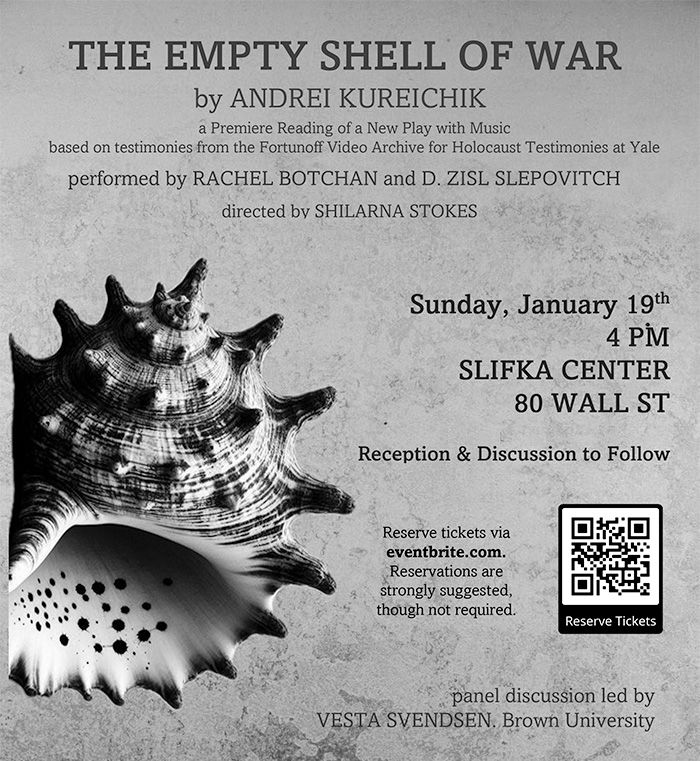
Andrei Kureichik: The Empty Shell of War (World Premiere)

The Fortunoff Video Archive for Holocaust Testimonies, and Yale’s Program in Theater, Dance, and Performance Studies, invites you to the premiere reading of Andrei Kureichik’s new play The Empty Shell of War.

The play, featuring performance by Rachel Botchan and D. Zisl Slepovitch, is directed by Shilarna Stokes.

When: January 19, 2025
Time: 4:00 PM
Location: Slifka Center, Yale University

Registration requested in advance. Please click on this link to register.

About the Play 

The Empty Shell of War offers a gripping exploration of war’s psychological scars. This monodrama follows the journey of a young Jewish girl from a Belarusian shtetl, surviving unimaginable horrors during World War II. Grounded in authentic testimonies from Belarusian survivors of the Holocaust archived at the Fortunoff Video Archive, the play reveals stories of courage, compassion, and survival. The play is a response to the policy of Holocaust denial pursued by Lukashenko’s dictatorial regime in Belarus. This will be the world premiere of the play.

About the Playwright 

Andrei Kureichik is a renowned Belarusian playwright, director, and publicist living in exile. Author of over 30 plays performed globally, his works include the groundbreaking Insulted.Belarus, a centerpiece of the global theater solidarity movement. His plays have been translated into 39 languages and honored with awards like the 2023 Best Foreign Play of the Season in Los Angeles and the European Parliament’s Sakharov Prize for Freedom of Speech. A Yale World Fellow, Fortunoff Fellow and Lecturer, Kureichik also teaches “Art and Resistance” at Yale University.

CREATIVE TEAM 

D. ZISL SLEPOVITCH (composer, woodwinds, sound design) is a native of Minsk, Belarus, a New Yorker since 2008. He is a Jewish music scholar (Ph.D., Belarusian State Academy of Music), composer, a multi-instrumentalist klezmer, classical, and improvisational musician (woodwinds, keyboards, vocals); a music and Yiddish educator. Slepovitch is a founding member of the critically acclaimed groups Litvakus and Zisl Slepovitch Ensemble, a regular contributor to the National Yiddish Theatre Folksbiene, a Musician-in-Residence at Yale University’s Fortunoff Video Archive for Holocaust Testimonies, a pianist and music coordinator at Stephen Wise Free Synagogue in New York. Slepovitch’s credits include “Defiance” movie, “Eternal Echoes” album (Sony Classical), “Rejoice” with Itzhak Perlman and Cantor Yitzchak Meir Helfgot (PBS), and “Fiddler on the Roof in Yiddish” (off-Broadway).

SHILARNA STOKES is a Senior Lecturer and Associate Research Scholar in the program of Theater, Dance, and Performance Studies at Yale. She has directed over thirty plays and musicals in theaters throughout the United States, and has received numerous awards, residencies, and fellowships for her directing work. Her current book project, “Playing the Crowd: Mass Pageantry in Europe and the United States,” examines large-scale political pageants performed in England, the US, Russia, France, and Germany. She is a graduate of Yale (BA in Theater Studies and Comparative Literature), Columbia University School of the Arts (MFA in Directing), and the Columbia Graduate School of Arts and Sciences (PhD in Theatre).

RACHEL BOTCHAN is an award-winning performer with extensive Off-Broadway and regional theater experience and a variety of stage, TV and film credits, She is known for her dynamic range and transformative portrayals. She is an award-winning audio book narrator with many titles for Recorded Books and Audible. She is a graduate of NYU Tisch School of the Arts where she received the Seidman Award for excellence in Drama.

PANEL DISCUSSION

Following the performance, a Q&A and Panel Discussion exploring the play’s themes and historical context will be led by scholar of Holocaust and Genocide Studies, Vesta Svendsen (Brown University).

VESTA SVENDSEN is a PhD student in History at Brown under Dr. Omer Bartov, studying the role of trauma in Belarus ’post-Soviet national identity formation. She originates from Brest, Belarus and was raised between Belarus and New Orleans. Vesta holds a BA from Tulane University in Russian Studies and an MA from Yeshiva University in Holocaust and Genocide Studies. In 2023, Vesta was a Summer Graduate Student Research Fellow at the US Holocaust Memorial Museum, studying western Belarus. Throughout her MA studies, Vesta engaged in part-time psychoanalytic training to broaden her understanding of transgenerational trauma. As an interviewer for the USC Shoah Visual History Archive, she gathers testimony from Russian-speaking Holocaust survivors and is currently translating a Russian-language Holocaust memoir. Vesta is a member of the Coordination Council of the Belarusian democratic forces. She possesses language skills in Russian, Belarusian, Ukrainian, French, Polish, and Yiddish.

Source: Stephen Naron, “Premiere reading of new play The Empty Shell of War at Slifka Center on January 19, 2025,” Fortunoff Video Archive for Holocaust Testimonies, 10 January 2025

Leonid Volkov: The Export Pozner

pozner-yale-1.jpgVladimir Pozner at Yale University on September 27, 2018. Photo by Peter Cunningham. Courtesy of YaleNews

Leonid Volkov
Facebook
September 28, 2018

Yale has an incredibly rich extracurricular life. Every evening is chockablock with special events, public lectures, round tables, debates, and so on. Many politicians and public figures consider it an honor to speak at Yale. Today, for example, the president of Ghana is going to be lecturing, and there is nothing exotic about it.

All these events fight for an audience. They are advertised in a variety of mailings, and the bulletin boards on campus are densely crammed with flyers.

I imagine the president of Ghana will be sad today. He was beaten this evening [September 27]. The prettiest flyers, which have been on the bulletin boards since mid-August, announced a lecture provocatively entitled “How the United States Created Vladimir Putin.”

I had never seen such a popular event here. It was standing room only. Audience members (students, professors, researchers, etc.) sat on the steps of the lecture hall and stood in the aisles. There were around three hundred people. And no, I could not resist my curiosity, either. I was really interested in how Channel One operated when it was exported.

On stage was the ageless Vladimir Pozner. Would that everyone looked like that at eighty-four! His speech and manners were flawless. His manner of interacting with the audience was impeccable. He joked when it was appropriate and answered questions quickly. He was a professional of the highest class.

[These were Pozner’s talking points.]

  • Putin extended a helping hand after 9/11, but it was rejected.
  • The first proposal Putin made when he was elected to the presidency in 2000 was that Russia should join NATO. He was mortally offended by NATO’s rejection of his offer.
  • He fully voiced this resentment in his 2007 Munich speech, and the resentment was justified.
  • The western media have portrayed Putin in a negative light, all but comparing him with Hitler. This treatment has been wholly undeserved.
  • By offending and attacking Putin, they naturally angered him and made him what he is. The media are to blame for this (sic).

Did Russia meddle in the 2016 US presidential election?

[Pozner’s response was that] the Russian regime cheered for Trump, naturally, because Hillary Clinton had said so many bad things about Putin, but Pozner had seen no proof of meddling. Besides, had America not meddled in elections the world over?

And so it went.

Moreover, [the tone of the Pozner’s speech was captured] in the very first words [out of Pozner’s mouth].

“First of all, believe me when I say I am not representing anyone here. I speak here as an independent journalist, a breed that has nearly died off in Russia.”

Oh, while I was writing all this down, there was a question about Crimea. [Pozner’s response can be paraphrased as follows.]

Was international law violated? Yes, it was, but Sevastopol is a city populated by Russian naval officers and sailors. How could Russia have allowed the possibility of losing its naval base there and having it replaced by a NATO base, by the US Sixth Fleet? Should international law not be disregarded in such circumstances? Besides, Crimea has always been part of Russia.

Finally, [Pozner told his listeners, they] would understand better what had happened in Crimea if [they] imagined what would happen if a revolution occurred in Mexico (sic). In this case, would the US not want to deploy several army divisions on its southern border?

Yes, a new referendum should probably be held in Crimea, but [Pozner] was absolutely certain of the referendum’s outcome.

Argh!

Pozner equated Putin and Russia, of course, in all his remarks.

“It was clear the Russians had to respond in a certain way,” he would say in reference to actions taken by Putin.

In short, my friends, I was impressed. The export Pozner is nothing at all like the Pozner served up for domestic consumption in Russia. (I hope he is very well paid.)

But despite his best efforts, Pozner portrayed Putin as a rather pitiful man: insecure, petty, and vindictive. In this sense, of course, Pozner did not lie.

Leonid Volkov has been attacked on his own Facebook page by readers and Mr. Pozner himself on the latter’s website for his allegedly inaccurate portrait of Mr. Pozner’s appearance at Yale. Stories about the evening published on Yale University’s in-house organ YaleNews and the university’s student-run newpaper the Yale Daily News, however, substantially corroborate Mr. Volkov’s sketch of the event. His description of Pozner and his talk also jibe with my own sense of Mr. Pozner as a chameleon who skillfully tailors his messages to his audiences and the times. Or was it not Mr. Pozner who routinely appeared on my favorite news program, ABC’s Nightline, when I was a teenager in the early 1980s, to defend the moribund Soviet regime with a completely straight face? Read “In the Breast of Mother Russia Speaks a Kind and Loving Heart” for an account of a similiarly virtuoso agitprop performance by Mr. Pozner in the US nearly four years ago. {TRR}

Translated by the Russian Reader