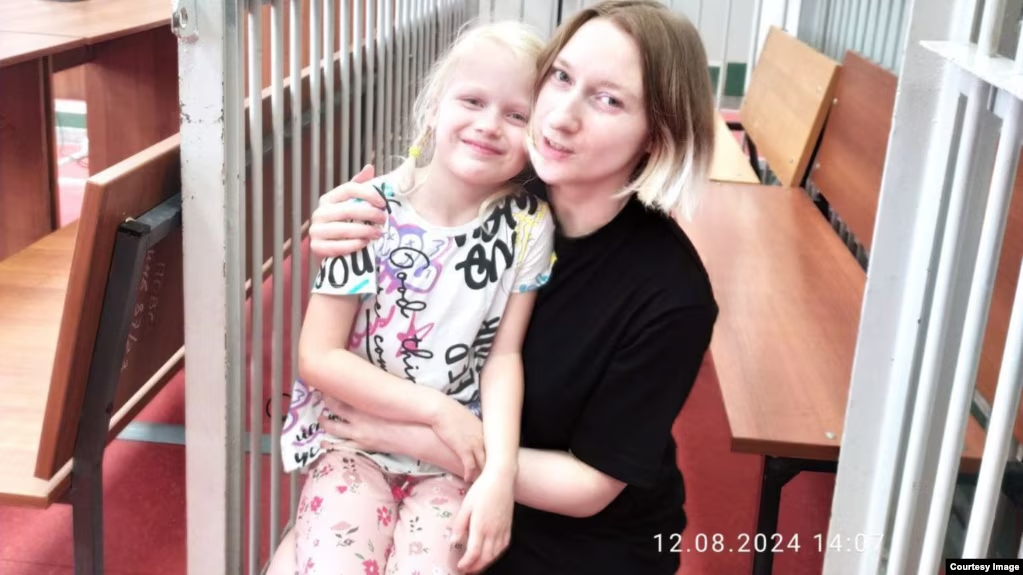
Polina Yevtushenko had deleted the social media posts for which she was tried prior to criminal charges being brought against her, she did not commit high treason, and her so-called crimes were victimless. And yet, she has been in a pretrial detention center for almost three years, and the prosecution asked the court to sentence her to eighteen years in prison. According to her lawyers, this would have been the longest sentence ever handed down to a woman in post-Soviet Russian history for a nonviolent crime that was not even committed. Today, the Central District Military Court found Yevtushenko guilty as charged and sentenced her to fourteen years in prison.
“This case is totally fabricated and unfounded. It’s completely unfounded, and the recordings that do exist and were submitted to the court speak to Polina’s innocence. In them, she repeatedly tries to dissuade her acquaintance Komarov from joining the Free Russia Legion. He made her acquaintance specifically so that this vile criminal case would be brought against her. This is a provocation,” say Polina’s acquaintances who attended the trials. (We are not naming them for their own safety.) “Polina is a courageous person. She’s a fine woman and never loses heart. It’s simply monstrous that she has been given such a long sentence for no reason.”
“I thought they were taking me to be killed”
Polina Yevtushenko, who is from the city of Togliatti, in the Samara Region, is twenty-seven. In July 2023, she was arrested for allegedly “inciting a Samara [city] resident to commit treason by defecting to the enemy, namely by joining the armed group the Free Russia Legion in order to take part in hostilities against the Armed Forces of the Russian Federation on Ukrainian soil” (per Article 30.1 and Article 275 of the Criminal Code of the Russian Federation: “preparation of terrorism”).
On that day, she took her daughter Alisa to kindergarten, and when she left, more than a dozen plainclothes security forces officers were waiting for her.
“They put cable ties on my hands and threw me into the car as if I were a sack of potatoes. Then these men got into the car and placed their feet on me. They didn’t explain anything. I thought that they were gangsters and that they were taking me to be killed. I screamed and called for help,” Yevtushenko later recounted.
After Yevtushenko was arrested, she was charged with five more crimes: publicly calling for terrorism on the internet (a violation per Article 205.2.2 of the Russian Federal Criminal Code), publicly calling for extremism, also on the internet (Article 280.2), disseminating knowingly false information about the deployment of the Russian Armed Forces, motivated by political hatred (Article 207.3.2.e), and condoning Nazism (Article 354.1.4). According to the FSB’s Samara office, she persuaded an acquaintance to go and fight in the Free Russia Legion, carried out “propaganda work,” and “posted instructions for Russian military personnel on how to surrender.”
Seven dates and “high treason”

In this photo, Yevtushenko is a slender young woman with blue hair like Malvina’s, wearing a t-shirt and pink jeans. She raised her young daughter alone and painted pictures, which she posted on her Instagram and VKontakte accounts. She also publicized her anti-war views on these social media accounts, republishing a petition demanding Putin’s resignation over the war he unleashed in Ukraine, posts from the Free Russia Legion (at the time, it had not yet been deemed a “terrorist organization” by the Russian Supreme Court and was not yet banned), and instructions on how to surrender in order to survive the war. She was always quite sociable and interested in all kinds of people, easily meeting new people and making friends, according to her acquaintances.
Nikolai Komarov wrote to Yevtushenko on VKontakte. He said she was very pretty and drew beautifully, and that he really wanted to meet her and date her. What is more, her page said that she used to work at a Yota store, and he had a question he couldn’t figure out himself, so maybe she could help? He lived in Samara, she lived in Togliatti, an hour away by bus, but that was not a problem—he would come to Togliatti.
“They had a total of seven dates,” says a [male] friend of Yevtushenko’s. “He always told her how much he liked her. He invited her out to eat. They went for bike rides, went bowling, and sang karaoke together. He asked her about her pictures and her daughter. That is, he made it patently clear that he was interested in her as a woman and that he was courting her.”
It later transpired that the only dates with Yevtushenko which Komarov didn’t record on a dictaphone were the first two.
“He would constantly tell her that he was afraid of getting drafted and wanted to leave Russia, and asked her to advise him where to go, what to do, and how to make a living,” Polina’s friend continues.” She would reply that if he was so afraid, he should go to China or Kazakhstan, open a Wildberries or Ozon outlet there, and not worry. But he kept bringing up the subject again and again, asking her about the Free Russia Legion, whose posts she shared on social media. Polina told him that they were fighting Putin and that was why she supported them, that she had Ukrainian blood and opposed the war. At the trial, recordings were played of Polina telling Komarov many times that he should not go there and get involved, of her trying to talk him out of it. But Komarov kept at her: ‘I want to join the Legion, let’s choose a “street name” for me.’ (That was his term for ‘call sign.’) She communicated with him in a friendly manner and did not want to get closer because the conversations were always the same.”
Yevtushenko was later asked why she had not immediately pegged Komarov as a provocateur. She replied that she had believed “the FSB would not employ such dimwits.”
In court, Komarov testified that he had independently recorded Yevtushenko’s conversations on a dictaphone, but then became frightened by what she was saying and decided to hand the recordings over to the FSB because he thought she could get him into trouble. The recordings show signs of editing, with conversations cut short, Yevtushenko said in court. During the investigation and the trial, her defense demanded access to the complete recordings, but they allegedly do not exist. Komarov claimed that he had long since sold both the dictaphone and the laptop from which he transferred the recordings to discs for the FSB at a flea market. The court took him at his word.
Center “E” operative, FSB agent, or just a criminal on the hook?
In 2009, Nikolai Komarov was sentenced to two years’ probation for stealing a Sony Ericsson mobile phone, Kholod has discovered. While his probation was still in force, Komarov was caught again and charged with seventeen counts of theft of cable and internet equipment. In May 2011, he was convicted and sent to prison for two years and one month, but in April 2012, he was released on parole, after only eleven months in prison.
“He can actually be sweet, handsome, and charming. He knows how to get under your skin, and girls usually like him. He’s a bit of a con artist,” says a friend of Komarov’s.
You would thus never suspect that Komarov had had run-ins with the law. On the contrary, he maintained a Twitter account on which he demanded that the Samara municipal authorities fill in a pothole and finally resolve the issue of an open manhole cover, and he came across as a caring person and even a grassroots activist. This was before the war in Ukraine, however.
In 2017, Komarov showed up at the Navalny organization’s field office in Samara and introduced himself as a lawyer.
“He was a very active member [sic] of the field office. He wanted to be friends with everyone. He would invite people to barbecues, suggest that we drink vodka, hang out at the office all the time, and willingly do whatever needed doing—if we needed to buy water, he would go buy it without question. He took part in our campaigns and protest rallies,” says Marina Yevdokimova, who was a staffer at Navalny’s Samara field office at the time. In 2021, after the organization’s field offices were shut down across the country, she fled Russia.
In 2019, during the COVID pandemic, Yevdokimova was the field office’s social media manager.
“We had just reached the peak of the outbreak, which we wrote about in a post on Telegram. We also wrote that doctors had no PPE. An administrative case was brought against me. The police were staked out near my home. They would knock on my door, but I wouldn’t open it, so then they would go to my neighbors and question them,” Yevdokimova continues. “There was a court hearing in May, and Kolya Komarov was a witness for the prosecution, to my surprise. He hadn’t been at the Navalny field office for a long time. He was upset with us because we hadn’t gone along with his strange proposals. He had then become friends with the Communists and NOD (National Liberation Movement) members, posted photos of himself with them, and participated in their rallies.”
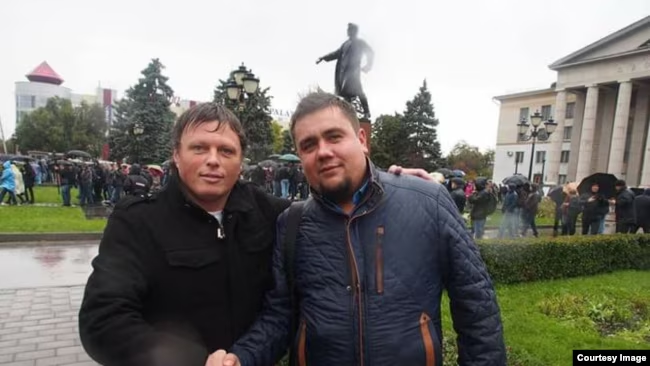
At Yevdokimova’s trial, Komarov testified that he had seen her walking through the market in Microdistrict 15 and had allegedly heard her discussing on the phone that she would post this particular message on Telegram.
“I heard about her criminal intentions and could not fail to report them to law enforcement,” he told the court.
“Strangely enough, I was acquitted,” says Yevdokimova. “The lawyer asked [Komarov] simple questions that [he] couldn’t answer properly: ‘Where do you live? How did you end up in the market at that time?’ This was during the pandemic and no one could move freely around town. Besides, many people had access to our Telegram channel, so it was impossible to prove that I was the one who had posted it.”
Yegor Alasheyev, another former staffer at Navalny’s Samara field office, also emigrated from Russia.
“In March 2017, we held a rally called ‘Dimon Will Be Held to Account,’ at which twenty-three of our supporters were detained,” Alasheyev recalls. “We appealed all the fines [imposed on them as punishment] and they were later overturned. Komarov was also detained, but he turned down our assistance, saying that he was a lawyer himself and ‘knew what he was doing.’ It later transpired that he had pleaded guilty and been sentenced to pay a fine. At first, he kept quiet about the situation, then he telephoned our office and asked us to pay the fine. (At that point, he had already stopped hanging out with us.) I told him that we needed to talk to the lawyers and come up with a plan. But he refused to talk to them, and two weeks later, a video was released on TV featuring a ‘disenchanted Navalny volunteer.’ Soon after, he started attending NOD rallies. We looked into Komarov and learned that he had been convicted of stealing cable, but we had suspected that he was here for a reason even prior to that. He always hung around the office and listened carefully to what we were saying. But we didn’t pay much attention to it—he had seemed harmless. We understood of course that someone would inevitably be planted in our midst and that we were being watched.”
In 2022, Protocol Samara discovered that Alexander Melikhov, whom Komarov had befriended, had been planted in the local Navalny field office. Melikhov was a lieutenant colonel in the police, and his surname and passport had been changed for the sake of this operation. Yevtushenko’s acquaintances do not rule out the possibility that both men infiltrated the organization at the same time.
During Yevtushenko’s trial, it transpired that another criminal case had been opened against Komarov. He had been charged with thirty-seven crimes under Article 173.1.2.b of the Russian Criminal Code (“illegal creation of legal entities or provision of documents”). He was sentenced to 330 hours of compulsory community service.
“It seems that he has long been firmly ‘on the hook’ of Center ‘E’ (the Russian Interior Ministry’s office for combating ‘extremism’ and ‘dissidents’—Sever.Realii) and the FSB, but they cover for him. He created thirty-seven fake companies and only got community service,” says a lawyer working in Russia.
A new method of recruiting?
In July, it will have been three years since Yevtushenko was jailed in a pretrial detention center. In June 2025, she was found guilty of “violating” the center’s rules for passing store-bought cookies to a neighboring cell. In July of the same year, she was sent to solitary confinement for ten days because she had described her court hearings in her letters. All this time, she has only been able to see her daughter through glass; the judge has allowed them one-hour visits. Yevtushenko’s parents have been raising Alisa.
“Visits take place through glass over a telephone and last one hour. During this hour, I talk alternately with my mother and with Alisa. During the last visit, I brought a sketchbook with me in which I draw pictures for Alice. She really liked it,” wrote Yevtushenko from the detention center. “Before that, I showed Alice some old photos of us from the time before my arrest, but she started crying, so I decided not to do that again… Of course, conversations through glass can hardly be called visits, but we are grateful for what we have. I really miss hugs. I want to hug and kiss Alisa, but I can’t.”
“Polina gets plenty of letters at the detention center. Many people support her because they understand the injustice of what has been happening to her. She doesn’t get discouraged, she rejoices in every little thing, and she has been learning English by mail,” says a friend of Yevtushenko’s who has attended all the court hearings in her case. “How do we usually imagine sting operations carried out by the special services? They involve persuasion, bribery, blackmail—the classics of the genre. But a new method has supposedly emerged in Polina’s case, which we learned of when FSB expert Tatyana Naumova was cross-examined at the trial. According to her, in a new manual developed by FSB criminologists, which has not been made available to the public, a new method of recruitment is [defined]: it is deemed ‘propaganda’ and ‘recruitment’ when someone praises something—for example, when someone claims that the Free Russia Legion has good equipment. Polina’s defense asked to review this secret manual, but the judge turned down their request. The defense lawyer then asked the judge to examine them himself and confirm that everything was indeed written that way there. But the judge refused to do so. Naumova also said that Komarov was ‘a person conducting covert operations.’ In other words, she effectively admitted in court that the special services had organized a sting. From the point of view of the European Court of Human Rights (ECHR), this is a gross violation of the right to a fair trial (per Article 6 of the European Convention on Human Rights). Evidence obtained in this way is considered inadmissible by the ECHR. And Russia, until it ceased to be a party to the Convention due to the war it unleashed in Ukraine, had been repeatedly punished for this” (e.g., in Vanyan v. Russia, 2005, and Lagutin and Others v. Russia, 2014—Sever.Realii).
An excerpt from Polina Yevtushenko’s closing statement at trial
“Your Honor, you have known me for almost two years. I am confident that during these two years you have been persuaded that I pose no danger to the community and that I can be released.
“For two years, I have only been able to see my daughter through glass and cannot even hug her. I did not see her at all during the first year [in police custody]. Last year, Alisa started first grade, and this year, on March first, she will turn eight years old. She needs her mother’s love, care, and help, and I need even more to be with her, to see her grow up, to raise her, to take care of her. I need to make sure she becomes a decent person—well-mannered, smart, well-read, and fond of our Motherland.
“Your Honor, I ask you to release me so that I can raise my daughter. Be a conduit of happiness for two loving hearts—those of a mother and her child. I have never committed treason. I love my Motherland, Russia, and would never do anything to harm her. If I have made any mistakes or committed violations, then being in prison for almost three years is more than enough punishment for me.
“I have come to grips with everything [I have done] and promise you that from now on I will behave in such a way that you shall never be ashamed of me. I ask you to make a just decision and release me to be with my daughter.”
According to a study by the human rights project First Department, between February 2022 and mid-December 2024, 792 people in Russia were charged with treason (per Article 275 of the Russian Federal Criminal Code), espionage (Article 276), and secret cooperation with a foreign state (Article 275.1). In 2024, 359 people were found guilty and sentenced to actual prison terms on these charges, and four more were sentenced to compulsory psychiatric treatment. Of these 359 people, 224 were found guilty under Article 275, 38 under Article 275.1, and 101 under Article 276. A total of 536 people have been convicted of violating these criminal code articles since the start of the war; Russian courts have not handed down a single acquittal. According to First Department, a significant number of these cases were based on sting operations carried out by FSB officers or persons associated with them.
Source: “The recruitment that never happened: Polina Yevtushenko sentenced to 14 years in prison,” Sever.Realii (Radio Svoboda), 6 March 2026. Translated by the Russian Reader