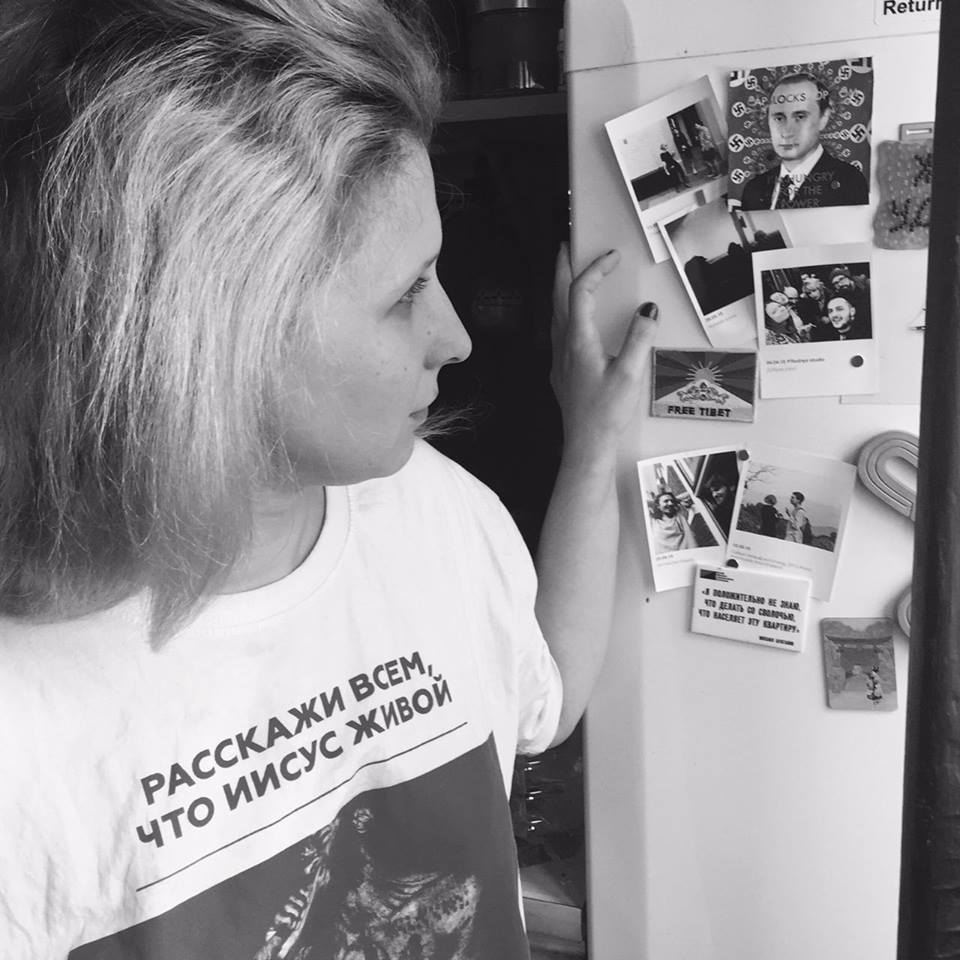
Ekaterina Schulman. Photo courtesy of Andrei Stekachov and The Village
Political Scientist Ekaterina Schulman on Why You Should Vote
Anya Chesova and Natasha Fedorenko The Village
September 16, 2016
This Sunday, September 18, the country will vote for a new State Duma, the seventh since the fall of the Soviet Union. The peculiarity of this vote is that it will take place under a mixed electoral system for the first time since 2003. 225 MPs will be elected to five-year tears from party lists, while the other 225 MPs will be elected from single-mandate districts. Several days before the elections, The Village met with Ekaterina Schulman, a political scientist and senior lecturer at the Russian Presidential Academy of National Economy and Public Administration (RANEPA). We talked with her about why you should vote if United Russia is going to win in any case, as well as about the changes in store for the Russian political system in the coming years.
The Upcoming Elections
The Village: On Sunday, the country will hold the first elections to the State Duma since 2011. The social climate in the city and the country as a whole has changed completely since that time. Protests erupted in 2011, and the people who protested on Bolotnaya Square and Sakharov Avenue believed they could impact the political situation. Nowadays, few people have held on to such hopes. What should we expect from the upcoming elections? And why should we bother with them?
Ekaterina Schulman: Everything happening now with the State Duma election is a consequence of the 2011–2012 protests, including changes in the laws, the introduction of the mixed system, the return of single-mandate MPs, the lowering of the threshold for parties to be seated in the Duma from seven to five percent, and the increased number of parties on the ballot. These are the political reforms outlined by then-president Dmitry Medvedev as a response to the events of December 2011. Later, we got a new head of state, but it was already impossible to take back these promises. The entire political reality we observe now has grown to one degree or another out of the 2011–2012 protest campaign, whether as rejection, reaction or consequence. It is the most important thing to happen in the Russian political arena in recent years.
The statements made by Vyacheslav Volodin, the president’s deputy chief of staff, on the need to hold honest elections, Vladimir Churov’s replacement by Ella Pamfilova as head of the Central Electoral Commission, the departure of someone more important than Churov from the CEC, deputy chair Leonid Ivlev, and the vigorous sacking of chairs of regional electoral commissions are all consequences of the protests. If they had not taken place, nothing would have changed. We would still have the same proportional voting system, the same seven-percent threshold, the same old Churov or Churov 2.0. Continue reading ““We Have a Surrogate Democracy”: An Interview with Ekaterina Schulman”→
A month ago, an acquaintance invited me to his house.
“I want to tell you a story,” he wrote.
We met. We left the kitchen, where there were a lot of people, and went to an empty room. He stood by the window and told his story.
“Recently, I met a guy at this party. We had some drinks, and he tells me he used to work in the security organs. So, in February 2012, they were called to an emergency meeting. Meetings like this are rare thing. They have them when there is a terrorist attack or something like that. So they called them to the meeting and said that some girls had danced in a church, and the patriarch was furious and had rung up Kolokoltsev, who was then the [Moscow Police Commissioner], and demanded to find them.”
To find us.
“‘And I found the blonde,’ he told me.”
“‘Alyokhina?’”
“‘Yeah. When I realized it was her, that it was her IP address, I thought for a moment about what to do next.’”
“‘Did you know she had a kid?’”
“‘I knew. But I did my job.’”
“And then he tells me,” my acquaintance went on, “that during the trial, they got them together and showed them a special speech that the patriarch had videotaped for them in gratitude. Like, you guys are doing important work.”
“How did he decide to resign?” I asked.
“That was how he decided to resign,” my acquaintance replied.
Nikolai Yaroshenko, Life Is Everywhere, 1888. Image courtesy of Wikipedia
The 2016 Elections: Putrefaction as the Laboratory of Life
Ilya Budraitskis OpenLeft
April 29, 2016
How do the upcoming Duma elections threaten the regime?
Today, it would seem that the upcoming September elections to the State Duma are a cause of growing concern only in the Kremlin. While polls continue to record a low level of public interest in the event, and the tiny number of parties allowed to run in the election wanly prepares to fulfill their usual roles, the president and his entourage are increasingly talking about possible threats.
The rationale of radicalization
At a recent meeting with activists of the Russian People’s Front, Putin noted that external enemies would preparing ever more provocations to coincide “with elections to the State Duma, and then with the presidential election. It’s a one hundred percent certainty, a safe bet, as they say.”
Regardless of their real value, the upcoming elections have been turning right before our eyes into a point of tension on which the state’s repressive apparatus has focused. Beginning with the establishment of the National Guard, the process has been mounting. Each security agency has now inaugurated its own advertising season, designed not only to remind the president and public of its existence but also to show off its unique capabilities, inaccessible to other competing agencies, for combating potential threats.
Prosecutor General Yuri Chaika has uncovered a plot by the Ukrainian nationalist group Right Sector, while in his programmatic article, Investigative Committee head Alexander Bastrykin essentially suggested canceling the elections since holding them could prove too dangerous. He made a direct appeal to stop “playing at pseudo-democracy” and provide a “tough, appropriate, and balanced response” to the country’s enemies “in light of the upcoming elections and the possible risks presented by the stepping up of efforts by destabilizing political forces.” With the appointment of Tatyana Moskalkova, even the previously neutral office of the human rights ombudsman has, apparently, been turned into yet another bastion of the fight against conspiracies.
This nervousness is certainly due to the fact that the growing economic and social crisis has had no visible political fallout for the time being. There have been no mass spontaneous revolts or sectoral strikes, although there has been an overall uptick in isolated labor disputes. The political realm has long ago been securely purged of any uncontrollable opposition, while the president’s personal rating has remained phenomenally high. Nothing, it would seem, portends serious grounds for political destabilization this autumn. The absence, however, of real threats itself has become a threat to the internal stability of the state apparatus.
Where does the threat lie? In recent times, it has become obvious that decision-making at all levels and whatever the occasion has been subjected to a rationale of radicalization. Its principle can be described roughly as follows: no new decision can be less radical than the previous decision. Bureaucratic loyalty is measured only by the level of severity. MPs must propose more sweeping laws against latent traitors. Law enforcement agencies must expose more and more conspiracies, while the courts must hand down rulings that are harsher than the harshest proposals made by the security officials and MPs. Permanently mounting radicalism enables officials to increase budgets, expand powers, and prove their reliability, while any manifestation of moderation or leniency can cost them their careers. This radicalization, whose causes are rooted in the political psychology of the Russian elite (which suffers from an almost animal fear of uncontrollability), has set off an extremely dangerous bureaucratic momentum. Its main problem is the inability to stop. It is not only unclear where the bottom is, but who is ultimately interested in reaching that bottom and leaving it at that.
All this generates a strange situation vis-à-vis the elections, which have generally functioned primarily as a political balancing mechanism for the Putinist system, and even now function in this way. Elections have always been a reminder—not to voters, but to the elite itself—that varying opinions within a clearly defined framework have not only been possible but have also been encouraged. This reminder has been important not out of faithfulness to an abstract principle, but as confirmation that political bodies (first of all, the presidential administration) have had the monopoly on deciding domestic policy, not a military or police junta.
Fixing the broken mechanism?
For the Kremlin, the upcoming elections are overshadowed by the political trauma of 2011, when the smoothly functioning system of managed democracy suffered a serious breakdown. The current chief political strategist Vyacheslav Volodin has more or less consistently focused on making sure the failure of five years ago is not repeated. Volodin’s mission is to fix the broken mechanism with political methods, not by force.
It is worth remembering that, for the greater part of the Putin era, parliamentary and presidential elections were parts of a single political cycle, in which the same scenario was played out. The triumphal success of the ruling United Russia party was supposed to precede and ensure the even more resounding success of Vladimir Putin. In December 2011, however, the cycle’s unity backfired against the Kremlin’s plans. The interval between elections enabled the protest movement to maintain its grassroots energy for several months.
The political rationale of Putin’s third term is now aimed not only at technically but also at conceptually disrupting this cycle. Amidst a sharp drop in confidence in the government, the Kremlin decided last summer to move parliamentary elections up from December 2017 to September 2016, and, on the contrary, postpone the presidential election from March 2017 to March 2018. The point of the maneuver is obvious. The presidential and parliamentary elections must now represent not two parts of the same script but two completely different scripts. In the first script, a limited number of parties, which make up the symphony of the Crimean consensus, will criticize the government and each other, thus competing for the sympathies of the dissatisfied populace. In the second script, the natural patriotic instinct of voters should leave no doubt as to the need to support Putin unconditionally.
The new ideological content was embodied by Volodin’s famous statement: “There is no Russia today if there is no Putin.” This personification virtually means that, as a symbolic father, Putin transcends everyday politics. You can be a liberal or a nationalist, a proponent of greater intervention in the economy or a fan of the free market. You can choose not to like the government or government officials. But the nexus Putin-Crimea-Russia is beyond any doubt. Those who fundamentally disagree with it are simply removed from the Russian political spectrum and branded “national traitors.”
In keeping with this rationale, responsibility for the sharp drop in living standards and the consequences of the neoliberal “anti-crisis” measures has been borne by ministers, MPs, and governors, by anyone except the president. Even now, when the propaganda effect of the “reunification” of Crimea has obviously begun to fade, the president’s personal rating remains high. Thus, according to the latest opinion polls, 81% of respondents trust Putin, while 41% do not trust Prime Minister Dmitry Medvedev, and 47% do not trust his government overall.
Within the new-model Crimean consensus, United Russia will no longer play the role of the backbone it played in the noughties. Untethered from the non-partisan figure of the president, it will take on the burden of unpopularity borne by its formal leader, Dmitry Medvedev, and his government. The mixed electoral system will enable candidates from local “parties of power” in single-member districts to dissociate themselves from United Russia, presenting themselves as “non-partisan Putinists” criticizing the soulless federal authorities. Volodin’s scheme involves loosening United Russia’s grip on power and slightly increasing the value of the pseudo-opposition as represented by the Communist Party and A Just Russia.
It is worth noting that the very existence of a bureaucratic mega-party previously played a stabilizing role by dampening intra-elite conflicts. Now they will inevitably come out into the open, including in the shape of inter-party struggles. Of course, the presidential administration counts on being able to effectively ensure compliance with the clear rules of this competition, but there are no guarantees. The managed multi-party system with the “father of the nation” towering over it consummates the new architecture of the Putin regime as a personalistic regime, and becomes more and more vulnerable.
In the new reality of the crisis, Putin’s depoliticization also facilitates a more intensive “natural selection” among bureaucrats at all levels by culling those who have not mastered the art of maintaining the conservative sympathies of the populace while simultaneously implementing what amount to aggressively anti-social policies. The September campaign is supposed to go off without a hitch, culminating in a predictable outcome. Having given a human face to the Central Elections Commission, which was seriously discredited by the previous leadership, Ella Pamfilova is meant to increase this manageability and predictability. It turns out that the upcoming elections are the primary pressure test of the new, post-Bolotnaya Square design of managed democracy. The future of Vyacheslav Volodin and his team, as well as Putin’s willingness to trust them with the extremely important 2018 presidential campaign, probably depends on how smoothly they come off.
From the foregoing it is clear that the objective of reestablishing the rules of managed democracy is directly at odds with the above-mentioned rationale of radicalization, whose standard-bearers are the competing law enforcement agencies. Their individual success in the internal struggle is vouchsafed by the failure of the political scenario, which would give rise to the need for a vigorous intervention by force. After all, the National Guard’s value would be incomparably increased if it put down real riots instead of sham riots, and Bastrykin’s loyalty would all the dearer if, instead of the endless absurdity of the Bolotnaya Square Case, he would uncover real extremists. To scare someone seriously, the ghosts have to take on flesh and blood.
Life is everywhere
Marx said that putrefaction is the laboratory of life. Now we see how Putinist capitalism has embarked on a process of gradual self-destruction. The upcoming elections provide a clear picture of how this has been facilitated by two opposing rationales, the political rationale (Volodin and the presidential administration) and the law enforcement rationale. Thus, the first rationale, in order to generate the necessary momentum and expand the range of opinions, must respond to social discontent by providing United Russia’s managed opponents with greater freedom to criticize. Restoring the internal political balance will inevitably lead to the fact that topics related to the crisis and the government’s anti-social policies will become the centerpiece of the entire election campaign. On the other hand, the security forces will destabilize the situation outside parliament. Together, they will do much more to undermine an already-flawed system than the long-term, deliberate efforts of any western intelligence agency.
Of course, Russian leftists should in no way count on events following an automatic course. But it is absolutely necessary to take into account the conflicts of interest within the elite and understand their decisive influence on the shape of the upcoming elections. These elections have nothing to do with the real struggle for power or traditional parliamentarianism in any shape or form. But they are directly related to the internal decomposition of an authoritarian, anti-labor, and anti-social regime. So our policy vis-à-vis these elections should be flexible and remote from all general conclusions. That means we can and should support certain leftist candidates in single-member districts. We must use all the opportunities provided by the leftist, socialist critique of the Medvedev government’s so-called anti-crisis policies. We must be ready to go to the polls. Or we must be ready to reject them, taking to the streets when the time comes.
Ilya Budraitskis is a writer, researcher, and editor at OpenLeft. Translated by the Russian Reader
This is just by way of understanding the hierarchy of the people in power in Russia.
The political wrangling went on for ten months. In March, Putin “went to ground” for a couple of weeks when the siloviki were demanding he surrender Kadyrov. It was clear he would not give up Kadyrov. Then for several months they demanded Geremeyev and his high-ranking relatives, but ultimately they did not get him, either.
This is what it basically comes down to.
The toughest guy in the real table of ranks in Russia is Ramzan Kadyrov.
The second rank includes Vladimir Putin, the selfsame Chechen elite, and members of the State Duma and Federation Council.
The third rank includes Bastrykin, Patrushev, Bortnikov, Chaika, and Geremeyev, whose degree of untouchability is the same. Any of them can steal anything and kill anyone, and he will get off scot-free.
The fourth rank includes any general in the Investigative Committee and Federal Security Service (FSB), and somewhere in there as well is Ruslan Muhudinov, driver of the deputy commander of the North Battalion [i.e., Ruslan Geremeyev].
Leonid Volkov is a project manager for opposition politician and anti-corruption campaigner Alexei Navalny. Translated by the Russian Reader
__________
Zhanna Nemstova Moving Backwards: Russia’s Moral Decay
December 28, 2015 The Moscow Times
The Public Opinion Foundation conducted a survey this month asking Russians two questions: “What was the main event of the year in Russia?” and “What was the main global event of the year?”
Noteworthy is that fully 40% of the respondents had trouble answering either question. And the most brutal political murder in modern Russia – the assassination of my father – did not even figure in the responses. State-controlled television hardly mentions it, with the exception of the first few days after the killing, when commentators spoke of him in contemptuous tones.
But the problem is not only the silence of the Kremlin’s official propaganda. The problem is the condition of Russian society. A Levada Center survey conducted in March of this year found that one-third of all Russians are indifferent to my father’s murder. That is a moral numbness best conveyed by the popular Russian sentiments of “It does not concern me” and “That does not affect me.” The well-known military journalist Arkady Babchenko refers to that type of thinking by his countrymen as “infantilism.” Perhaps he is right.
This attitude finds expression not only in widespread apathy, but also in people’s inability to recognize even obvious causal relationships. It is understandable why some people cannot see the medium-term and long-term negative consequences of the annexation of Crimea, but it was not so difficult to predict that consumer prices would rise as a result of Moscow’s food embargo and the hefty tolls imposed on trucks traveling on federal highways.
The political system that President Vladimir Putin has built robs the Russian people of the ability to think, analyze, ask questions, formulate positions or remember the past. It offers no stimulus for that: Putin’s Russia has no need of people who think for themselves. It has reduced competition to a minimum in all areas, including the political field. And it is not always the smartest that succeed in this system.
It is a sad and potentially dangerous situation when the political playing field lies decimated and debates and discussions have been replaced with sometimes violent pressure from the authorities. That has also compromised the quality of the opposition itself and made it a truly heroic feat to even take part in the opposition movement in Russia. There are no democratic institutions and the activists are fighting for survival. Under such conditions, opposition figures have no chance to become public figures and the public has no way of knowing who is who.
People have short memories, and that makes life easier for Putin and his inner circle, who are constantly confusing their facts. First they claim there are no Russian soldiers in Crimea and eastern Ukraine, and then they admit to their presence. First they promise not to raise taxes and fees, and then they impose new tariffs on long-haul truckers. Forgetfulness is a handy humantendency, and the Kremlin’s television propaganda exploits it to the fullest.
This explains why leaders have no personal reputations and remain unaccountable before the public. Perhaps the social apathy and the public’s lack of interest in politics is a defense mechanism, people’s way of responding to the flood of lies and aggression from the authorities. Nobody can figure out where the truth lies, and so it is best not to even go looking for it.
All politics in Russia are situational and as volatile as oil prices. Even loyal politicians and officials do not always manage to fall into line exactly as they should. For example, it is amusing to see how famed film director and die-hard Putin fan Nikita Mikhalkov gets outraged over the way his own patriotic show on state-controlled television is subjected to censorship.
The authorities and the ruling elite are out for their own survival. That end justifies all means, including the tactic of keeping military tensions high at all times. As a result, Russia is increasingly moving away from humanistic values and toward a confrontational relationship with the world. But perhaps that is not putting it strongly enough: maybe Russia is moving toward total apathy. However, war is becoming the context for all other issues in life.
Russian journalists often ask me why I fight for a fair and impartial investigation into my father’s murder. For me, the very wording of that question is sickening because it shows that medieval values now reign supreme in Russia: nobody understands that it is not just I who needs such an investigation, but all Russians if this country is to ever move forward.
We must wage a long and grueling fight for human rights. If we simply give up that struggle and accept the fact that, in Russia, someone can just go and kill a prominent public figure, a statesman and leader of the opposition with absolute impunity, then we must also come to terms with the fact that the same thing could one day happen to any of us.
Today’s opposition members are now at greater risk than ever before. I see the condescending attitude shown toward the small handful of people who continue to struggle for democracy in Russia. I have grown accustomed to the eternal question: “What do they offer?” But just imagine if one day even that small group would no longer exist. Who, then, would conduct anti-corruption investigations, participate in even nominal elections, initiate investigations into wrongdoings by Duma deputies or provide support for political prisoners? No one, that’s who.
My father long experienced that condescending attitude from others who behaved as if they were looking down on him from on high. And now he has been murdered – for his views, for daring to express his position, for his unwillingness to be indifferent or apathetic. And suddenly, his absence is sorely felt.
Putin’s Russia has not brought a revival of spiritual values, as state-controlled TV tries to convince us. It has caused Russia’s moral decay. And as long as Russians approach every problem through the filter of whether it will affect them personally, this country can move in only one direction – backward.
Zhanna Nemtsova is a Deutsche Welle reporter and the founder of Boris Nemtsov Foundation For Freedom.