
Asylum Seekers

Yulia Yemelyanova. Source: The Insider

Kazakh authorities have granted Russia’s request to extradite activist Yulia Yemelyanova, a former employee of the late Alexei Navalny’s Petersburg office. According to the Russian opposition-in-exile’s Anti-War Committee, Kazakhstan violated its own protocols in making the decision to extradite Yemelyanova, as the Russian activist’s application for asylum is still under review in the country.

This past October, Kazakhstan’s Prosecutor General’s Office had guaranteed that extradition requests would not be considered until all administrative procedures related to obtaining asylum were completed. Yemelyanova’s defense intends to appeal the extradition decision to the country’s Supreme Court.

Yemelyanova was detained on Aug. 31, 2025, at Almaty airport while in transit to a third country. She has been held in pretrial detention ever since. In Russia, she is being prosecuted for theft (Part 2, Article 158 of the Criminal Code) in connection with a 2021 incident in which she allegedly stole a mobile phone from a taxi driver. Yemelyanova’s defense calls the case fabricated. It was sent to court in July 2022, by which time the activist had already left Russia.

Yemelyanova is the fourth Russian asylum seeker since late January to be handed a deportation decision from Kazakh officials. The others are Chechen Mansur Movlaev, an open critic of Ramzan Kadyrov; Crimean resident Oleksandr Kachkurkin, who is facing treason charges in Russia; and Yevgeny Korobov, an officer who deserted from the Russian army.
Source: “Kazakhstan moves to extradite former employee of Navalny’s St. Petersburg office to Russia,” The Insider, 11 February 2026


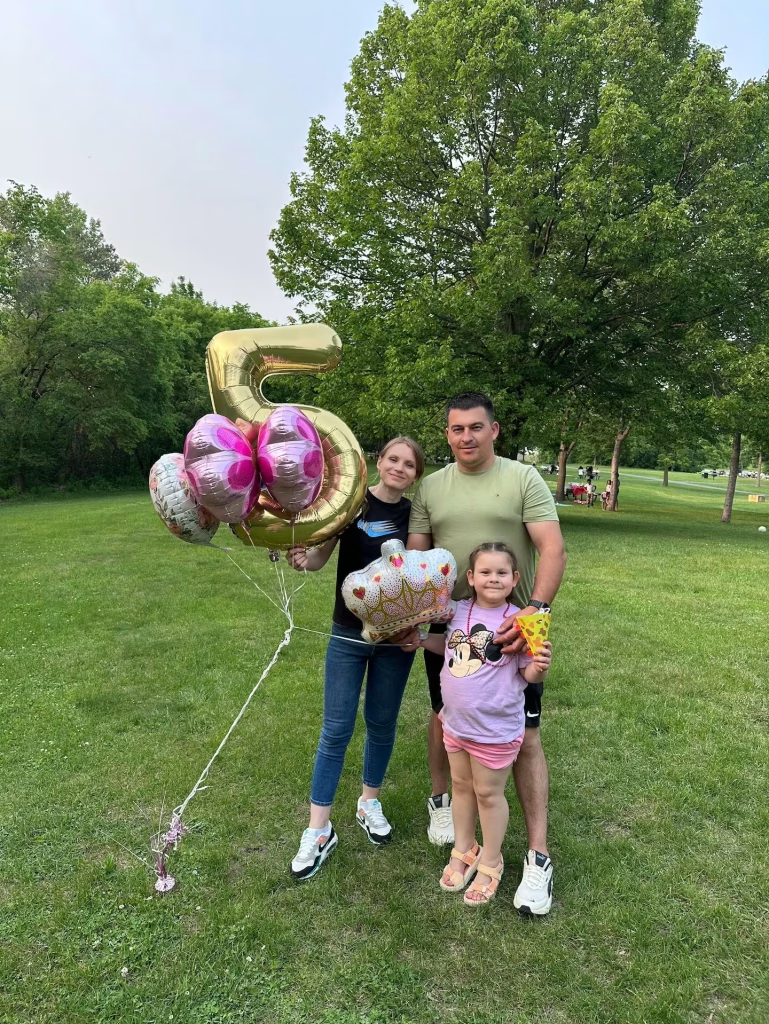
Dmytro Kulyk with his wife Oksana and daughter Elina. Source: Daily Beast

A Ukrainian dad escaped Vladimir Putin’s drone and missile attacks back home only to be grabbed by a band of ICE stooges in a Walmart parking lot in Minneapolis.

“I hoped I would find peace in America. I’ve done everything the government required, I don’t understand why I am behind bars,” Dmytro Kulyk told the Daily Beast from the Kandiyohi County Jail in Willmar, Minnesota.

The 39-year-old father was getting a pickup order at a Walmart in Maple Grove when he found himself surrounded by immigration agents last month. He’d been working as a delivery driver to make ends meet, while also supporting his family by doing roofing work.

Kulyk legally entered the U.S. in late 2023 along with his wife, 38, and daughter, who’s now 5. The family was sponsored by U.S. citizens as part of the Uniting 4 Ukraine program, a humanitarian program set up in April 2022 to allow Ukrainians fleeing Russia’s war to live and work in the U.S. on “parole.”

Once the initial two-year parole period expires, entrants can file for re-parole to remain in the country longer. That’s exactly what Kulyk says he did. His wife and daughter’s applications were approved. But his remained pending.

He said he was putting groceries in his car on Jan. 1 when he was approached by three ICE agents.

“I explained to the ICE officers that the war was killing people, that my wife had a disability, that it was violence, terrorism which we had escaped from but one of them began to laugh,” Kulyk told The Daily Beast. “I asked why he was laughing and I was told that he was pro-Russian, wanted Russia to win the war.”

DHS and ICE did not immediately respond to a request for comment.

He can’t understand why he’s been treated like a criminal. He did everything by the book, he says–paying taxes and filing his immigration paperwork on time, working multiple jobs to take care of his family. He had no criminal record to speak of.

His immigration attorney, Julia Bikbova, suggested his re-parole application may have intentionally been stalled to provide immigration authorities with a pretext to deport him.

“Our government, our Homeland Security, promised Ukrainians to protect them during the war. There are approximately 280,000 Ukrainians on U4U, Uniting for Ukraine program in the United States, including the Kulyk family,” she told the Daily Beast.

“My client did everything the government required him to do: on June 5 he applied for the re-parole and his wife paid $2,040 of fees for her and child’s granted applications. His wife and daughter have recently received their re-paroles but he has not, his application is pending.

“ICE detained him as ‘illegal’ and began deportation proceedings: This is a sick way of forcing a man with a clean criminal record to become unlawful in the U.S. by delaying the review of his application, which the very same authority had requested to file.”

Kulyk is now terrified he’ll be sent to the frontlines to fight Vladimir Putin’s troops if he is deported back home. He and his family endured relentless Russian attacks before finally deciding to flee their home in the Odesa region in 2023. When they saw ruins on their own street in Chornomorsk, they called their friends in Texas and asked for help, leading to their enrollment in the U4U program thanks to having U.S. citizens as sponsors.

Kulyk now can’t stop worrying about his wife, Oksana, and daughter, Elina.

“I am worried they can drag my wife and kid out of our home,” he told The Daily Beast, adding that he wanted to appeal directly to American authorities to make them understand he’d done nothing wrong.

“Please hear me: I came to America to escape the war, to pray in church and work hard. But now my heartbroken and sick wife has lost over 10 pounds since ICE arrested me on January 1. She’s been panicking, and my little daughter has been crying without me every night – this is unjust,” he said.

Oksana says she’s been too “terrified and lost” to leave home while her husband is locked up, afraid that immigration agents might return for the rest of the family.

“I am too scared to drive my 5-year-old daughter to school in my husband’s car. I’m terrified ICE will detain me and our daughter will end up alone,” she told The Daily Beast. “This is just as scary as the war in Ukraine, except now we don’t have Dmytro with us. Our daughter Elina cries herself to sleep with her cat plushie. She says the toy is daddy.”

Most Ukrainian refugees are women and children but some men have also left the country for various reasons. Kulyk was granted a permit to leave in order to care for a family member with a medical condition.

But Kulyk is not the only Ukrainian refugee to be swept up in the Trump administration’s controversial immigration crackdown.

Nearly 1,000 miles away, in Philadelphia, Zhanna was poring over messages in a group chat of 349 other refugees called “Ukrainians in Detention.” She joined the group last month, when her friends Andrii and Yaroslav ended up in detention. Although Bartosh has legal Temporary Protected Status, she stopped going to the office and now works from home.

“ICE rounds up men who buy tools or work in construction, so every day I call my husband, a construction worker, to check if he is OK. Even when the war started in Ukraine and we had to escape abroad, the same morning I wasn’t as stressed as I am now,” she told the Daily Beast. “In our chat I read that all arrestees are men, that at least five of them have signed up for self-deportation… but where is there to go now? Europe is also deporting Ukrainians. Our TPS is good until October but we want to understand, are we really legal in the United States, or is it time to pack up our suitcases again?”

Immigration attorneys count about 300 cases of detained Ukrainians across the United States and up to 150 refugees deported to Ukraine, Bikbova said.

“Most of the arrested Ukrainians are men, the majority of them have a clean criminal record but as we see in Kulyk’s case, they are equated to people who jumped the border, broke the law,” attorney Bikbova told the Daily Beast. “Behind every deported man, there are crying women and children, left without support. For some mysterious reason, we see male Ukrainian refugees being arrested and put on airplanes. If he gets deported, my client Kulyk will most certainly go to the front.”

Trump’s administration has also been deporting Russian asylum seekers. According to a report by Current Times, more than 50,000 Russians have fled the war and political repression to the U.S. since February 2022. Journalist Ilya Azar has been covering the deportations for Novaya Gazeta.

“They send out 40-60 people on each plane. There have been five airplanes,” Azar told the Daily Beast on Tuesday. The deportation planes transit to Russia through Egypt, and Russian security services meet the deported citizens. Azar’s report noted that “all men received draft notices” upon their arrival in December.

Source: Anna Nemtsova, “Laughing ICE Goons Seize Dad Who Fled Ukraine War at Walmart,” Daily Beast, 12 February 2026. The emphasis, above, is mine. \\\\\TRR
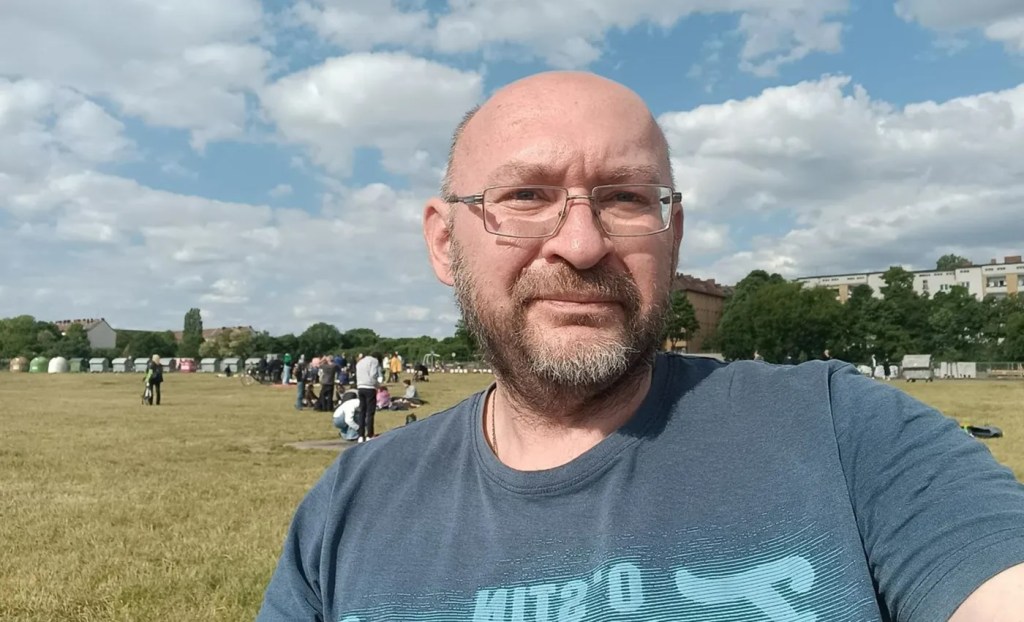

Georgy Avaliani. Source: Mediazona

German authorities last week denied asylum to 47-year-old engineer Georgy Avaliani, who deserted from the front line in 2022. His wife and two children were rejected alongside him.

“There is no reason to believe that, upon returning to the Russian Federation, they would face a high probability of persecution or serious harm,” wrote an official from the Federal Office for Migration and Refugees (BAMF), despite Avaliani’s account of being tortured after fleeing the front.

Mediazona has reviewed BAMF decisions in Avaliani’s case and those of other deserters, discovering that officials are producing boilerplate documents that repeat one another almost word for word. In justifying the refusals, the German agency argues, for instance, that mobilisation in Russia was intended to “strengthen the armed forces” rather than repress dissent, and therefore cannot be considered political persecution. They further say that mobilisation has effectively ended because Vladimir Putin announced it—verbally.

When describing potential punishments for deserters, officials cite not the criminal code but an administrative article regarding failure to comply with military registration duties. They even specify that the maximum penalty is a fine of €302.

Most notably, in every decision examined, BAMF cites Mediazona’s own article from 2023“Evading > refusing > fleeing. A year of mobilization in Russia through trials and verdicts”, as evidence that mobilised men face little more than a fine. That article noted that, at the time of publication, failing to respond to a summons did not yet carry a heavy penalty. While the situation has since changed—an eventuality the original article warned about—the original reference remains in the German files.

Relying on information from that article is also fundamentally flawed because BAMF applies it to people already wanted under serious criminal charges for desertion or abandoning their unit. In its rulings, the agency ignores the severity of these consequences, lumping deserters in with those who simply left Russia when mobilisation was first announced. This is exactly what happened to Georgy Avaliani.

A year in a refugee camp

Avaliani, an engineer, arrived in Germany with his wife, Oksana, and their two children on January 26, 2025. By then Georgy, who was drafted shortly after mobilisation began and later deserted, had been on a federal wanted list for over six months.

The family was granted asylum-seeker status without an initial investigation into the specifics of their escape. Like other applicants, they were placed in temporary housing: a small portacabin with two bunk beds at the former Tempelhof airport site. Their journey to Germany had been arduous. On January 18, Georgy, who had managed to leave Russia before his name appeared on the wanted list, met his wife and children in Bosnia. From there, they travelled to the Croatian border and requested asylum.

In Croatia, the asylum process is largely a formality; in practice, obtaining protection there is nearly impossible. Consequently, many migrants use it only as an entry point into the EU before heading to countries with functioning reception systems. The Avalianis did the same. After a preliminary registration in Croatia, they spent a week travelling to Berlin.

For nearly a year, the family was cramped in a camp with 2,000 other applicants. Finally, just before the start of 2026, they were moved to a hostel in western Berlin. But Georgy’s hopes of integration (he had been diligently learning German and hoped to return to engineering) were soon shuttered. On January 16, just two weeks after their move, BAMF rejected the entire family’s asylum claim.

Avaliani intends to appeal. If he fails, the family must leave Germany within 30 days or face deportation to Russia, where Georgy faces up to 10 years in prison for abandoning his unit during a period of mobilisation. Despite having clear evidence of persecution, the German authorities have ignored his claims.

The two escapes of Private Avaliani

Before the war, Georgy Avaliani was a well-paid engineer at the Moscow water utility, Mosvodokanal. He had no plans to leave Russia. Shortly before the full-scale invasion of Ukraine, he even enrolled in a seminary to pursue a religious education.

Georgy had never served in the army due to a heart condition. However, following the “partial mobilisation” announcement, he received a summons on October 6, 2022. At the time, his three children were minors; by law, as the father of a large family, he should have been exempt. The couple tried to contest the draft through the military enlistment office and the prosecutor’s office but failed. Georgy chose not to go into hiding, unwilling to abandon his family.

After a medical commission in November, he was sent to a training camp in the Moscow region and then to the occupied Svatove district of the Luhansk region. His unit was stationed in the village of Novoselivske, 20 km from the front line. After a few days, noticing the chaos within the unit, Avaliani decided to slip away, gambling that no one would notice his absence. He reached a nearby road and hitched a ride to the village of Troitske, a gathering point for mobilised men.

Part of a local hospital had been turned into a shelter for soldiers with nowhere else to go—some had lost their units, others were waiting to withdraw their pay, and some were recovering from wounds.

While staying there, Georgy met another mobilised soldier. They shared the same grim impression of the front and a desperate desire to return home. They found three others who felt the same and hired a taxi driver to take them to a spot where they could cross the border on foot.

After the driver dropped them off, the group split up. Along the way, Avaliani and his companion heard a helicopter. Georgy later told journalists and BAMF officials that the second group had been gunned down from the air. While there is no independent confirmation of this, Avaliani and the other man survived only to be detained in an abandoned village.

There is little doubt Georgy made this journey on foot; “Goodbye to Arms”, a project that assists deserters, thoroughly verified his route. Alexei Alshansky, a coordinator for the organisation, says the helicopter story is the only detail rights activists have been unable to confirm.

Following his capture, Avaliani was thrown into “a basement” for 10 days. He says he was beaten repeatedly and subjected to mock executions. Mediazona has previously reported on this location, known as the Zaitsevo Centre for the Detention of Servicemen, based on the testimony of another deserter, Sergei Savchenko. Volunteers from “Goodbye to Arms” identified the site in the occupied village of Rassypne by comparing testimonies with video footage.

From the basement, Georgy was sent to an assault unit. Two days later, an ammunition dump near their position exploded. Avaliani suffered a concussion and a heart attack. He was sent to a distribution point where he befriended the doctor issuing referrals. The medic sent him to a hospital inside Russia, hinting that he could just as easily head straight for Moscow instead of the ward.

Avaliani did exactly that. After reuniting with his family, he hid at a dacha in the Tula region. Occasionally, he ventured to Lyubertsy for medical treatment. As time passed he grew less cautious, but in mid-February 2024 military police arrested him outside his home.

He was sent to Kaliningrad in western Russia, the permanent base of his unit, to await his fate. When a commander learned of Georgy’s engineering background, he set him to work renovating his private dacha. Meanwhile, Georgy pushed for a formal medical commission. When it finally took place, the results were surprising: he was not only declared fit for service but his category was upgraded from “partially fit” to “fit with minor restrictions”.

In May, he was told to report for questioning regarding a criminal case. Georgy fled again. On the way to the commander’s dacha, he got a taxi and flew to St Petersburg. His wife met him there to hand over his passport. From there he flew to Belarus, then Uzbekistan, Georgia and finally Montenegro, where he was taken in by a Swedish artist for whom he helped build a swimming pool.

Oksana remained in Lyubertsy with the children. Weeks after her husband left, an investigator began calling her. Georgy was placed on a federal wanted list.

In September 2024, security forces raided the family home. They confiscated phones from Oksana and the children, returning them only two weeks later. The stress caused Oksana to suffer a nervous breakdown, leading to a month-long stay in a psychiatric clinic. The visits from military police continued; the last raid occurred on January 7, 2025. After that, Oksana finally agreed to leave Russia.

Georgy has spoken openly to the press about his escape. In Montenegro, he was interviewed by Current Time TV. The family crossed the German border accompanied by a journalist from Die Welt, which later published a detailed account. A report for the Franco-German channel Arte was also filmed by Russian journalist in exile Masha Borzunova.

The first six months in Germany were particularly precarious. Under EU law, the migration service could have deported the family back to Croatia, their first point of entry. To prevent this, Georgy sought help from the church.

The tradition of Kirchenasyl, or church asylum, began in 1983 after Cemal Kemal Altun, a 23-year-old Turkish activist, took his own life in a West Berlin court while facing extradition. His death moved church communities to unite to protect refugees from deportation. Every year, hundreds of people receive a reprieve through this practice. The Avalianis were among them.

“It is a semi-legal, more like a cultural phenomenon that works differently in different states,” explains Alshansky. “The church gives the applicant a document stating they are under their care, and the authorities leave them alone.”

Thanks to this intervention, BAMF could not reject the family simply because they entered via Croatia. They were forced to consider the case on its merits. They rejected it anyway.

BAMF’s motivation

During his personal hearing, Georgy Avaliani detailed his service and desertion. When asked what he feared if returned to Russia, he replied: “I fear for my life. Legally, I could be imprisoned for up to 20 years. But more likely, I will be killed before trial or in prison… I know for certain that if they find me, a subhuman death awaits me.”

His wife, Oksana, tried to explain the psychological toll the military police raids had taken on her and the children. The family provided lots of evidence: the mobilisation order, the wanted notice from the interior ministry’s website, a letter from a German humanitarian organisation, medical records and Georgy’s military ID.

In its rejection, the agency claimed the Avalianis were “apolitical people”, making it unclear why they believed the Russian state would view them as opponents. BAMF argued that if they were truly targeted, Georgy would never have been able to leave Russia so easily.

Having erroneously stated that Avaliani faced only an administrative fine, the official added that it was “not evident that in the applicants’ case, due to specific circumstances, a different [punishment] should apply”.

The document also asserted that officials found no evidence that mobilisation continued after Putin’s verbal announcement. Even if it were to resume, BAMF argued, it was not certain Avaliani would be called up again, given Russia’s 25 million reservists.

“Even taking into account that the applicant evaded mobilisation, it is not to be expected that… he would be subjected to the inhuman or degrading treatment required to grant asylum,” the decision stated.

The agency concluded the family could lead a dignified life in Russia. Despite the economic crisis, the official noted that people in Russia are still provided with food, social benefits and pensions. “It is not seen that… they would find themselves in a completely hopeless situation,” the ruling said. Their physical and mental health was also deemed insufficient to require treatment specifically in Germany.

A template for rejection

Alshansky attributes the BAMF decision to the wave of draft evaders who fled to Europe after 2022.

“A crowd of people rushed to claim asylum over mobilisation, some without even a summons,” he says. “I think they have exhausted the Germans to the point where, as soon as they see a Russian applicant and the word ‘mobilisation’, they just churn out this rejection.” Artyom Klyga, from the rights organisation Connection E. V., confirms that around 1,000 Russians have requested asylum in Germany due to mobilisation.

Alshansky points out that the rejection text clearly treats Avaliani as a mere draft dodger rather than a man who fled the front and is now a fugitive. He believes BAMF compiled the document from fragments of other cases without truly studying Georgy’s story. “I have compared this rejection with others. It is a template; paragraph after paragraph is identical. They just changed the personal details in a Word file,” Klyga agrees.

Mediazona compared several BAMF decisions regarding Russians who fled mobilisation. The similarities are striking. In the case of a young man who left after an attempt to serve him a summons, the agency also cited Putin’s words on the end of mobilisation. The description of the economic situation in Russia—including the detail that 15% of Russians live below the poverty line—is identical in both his and Avaliani’s files.

In another case involving a reservist who left on a tourist visa, the agency used the same argument: that mobilisation is about military strength, not political vengeance. That document also cited the same €302 fine.

The same arguments were used against Anton Sh., a deserter from Ufa whose story was covered by Sever.Realii. He had been tortured in the same Zaitsevo cellar, where guards pulled out almost all of his teeth. Despite his ordeal and the fact he is wanted in Russia, BAMF ruled he faced no danger because he had been able to leave the country freely.

Georgy Avaliani is now consulting with lawyers to appeal. “From my interview, it is perfectly clear that my situation is different [from other cases BAMF cited in the rejection]. This rejection shows that these people either cannot read or didn’t bother to try,” he said.

Even if his appeal fails, Georgy has no intention of returning. “I didn’t come here for tastier sausage, but to avoid dying in prison,” he says. “I had a good job in Russia. I will never reach that standard of living here; I’m not 20 or even 30 years old anymore. I didn’t travel far for a better life. I left solely because of persecution. Pity they don’t understand that.”

“Goodbye to Arms” estimates there are currently about 100 Russian deserters in Germany. For others planning to follow Avaliani’s route through Croatia, Alshansky recommends heading to other countries, such as Spain, where he says the bureaucratic logic remains more straightforward than in Germany.

Source: “Rubber‑stamping rejections. Germany turns away Russian army deserters who refused to fight in Ukraine, claiming they face only a fine back home,” Mediazona, 5 February 2026. Thanks to News from Ukraine Bulletin for the heads-up. The emphasis, above, is mine. \\\\\TRR

Russian Deserters and Kenyan Job Seekers

Yevgeny Korobov, a former officer of the Russian army, stands in the middle of the room dressed casually in a black shirt and light pants. The 30-year-old has been living in Astana, the capital of Kazakhstan, for almost three years.

He says that during this time seven or eight other deserters have stayed in his apartment.

“I try as best I can to help people like me. You don’t need to pay me, just live here, that’s all,” he says. “Who else will help them? After all, there is something that binds us. We are all deserters. We all ran.”

Just four years previously, Korobov was fighting in Ukraine from February to May 2022.

‘The war has begun’

Korobov had always wanted to be in the military, although his parents were postal workers. He studied at a military college in his native Krasnoyarsk, before joining the Russian army as “a young officer full of enthusiasm to serve”. His contract was to last until 2023.

His enthusiasm soon soured, however.

“During service in the army you encounter injustice and madness, and you begin to become completely disillusioned with everything, with how things are in Russia,” he says.

In early 2022, Korobov was sent to military exercises in the Kursk region, near the Ukrainian border. “I didn’t believe there would be a war, but we went there with anxiety,” he recalls.

He describes what he saw after crossing the border into Ukraine: “We drove through populated areas. People were living their lives, someone was refueling a car, someone was drinking coffee, someone smoking. And we’re driving. The war has begun.”

His brigade moved towards the capital Kyiv, stopping in the Brovary district east of the city.

This is the area where the Ukrainian prosecutor’s office says that Russian soldiers had carried out war crimes. [Investigations by the] outlets Meduza and Radio Liberty allege that soldiers of the 15th Brigade, where Korobov was based, had set up a torture chamber in a post office in the Kyiv region. Journalists also reported on the execution of at least five civilians by the same brigade.

Korobov claims that he personally did not witness war crimes, but heard about them from others. He says that his job was to escort rear columns, navigation and route reconnaissance during the war, and that therefore he was constantly on the move.

His brigade was near Kyiv until the end of March, after which he left the region when Russian forces retreated following the failed attempt to encircle the Ukrainian capital. As he retreated, Korobov saw destroyed Ukrainian towns. He says this caused him “horror and disappointment”.

Korobov says that the columns ran into ambushes by several Ukrainian forces.

“We had to fire back,” he recalls. “What else could we do? Die? Am I a good person if I died? I also wanted to live and wanted all my soldiers to return. What were we fighting for? For our lives. The Ukrainians had an enemy — us. We had two enemies — the Ukrainians and our own commanders.”

The ‘war hero’

At the end of 2022, just before he finally deserted and left Russia for Kazakhstan, Korobov was ordered by his commander in Moscow to appear on Russian television.

The show painted him as a war hero who had been injured in battle.

“Senior Lieutenant Yevgeny Korobov, together with his group, was escorting a rear column,” said the host of a popular evening talk show on Channel One. “They ran into an ambush. They fought superior enemy forces. They destroyed at least 15 militants and enemy equipment. They themselves had no losses.”

Korobov calls the story, first reported by the Russian defence ministry, fabricated. He says his unit did run into an ambush at the beginning of March 2022 in the Chernihiv region, but that the extent of the ordeal was greatly exaggerated.

A still of “war hero” Yevgeny Korobov’s appearance on Russian TV. Source: smotrim.ru/BBC News Russian

“Fell into an ambush — yes. ‘Carefully prepared’ — hardly. Whether the enemy’s numbers were superior, I don’t know how many people were there or who was firing,” retorts Korobov.

After appearing in the media, he received a medal for courage for which Korobov says he “couldn’t care less”. “For an invented feat? For a war I didn’t want to take part in? I already didn’t want to serve in the army at all — I was just enduring until my contract ended.”

What Korobov does not dispute is that he was injured in Ukraine. During the course of the television interview, he is noticeably limping.

‘No way back’

Korobov was wounded in the leg in Donetsk in May 2022 after which he was evacuated and returned to Russia.

At the time, the command was issued to assault the village of Ozerne, near Lyman. “Only once were we able to get close to it; we were hit with everything possible, and during all the following assaults we couldn’t even approach,” says Korobov.

“At that point I already understood that there was no chance we would be allowed to go home. And that the only way to leave there was as dead or wounded.”

One day, their unit accidentally landed a drone on Ukrainian positions. Korobov says his unit of four people was sent to retrieve it and told by his commanding officer not to return without it — a mission that he describes as impossible.

“I understood that that was it, there was no way back,” he says. “And I opened fire on my own soldiers. I fired a burst into the ground. I wounded my guys. Then I wounded myself, shot myself. I provided first aid, and we crawled towards evacuation.”

This suggests that the injury that was reported and celebrated on the television program Let Them Talk was one Korobov inflicted on himself.

The BBC cannot independently verify Korobov’s account, although he provided photographs of his wounded leg.

Korobov and the remnants of his platoon were then evacuated from the frontline. He spent a month and a half in a hospital, then underwent rehabilitation.

Korobov wanted to serve out his contract in Russia until 2023, without returning to Ukraine. However, after the announcement of further mobilisation in September 2022, all contracts became indefinite. At the end of that year, he was informed that he would be sent back to Ukraine.

Looking for asylum

Korobov says that before leaving Russia he contacted the Go By The Forest project, which helps former Russian soldiers like himself who fear returning to the war in Ukraine. Activists then drew up a route for him to escape to Kazakhstan.

Soon he had packed a bag and left Russia.

A criminal case for desertion has since been opened against Korobov, and he faces up to 15 years in prison. Because of this, for the first months of life in Astana he hardly left the house.

Later, he found a job at a bar — illegally, because, as an asylum-seeker, he wasn’t permitted to work there.

“Kazakhstan has not granted asylum to a single Russian citizen yet, and I think it won’t,” says Korobov.

“We are waiting for a decision from European countries, especially from France, because at the moment it is the only country that has accepted Russian deserters,” he says.

Korobov understands the reluctance of Western countries to accept Russian deserters, but believes that this is one of the “effective ways of resolving the conflict: not only supplying weapons and imposing sanctions, but also giving Russians the opportunity to refuse to carry weapons, to refuse to fight.”

The BBC spoke to Artur Alkhastov, a lawyer from the Kazakhstan Bureau for Human Rights, who has been helping Russian deserters who fled to the country during the past three years. Part of the process is to verify the former soldiers, in order to prevent agents of the Russian security services from infiltrating the group.

He says verifying Korobov’s story was difficult and took time.

In his view, a Russian deserter today is in even greater danger than many other opponents of the war or political dissidents, because the Russian authorities see these former soldiers as traitors.

This puts Russian deserters in Kazakhstan and Armenia in a vulnerable position, because both countries host Russian military bases.

Korobov and other deserters can currently be protected from extradition to Russia because they hold the status of asylum seekers, but this does not protect them from the threat of abduction, Alkhastov explains.

Source: Amalia Zatari, “Russian ‘war hero’ turned deserter: ‘I shot myself and my own men to get us out of Ukraine,'” BBC News Russian, 2 February 2026


Kenyan job seekers were lured to Russia, then sent to die in Ukraine. Source: msn.com

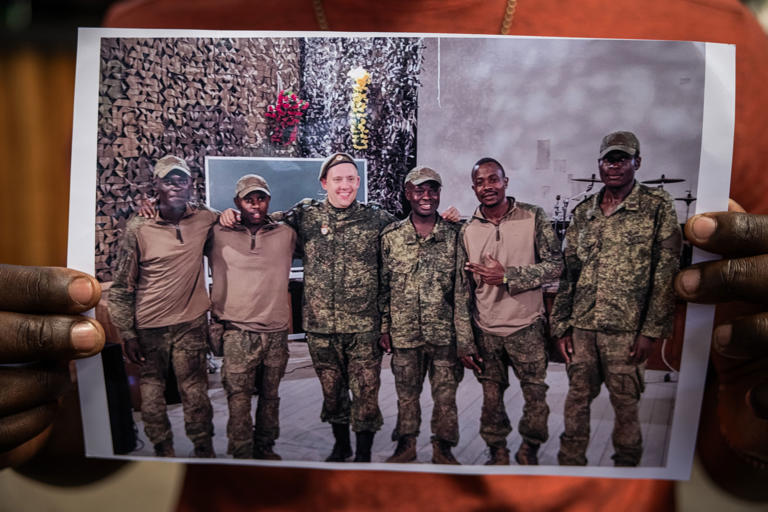
Hundreds of Kenyans have been recruited by the Russian military to serve on the front lines in Ukraine, according to former recruits and their families. Many have never returned.

Most men said they were tricked — offered civilian or “safe” security jobs in Russia, only to be handed a weapon and sent to the battlefield. Others were current or former soldiers who joined up as mercenaries, lured by promises of higher wages. The survivors described inhumane treatment by Russian commanders and harrowing scenes of slaughter.

While there have been isolated reports of Africans conscripted by Moscow to fight, The Washington Post uncovered an extensive clandestine pipeline stretching from Nairobi to the forests of eastern Ukraine. Russian recruitment in Kenya is more widespread, and more deadly, than previously reported, and the effort extends across the continent. The Post spoke to recruits or their family members in South Africa, Botswana, Tanzania and Nigeria, and it heard anecdotal accounts of fighters in Ukraine from eight other African countries, including Ghana, Zimbabwe and Cameroon — hidden victims of the largest European conflict since World War II.

The phenomenon is driven by two converging forces: economic desperation in Kenya, pushing young men to pursue vague promises of work thousands of miles from home, and the Russian military’s boundless appetite for fresh bodies, as it seeks to press its advantage in Ukraine without sending more of its own to die. In the middle are African recruiters, operating with direct or implicit help from political connections. Kenyan authorities have repeatedly urged young men to immigrate to Russia despite evidence that employment agencies are steering job seekers into combat.

This account is based on interviews with four Kenyans who fought in Ukraine — three of whom were wounded — and family members of nine other Kenyan recruits, including active-duty soldiers who traveled to Russia to join the military. Some came from specialized units run by military intelligence, or from the elite SPEAR team that guards the U.S. Embassy in Nairobi. The Post reviewed corroborating documents from the men sent to fight, as well as messages between recruiters and family members desperate for news of their loved ones.

Two of the injured Kenyans, neither of whom had military experience, said they were sent to fight in Ukraine with only a few days of training in a language they did not speak.

“They said: ‘Learn fast. We are taking you to the war,’” said the first man, whose hands were lacerated by shrapnel from a drone strike. He crossed rivers full of bodies on his first day, he said, and saw most of his party killed.

“I didn’t even see any people,” said the second Kenyan, who suffered burns to his head and hands in a separate incident. “It was just robots — drones — shooting at us.” Like others in this story, the men spoke on the condition of anonymity, fearing for their safety and for their fellow Africans still in the line of fire.

In November, Ukraine’s foreign minister said his government had identified 1,436 citizens from 36 African countries fighting for Russia.

“They are treated as second-rate, expendable human material,” Andrii Sybiha said in a post on X. Most, he added, “do not survive more than a month.”

Those who aren’t killed are often captured and imprisoned, survivors said, or wounded and prevented from returning home. Former recruits said those who refused to go to the front lines were threatened with arrest in Russia; others were deployed to deadly positions after their families talked to the media.

The Russian Defense Ministry did not respond to requests for comment.

The Kenyan government told The Post that it had learned of the recruitment schemes only through media reports three or four months ago, and that it was constrained by diplomatic norms. “Our ambassador [in Moscow] doesn’t have jurisdiction to leave his office and go into morgues,” said Hellen Gichuhi, Kenya’s secretary for diaspora welfare and partnerships. She declined to say how many Kenyans had asked the government about the fate of relatives in Russia, or how many Kenyans had been killed in Ukraine. “They are being recruited by rogue agencies,” she said.

Although some conscripts reported receiving salaries, most said their bank accounts were raided or frozen by recruiters. Many families said their loved ones simply went silent. A single WhatsApp group for relatives of missing Kenyans has nearly 100 members. Some have already had their worst fears confirmed.

Kenyan Grace Gathoni, 38, said her husband and the father of their four children, Martin Macharia, left for Russia on Oct. 21 after being promised a job as a driver or a cleaner. He was forced to sign a contract he didn’t understand, she said, and deployed to Ukraine.

When they last spoke on Nov. 19, she said, Macharia asked for her prayers. A week later, she saw his body on a Kenyan news bulletin.

Her 4-year-old keeps asking when he will return home, she said. The older ones know he’s not coming back.

The recruiters

Kenya, a longtime U.S. security partner in East Africa, is not growing fast enough to provide jobs for its population of 53 million. Young people struggle to find steady work; underfunded public schools and hospitals often lack staff and resources. Political graft is rampant.

President WilliamRuto has made exporting labor a central plank of his economic strategy, promising to send a million people abroad to work. Labor Minister Alfred Mutua visited Russia in June to highlight Kenyans who had found jobs there through an agency. Kenya’s prime cabinet secretary, Musalia Mudavadi, said in December that the two countries are discussing a labor treaty.

But The Post identified five Kenyan companies ostensibly recruiting for civilian jobs in Russia that instead funneled men to the front lines in Ukraine. Most prominent among them was Global Face, run by businessman Festus Omwamba, whom multiple families identified by name. Gichuhi, the diaspora welfare secretary, said most recruiters had been arrested and Global Face de-registered, although Omwamba was still at large.

Families also pointed to Edward Gituku, an associate of Omwamba who was arrested on human trafficking charges in September after 22 Kenyan men were detained while preparing to travel to Russia. Lawyer Danstan Omari, who initially represented Gituku, told The Post that his former client had admitted to sending more than 1,000 men to Russia, many of whom subsequently served in the military.

Eight Kenyans said they or their relatives had gone to Russia through Global Face, providing phone numbers registered to Omwamba, Gituku or other agency employees — and, in many cases, proof of payment to the recruiters. All said they were lured by the promise of civilian jobs, except for one man, a former Kenyan military recruit who said he knew he was being sent to fight.

The Post attempted to contact Gituku and Omwamba using numbers shared by families but was unable to reach them for comment. Global Face did not respond to emails seeking comment and appeared to have no physical offices in Kenya.

In April, Omwamba arranged for Oscar Khagola Mutoka, a 39-year-old veteran of Kenya’s U.S.-trained Ranger unit, and another local man to leave for Russia, according to Peter Shitanda Malalu, Mutoka’s cousin. Mutoka’s family last heard from him in June but kept sending messages; in January, they finally received a response from his phone. It was in Russian, from his former commander, saying he had been killed in August.

The message said “if we wanted the body, we can find it at the morgue in Rostov,” Malalu said. “We do not know if he was ever paid, but our family never received anything.”

The family shared that and other messages from the commander, including one in which he said that “compensation for the death of a soldier is granted to relatives who have citizenship of the Russian Federation” and in which he offered to bring Oscar’s body to Moscow’s airport. From there, he said, the family would be responsible for transportation costs.

In September, as Mutoka’s sister tried to trace him, she contacted a number registered to Omwamba. She received a reply saying he was in Russia and would follow up on Mutoka’s whereabouts, according to a voice note she shared with The Post. The last message from Omwamba’s number in January brushed off the family’s increasingly urgent pleas: “I do not want to be involved in your gossip,” he wrote on WhatsApp.

Another Kenyan woman, Risper Aoko Ouma, said her 39-year-old husband had flown to Russia in July on a flight arranged by Omwamba. A military veteran of 14 years, Duncan Otieno Juma was wounded almost immediately that month in a Ukrainian drone attack that killed another Kenyan and many other Africans, she said. He was then sent back to the front lines. She said she has not heard from him since August. When she asked a Global Face employee for news of her husband, she received a demand for money.

“How much are you ready to pay me?” the employee asked in a text message viewed by The Post.

More than a dozen African men were killed in October in the Kupyansk area of eastern Ukraine, Volodymyr Dehtyarov, a Ukrainian military public affairs officer, told The Post. Among the dead was a Kenyan man, whose passport he provided. The man’s family confirmed he had gone to Russia in September. They never heard from him again.

Kenyans are still making the journey, despite a growing awareness of their likely fate. A man who considered going to Russia but ultimately decided against it said two of his friends left on Dec. 27; immigration agents are watching out for men traveling to Moscow, he said, but it only means you have to pay an extra bribe.

The contract

One of the Kenyan recruits who made it back from Ukraine, a 32-year-old whose silver tooth flashed in a confident smile, now wears black gloves to hide the burns on his hands and a wool hat pulled low over burn scars on the back of his head. He said he paid Omwamba’s company and his employees a total of $390 for a civilian job in Russia.

Before he left, he said, he underwent a physical and met a man who identified himself as a member of the Russian Embassy in Nairobi. They gave him a contract in Russian to sign but refused to give him a copy, he said. He was told he’d be paid $2,650 per month for frontline work, $2,150 for a rear position away from the fighting and $885 for working back in Russia — still a small fortune in Kenya.

In August, he flew to St. Petersburg with three other civilians, all of whom were told they would work as security guards, and three former Kenyan soldiers. Despite having tourist visas, he said, they were taken by handlers to open accounts at Bank Saint-Petersburg, which is subject to U.S. sanctions. Then they were presented with new contracts — all offering frontline rates. None of them, he said, were given the option to stay in Russia.

“We said we need to translate this document, and we will sign it when we are satisfied,” the man recalled telling the Russian agent, but he was told there was no time. The men could either sign the frontline contract, the agent said, or repay the money they had spent to travel there.

“That’s what forced us to sign,” the recruit said.

A former member of Kenya’s armed forces now employed in the security sector said Omwamba’s company has recruited more than 50 military veterans whom he knew personally, including at least two who were working for a security company in the Middle East. Many had been killed, he said, citing accounts from his Kenyan contacts in Russia.

One recruit’s mother said he was a former military police officer who was working as a guard at the U.S. Embassy in Iraq when he was recruited by Russia. “He was my only son,” she said, showing a picture of a muscular man smiling on a beach. She paid nearly $3,900 to the recruiters to try to get him back, she said, but they took the money and he never came home. She doesn’t know if he’s alive.

Another person in the Kenyan security industry said he knew at least 32 active members of the military who had deserted to head to Russia. A woman said her 37-year-old brother, previously an inspector in the general service unit of the Kenyan police, had also made the trip, not realizing he was being recruited by the army. He sent an email upon arriving asking her to download a secure app so they could speak.

“He was in hiding,” she said. He was trying to escape, he told her. She never heard another word from him.

Michael Muchiri, a spokesman for Kenya’s police, told The Post that a key recruiter was arrested last year and that no serving officers had gone to Russia. The Kenyan militarydid not respond to requests for comment.

Sent to die

The 32-year-old recruit, along with 16 other Kenyans, a Guinean and several Cameroonians, undertook two weeks of training in shooting, navigation and fitness in Russian-occupied Ukraine, he said.

“We were told: ‘You are our machinery; you have to work like machines. … You must fight,’” he said. A fellow Kenyan nicknamed Mwas told him new conscripts all went in the same direction — “to the front line.” Mwas was killed shortly after they spoke, he said.

The man was among six Kenyans sent to fight; another six refused but eventually relented after they were threatened with arrest, he said.

On Sept. 16, his first day in combat, the 32-year-old, another Kenyan and three Russians were ordered to run across open ground to a forest. The area was mined, he said, and there were explosions. Their Russian guide shot at drones overhead and showed them how to navigate from dugout to dugout, he recalled, but the Kenyan began to lose his nerve when they came across a couple of Russian soldiers bleeding badly.

During their last sprint, he said, a drone fired explosives and bullets at them. The blast knocked him over and his backpack, stuck over his head, caught fire. One of the Russian soldiers was killed.

He was taken to a field hospital packed with wounded men, where he stayed for a week before being transferred by train to a hospital near St. Petersburg, he said. When doctors told him he was well enough to return to the front lines, he said, he hatched an escape plan. He asked that details not be divulged, as other injured soldiers might need similar contacts to get out, but he shared documents — including his medical report, Russian visa and a Russian military ID — to support his account. Before leaving the country, he managed to access his new bank account and withdraw about $5,000 from his promised signing bonus of $25,000.

At least, he said, he hadn’t come home empty-handed.

A 27-year-old Kenyan relayed a similar story: payments to Global Face staff, the offer of a civilian job and being taken by an agent to open a bank account after arriving in Russia. He had to sign a standing order giving the agency access to his account, he said. Later, when he tried to withdraw his money after being wounded, he was told his account was blocked. He provided a bank card, Russian military ID, medical records, photographs and other papers to support his account.

“The commanders said: ‘We have paid 1.5 million rubles to bring you here, so you’re in our hands,’” he said.

During his training in Rostov, he met about 30 other Kenyans, including a police officer from a paramilitary unit and a former soldier from the elite U.S.-trained long-range surveillance squad, he said — as well as men from Togo, Nigeria and Malawi.

“The trainers didn’t speak English. They just showed you how to shoot a gun,” he said.

In Ukraine, his group of 27 included five Kenyans, he said. They were ordered to sprint across open ground and cross two rivers, one swollen with bodies. Only he and another Kenyan survived the onslaught of Ukrainian drones, he said.

The recruit had injuries to his hands; the other man was wounded in the leg. They came across an injured radio operator, who messaged for help. None came. They spent another two days limping back to a Russian base.

The man said he was hospitalized with eight other wounded Kenyans, some South Africans and a Cameroonian. One had lost part of an arm; two had lost their legs.

“One man with no legs asked if he could go home,” he said, “and was told, ‘When your contract ends.’”

He escaped from the hospital, and then from Russia, he said. Since returning home, he has struggled to find work.

A third man who traveled to Russia in August said he and another Kenyan were given weapons but no training and ordered to carry heavy backpacks of rations to frontline positions in a Ukrainian forest.

When they reached the forward operating base, they were told to rest, the man said, then abandoned by the Russian soldiers they had resupplied. With no water, they drank from a river filled with corpses.

“We saw so many dead,” he said.

Source: Rael Ombuor and Katherine Houreld, “Kenyan job seekers were lured to Russia, then sent to die in Ukraine,” Washington Post, 2 February 2025. I have subscribed to the Washington Post for several years and have depaywalled this article as a public service. You can also access it for free here. ||||| TRR