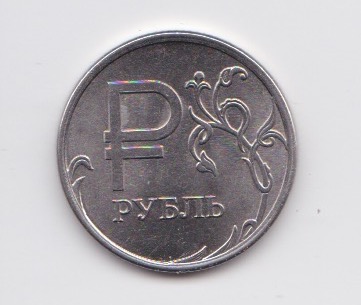
 This one-ruble coin, minted in 2014 and sporting the newish symbol for the ruble, adopted in 2013, won’t buy you love or much anything else.
Poor Russians Go into Debt
Tatyana Lomskaya
Vedomosti
October 11, 2017
Low-income Russians have been unable to wait for an uptick in incomes and have turned to loans to meet their consumer needs. Experts, including the Central Bank, believe such borrowers are a danger to the economy.
The demand of Russians for loans has been growing. In August, their arrears to banks rose to levels not seen since the spring of 2014. Ruble-denominated loans reached their maximum historic high, according to RANEPA’s monthly newsletter Monitoring the Economic Situation in Russia. Banks have been vigourously issuing loans. In July, they provided Russians with 23% more loans than at the same time last year. Consumer loans have been the fastest growing. According to the National Credit History Bureau, such loans increased by 27% over the past eight months.
Loans have been playing a growing role in the budgets of Russian families, notes the newsletter. In the first six months of the year, new loans made up 21% of household final consumption expenditures. This is significantly higher than the crisis levels of the last two years (15–18%), although it is still below the peak levels of 25–27% in 2013–2014. With virtually no increase in the real incomes of individuals, this generates additional risks to their financial circumstances, noted RANEPA’s analysts.
Residents of poor and distant regions are the biggest borrowers of consumer loans at the moment, along with the poorest segments of the populace, notes Natalya Zubarevich, director of the regional program at the Independent Institute for Social Policy. This is how they offset falling incomes. Wages in Russia have been growing since August 2016, but real incomes have continued to fall.
People cannot skimp and save forever. People turn to loans to meet their needs, says Zubarevich. What matters is that banks not issue too many loans, which would raise the specter of a huge number of defaults.
The debt burden has been growing more quickly in regions with the highest poverty levels, according to the FR Group, although the situation varies from region to region, notes project manager Anastasia Zyurkalova.
Russians have been spending more and more of their income on consumption. According to some indications, they have abandoned the savings model of financial behavior, acknowledges Yelena Grishina, head of RANEPA’s research laboratory on pension systems and social sector actuarial forecasting. One of the ways they survive is by taking out loans. Certain segments of the populace have outlived the means they once had for limiting consumption. In the first six months of 2017, a linear dependence bwtween increases in the volume of loans and poverty levels in the regions was observed, says Grishina. Russians are now more positive than a year ago: they have assessed the changes in their welfare, and the percentage of those who skimp on food and clothing has decreased, note RANEPA’s analysts [sic].
The burden of non-mortgage loans is highest in regions with high unemployment and a poorer populace, Alfabank’s chief economist Natalya Orlova wrote last autumn. The middle class [sic] would be unlikely to emerge as the main source of the growth in demand for retail loans, she noted. The average borrower is more likely to be someone with a limited income. Judging by the numbers for the first six months of 2017, nothing has changed, says Orlova. It is still less well-off Russians who want to bring their consumption up to average levels. The increase in retail loans in the poorest regions is likely due to people’s tapping out their savings and and trying to maintain a certain level of consumption, agrees Karen Vartapetov, an analyst at S&P.
A significant portion of the demand for consumer loans comes from people whose incomes are less than the median income in Russia. Often, their incomes are unstable as well, and their debt burdens are high, noted analysts in the Central Bank’s research and forecasting department. (Their opinions may differ from the financial regulator’s official stance.) Yet banks currently do not really have the capacity for an increase in lending, and so even a moderate uptick in consumer loans is fraught with risks no less serious than during the 2010–2012 loan boom. To limit these risks, the Central Bank has been working out individual debt burden indicators, notes a source at the regulator. The share of an individual’s expenditures on repaying loans should be such she could continue to pay back the loan even if negative events were to occur.
For the time being, the largest banks surveyed by the Central Bank have reported that the percentage of borrowers with increased levels of debt burdens has not grown, and the number of people with monthly incomes of less than 20,000 rubles [approx. 290 euros] who have taken out cash loans has fallen, says the source at the regulator. The banks have been forced to behave more conservatively. Everyone well remembers the wave of late payments in 2012–2013, says Yuri Gribanov, CEO of Frank RG.
After the crisis of 2015, the quality of loan applicants has not improved considerably, notes Sergei Kapustin, deputy board chair of OTP Bank. There are still many people with problematic debts that have not been managed and refinanced at another bank. According to certain channels, the share of such debts is ten percent, and banks have been forced to lower the number of loans they issue. In addition, a number of bankers issue unsubstantially large loans to people who have borrowed money at other banks in amounts disproportionate to their incomes.
The demand for consumer loans is currently quite high, says Mikhail Matovnikov, Sberbank’s chief analyst, and there are still a lot of extant bad loans at high interest rates, especially among low-income Russians. This not at all what the economy needs, and it is bad for borrowers, too, he argues.
The banks’ fight against such loans has pushed borrowers into the arms of microfinance institutions, where the circumstances can be even worse. This year, the microlending market has grown from 186 billion rubles to 242 billion rubles [approx. 3.5 billion euros]. The banks have not met the steadily growing demand for loans, according to research by microlender Home Money.

A screenshot from Russian microlender Home Money’s website. “It’s simpler to make a phone call than to borrow from somebody! Call if you need to! New services: personal legal consultant; home protection; credit history.”
Measures to limit interest rates cooled the consumer lending market in 2015–2016, notes Dmitry Vasilyev, an analyst with Fitch. Currently, the portfolio’s growth matches the nominal growth in incomes of Russians (2–3% during the first sixth months of 2017) and the percentage of risky and unsecured loans has lowered. Some borrowers have drifted to the microlenders, while some banks have been weeded out due to noncompliance with tougher standards, says Vasilyev.
Orlova points out the banking sector is at a crossroads. Maintaining quality lending means not taking on as clients people working in the informal sector and incapable of confirming how much they make and microlenders currently lending at very high rates. Or banks could increase their appetite for risk and take on inferior borrowers to increase their market shares and loan portfolios. Banks have to earn money. If there are no borrowers willing to pay (for example, the government, which would have to become much more active in the state debt market), the issue would become particularly critical. Prospects for income growth in the coming year are worsening, and the risk that not very well-off people would not be able to service their loans is growing, warns Orlova. Poverty will not seriously decline in Russia in the coming year, if we believe the government’s three-year macro forecast, as submitted to the State Duma. It will drop from 12.8% of the populace this year to 11.2% in 2020, i.e., it will not drop to the levels of 2012–2013 (lower than 11%).
Translation and image of the ruble coin by the Russian Reader. Thanks to Comrade Koganzon for the heads-up. The original article, as published yesterday by Vedomosti on the front page of its paper edition, was behind a paywall. Thanks to Press Reader for providing me with the text of the article.