When the Soul Can’t Keep Silent

Aydyn Zhamidulov. Photo: Russian Defense Ministry via Kommersant

Kommersant has learned that a military court has begun hearing the criminal case against Senior Lieutenant Aydyn Zhamidulov, a platoon commander in the Airborne Troops, and his subordinate, Private Alexei Dorozhkin. The Russian Investigative Committee alleges that the men kidnapped a young woman who had threatened the officer that she would tell his wife about their relationship and took her to their unit’s temporary deployment point as a Ukrainian spy. There, they stabbed the victim to death and blew up her body in an attempt to conceal their crime. Zhamidulov gained renown for writing patriotic poems during his combat training and was shown reciting them on Telegram channels.

The criminal case against Senior Lieutenant Zhamidulov and Private Dorozhkin was submitted to the Southern District Military Court, sitting in Rostov-on-Don. The men are accused of the kidnapping and brutal murder of a resident of the Luhansk People’s Republic per articles 126.1, 105.2, 30.3, 33.4, and 244.2 of the Russian Criminal Code.

In the file of the case, as investigated by military investigation units at the Russian Investigative Committee, it is reported that Zhamidulov is twenty-eight years old, a native of Kazakhstan, and lived in the Pskov Region. He has a higher education, is married, and was raising two daughters.

In January 2022, Zhamidulov signed a contract with the Defense Ministry and, in the rank of senior lieutenant, served as commander of a parachute platoon in an airborne assault regiment of the famous 76th Airborne Division.

In late 2022, a video was widely circulated in social networks and the media in which Lieutenant Zhamidulov recited a poem of his own about the those involved in the special military operation. At the end of the recital, the officer stated that his family was proud of him and was waiting for him to come home.

Dorozhkin was mobilized on 1 January 2023. Ranked as a private, he served as a senior scout in the Airborne Troops.

According to investigators, at about eight p.m. on 13 January 2023, Zhamidulov and other military men, including Dorozhkin, were drinking hard alcoholic beverages at the Rainbow Cafe in Luhansk. About half an hour later, local resident Valentina Davronova, with whom Zhamidulov had previously been in an intimate relationship, entered the cafe.

A row broke out between the senior lieutenant and the twenty-three-year-old woman. Fearing that Ms. Davronova would report their relationship to his wife, Zhamidulov decided to deal with the young woman, the case file says. He told his subordinates that he would take Ms. Davronova to her current boyfriend.

The young woman was put in the back of a KamAZ truck, and when the truck arrived at the unit, Zhamidulov tied her hands with duct tape. Dorozhkin, who went with them, was ordered by the senior lieutenant to tape Valentina’s eyes, which he did.

To avoid questions from his subordinates and make his actions look legitimate, the investigators note, Zhamidulov told them that Ms. Davronova had served in the Ukrainian army from 2018 to 2021 and had tattoos featuring Ukrainian symbols on her body. He also alleged that she was engaged in intelligence on behalf of the Ukrainian armed forces.

The young woman was taken to a soldier’s bathhouse, where Zhamidulov stabbed her about two dozen times in different parts of her body. At that time, the commander of a reconnaissance platoon combat vehicle, Sergeant Roman Pleshcheyev, entered the bathhouse (his case will be tried separately). Zhamidulov ordered him to finish off the victim. Not wanting to kill her, but fearing negative consequences on the part of the senior lieutenant, Plescheyev stabbed Ms. Davronova with his knife in the area of her left shoulder and right leg.

At 12:20 a.m., Dorozhkin entered the bathhouse, and Zhamidulov instructed him to finish what he had started. Pleshcheyev left the room and Dorozhkin killed the victim by stabbing her in the area of her heart.

Having made sure that the young woman was dead, Zhamidulov ordered his subordinates to take the body outside the temporary deployment point and detonate it with three F-1 grenades so that the deceased could not be identified and the cause of her death could not be determined.

Nevertheless, the crime was solved literally while the trail was still hot. All three defendants were detained and then remanded in custday by a military court.

The case is now in preliminary hearings, and is expected to be considered on the merits this summer. Zhamidulov’s lawyer Natalia Kokhan refused to comment on the case without vetting her answers with her client.

Source: Kristina Fedichkin, “Paratrooper poet accused of murder,” Kommersant, 29 May 2024. Translated by the Russian Reader


[…]

WHEN THE SOUL CAN’T KEEP SILENT
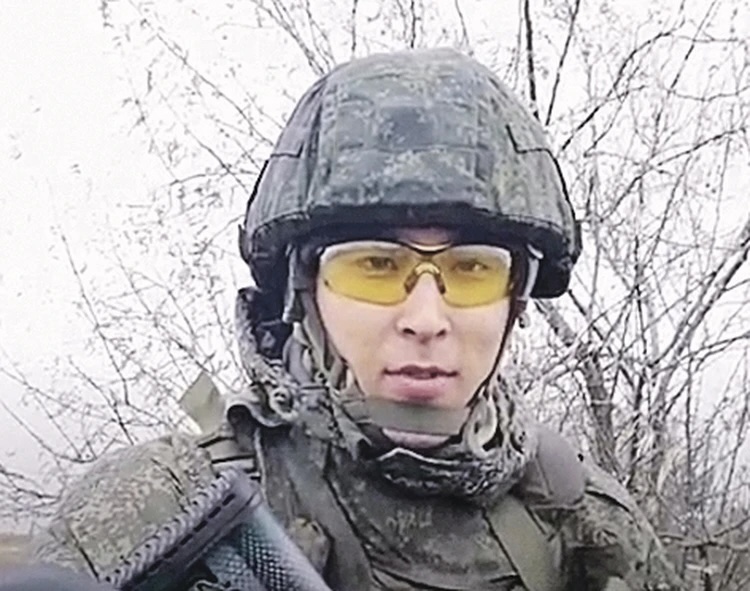
Aydyn Zhamidulov. Photo: Komsomolskaya Pravda

Aydyn Zhamidulov was mobilized from the Orenburg Region. As a civilian he worked as a welder, but now he serves in an Airborne Troops reconnaissance unit. He has a wife, two daughters, and his parents waiting for him at home.

“I was retrained in my specialty. In the short period of mobilization combat training, everything — camouflage, identifying the enemy, working with topographic maps, artillery fire — is very easy to learn,” Zhamidulov said.

All of the things he saw and his interactions with his fellow soldiers inspired Aydyn to write poems. They are plain but honest and poignant, straight from the heart.

Always our ancestors fought evil.
They wrote history with blood, with the pen.
They weren’t afraid to go all the way.
They removed shackles, they united hearts.
Now, our brothers, it’s our turn
To defend our country, our home, and our people.
To do justice, to open their eyes.
The enemy is in deep,
like a needle under the skin.
Let us strike down the puppeteers,
the servants of evil,
Who pull the strings
Of bewildered people,
Of gray-haired mothers
shedding tears
For them, the lives of people
are just a game.
We must put a stop to this
once and for all!

Source: Yulia Reutova, “Victory will be ours! Komsomolka found out what the mobilized are talking about,” Komsomolskaya Pravda, 15 December 2022. Translated by the Russian Reader. Thanks to The Insider for the link.

The Enemy Within Is Everywhere

The Russian National Guard Has Been Crushing the General Staff
Alexander Goltz, Military Observer
The New Times
June 5, 2017

A calling card of a militaristic society is the tendency of the authorities to respond to all challenges by means of force, military or otherwise. The Kremlin’s fear of so-called color revolutions has materialized into a buildup of the resources available to the recently minted Russian National Guard (Rosgvardiya), which was designed to quell unrest. Unprecedented powers have now been added to its resources. 

 «Чтобы все было в ажуре». Экспонаты организованной Росгвардией выставки, которая посвящена технологиям правохранительных органов, Красноармейск, Московская область, 25 мая 2017 года. Фото: Антон Луканин/ТАСС“So that everything is just so” (Chtoby vsyo bylo v azhure). Exhibits at a trade show, organized by the Russian National Guard, dealing with law enforcement equipment. Krasnomarmeysk, Moscow Region, May 25, 2017. Photo courtesy of Anton Lukanin/TASS
In the last part of May, when the public was distracted by the police raids on the Gogol Center and director Kirill Serebrennikov, almost no one noticed a new decree, issued by President Putin, which approved the “Regulations on the Tactical and Geographical Organization of the Forces of the Russian Federal National Guard.” At first glance, it is a run-of-the-mill and extraordinarily boring bureaucratic document. But that it is only at first glance. In fact, only a few lines in the decree point to a genuine revolution in the organization of Russia’s military.

“By decision of the President of the Russian Federation,” reads the document, “the units and divisions of the Armed Forces of the Russian Federation, as well as other military formations and bodies, can be transferred to the tactical subordination of the district commander to perform tasks assigned to National Guard troops.”

A New Kind of War

In both Soviet and post-Soviet times, the possibility was envisaged that the Internal Troops of the Interior Ministry, on whose basis the Russian National Guard was established in 2016, could be subordinated to the Armed Forces. After all, an external foe could have gained the upper hand over the army, and to repel it, it would have been necessary to concentrate all the country’s military forces into a single fist. Units from the Internal Troops have been involved in all major military exercises in recent years under the command of the army. But it has never been suggested that army units would be subordinated to the command of the Internal Troops.

There were no hints in last year’s law, which instituted the Russian National Guard, that army units could be subordinated to Guard commanders, for such subordination could mean only one thing: the Kremlin regards domestic threats as much more dangerous than foreign threats. These domestic threats are so serious that, at some point, the Russian National Guard might lack the strength to repel them, although, according to its commander-in-chief, Viktor Zolotov, its troop strength has doubled in comparison with the Internal Troops (which had 187,000 men in its ranks before their reassignment), i.e., the Russian National Guard has close to 400,000 soldiers. The president’s decree means the authorities concede the possibility of large-scale unrest that would affect the entire country. Under such circumstances, all reserves would be deployed, and the army would be engaged in performing their notorious “internal function,” something the military has avoided like the plague both in Soviet and post-Soviet times.

In 2014, however, at a conference organized by the Defense Ministry, the generals, wishing to oblige the Kremlin, came to the stunning conclusion that so-called color revolutions were a new form of military action. Thus, in the new edition of The Military Doctrine of the Russian Federation, published in December 2014, we read that modern military conflicts are characterized by the “integrated use of military force and non-military political, economic, informational and other measures, implemented with extensive use of the populace’s protest potential and special tactical forces.” As we see, the “populace’s protest potential” is equated with the actions of enemy saboteurs.

Loyalty Counts

At this point, seemingly, it was incumbent that something be done. Defense Minister Sergei Shoigu has on several occasions ordered several military institutions (including the Academy of the General Staff, for example) to carry out research on how the Armed Forces should react to such threats, but the outcomes of this research are still unknown. Likely as not, the officers corps did not wish to dirty its hands by planning how to deploy troops against its own people. All they could force themselves to do was come up with the idea of subordinating the army to the Russian National Guard, thus shifting responsibility to it for using force on the streets of Russia’s cities. Yet the commanders of the army units assigned to the Russian National Guard will themselves have to decide, when push comes to shove, whose orders to carry out and how to carry them out.

Last summer, units of the Russian National Guard and the Airborne Forces engaged in joint exercises in Volgograd Region. Servicemen from two brigades of the Russian National Guard and the Special Ops Centers, as well the Fifty-Sixth Airborne Assault Brigade of the Airborne Forces were involved in the exercises: a total of four thousand men. However, a member of the Defense Ministry, Lieutenant General Andrei Kholzakov, Deputy Commander of the Airborne Forces, was in charge of the maneuvers. The general explained then that the exercises were the first to take place “after the reformation of the Internal Troops. We have been working out issues of interaction to understand how to cooperate in the future.” The reason why, during the initial stages, army generals were tapped to command the exercises is obvious. Their colleagues in the Russian National Guard did not have the know-how and experience to plan large-scale operations. But now, the president’s decree would have us think, the Kremlin favors loyalty over knowledge and ability, and it has subordinated the army to the police. By hook or by crook, the army is being prepared to put down its own people.

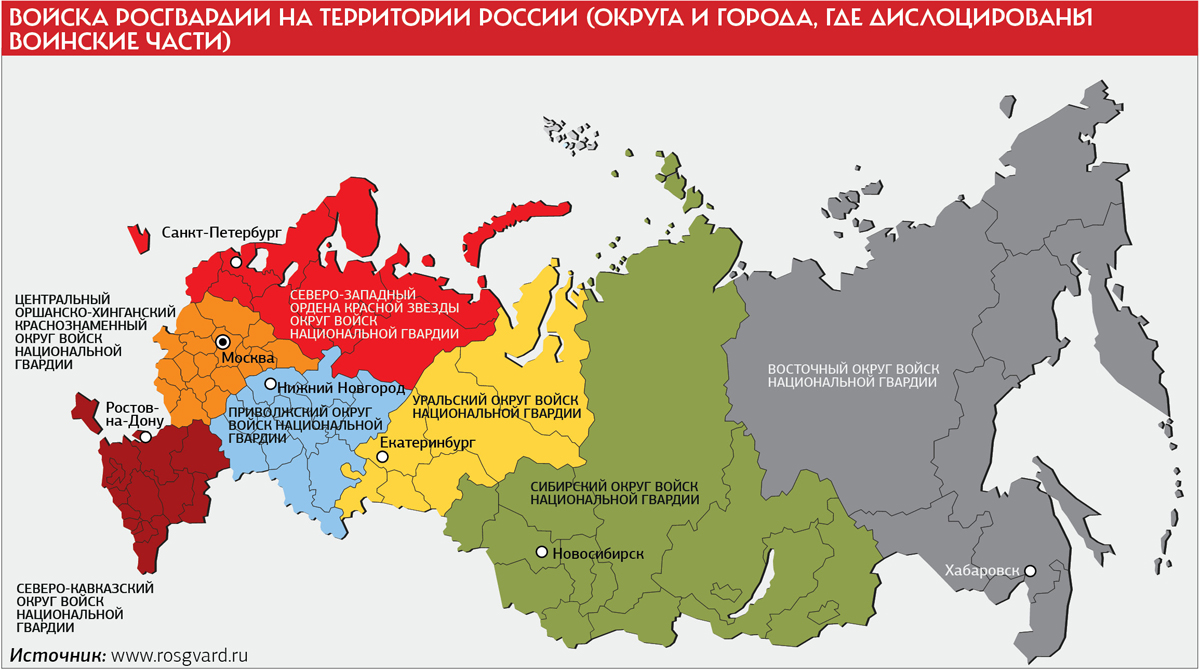
Russian National Guard Units in Russia (Districts and Cities Where Units Are Deployed. Source: www.rosgvard.ru

Super Law Enforcement Authority

The authorities, however, have not been hiding what jobs, the most important, as they imagine, the Russian National Guard will have to take on for the state. Deputy Prime Minister Dmitry Rogozin quite seriously dubbed it the “most belligerent military unity solving problems inside the country.” Even so, he underscored that the “Russian National Guard must be armed to the teeth, and not just to the teeth, but with the highest-quality weapons.”

True, the Guard itself is steadily becoming a super law enforcement body, a secret service backed up by thousands of troops. Relatively recently, for example, it transpired that the Guard was establishing a service for monitoring social networks on the internet.

“We see today the areas where we would like to develop. IT is in first place. […] The Russian National Guard plans to train IT specialists and specialists for monitoring social networks,” said Colonel General Sergei Melikov, deputy commander of the Russian National Guard.

According to Melikov, “such training groups” were already functioning at the Perm Military Institute.

Военнослужащие Росгвардии во время курса боевой подготовки, Московская область, февраль 2017 года. Фото: Дмитрий Коротаев/Коммерсантъ Russian National Guardsmen during combat training. Moscow Region, February 2017. Photo courtesy of Dmitry Korotayev/Kommersant

General Melikov claimed the new unit would tasked only with tracking terrorists and preventing their attacks. But it is more likely the cyber-guardsmen will identify groups of “rebels,” including people planning to take part in protest rallies.

In the meantime, the media has reported on the Russian National Guard’s intentions to obtain permission to perform investigative work, thus establishing their own version of the Moscow Criminal Investigation Department (MUR). So far, high-ranking officials in the Guard have decisively denied this. However, General Melikov revealed that the Russian National Guard would train the appropriate specialists if the authorities decided to give them these powers.

Finally, the top brass has consistently been involved in guiding the National Guardsmen ideologically. It would seem their ideal is the NKVD, for the authorities have not limited themselves to naming an tactical division of the Guard after Iron Felix. So, in the very near future, Dzerzhinsky’s name will be resurrected, incorporated as part of the name of the Guard’s Saratov Institute. The Guard’s units and divisions are supposed to be given the insignias and honorary titles of glorious predecessors. Uniformed historians have been tasked with finding something heroic about the NKVD’s troops. It is curious what they will write about the involvement of these “glorious warriors” in wholesale deportations and whether they will use these “heroic examples” to educate the Guardsmen.

The Potential Enemy 

For the time being, the Russian National Guard’s commanders insist that its main objective is confronting terrorists and armed gangs, underplaying its role in dispersing civilians. But the same day the president’s decree was published, May 20, an article with the byline of Yuri Baluyevsky was published in the Independent Military Observer. In the recent past, Baluyevsky had been chief of the Armed Forces General Staff; he was later deputy secretary of the Security Council, and is now an adviser to the Russian National Guard’s commander-in-chief. His article is notable for its frankness.

“As a military man,” writes Baluyevsky, “I compare our country to a target. The center is the leadership and political elite. The second circle is the economy, the third, infrastructure, the fourth, the populace, and the fifth, the Armed Forces. Currently, it is not the Armed Forces who are being attacked, but the civilian population, since, compared with the military, it is the segment of society most vulnerable to the forces and methods of psychological warfare. The scenario for how events unfold is known from the color revolutions. The organizers get millions of people shouting ‘Down with the government!’ to take to the streets. The authorities start to lose control. Next come sanctions and an integrated attack on the country’s economy. The armed forces don’t know what to do. All of this leads the country to collapse. This is how a modern war could unfold.  The emergence of the National Guard is a response to the challenge to our society, to the threat posed by the use of so-called nonviolent resistance, which it would be more accurate to call a ‘color revolution.'”

Thus, society’s allegedly least responsible segment, the civilian population of one’s own country, has been transformed into a potential enemy against whom the Russian National Guard and the army will be allowed to use force. They will be allowed to use military force against their own people.

Translated by the Russian Reader. Thanks to Comrade AKH for the heads-up