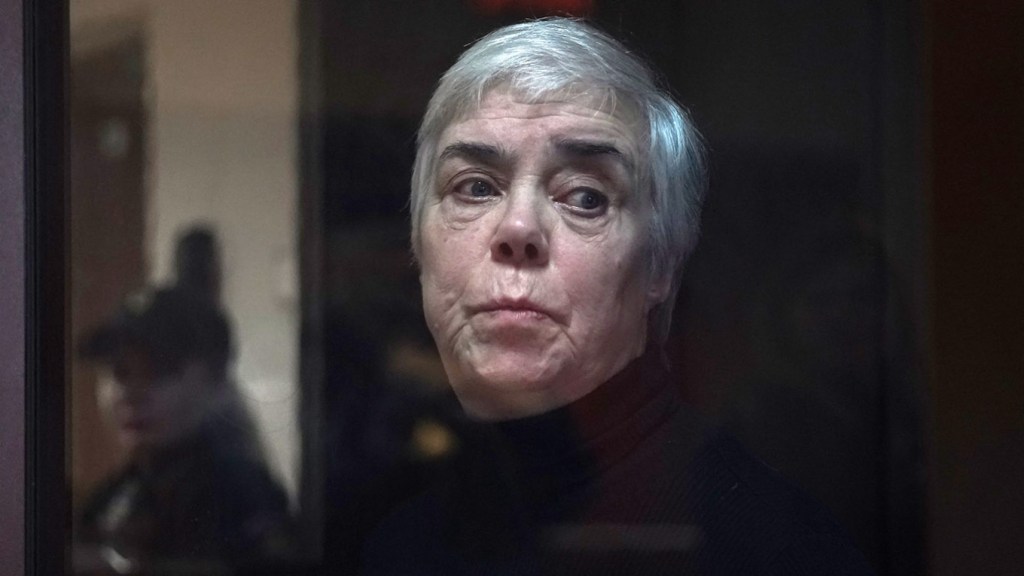
Lawyer Dmitry Talantov has been sentenced to seven years in a penal colony on charges of disseminating “fake news” about the Russian army and inciting hatred in connection with several social media posts about the war. Talantov had been on the defense team of journalist Ivan Safronov, who was sentenced to twenty-two years in a penal colony for high treason. Talantov had also served for many years as the head of the Udmurtia bar association, so it is likely that both the judge who sentenced Talantov and the prosecutor who petitioned the judge to sentence the respected 64-year-old defense lawyer to twelve years in prison knew him personally.
Talantov delivered a memorable closing statement today in court.
In Russia, where censorship has gutted the remaining independent media outlets, and all protests are nipped in the bud, trials have paradoxically become the best venue for free speech, so it is no wonder that an entire book of closing statements has been published. Here are several examples of closing statements by Russian political prisoners.
Dmitry Talantov, sentenced to seven years’ imprisonment for antiwar social media posts:
Brodsky once said that “prison is a lack of space counterbalanced by a surplus of time.” I didn’t completely understand this phrase. I didn’t get it. I’m certain that none of you totally understands it, because it is the surplus of time which is frightening about this situation, not the lack of space. It is the time during which you suffer, and the time that tries to kill you. Every minute tries to kill you, and every minute in there [in prison] is equal to an hour.
[…]
People often ask for forgiveness during their closing statement. I also want to ask for it. I’m saying this to my wife. Forgive me, Olga. I love you. If this is overdoing it emotionally, then I’ll put it this way. Olya, if you’re ever sent to prison for twelve years for some reason, I’ll wait for you to get out. Take it easy.
Sasha Skochilenko, the Petersburg artist and musician sentenced to seven years’ imprisonment for posting antiwar price tags in a supermarket and released as part of a prisoner swap in August 2024:
Alexei Gorinov, the Moscow municipal district council member who was initially sentenced to seven years in prison for “disseminating fake news” during an argument about whether it was appropriate to hold celebrations for children during a war, and who is now on trial a second time for allegedly “condoning terrorism” in conversations with cellmates:
I was also a municipal council member during the August 1991 coup. I stood with other defenders outside the Russian Supreme Soviet, the so-called White House. We were defending our freedom, our right to live freely and, thus, to speak freely, voice our thoughts, gather information, and share it. If they had told me then that thirty years later I would be tried by a criminal court for my words, for my opinion, I wouldn’t have believed them.
Nadezhda Buyanova, a pediatrician, was sentenced to five and a half years in prison for “disseminating fake news,” after she was denounced by the widow of an army officer killed in Ukraine: the doctor had allegedly said to the woman’s seven-year-old son that his father had been a “legitimate target”:
If there used to were doctors and patients, nowadays there are providers and clients. That’s what we were told at the planning meetings: “Humiliate yourself. And us.” We medics can be slandered, we can be insulted, we can be called every name in the book. We can’t defend ourselves, our explanations are not heard by our superiors, and conflicts are not resolved.
There was no interrogation and the child had nothing to say. “At the end of the appointment, he walked out of the office.” You cannot believe such a tale. You cannot lie like that: it’s a disgrace. How can you accuse a person without evidence, on the basis of a false accusation? Where is the logic? Where is the justice? Earlier, in ancient times, there were wise men. They would have said: “Well, what do you expect from a person without proof?”
Roman Ivanov, a journalist for RusNews, was sentenced to seven years in prison for three social media posts. During his closing statement in court, he knelt down to apologize to Ukrainians:
What can we do in this situation? I honestly don’t even know anymore. But I want to ask for forgiveness from all the citizens of Ukraine, to whom our country has brought grief, whom our country has robbed of their relatives, their loved ones, and their friends, who will never come back.
And [I ask for forgiveness] not for the whole country, but for me personally, for Roman Viktorovich Ivanov, a citizen of the Russian Federation. I would like to get down on my knees before the relatives of the people who were murdered in Bucha, although I don’t know who murdered them. But they are the consequences of what our country has become.
The politician Alexei Navalny was repeatedly tried on trumped-up charges before he was murdered in a penal colony on 16 February 2024. Perhaps it was Navalny, during his endless trials, who revived the closing statement in court as a literary genre. Here is an excerpt from his speech at his trial for “extremism” in July 2023:
Source: “How Closing Statements in Court Have Become the Main Source of Opinion Journalism in Warring Russia,” WTF? daily newsletter (Mediazona), 28 November 2024. Translated by the Russian Reader
Former Moscow politician Alexei Gorinov, the first known Russian to be imprisoned for denouncing the invasion of Ukraine, was sentenced to three more years on Friday on charges of “justifying terrorism” that he says he was framed for.
Ahead of his sentencing, he read the following statement to the court and the press:

“All my life I have been an opponent of aggression, violence and war, and devoted myself exclusively to peaceful activities: science, teaching, education, governance and public activities as a deputy, human rights activist, member of election commissions and controller of the electoral process. I never thought that I would live to see such a level of degradation of my country’s political system and its foreign policy, when ordinary citizens who favor peace and are against war, who number in the thousands, would be accused of slandering the Armed Forces and justifying terrorism, and would be put on trial.
“The third year of the war is coming to an end. The third year of casualties and destruction on European territory, of deprivation and suffering of millions of people on a level unprecedented since World War II. We cannot remain silent about this.
“Back in late April, our former defense minister announced the losses of the Ukrainian side in the armed conflict – 500,000 people. Think about this number! And what losses have been suffered by Russia, which, according to official information, is constantly successfully advancing along the entire front? We still do not know. And who will be responsible for this? What is all this for?
“Our authorities and those who support them in their militaristic aspirations wanted this war so much — and now it has come to our land.
“I would like to ask them: has our life become better? Is this how you understand the well-being and security of our country and its population? Or did you not envision these developments in your calculations?
“But for now we have to answer not to those who organized the war, continue to kill, propagandize the war and engage in mercenarism. Rather, we ordinary citizens of Russia, who raise our voices against war and for peace, have to answer, paying with our freedom and, for some, with our lives.
“I belong to the outgoing generation of people whose parents took part in World War II or survived it with all its hardships. The generation that has already passed away entrusted us with preserving peace with all our might as the most precious thing on Earth for all its inhabitants. But we have neglected these principles and devalued our memory of these people and the victims of that war.
“My guilt is that I, as a citizen of my country, allowed this war to happen and failed to stop it. And I ask you to note this in the verdict. But I would like my guilt and responsibility to be shared with me by the organizers, participants and supporters of the war, as well as the persecutors of those who advocate peace.
“I continue to live with the hope that someday it will be so. In the meantime, I ask the people of Ukraine and my fellow citizens affected by the war to forgive me.
“Within the framework of the case in which I was accused and tried for my opinion that we need to seek an end to the war, I have expressed my attitude fully to this abominable human endeavor. I can only say that violence and aggression breed nothing but reciprocal violence. This is the true cause of our troubles, our suffering, our senseless sacrifices, the destruction of civilian and industrial infrastructure and our homes.
“Let us stop this bloody, needless slaughter — neither for us nor the inhabitants of Ukraine. Isn’t it time to leave our neighbors alone and deal with our own snowballing domestic problems? Long ago we proved to the world how brave, resilient and peace-loving we are. So, maybe enough is enough?
“Lev Nikolaevich Tolstoy — from a letter to his son (1904): ‘For me, the madness and criminality of war is so clear that I can see nothing in it except for this madness and criminality.’
“I too join and subscribe to these words of our great compatriot.
“You can join too!”
SOTAVision reported that Judge Vladimirov interrupted Gorinov when he started to talk about losses in the war in Ukraine and called a 15-minute break so Gorinov could “think over his speech again.”