Degenerate Art

The FSB has opened a criminal case on charges of “high treason” against artist and former Mediazona publisher Pyotr Verzilov. The details of the case are not yet known, but as part of their investigation, law enforcers raided the homes of a number of artists and activists across Russia. Many of those whom the law enforcers raided are not personally acquainted with Verzilov.

In the early hours of Tuesday morning, people identifying themselves as FSB officers searched the home of Petersburg artist Katrin Nenasheva and her girlfriend Natasha Chetverio. Nenasheva was taken away for questioning, while Chetverio was released, but both had their electronic devices confiscated. The homes of artist Sasha Blot, Party of the Dead activist Kristina Bubentsova, illustrator Vladlena Milkina, and architect Alexandra Kachko were also searched in St. Petersburg.

Law enforcers simultaneously raided the apartments of Verzilov’s mother Yelena, members of the art group Yav, actionist Anastasia Mikhailova (an associate of the artist Pavel Krisevich), and Pussy Riot members Rita Flores, Olga Pakhtusova, and Olga Kuracheva. The latter two were involved in the action “The Policemen Enters the Game”: along with Verzilov, they ran out onto the field of a Moscow stadium during a World Cup match there.

In Moscow, a female acquaintance of the artist Philippenzo (who is now in exile) was taken from her flat. The Yekaterinburg artist Ilya Mozgi and the Ulyanovsk artist Ilya Kholtov were both taken away for questioning after their homes were searched. Nizhny Novgorod artists Artem Filatov and Andrei Olenev were questioned. Samara artist Denis Mustafin’s home was searched. Although he was not at home, his mother’s computer was confiscated.

Some of these have already been released from interrogation (Nenasheva and Kholtov, for example), while others are still being questioned. It is known that most of them have now been designated as “witnesses” in the case against Verzilov. Many of them were asked about their connection to Verzilov: many did not know him personally and had never had much contact with him. Kristina Gorlanova, the former director of the Urals branch of the Pushkin State Museum of Fine Arts, located in Ekaterinburg, whose home was also searched, said that she had “heard nothing” about the “artist” who occasioned the search.

It is still unclear what gave rise to the criminal case. Under new legislation, however, switching to the enemy’s side during a war can be considered “state treason” can be considered as switching to the enemy’s side during a war. In an interview with Yuri Dud last year, Verzilov admitted that he had originally traveled to Ukraine as a documentary filmmaker, but now he was at the front “as a military man.”

“Verzilov: Inside [the] War,” vDud, 5 October 2023. In Russian, with English subtitles

Many of the artists whose homes were raided may never have been involved in Verzilov’s activities, but they themselves have produced works about current events in Russia and Ukraine. We wrote last year about the works of Yav and Philippenzo. Mustafin was fined for flying a a Russian flag inscribed with the phrase “Today is not my day” outside the Ministry of Defense in Moscow on 12 June 2022. Milkina made a public art piece about “people who are scared” on a Petersburg square and T-shirts with the word “Peace” on them.

Source: “Law enforcers raid homes of artists and actionists on eve of elections,” WTF? newsletter (Mediazona), 12 March 2024. Translated by the Russian Reader


Petersburg artists find ways to get their messages across even amidst strict censorship. They mount underground apartment exhibitions, “tiny pickets” on city streets, and exhibitions and performances in the woods. It all smacks of the Soviet guerrilla art and actionism from which the international stars of post-Soviet conceptualism later emerged.

Bumaga explores how street art shows have gained popularity in Russia, how guerrilla art has changed in recent decades, and how today’s actionists resemble the organizers of the notorious Bulldozer Exhibition.

“I’m for peace!” Photo: Tiny Picket (Instagram)

Street exhibitions have been around since the 1960s. One of the first such projects was dubbed “the Soviet Woodstock”

Guerrilla street exhibitions in Russia date back to the so-called unofficial art scene of the 1960s and 1970s. Pursuing the idea of coupling art and ideology, the authorities forced undesirable artists out of public art life.

In 1962, Nikita Khrushchev cracked down on the exhibition 30 Years of the Moscow Union of Artists, at the Moscow Manege. The Soviet premier wanted to expel all of its participants from the CPSU and the Union of Artists, although almost none of them were Party or Union members. Artists and connoisseurs reacted to political censorship in the USSR by forming an artistic underground, meaning that the most progressive art was exhibited at apartment exhibitions and in salons.

The 1970s witnessed open confrontation between the art and the world authorities. The most flamboyant members of the artistic underground were the Lianozovo school, who gathered and held exhibitions in a barrack in Moscow’s Lianozovo neighborhood. The leader of the group, Oscar Rabin, organized one of the most infamous guerrilla street exhibitions in the history of Russian art, which later became known as the Bulldozer Exhibition. On 15 September 1974, the artists staged a show of paintings in a vacant lot in Moscow’s Belyayevo Forest. The authorities sicked police on the participants and attendees and destroyed the show with bulldozers.

This crackdown on artistic expression triggered an international uproar, and the Soviet authorities made concessions. Two weeks later, the artists were allowed to hold an officially sanctioned exhibition featuring an expanded list of participants in Moscow’s Izmailovo Park.

This time the police were tolerant towards the artists and their guests: no one was detained. The exhibition lasted for several hours and, thanks to the beautiful weather, it turned into a big picnic. Western journalists dubbed the event “the Soviet Woodstock.”

Soviet unofficial artists continued this tradition, and one art group published 14 volumes documenting their activities

However, the underground’s victory at the Bulldozer Exhibition was not unequivocal. Unofficial art continued to defend its right to exist at an exhibition in the Beekeeping Pavilion at VDNKh (February 1975), at the Preliminary Apartment Previews for the All-Union Exhibition (spring 1975), and at an exhibition in the House of Culture Pavilion at VDNKh (September 1975).

These exhibitions were sanctioned, but the authorities still created a number of organizational obstacles for the artists. For example, only those artists who had a Moscow residence permit were allowed to show their work at the House of Culture. In addition, the authorities made the condition in which the artists worked unbearable: during the mounting of the show, the temperature in the pavilion topped forty degrees Celsius. Thirty-eight works were banned by the censorship commission. It is not known how many works were exhibited, ultimately, but a total of 145 artists participated in the show.

After the scandals provoked by the “unofficial” artists’ public appearances, the authorities began pursuing a policy of legalizing alternative art. In May 1976, the Painting Section of the Graphic Artists Committee was established, primarily to monitor and control the ideologically dangerous underground.

We should keep in mind that we do not have information about every single Soviet-era guerrilla exhibition. Many were held without leaving any trace in contemporary newspapers and other documents.

Collective Actions, a group led by Andrei Monastyrsky, did a huge amount of work in this sense. The artists compiled fourteen volumes documenting their Trips to the Countryside — actions during which various events took place in particular landscapes, including installations, performances, and minimalist interventions in nature. By going outdoors, the artists showed that art could be implicated in the space outside galleries and museums. Another important feature of the performances was the inclusion of viewers in the works: their participation and reactions were part and parcel of the conceptual actions. The way the actions were staged encouraged the spectators to focus on the processes of anticipating and comprehending the happenings. That is, the spectacle itself was an occasion for reflection, a statement meant to spark a dialogue.

In [1977], for example, Collective Actions simply hung a red banner between trees in the woods. The banner read: “I HAVE NO COMPLAINTS AND I LIKE EVERYTHING, ALTHOUGH I’VE NEVER BEEN HERE AND KNOW NOTHING ABOUT THESE PARTS.”

Collective Actions, Slogan (1977). Photo courtesy of New East Digital Archive via Bumaga

Guerrilla exhibitions are still organized nowadays, many of them dedicated to political prisoners

As a rule, guerrilla exhibitions and actions have a political agenda, so their organizers can be punished quite severely, even by Russian standards.

Nevertheless, there is activity in this field. For example, on 5 August 2023, Petersburg activists mounted an open-air exhibition on the Sestroretsk Ecotrail on the Day of Remembrance of the Victims of Sandarmokh [sic], a tract in the forests of Karelia where victims of the Great Terror were shot and buried in mass graves. Fifty works hung in the open air for a record time — almost an entire day.
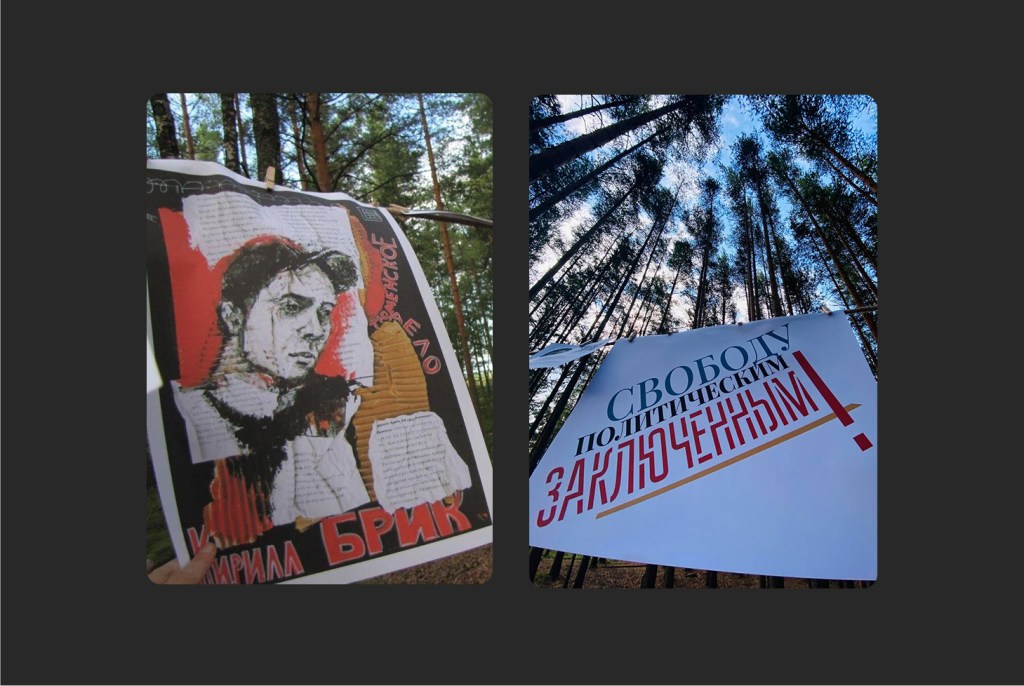
Placards in support of Tyumen Case defendant Kirill Brik (left) and the release of political prisoners (right) at 2023 guerrilla exhibition in suburban Petersburg. Photos courtesy of 123ru.net via Bumaga

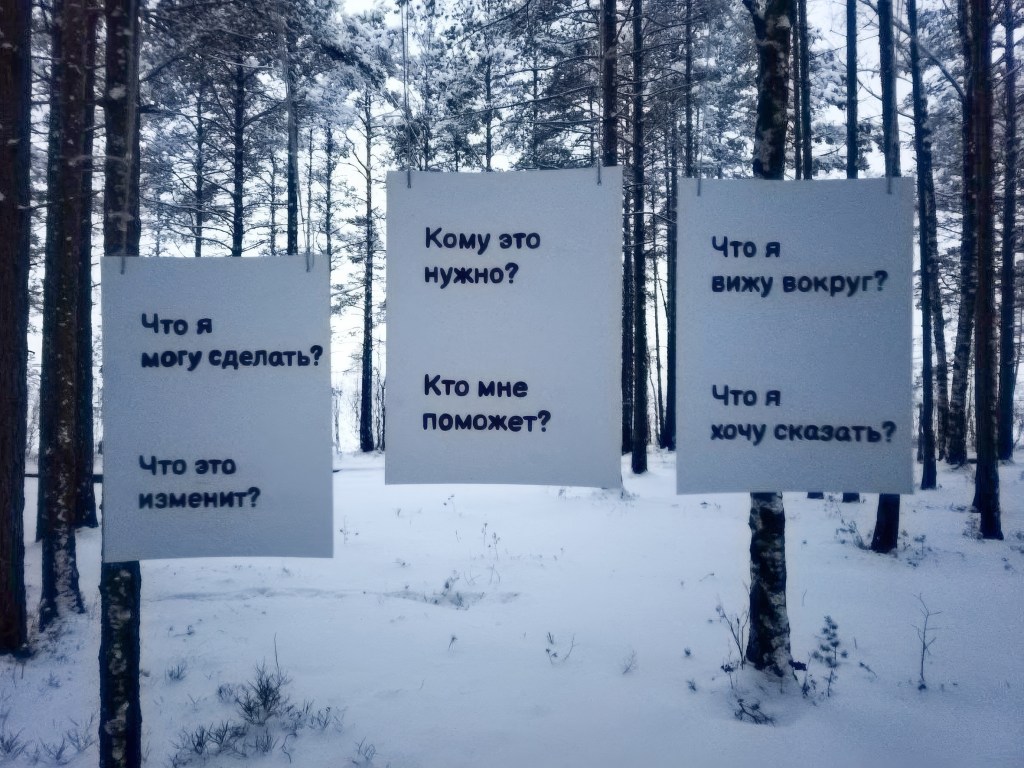
Several placards were also hung in the woods outside Petersburg this winter — for example, on December 10, Human Rights Day, the work I Dissent, Therefore I Am. And in January, an installation featuring a quotation from the Bulat Okudzhava song “Hope’s Little Band” was mounted outside the city.
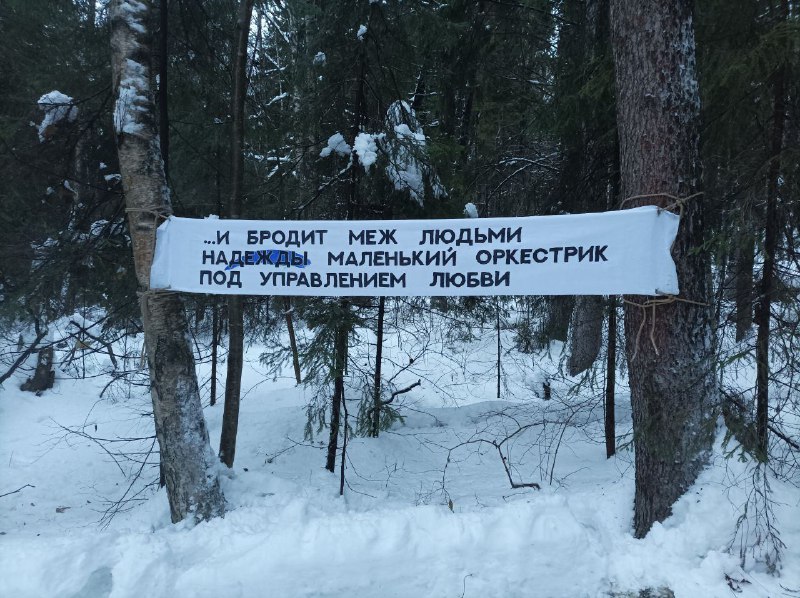
“…and wandering amongst people / is hope’s little band, / conducted by love.” Photo: Bumaga reader
“What can I do? What would it change? Who would care? Who would help me? What do I see when I look around? What do I mean?” Part of the installation I Dissent, Therefore I Am. Photo: a Bumaga reader

In 2022, Petersburg hosted Carte Blanche, an international guerrilla street art festival. In addition to street works, a stationary exhibition at the abandoned Sailors Palace of Culture on Vindavskaya Street attracted great attention; it featured over twenty artists, including Vladimir Abikh, Maxim Ima, and Slava PTRK. That same autumn, Petersburg hosted the underground exhibition Continuity, dedicated to political prisoners of the past and present, including the victims of the Great Terror and those caught up in the Network Case. Some of the works were made by political prisoners themselves using improvised means and materials while they were incarcerated in pretrial detention centers and penal colonies.

Contemporary street exhibitions continue the Soviet tradition, but the state’s reaction to them has become tougher

Today’s guerrilla exhibitions in many ways are a continuation of the Soviet and post-Soviet tradition. The Bulldozer Exhibition can hardly be called an artistic event also. It was also a political event. It was a challenge to a repressive regime, “the first and most significant collective performance,” as art historian Yevgeny Barabanov wrote.

Since 2022, such exhibitions also have not only aesthetic but also political goals. Although in the Soviet and post-Soviet years, “unofficial” exhibitions, albeit with certain restrictions, could be legitimated [sic], since 2022, the state does not even attempt to compromise with artists.

Moreover, crackdowns against artists who voice alternative opinions have reached a new level. In 1991, the Moscow actionist Anatoly Osmolovsky and his group E.T.I. used their bodies to spell an indecent word for the phallus [khui] on Red Square. After the action, Osmolovsky was detained and threatened with charges of “malicious disorderly conduct.” However, thanks to the petitions submitted to the authorities by his art world colleagues and the Memorial Society, Osmolovsky was soon released.

Nowadays, petitions and statements of support are not enough to get artists acquitted. Sasha Skochilenko was sentenced to seven years in prison on charges of disseminating “fake news” about the Russian army. The young woman replaced price tags at a Perekrestok chain grocery store with anti-war messages.

Source: “Placards in the woods and art shows in flats: how this differs from Soviet guerrilla art,” Bumaga, 12 March 2024. Translated by the Russian Reader
Darja Serenko’s Quiet Picket

Picketing the Everyday
Marina Simakova
OpenLeft.ru
May 7, 2016

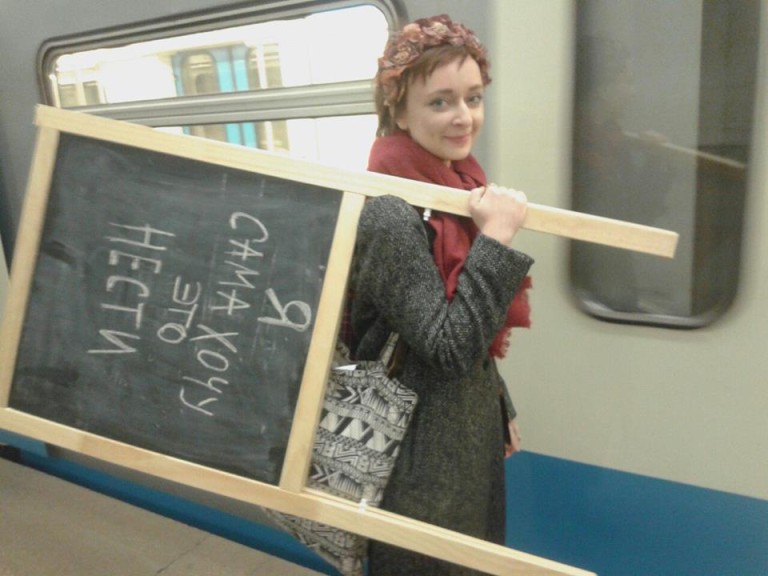
Quiet Picket, a recent initiative by Darja Serenko, teeters on the verge of artistic intervention and protest action. Every day, Serenko boards public transport (often, the subway) bearing a new placard inscribed with an extensive message. Its purpose is to invite people to engage in a discussion. Serenko thus explores the space of communication itself: the distance between placard and recipient, and how potential interlocutors navigate the distance. So far she has produced fifty-four placards, gone through six markers, and directly communicated with ninety-three people. Marina Simakova spoke with Serenko about the background of the action and its effects.

serenko-1
Darja Serenko: “I want to carry it myself.”

Tell us how and under what circumstances the idea for the action occurred to you. What was the occasion?

The action grows out of several occasions. On the one hand, the arrest of Ildar Dadin; on the other, the story with the itinerant exhibition {NE MIR}, when we artists were detained by police while carrying our artworks down the street. I had been contemplating a solo picket for quite a long time. I had a dream of doing an ordinary picket, holding a placard at chest level that would resemble the headings in children’s encyclopedias: “And did you know that…” But ultimately a kind of reformatting of the very principle happened in my head. My understanding of it changed.

And what defined its format?

I was riding the subway after the closing of a {NE MIR} exhibition. I had grabbed a small poster by the Lights of Eirene movement. It featured the famous photo of John Lennon and Yoko Ono during their Bed-In for Peace, and next to it, a current photograph in which similar looking people were lying in approximately the same poses. I was carrying the poster unfolded so it would not be crumpled, and I noticed that everyone in the subway car was looking at it. It dawned on me then and there this was the perfect form of communication. It was completely unobtrusive.

Why did you decide to do it alone, without friends? Did you ask anyone else to join you?

I said from the get-go that the format was open. Two young women joined me, but each has changed the format to suit her. One of them, Sasha, joined about ten days ago. She has attached a placard to her backpack (it comes out more static), and she has been traveling with the same placard for a week. On the other hand, she usually prints it out, and it contains references. The second young woman, Valeria, has also been doing a quiet picket on public transport. She wrote me to ask my permission, and of course I agreed. I have asked the young women to share photos of their placards and stories about what happened as they are able. In no way do I want my action to smack of a manifestation where “I, the performance artist, march forth and educate people.” That is not how it is. Although I do conceive of it as an educational project.

So your action could go viral?

It is difficult to talk about a virus when there are only three young women. But this format really is networked, simple, and palatable. It also functions without me.

How has it been documented?

On VKontakte and Facebook, and a bit on Instagram.  I have a small public page on Vkontakte, and I post a written report on my personal page on Facebook every afternoon or evening, when I have a free minute. I try and describe the situations, the conversations, and the behavior, both my own and that of the people with whom I interact. I also post photographs of the placards.

serenko-2
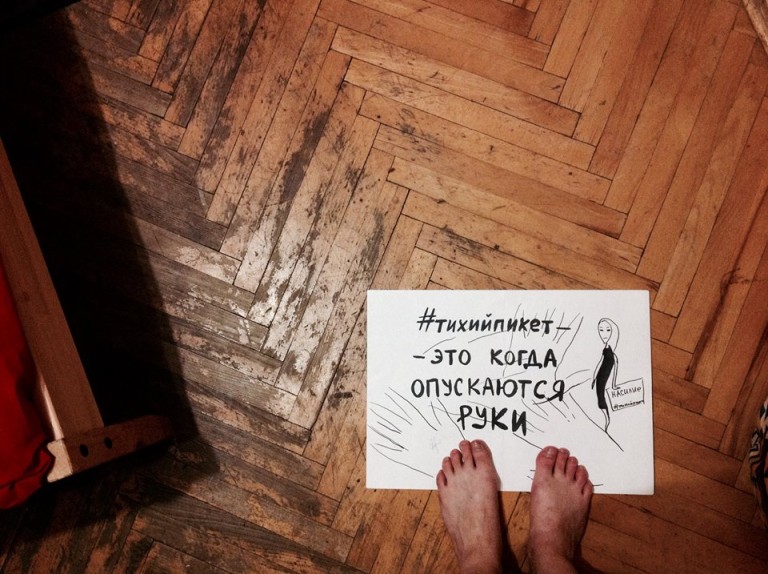
“#quietpicket is when you feel discouraged and your arms fall.” In Russian, the expression “[one’s] arms fall” means to “feel discouraged.”

And is someone watching and photographing you?

Yes, constantly. Stealthily, very politely. If people photograph at close range, they always ask my  permission. Actually, I have got used to thinking of my action as a tape. Today, something like two hundred people wrote me asking what the action was all about. They had not been following it, and I already find it hard to conceive it any other way and explain it all in a jiffy, because some things were improvised and then they caught on. The format of the action has been changing.

How has it changed?

Initially, I had planned to make a placard early in the morning or the night before, ride around with it for a day, and make a new one the next day. I could not imagine subsequent interventions into the placard. But then I sensed the need to alter it depending on the reactions, to write and draw something extra, to explain something on the back. First, the placards were one-sided, then they became two-sided, and then I started doing several narratives within a placard.

After hearing why I was doing this, one of my accidental interlocutors said, “Oh, I get it. You are making a social alphabet.”

Yes, you could say that as well, and so the alphabet format emerged in my action. I want to put together an entire alphabet. Yesterday, I traveled with Г, for gomoseksual’nost’ [homosexuality], and today it was Ш, for shovinizm [chauvinism].

There is also a storyline involving poems I write on the placards. They can be connected with the topic of the placard, as stated on the other side, or they might not be connected. For example, I have been riding around with texts by the poets of the Lianozovo School, the poems of Vsevolod Nekrasov and Igor Holin, and I have been telling people about poetry. And when people ask me whether I think they are poems, I say that of course they are.

Sometimes, the text on a placard is arranged like a dialogue. There is an enquirer of sorts and a respondent.  There was a photo stand-in placard with holes for the eyes and mouth on which I wrote about the social status of women. The allegory in this case was simple: almost any face could be placed on the placard. But, actually, each placard turns out different from the others.

The last few days I have been stitching the sheets of paper together with thread, because I have run out of tape. (I use A3 sheets, which I combine into one big sheet.) It is an excellent means of representing a placard, because while I am stitching it together, I can turn it over and still remain focused on some task.

Sometimes, I also sew a new placard to an old one. This is a palimpsest placard, and the one is visible through the other. The placards thus form strange seams and montages.

I now always have a pile of posters in my bag.  If I see a person is reacting to the placard I am holding, and realize that I want to say something to them, I take another placard from my bag and sew it to the first. When I was riding around with the placard “Our government is fabricating [in Russian, “stitching up”] yet another case against yet another political prisoner,” I sewed it as well I could, in several rows, with rough stitches. By the way, I have been stitching the alphabet placards into a single notebook so later you can flip through it.

serenko-3
Darja Serenko, Photo Stand-in Placard on Social Status of Women (Quiet Picket), 2016

How do you think up the texts for the placards? Do you take advantage of items in the news?

Everything is unstable when it comes to this, too. For May Day I made a topical placard, and after Pavlensky’s action [when the artist summoned sex workers to his court hearing as witnesses—OpenLeft] I made a placard about prostitution. But there are issues I simply have to cover, so I conceive of Quiet Picket as an educational project, albeit semi-ironically and semi-seriously.  Although it happens that I see my action as a kind of monstration. I ride in the subway, look at people, and think I would like to cheer them up.

Besides the fact that the project is educational, how do you define it for yourself? As a series of political art performances or as a civic initiative?

I see it as a continuation of my own work as a poet. In the poetry I have been doing, I spent a long time trying to achieve some kind of interaction: I took readymades and inserted them into poems. I think this know-how has influenced Quiet Picket. I am not saying that Picket is a purely poetic endeavor, but thanks to poetry the placard itself has greater opportunities for communicating. And the aspect I cannot keep track of in poetry, the aspect of reading [meaning the reader and her interaction with the poetic text—OpenLeft] is a process I can observe in this case. I see the person’s eyes running over the text, and at the same time she can address me, while I observe how her interpretative mechanisms function, and I can influence them. Quiet Picket takes place in this gap, in the distance between the person and the placard.

Have you thought about urban studies? After all, your action is nothing less than an intervention in one of the most important urban infrastructural spaces, an intervention that would let you get a feel for certain problems, study the behavior of passengers, do work on communications, and so on.

I might prove insufficiently competent as a researcher in this field. I have been trying to document everything I do, and perhaps the outcome will be an article or essay I write. I have not drawn any conclusions for the time being. My research involves collecting information and gaining the know-how of conversing with people on pointed topics that many of them find painful.

There is a rather glaring contradiction in your action. On the one hand, it lays claim to a certain intimacy. It summons a man in the crowd to have a private conversation; it invites him to a politicized discussion. On the other hand, it is very public and open to multiple counter-statements. Could you comment on this?

I don’t see a contradiction here. The fact is that the star of my action is the person who has brought herself to engage in reciprocal communication. She is the master of the situation, not me. She defines her own borders. She can approach me and whisper something in my ear, or she can holler at me from the other end of the subway car, aware that everyone will hear her and thus let other people get involved. It has also happened that a person has asked me to exit the car and have a chat. In that case, I obediently go with him and talk.

serenko-4
Darja Serenko in the midst of Quiet Picket on the Moscow subway

If we shift the focus from the action itself to its subject, meaning you, we can detect yet another problem. At first glance, you appear as a naïve angel in this action. Eyes downcast, silently but persistently, you broadcast your appeal to people. Prepared for any reaction, you throw yourself at the mercy of angry, tired subway passengers. There is a certain victimhood about all this, almost evoking associations with the holy apostles. At the same time, we can look at you in a different way, as an artist working in the aftermath of Situationism and rationally exploiting the temporal distance. So you are protected from the man in the crowd by theory and your own stance, which have found their own places on your placards, while your potential interlocutor, the so-called man in the street, simply has nothing to oppose to you. You thus possess a certain power from the outset.

First, the image of me as meek silent angel is not true. It has been conjured from a photograph of me that has become quite popular. Usually, I don’t look that way. Second, yes, I have a background in culture, a knowledge of manipulative devices, and a set of readymade arguments. There is no getting away from it, but in the process of communicating I still feel unarmed and naked. The things people say, their experience, and the situations they reference have often stumped me. It has happened that I have nothing ready to say to them.

You assumed this experience would change you, pose new questions, and, perhaps, even force you to undergo a kind of metanoia.  Or am I wrong?

I haven’t had the time to keep track of what has been happening to me. But as a woman and feminist, I do think about my own feminine subjectivity (and objectivity). The placard is an amazing agent. When I use the placard to broadcast a feminist agenda, which I do quite often, I am simultaneously the subject and author of the placard and its object.  When I have to dialogue with someone on the topic, I have to act as a subject. So I balance between these points like a pendulum, and this affects me. Of course, I know about the experiments of artists whose bodies, including social bodies, have become sacrificial bodies. But I am faced primarily by the task of a cultural worker. I really wanted and still want to tell people about certain facts. It pains me these facts are hushed up, many people don’t have access to them, etc.

And why should people believe what you tell them? The legitimacy of your claim to know the facts is supported by what? Are you appealing to the status of cultural worker?

Since my format is encyclopedic, I appeal to sources. You will have noticed the references on my placards. People and I often google something: they verify the information on the Internet. I realize that the informational field is infinite, and for various reasons people often deal with only a fragment of this field. I offer them an alternative.

serenko-5
Darja Serenko, “This is how our government has been fabricating yet another case against yet another political prisoner” (Quiet Picket, 2016)

The action has been running for five weeks, and you certainly have managed to collect the most incredible textured. Could you tell us about the most memorable, unexpected or personally important incidents during the picket? I will phrase my question even more openly. Tell us about whatever you would like.

For example, an elderly woman read my placard about political prisoners and thanked me. We were sitting opposite each other in the subway, and she told me about her life. She was a medical worker who helped athletes recover after injuries. On the back of my poster was an old poster, the May Day poster, on which the phrase “Thank you for your hard work” had been written.  She then asked me to exit the subway with her and offered to reward me for my work by having a look at my back and spine.

How long are you planning to continue the action?

For a year. I have a palpable dream that one day I will hit on the right phrasing, the right interactive possibility, and a person will want to make a placard in response right in front of me—as a creative act, as a statement, as an expression of contempt for me or, on the contrary, out of a desire to express agreement or disagreement.

Translated by the Russian Reader. Photos courtesy of OpenLeft.