Here we should recall Bruno Latour’s last public statement. He left us in October 2022, but managed to formulate in his final text, “Is Europe’s soil changing beneath our feet?” that this war is not only political, but also energy-related, and therefore environmental. I’ll drop the link in the comments below.
It is clear that this is not the war’s main cause of the war. It has many causes, and it is difficult to say whether there is a main cause among them.
Did the war start because the Russian leadership, fed up with earthly pleasures, wants to go down in history? Yes.
Is it a continuation of Russia’s imperialist policies as whole? Yes.
Is it a continuation of the Cold War? Yes.
Is it a consequence of the excessive buildup of aggression, resentment, and indignation in Russia itself? Yes.
But is it also a campaign against the modern world, not only in a cultural sense, but also in the sense of a fight on behalf of the old energy world, on behalf of coal and oil and gas? Yes again. And it is a fight against those “made-up” environmental and climate problems of ours.
This does not mean that the Russians who blew up the Kakhovka hydroelectric power plant had such motives, that they thought, “Fuck you, environmentalists! Suck on this, Greta Thunberg!”as they did what they did. I think they had the simplest of motives — to hold back the Ukrainian army offensive in this area.
But it is the effect wrought by a savage who shows up in a reputable joint and doesn’t understand why he should use a fork, cannot blow his nose on the curtain, and has to wipe his ass. That is, it is the effect wrought by a subject who completely fails to grasp the entire problem of modernity. He does not even try and is unable to understand it, and thus doesn’t regard his actions and their consequences in this way as a matter of principle. He just doesn’t give a fuck. Such a thing as caring for nature has never occurred to him: the savage is hopelessly behind the times.
And Latour writes in his essay that, unfortunately, the problem of savages with dirty asses (well, he doesn’t put that way: the man was cultured after all; I’m conveying the gist of his remarks) is not confined to Russia.
“In order to convince ourselves of this, we only have to identify those we would have to learn to fight if we were serious about getting rid of Putin’s gas and oil. Perhaps they reside on our street, fill the tank of our car, or increase our stock portfolio…”
Source: Dmytro Rayevsky (Facebook), 8 June 2023. Mr. Rayevsky is an editor at Babel.ua, a Ukrainian news and analysis website that ceased publishing its Russian edition after Russia’s February 2022 invasion of Ukraine. It has continued, however, to publish stories in Ukrainian and English translation. Translated, from the Russian, by the Russian Reader
Friends,
After Russia’s destruction of the dam at Nova Kakhovka, Ukrainians face a manmade catastrophe in the Kherson region, amidst all the other horrors of Russia’s invasion. Ukrainians are hard at work, essentially by themselves, rescuing their fellow citizens from the high waters, often braving Russian artillery and sniper fire. We can help those volunteers. Here are ten ways.
1. Ukraïner have a small group on the scene who have been evacuating people right from the beginning. Your donation would mean a lot to them. You can support them on Paypal from abroad via tymoshenkoyulia99@gmail.com or follow this link.
2. Rescue Now UA is a Ukrainian evacuation organization founded when this invasion began now active in Kherson. They are constituted as a US 501(c)3 so donations by Americans are tax-deductible. You can send money by PayPal here or consult the donation link here.

3. The Ukrainian Firefighters Foundation is raising money to buy pumps for the Kherson Emergency Services. You can help via Paypal via bimbirayte@gmail.com or by going to this page and hitting the Paypal button.
4. Vostok SOS is a Ukrainian evacuation organization working in the flooded Kherson region now to move people with limited mobility, children, and animals. You can support them through Paypal on nfo@vostok-sos.org or use this donation link.
5. The Prytula Foundation is an established Ukrainian NGO specializing in matching equipment to local needs. They are already delivering boats and other gear. You can support them via Paypal on serhiy.prytula.kyiv@gmail.com (specify goal) or follow this donation link.
6. UAnimals has been evacuating and caring for animals throughout the war and is raising funds to do so now in Kherson region. As you might have noticed Ukraine is a country that cares for its land and its animals. Donation link is here.
7. Razom is an American NGO that cooperates with local Ukrainian NGOs. If you donate to Razom, they will make sure your support is appropriately directed. It is a US 501(c)3. You can donate here.
8. World Central Kitchen is an international NGO that has done extraordinary work in Ukraine during this war. They are providing excellent nutritious food in Kherson region right now. You can support them here.
9. United24 is President Volodymyr Zelens’kyi’s official fundraising platform (I am an ambassador). Their “Lifeboat Ukraine” project is raising money for gear for rescue operations. Follow this link and look for the Help button.
10. ComeBackAlive is a trusted NGO that supports Ukrainian soldiers. Ukrainian soldiers are now evacuating disabled people and the elderly. They are also using their drones to deliver water to people stranded on rooftops. Beyond that: rescue operations are hindered by Russian artillery and snipers. Only Ukrainian soldiers can get them out of range. Here’s a link.
Please help. A catastrophic manmade flood as part of a war of atrocity is no everyday calamity. Ukrainians are on the scene doing what they can with remarkable calm. We should so what we can to support them. A few moments at a keyboard right now can save lives, and help good people feel like they are not alone.
P.S. And please share this!
Source: Timothy Snyder, “How to help Ukrainians during the flood,” Thinking about…, 8 June 2023

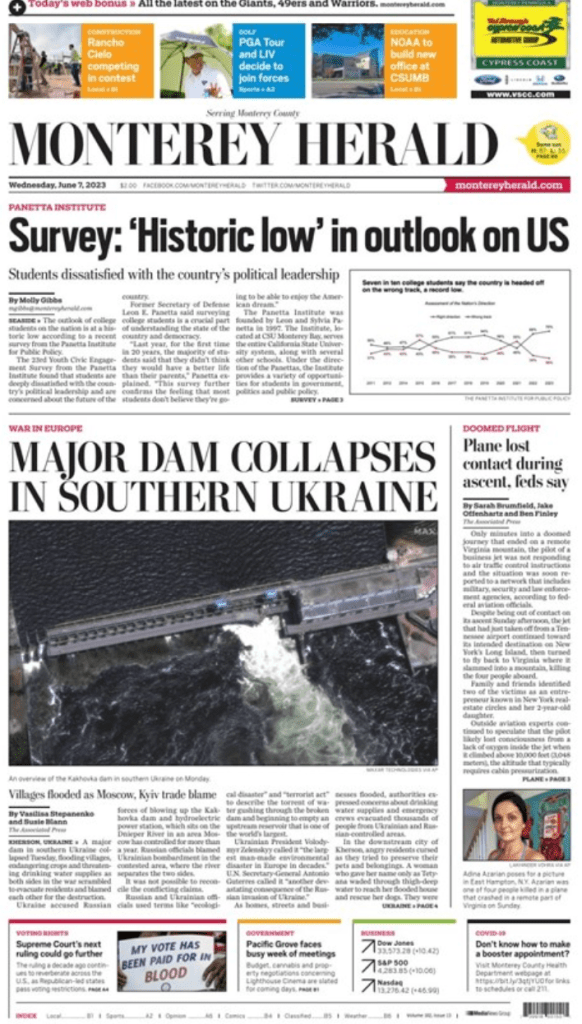
Russia’s war on Ukraine has also been another war of fossil fuel capitalism on the environment, but June 6 marked a new turning point in ecocide when the Kakhovka Hydroelectric Power Plant was blown up in an act of horrifying brutality, an egregious violation of international humanitarian law, and a war crime that shakes the very pillars of global food and environmental security.
While Tucker Carlson dedicates the pilot episode of his new show on his sociopathic accomplice Elon Musk(ovich)’s platform to conspiracy theories as to how Ukraine is to blame for the destruction of the dam (and essentially everything, up to phantasmagoric “persecution of Christians”), and his far-right minions readily spread them, the reality is that the Kakhovka HPP was controlled by the Russian occupation troops, that the Z-propagandists (including that infamous “Tatarsky” guy who was blown up by a statuette of himself) had repeatedly called to destroy the dam, and that their first reaction was boasting about its destruction. (In addition, the Russian government had just canceled investigations of accidents and terrorist attacks at hydraulic structures until 2028).
As a result of the dam’s destruction, countless lives and homes have been devastated. Dozens of settlements, home to tens of thousands of people, are now in peril from catastrophic flooding. The evacuation process has commenced, but the harm inflicted extends far beyond human suffering. In the Kazkova Dibrova Zoo alone, hundreds of animals have perished, and thousands more, both domestic and wild, face a similar destiny in the affected areas. The environmental impact is alarming. Vast stretches of agricultural land have been damaged, and the loss of the Kakhovka Reservoir puts the water supply of numerous regions, cities, and villages (as well as the Zaporizhzhia Nuclear Power Plant’s cooling system) in jeopardy. The potential for outbreaks of botulism looms, following the dumping of large amounts of fish onto the land. Far-reaching ecological consequences would be even worse, with the aridification and desertification of the nearby steppes haunting future generations.
The Social Movement argues that while Russian occupation forces remain in Ukraine, the safety of its residents is perpetually at risk, living under the constant shadow of potential terror attacks. At this moment, the most effective aid we can offer is supporting local volunteers and organizations directly involved in disaster response. We implore local activists and trade unions to rally together, harnessing every possible resource to aid those impacted by this tragedy.
This devastating situation again underscores the vital importance of a welfare-oriented approach to the needs of Ukrainian citizens, one that enables a systemic response to such significant challenges. To overcome the catastrophe with the current neoliberal practices that only exacerbate such crises makes the task of overcoming these disaster impacts an even greater challenge for our nation’s future.
You can donate to organizations that are already providing aid on the ground like Vostok SOS or UAnimals. You can find others here: https://t.me/VolunteerCountry/4129
Source: Denys Pilash (Facebook), 7 June 2023. I edited this text slightly to make it more readable. ||| TRR
The first time I spoke with Olga Shpak, I made the mistake of beginning as I often do when interviewing researchers: by asking for some basic biographical information. “I used to be a scientist,” she said, not sounding bitter, only a bit nostalgic. Now, she clarified, she’s a war volunteer.
Shpak built a storied career studying Arctic and sub-Arctic marine mammals as a researcher at Moscow’s prestigious A.N. Severtsov Institute of Ecology and Evolution of the Russian Academy of Sciences. Her work inspired some of Russia’s most significant whale conservation measures over the last decade, including protections for bowheads in the Sea of Okhotsk, an Alaska-sized body of water on the country’s Pacific coast. But in February last year, just as Vladimir Putin prepared to invade her home country of Ukraine, Shpak abruptly left, ultimately saying goodbye to her life in Russia—and the whales.
“There were relatively very few projects in Russia aimed at actually protecting marine mammals, rather than exploiting them,” Phil Clapham, a retired biologist and a leading expert on large whales, told me. “And with Olga’s loss to the war, they lost one of the absolute—probably the best one of all.”
Today, Shpak is working near the front lines of the war, helping nonprofit aid groups supply civilians and soldiers with everything from underwear and tourniquets to drones, wood-burning stoves, and pickup trucks. When we spoke, bomb sirens blared in the background, a numbingly routine occurrence for Shpak, who told me her focus had been entirely consumed by the war effort. “To do science you have to concentrate,” she said. “You have to kind of put your brain in a certain mode. And that switch is broken.”
[…]
As for Shpak, she’s not sure she’ll ever return to studying marine mammals. People are her priority now. “I became a biologist thinking that ‘I hate people, so I will work with animals,’” she told me. “But now I understand how it’s important and satisfying to help the community survive—I understand the importance of the word ‘community.’”
The destruction of Ukraine’s Kakhovska dam, likely to have been the work of Russian forces, highlights a problem with capitalist society: not being able to see the whole picture.
Capitalism fragments information and knowledge into separate categories: climate breakdown, Russia’s war on Ukraine, legacies of colonialism.
These categories compartmentalise different acts of violence, making them separate. Take a look at the “climate” sections of major news outlets and you can see that Russia’s invasion of Ukraine is not part of these conversations.
But in reality, the global climate emergency and Russian imperialism are deeply entangled – and it’s time to see them as such.
In the past year, major environmental organisations such as Greenpeace have taken a stance against fossil fuel extraction and petrocapitalism, which have allowed Russia to maintain and expand its empire for years. But that’s not enough today.
The destruction of the Kakhovska dam has caused massive damage, flooding homes and habitats, killing animals, plants and insects en masse. It has contaminated water, washed away landmines and other explosive weapons, and posed a new threat to the Zaporizhzhia nuclear power plant. So far, evidence points strongly in favour of an explosion conducted by Russia.
The flooding has also impacted protected areas that are part of the transnational Emerald Network, including several national nature parks: Velykyi Luh (which remains illegally occupied by Russia), Kam’ianska Sich and Nyzhniodniprovskyi.
This will severely damage biodiversity in Ukraine and contribute to the sixth mass extinction of species globally.
Russia is guilty of ecocide
The destruction in the Kherson region joins a growing number of incidents of deliberate or negligent environmental destruction by Russian forces, which are currently under investigation by Ukrainian prosecutors under the charge of ecocide.
The Rome Statute of the International Criminal Court does not list ecocide as an international crime, but it is part of Ukraine’s criminal code – and Ukraine can set an international precedent by holding Russia accountable for environmental harm.
Other examples of ecocide include another incident in the Kherson region: in March 2002, almost four million birds died at a poultry farm in Chornobayivka that came under massive Russian shelling. That same month, there was a Russian missile attack on an oil depot in the Rivne region.
Beyond the environmental destruction at Kakhovska, Russia has prevented or obstructed the evacuation of civilians from the Russian-occupied southern bank of the Dnipro river (Ukraine controls the northern bank). Ukraine-controlled territory has been attacked by Russian missiles, as rescue teams and volunteers try to evacuate people and animals from the flood zone. Some rescuers have been attacked and killed.
Repeated warnings
Ukraine previously warned the international community about the risk of the destruction of the Kakhovska dam. On 20 October 2022, president Volodymyr Zelenskyi addressed the European Council. “If Russian terrorists blow up this dam,” he said, “more than 80 settlements, including Kherson, will be in the zone of rapid flooding. Hundreds, hundreds of thousands of people may be affected.”
Ukraine has also sent repeated warnings about the risk of an explosion at the Zaporizhzhia nuclear plant, which has been under Russian occupation since March 2022. Last month, the head of the International Atomic Energy Agency, the UN’s nuclear watchdog, warned that the plant’s situation is “potentially dangerous”.
Russia continues to target hazardous infrastructure. Just last week, it repeatedly shelled an ammonia pipeline (the world’s longest), which would cause severe environmental damage if any ammonia was released.
It is important that the world listens to these warnings and takes them seriously. Ukrainians are not speaking from a space of abstraction. These warnings come from lived experience, including the memory of the Chornobyl nuclear disaster in 1986.
Russia has clearly indicated its intention to kill Ukrainians and destroy Ukrainian habitats by any means, including ecocide.
Environmental organisations globally must take urgent action in support of Ukraine and against Russian colonial violence. It is not enough to just lobby against fossil fuel extraction; we must recognise that the end of Russian imperialism is key to the struggle for climate justice. Ukrainian environmental activists have spoken about the increase in CO2 emissions caused by the Russian invasion.
If climate emergency initiatives only remember Ukraine in relation to the global food crisis and crop shortages (the destruction of the Kakhovska dam has further damaged the country’s agricultural sector) or the impact the war has had on the global fossil fuel economy, but remain silent and inactive when Ukrainians are killed by flooding and shelling, they are complicit in Russia’s invasion.
Environmental organisations should be more proactive. They should stand in solidarity with Ukraine by protesting, demanding full support from their governments and international organisations, demanding that rescue teams are sent, and organising donation drives. Today is already too late; there is really no time left.