
Paywalls, Firewalls, and “Extremist Content”

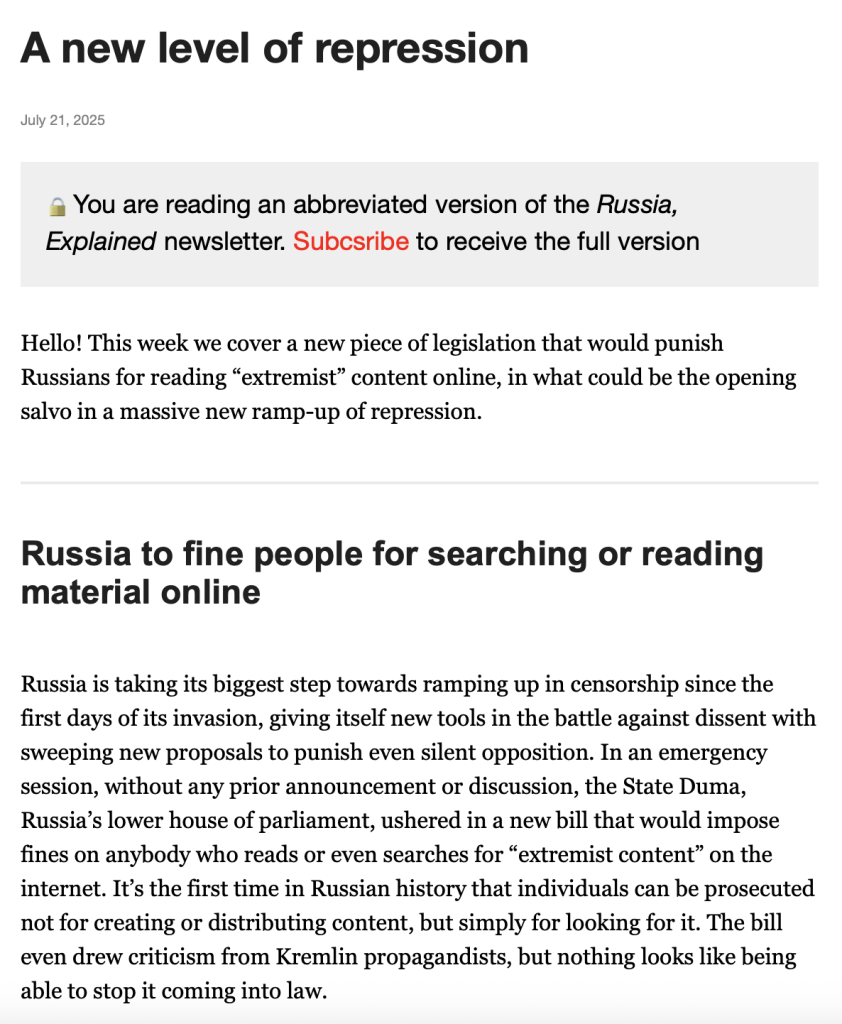
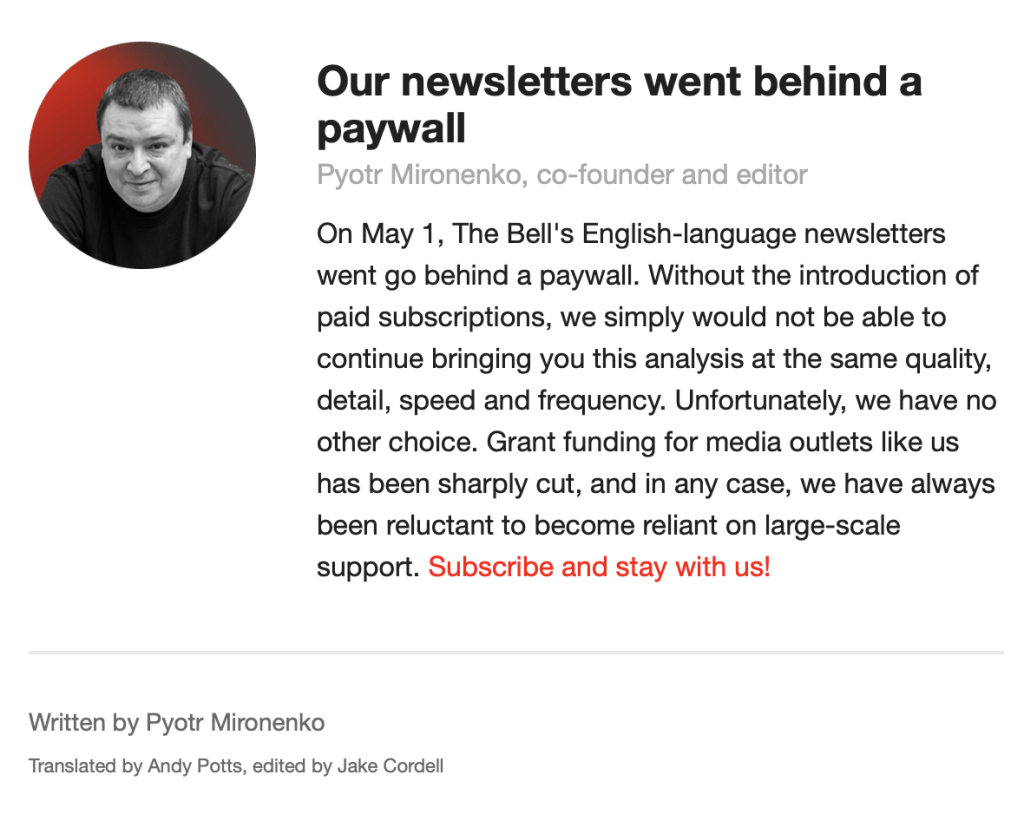
Source: Screenshots of an email from The Bell, 21 July 2025, and pro.thebell.io. I “subcsribe”* to a fair number of newspapers, magazines, and online media outlets. None of them would dare to charge me $348 or even $189 for a mere two newsletters a week. That The Bell asks so much for its meager output gives you an idea of how much it was previously receiving, directly or indirectly, from “grant funding for media outlets like us,” that is, from the U.S. government. ||| TRR

* The same typo was in last week’s “abbreviated version” of Russia, Explained.


A growing chorus of pro-Kremlin figures is speaking out against a proposed law that would impose fines for accessing or searching for online content labeled “extremist” by Russian authorities.

The bill, which was passed in its first reading in the lower-house State Duma on Thursday, envisions fines of up to 5,000 rubles ($64) for individuals who “knowingly” view or search for banned content. It does not specify how such activity would be detected, prompting concerns from experts about increased surveillance and possible abuse by law enforcement.

Yekaterina Mizulina, head of the Kremlin-aligned Safe Internet League, said the legislation could backfire on police, as well as those who support the Kremlin and help authorities in their crackdown on dissent.

“We actively monitor this kind of [“extremist”] content and share findings with law enforcement as part of our chartered mission,” Mizulina wrote on Telegram.

“What’s most striking is that under the draft law, even Interior Ministry officials monitoring such content could technically be acting illegally. And any private citizen who reports, say, [potential school shooters] to law enforcement could also face fines,” she added.

Margarita Simonyan, editor-in-chief of the state-funded RT news network, also criticized the bill.

“Dear government, tell me, plz, how are we supposed to carry out investigations and throw shade on all types of extremist groups like FBK if we are barred from even reading about them?” Simonyan wrote on Telegram, referring to Alexei Navalny’s Anti-Corruption Foundation, which Russia outlawed in 2021.

“I hope there will be changes,” she added.

Amnesty International, a London-based NGO, earlier decried the bill as “vague and overly broad,” warning that it enables arbitrary enforcement.

“Once again, the Russian authorities are disguising their relentless persecution of dissent as countering ‘extremism,’” said Marie Struthers, Amnesty’s Eastern Europe and Central Asia director.

“In today’s Russia, ‘extremist’ materials could be anything from a book promoting same-sex relationships to social media posts by opposition groups,” Struthers added.

The Kremlin on Thursday declined to comment on the controversy surrounding the bill, but acknowledged that the “issue has clearly sparked a strong public reaction.”

Authorities in Moscow currently maintain a list of around 5,500 banned “extremist” materials, including books, religious texts, songs, films and other media.

If lawmakers pass the bill and President Vladimir Putin signs it into law, it would take effect on Sept. 1.

Source: “Pro-Kremlin Figures Decry Bill Criminalizing Access to ‘Extremist’ Content,” Moscow Times, 17 July 2025. The Russian Reader was banned and blocked in Russia in July 2022 (with WordPress’s connivance), as chronicled here, here, and here.

Onward and Upward (The HIV Epidemic in Russia)

"HIV Positive." Photo courtesy of Gazeta.ru and Shutterstock
“HIV Positive.” Photo courtesy of Gazeta.ru and Shutterstock

UN Identifies Russia as Epicenter of HIV Epidemic
Takie Dela
July 15, 2016

UNAIDS, the United Nations organization that deals with HIV prevention, has published a report that claims Russia has the largest HIV epidemic in the world, writes Gazeta.ru.

According to UNAIDS, Russia’s regions accounted for approximately 80% of new HIV cases last year. The countries of Eastern Europe and Central Asia accounted for another 15%.  The study says that, in terms of the speed with which the number of patients has been increasing, Russia has bypassed such countries as Mozambique, Kenya, Uganda, and Zimbabwe, although the numbers of people who are infected are twice as many as in these countries as in the Russian Federation.

According to the Federal AIDS Center, there are currently 824,000 HIV-infected people in Russia. Moreover, the proportion of new cases is 11% or 95,500 people. UNAIDS experts claim the deteriorating situation is due to the fact that Russia lost international support [sic] in the form of HIV programs and has failed to replace it with adequate preventive methods paid for by government funds.

According to data from the Ministry of Health, only 37% of patients under constant medical observation receive the medicines they need, that is, 28% of the total number of patients. On June 12, it came to light that Russia’s regions have begun receiving less money from the federal government for the purchase of drugs for HIV-infected patients. The funding cuts have ranged from 10% to 30%. Due to the fact that funding is insufficient, medicines are prescribed only to patients suffering critical levels of immunosuppression.

Another factor contributing to the spread of HIV in Russia is intravenous drug use. More than half of HIV-infected people were infected in this way.

Translated by the Russian Reader

__________

Relevant excerpts from Prevention Gap Report (UNAIDS, 2016):

Page 174. The scale of prevention programmes for key populations was insufficient to curb the region’s surging epidemics. This was particularly true in the Russian Federation, home to the region’s largest HIV epidemic and largest population of people who inject drugs (1.5 million).

Page 178. On average, 82% of people on antiretroviral therapy have a suppressed viral load. The highest rate was in the Russian Federation (85.2% of people on antiretroviral therapy), followed by Ukraine (77.7% of people on antiretroviral therapy); the lowest rate was in Tajikistan (32%). Given that only 21% of people living with HIV were on treatment, however, the prevention effect of the suppressed viral load would have only a marginal effect on reduction in HIV incidence.

Page 178. Even the limited coverage by prevention programmes was under threat. The Global Fund has been the region’s largest donor for HIV prevention among key populations since 2004. As of July 2013, however, the Russian Federation was classified by the World Bank as a high-income country; 7 of the other 14 countries are classified as lower-middle-income countries. As a result, international support to HIV programmes in the region is decreasing, and new domestic funding for HIV prevention is not keeping pace as the priority of HIV programmes in many countries is to increase coverage of antiretroviral treatment. In the Russian Federation, 30 projects serving some 27,000 people who inject drugs were left without financial support after the Global Fund grant ended in 2014. Although remaining projects in 16 cities continued to provide essential HIV services to people who inject drugs in 2015, their scale is not sufficient to change the trajectory of the HIV epidemic in the Russian Federation.

Page 179.  In the Russian Federation a so-called “law on foreign agents” interrupted the work of community-based organizations that receive international funding to provide HIV prevention services to key population in the absence of domestic funding for these purposes.