
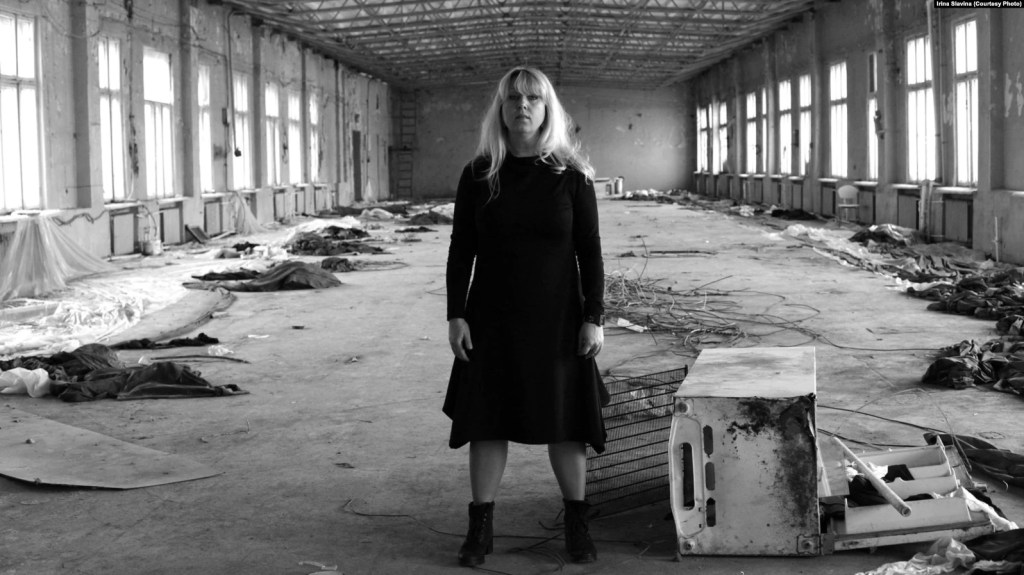
The Nizhny Novgorod authorities have refused to memorialize journalist Irina Slavina, who committed self-immolation on October 2, 2020, blaming the Russian state for her death. The journalist’s death was preceded by a search at her house as part of a criminal investigation into local businessman Mikhail Iosilevich, who was charged with “[carrying out the work of] an undesirable organization” (per Article 284.1 of the Criminal Code). In 2019, Slavina was sentenced to pay a fine of 70 thousand rubles for “involvement in the work of an undesirable organization.”
After Slavina’s death, human rights activists attempted to get the Investigative Committee to launch a criminal investigation of possible “incitement to suicide,” but the Committee turned them down on three occasions. The first time it argued that the journalist had suffered, possibly, from a “mixed personality disorder,” while the second time the Committee ruled that the suicide was the result of “emotional turmoil and a conscious wish to die.”
One of the projects undertaken by Irina Slavina, editor-in-chief of the independent Nizhny Novgorod publication Koza Press and a grassroots activist, was the rescue in 2015-2018 of a green zone near her house where the city authorities had decided to build a shopping center. The developer cut down dozens of trees, but the construction itself was stopped through the efforts of grassroots activists.
After Slavina’s self-immolation, Nizhny Novgorod residents began bringing flowers to the place of her death every Friday. Friends of the journalist planted flowers and seedlings in a small park near her house, dubbing the site “Slavina Square.”
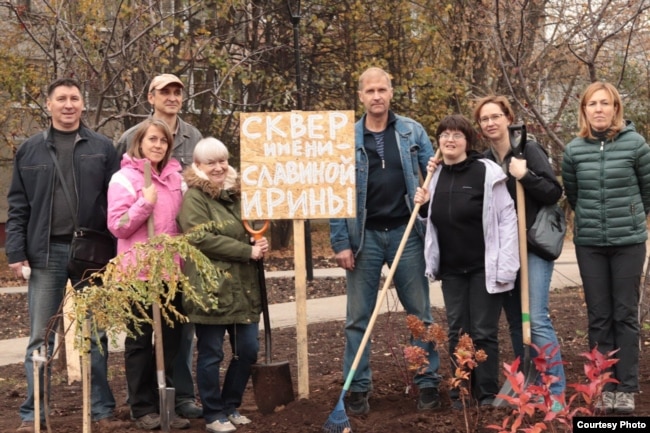
At the same time, activists gathered signatures on a petition asking that the place Slavina had fought to save from redevelopment officially bear her name. The greenery in the square was also restored by the heads of the city’s Nizhegorodsky district. But these officials did not support the idea to naming the square after the journalist. They decided instead to name it in honor of the local architect Vadim Voronkov.
One of the initiators of the idea of naming the square after Irina Slavina was the Dront Ecological Center, whose employees petitioned the mayor’s office. But the authorities turned the request down, explaining that Slavina was not “an outstanding statesman and public figure or a spokesperson for science, culture, art and other public spheres who deserved broad recognition for her work.”
Local media recall that Nizhny Novgorod regional governor Gleb Nikitin had once presented Slavina with an official certificate of gratitude for her professional journalistic work and personal service and had earlier promised that he would make every effort “to ensure that the investigation of the circumstances that led to the tragedy is supervised at the highest level.”
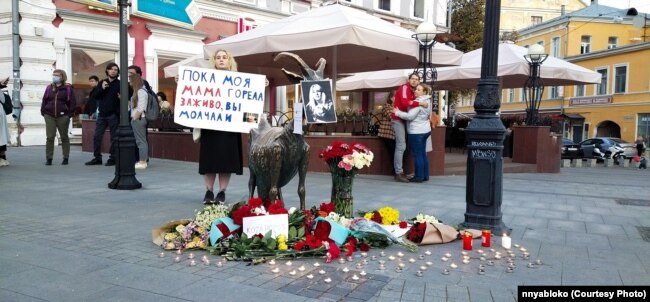
In April of this year, Dront began collecting signatures from ordinary Nizhny Novgorod residents who would like to see a Slavina Square in the city. The petition drive is still ongoing, but officials have already made their decision.
According to the newspaper Kommersant-Privolzhye, new trees were planted in the square a few days ago. The daughter of architect Vadim Voronkov, who was employed as the city’s chief architect for twenty years [in Soviet times, when it was still the closed city of Gorky], took part in the planting ceremony, which was organized by the Nizhny Novgorod State University of Architecture and Civil Engineering.
Alexei Fomenko, an activist with the project 42 — I Have the Right, called this decision by the authorities “a special operation on Slavina Boulevard.”
“For several decades, no one cared about the boulevard or the architect Voronkov. At one time, it was even decided to build the boulevard over. But then, suddenly, there is a ceremony, tree planting, and children. The mayor’s office and the deputies of the City Duma, realizing that we would not back down, and having no desire, on the one hand, to get a kick in the butt from their superiors, and on the other, getting their mugs dirty yet again, decided to resort to the good old ruse of round up some public employees, holding the necessary event hugger-mugger, and formalizing everything properly,” says Fomenko.
The plan of the authorities has not been welcomed on social media. Irina Slavina’s husband Alexei Murakhtayev was categorical in his condemnation.
“The authorities are once again doing something stupid. I do not know who the architect Voronkov was and what he has to do with this square. There must be some kind of cause and effect relationship! There is no cause, however, but the effect will be people’s discontent,” the deceased journalist’s husband argues.
The Nizhny Novgorod authorities explained their refusal to memorialize Slavina by claiming that her work “did not deserve broad recognition.” Vladimir Iordan, a friend of the journalist and a lecturer at the Nizhny Novgorod Theater School, does not agree with their appraisal.
“I have never met a more outstanding public figure capable of sacrificing their life for the sake of the ideals of justice, a more implacable campaigner against corruption and totalitarianism, a more honest and caring person. Slavina’s articles disciplined officials and deputies, and they exposed embezzlers. Governor Nikitin, when it was advantageous to him, liked to underscore that he reacted to all of Ira’s articles and requests. But Slavina was more than just a journalist — she was a real public figure in the original sense of the phrase. She was a driving force in many grassroots campaigns — against the lawlessness of tow truck operators, against the punitive beautification of parks and squares, against the redevelopment of Nizhny Novgorod’s historic center. She was a sensitive person who completely rejected injustice, lies, and hypocrisy,” says Iordan.
German Knyazev, an entrepreneur, public figure, and friend of Slavina, is sure that Slavina will not be memorialized under the current political regime.
“I think her main achievement was doing independent journalism in a totalitarian state, and my prediction is that this totalitarian state will never name a square after her,” Knyazev argues.
Meanwhile, the Iosilevich case, responsible for the humiliating search took place at Slavina’s home the day before her death, continues. Entrepreneur and activist Mikhail Iosilevich is on trial, accused of collaborating with Mikhail Khodorkovsky’s Open Russia and threatening a witness. Despite the flimsy evidence, the prosecutor has requested four and half years in a minimum security prison camp for Iosilevich. On the eve of his trial he tried to leave Russia using an Israeli passport. The attempt was unsuccessful: Iosilevich was removed from a plane bound for Tel Aviv. According to the activist, his departure would have been the “ideal option” for all parties in the trial. “But no it is then! We will go on with the oral arguments, the rebuttals, the final statement . . . and the conviction of an innocent man,” Iosilevich wrote in a telegram.
Immediately after Slavina’s self-immolation, the Nizhny Novgorod regional prosecutor’s office ruled that the search in her apartment had been lawful. The search was part of the investigation into Iosilevich, which was prompted by his alleged cooperation with Open Russia. It is still not clear what form this “cooperation” took, however.
“Today, at 6:00 a.m., 12 people entered my apartment using a blowtorch and a crowbar: Russian Investigative Committee officers, police, SWAT officers, [official] witnesses. My husband opened the door. I, being naked, got dressed under the supervision of a woman I didn’t know. A search was carried out. We were not allowed to call a lawyer. They were looking for pamphlets, leaflets, Open Russia accounts, perhaps an icon with the face of Mikhail Khodorkovsky. I don’t have any of these things,” Slavina wrote [on Facebook that day].
The next day, Slavina burned herself outside the Interior Ministry headquarters in Nizhny Novgorod. She left a suicide note on Facebook: “I ask you to blame the Russian Federation for my death.”
Source: Alexander Lugov, Radio Svoboda, 12 May 2022. Translated by the Russian Reader