In this newsletter we will share how much support of political prisoners really matters.Darya Kozyreva, a 20-year-old activist from St. Petersburg (and a former defendant of OVD-Info), was set free from prison this spring. Her story became an example of how publicity can bring attention and support from all around the world.
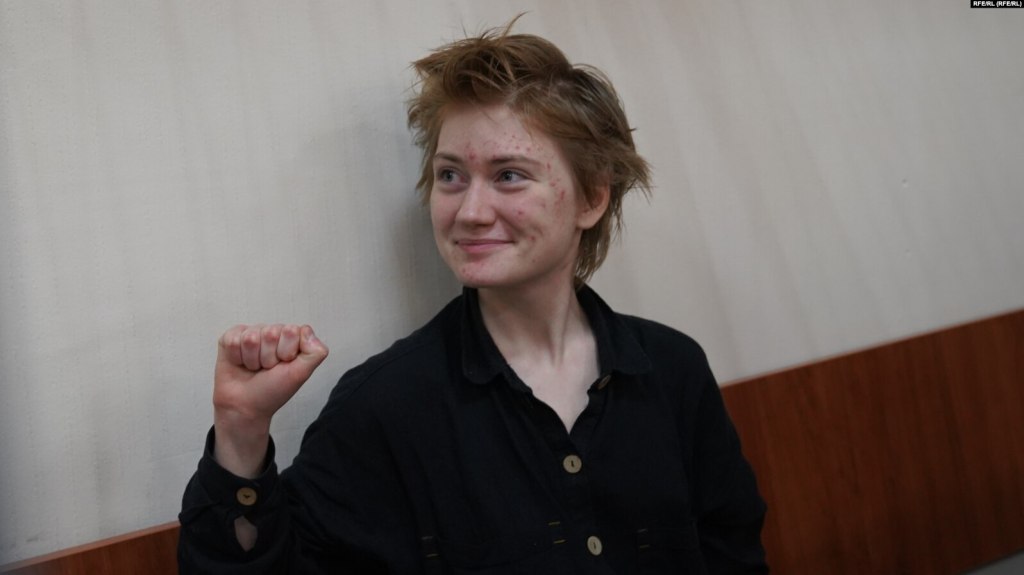
Darya Kozyreva in court 18 April 2025. Photo: Andrey Bok for OVD-Info
Darya’s troubles with Russian repressive laws began when she was just 18. She was kicked out of medical school because she spoke out against the war. Then, she was arrested for putting a poem by Ukrainian poet Taras Shevchenko on his monument in St. Petersburg. This, along with an interview where she criticized the war, led to her being sent[enced] to a penal colony for over two and a half years.
Her case got a lot of attention in Russia – and surprisingly, outside of it too. A popular group called A Mighty Girl shared Darya’s story, showing her courage and giving a link to our Vestochka service so people could write to her. The post got over 38,000 reactions, proving that one act of sharing can bring many people together to help.
Because of this media attention and the kind people who helped, Darya received more than 600 letters from abroad. For someone in prison for political reasons, a letter is more than just a message from a stranger – it’s a connection to the outside world. For people who lost their freedom for their beliefs, it shows them that people remember them, that their fight matters, and they are definitely not alone.
Darya’s release was also made possible by the financial support of people like you. OVD-Info organized three major fundraising campaigns to pay for her legal defense, including her lawyer’s work in the appeals court and visits to the detention center. Together, we raised over 500,000 rubles (over €5,000) to ensure she had the best possible protection.
Right now, our Vestochka list has 1,098 people who are still in prison. Many of them don’t get the same media attention that Darya did. These people are in prison because of their political beliefs or anti-war views. They deserve human connection and support just as much. For them, a letter can be the only source of comfort and hope.
> 2100 people in Russia are behind bars because of their political views. We believe that no one should face this kind of injustice alone.
You can bring that comfort. You don’t need to know their whole story to help. You can write to a random person, or find someone with similar interests to be a pen-pal. This can give someone in prison a bit of warmth and attention.
You don’t need to speak Russian to help! Our volunteers translate your messages. This makes sure your letters can get past prison censors and reach the people who need them most.
Write a Letter: Go tovestochka.ioand pick someone to write to. You can write to a random person or find someone with similar interests.
Support Vestochka: Running a service that translates and sends thousands of letters for free (for both the sender and the recipient) costs money. Your donation helps us keep this important service going.
Remember: everything OVD-Info does from legal help to sending letters is only possible because of you. Since we can no longer take donations in rubles, support from other countriesis more important than ever.
Thank you for being with us and for believing that no one should face the system alone.
“Try me for treason. I betrayed your deranged state”, the Russian anti-war protester Andrei Trofimov told the Second Western District Military Court in May.
In 2023, Trofimov was sentenced to ten years’ imprisonment, for opposing Russia’s war in Ukraine in social media posts, and trying to join the Free Russia Legion that fights on Ukraine’s side. At that hearing, Trofimov said he hoped for Ukraine’s victory, and called president Putin “a dickhead”.
On the basis of that statement alone, he was further accused of “justifying terrorism” and defaming the Russian army. For those “crimes”, the judge at the hearing in May this year, Vadim Krasnov, added three years to Trofimov’s sentence.
Before sentencing, Trofimov told the court that he had not justified terrorism, but supported the Ukrainian armed forces’ legitimate military actions against aggression, and had not defamed the Russian army whose actions were unconstitutional and illegal. He told the court that he considered himself guilty of a much more serious crime: treason – taking the enemy’s side in war.
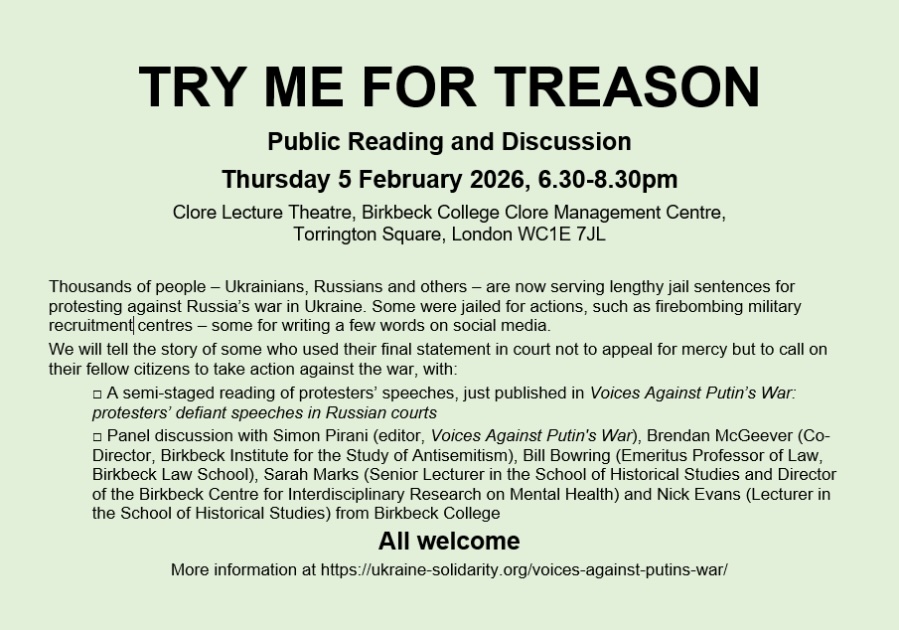
And there will be another chance to hear these powerful readings in London – on Thursday 5 February 2026, 6:30 p.m., at Birkbeck College. Here are the details.
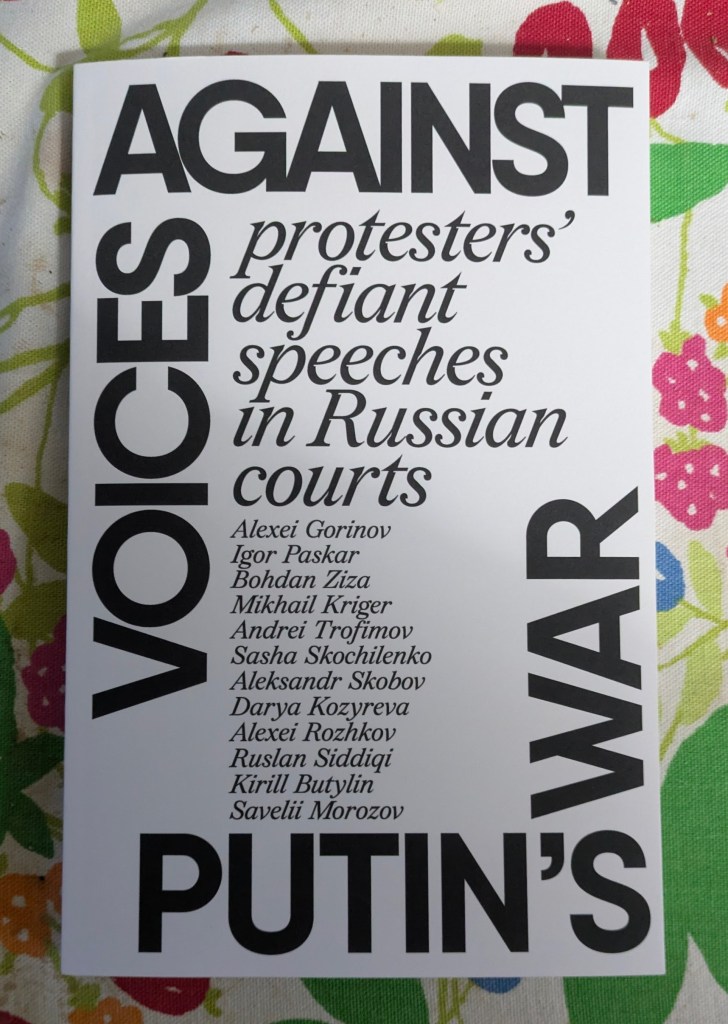
You can order copies of Voices Against Putin’s War, or download a free pdf, here.
We published the book against the background of repeated claims that a peace agreement is about to be signed between Russia and Ukraine. These are louder than ever after this week’s talks in Berlin. At the time of writing this, it is not clear to me that the Kremlin is really interested in stopping the war, or what the “security guarantees” being offered to Ukraine actually mean.
I would recommend following the excellent arguments made about the peace process by Oleksandr Kyselov (most recently here, also here and here), Hanna Perekhoda (who writes on Facebook here), and other Ukrainian socialist writers.
If you want to know why the 20% of Donbas that Ukraine still controls matters so much, this comment by the Institute for the Study of War is worth reading. This speech by Valery Zaluzhny helps us understand what the Ukrainian political elite thinks.
Whatever the outcome of the talks now in progress, if any, the defence of victims of Russia’s military occupation of Ukrainian territory, and domestic political repression, will remain a central issue for our movement, right across Europe.
On May 16, 2022, the Ukrainian artist Bohdan Ziza poured blue and yellow paint – the colours of his country’s flag – on to a municipal administration building in his home town, Yevpatoria, in Crimea.
Ziza posted a video of the action online, with a call to “adherents of graffiti culture, all the vandals of Crimea, Russia and Belarus” to protest against “the most horrific war” unleashed by “[Vladimir] Putin and the machine of state.” He was soon arrested and charged with “committing a terrorist act” and “incitement to terrorism”.
In June 2023, Ziza used his final statement to the Russian military court that sentenced him to fifteen years’ imprisonment to denounce the war again: “My action was a cry from the heart, from my conscience, to those who were and are afraid — just as I was afraid — but who also did not want this war.”
Ziza is one of ten anti-war protesters whose speeches are published this month, in English translation, in Voices Against Putin’s War: protesters’ defiant speeches in Russian courts. The collection also includes two statements made outside court, related interviews and letters, a summary of seventeen other anti-war speeches in court, and a survey of the anti-war protest movement and the repression against it.
In Russia, dissenters since the Populist rebels of the 1870s have used their final statement in court to urge resistance to power. The tradition flourished in the workers’ movements that preceded the 1917 revolution, was broken by the 1930s Stalinist show trials with their formulaic confessions, and reborn after the 1950s “thaw”, with dissidents such as the writers Andrei Sinyavsky and Yulii Daniel.
In 2022, Russia’s all-out invasion of Ukraine was followed by a brutal crackdown on civil society in occupied territory, Crimea included, as well as repression of domestic dissent. Protest was driven off the streets. Individual non-violent direct actions like Ziza’s, or writing or speaking against the war, were punished with long jail sentences, such as those now being served by most of the protagonists in Voices Against Putin’s War.
Ruslan Siddiqi, the Russian-Italian anarchist, went further: he is serving twenty-nine years’ imprisonment for derailing a train that was carrying munitions to Russian army units in Ukraine.
In court, he declared himself a prisoner of war, rather than a political prisoner: “My targets were Russian military equipment and the logistical chains used to transport military hardware and fuel. I wanted to impede military operations against Ukraine.”
Acting according to one’s conscience, in a dystopian world of militarism and big lies, was a central consideration for many of the protagonists.
Alexei Rozhkov, who firebombed a military recruitment centre in Sverdlovsk region, fled to Kyrgyzstan while on bail, before he was kidnapped by Russian special forces and returned to be put on trial.
He told the court that sentenced him to sixteen years: “Although I have never been a politician or a statesman, I could not remain indifferent when the war began. I have a conscience, and I preferred to hold on to it.”
The book’s protagonists oppose the war from a wide range of political viewpoints. On one hand, there are pacifists such as Sasha Skochilenko, the artist jailed for seven years for replacing labels in a supermarket with handwritten anti-war messages (and later freed in a prisoner swap between Russia and Western countries), who told the court: “Wars don’t end thanks to warriors — they end thanks to pacifists.”
On the other hand, there are political activists who spoke of Ukraine’s right to resist Russia militarily. Aleksandr Skobov, 67, the oldest protagonist, first jailed for activity in the socialist wing of the Soviet dissident movement in 1978, refused to stand when the judge came into court.
Skobov wished death on the “murderer, tyrant and scoundrel Putin.” He said he would never stop calling on honest Russians to join the Ukrainian armed forces, and for air strikes on Russia’s military facilities.
No less adamant in support of Ukraine was the youngest protagonist, Darya Kozyreva, 19, sentenced to two years and eight months’ imprisonment for laying flowers and a poem at the statue of Ukraine’s national poet, Taras Shevchenko, in St Petersburg.
In court, Bohdan Ziza denounced not only the 2022 invasion but also the frenzied assault on Crimean Tatar organisations that preceded it in Crimea, which Russia annexed in 2014. “Those who so passionately seek ‘Nazis’ in Ukraine have not opened their eyes to the Nazism in Russia, with its ephemeral ‘Russian world’,” with which the armed forces have “tried to extirpate Ukrainian identity”.
(Last month Ziza, on his own demand, had the Russian citizenship that was imposed on him along with all Crimean residents revoked. He is today in Vladimir Central jail, where “politicals” have been incarcerated since the 19th century.)
Voices Against Putin’s War results from the work of a small volunteer group of translators supporting Russian anti-war organisations, of which I was part, and is supported by the European Network for Solidarity With Ukraine. On top of the speeches published, we have summarised seventeen more from the wonderful “Poslednee Slovo” (“last word”) website.
The trials highlighted in the book also provide a snapshot of Russia’s wartime lurch towards a form of fascism. Against those who take non-violent direct action, charges under terrorism laws were standardised in 2022, with jail sentences of between ten and twenty years. Torture of detainees is routine.
Long sentences are designed to terrorise people into silence: Andrei Trofimov got ten years for social media posts justifying Ukrainian military actions against Russia.
For his two-minute speech in the military court, which ended “Glory to Ukraine! Putin is a dickhead” he was charged with “condoning terrorism” and “defaming the army”: a further three years were added to his sentence.
The monstrosity of Russia’s domestic repression may properly be understood in the context of the bloodbath it has visited on Ukraine, and especially on the occupied territories.
Hundreds of thousands of Russian and Ukrainian soldiers have been killed and wounded in action, and millions of Ukrainian civilians have been uprooted from their homes by bombing. Added to that, people in the occupied areas have faced enforced imposition of Russian citizenship, mass deportations including of children (the basis of a case against Putin in the International Criminal Court), legal nihilism, and an economic slump.
The primary instrument of social discipline in the occupied areas is enforced disappearances, including imprisonment. In September 2024, Ukraine’s register of persons “missing under special circumstances” counted some 48,324 names, of which 4,700 were confirmed by the Ukrainian government to be in captivity, although the true number may be far higher.
The Organisation for Security and Cooperation in Europe estimated that 16,000 people on the register were adult civilians. The Kharkiv Human Rights Protection Group identified 5,000 victims of enforced disappearances while preparing material for the International Criminal Court, and the Ukrainian ombudsman is working on 1,700 such cases. (All these numbers relate to civilians detained or missing, as distinct from Ukrainian prisoners of war, of which there are some 8,000–10,000.)
In short, Russia has taken many thousands of civilian prisoners in the occupied territories, whose fates often remain unknown. Many are political prisoners: 585 journalists, community leaders and activists from newly-occupied territories identified by human-rights organizations, 265 counted by the Crimean Human Rights Group, and others.
Furthermore, there are the thousands of civilian prisoners jailed by the so-called “People’s Republics” in Donetsk and Luhansk between 2014 and 2022, including for political offences, who have been transferred to prisons in Russia.
Alongside this orgy of violence, Russia’s machine of domestic repression has gone into overdrive.
A swathe of new censorious laws, for instance penalizing “disseminating knowingly false information about the Russian military” (which includes calling the war a war) have been added to the pre-existing laws on “foreign agents”, “undesirable organizations” and “extremism” from the last decade. Deranged police sweeps of people whose critical comments are harvested from social media have intensified.
The leading human-rights organisation Memorial: Political Prisoners Support, now based abroad, lists over 3,000 political detainees today, compared to just 50 in 2015 and 420 in 2021. After the post-Stalin “thaw”, historians reckon the number of political detainees in the Soviet Union fell to 5,000-10,000 in the 1970s (in the fifteen-republic union, with a population nearly twice that of Russia alone).
The trend reflected in these numbers justifies the term we have used in Voices Against Putin’s War: a “21st-century gulag.”
Amidst an international tide of rising right-wing authoritarianism and militarism, culminating in the genocide in Gaza, the speeches in the book are significant far beyond Russia. In his foreword, John McDonnell, a left-wing Labour MP in the UK, calls them “an inspiration to all those across the globe who see an injustice, and who refuse to passively comply”, from Israeli draft refuseniks and Palestine Action supporters in Britain to women demonstrating for life and liberty in Iran. That is where hope lies in our dark times.
□ Thursday 20 November, 7:00 p.m. TRY ME FOR TREASON. Readings from anti-war protesters’ speeches in Russian courts, and book launch for Voices Against Putin’s War. Pelican House, 144 Cambridge Heath Road, Bethnal Green London E1 5QJ. Register free on Eventbrite here.
When Putinism lies in ruins, Russians will remember the fearless moral clarity of this prison letter from Darya Kozyreva, a medical student first expelled from university and then arrested for her antiwar actions.
Darya Kozyreva
‘Russia is wrapped in a heavy, impenetrable cocoon, a cocoon of silence. How many crimes the Putin dictatorship has committed, how many foreign cities it has seized and devastated, how many killings and tortures it has meted out, and the response to all these outrages is a deafening silence.
‘Many prefer not to know what is happening, to close their eyes and stop listening. Many deceive themselves, wishing to be deceived — after all it is so easy to believe blindly what the television says, even if it is broadcasting the most monstrous lies.
‘But many know perfectly well what this vile regime is doing. They endure the burden of their dissent, their outrage, their anger. And all the same, they are silent.
‘Just as any crime is committed with somebody’s tacit consent, so any dictatorship is maintained thanks to the people’s silence. A colossus with feet of clay will be worthless if all the dissenters speak out.
‘But they are silent.
‘One person thinks that everything has been decided, and that there is no reason for them, a minor figure, to get mixed up in this. Another hopes that others will say everything — but those others also find excuses to remain silent.
‘The real reason for this silence is human fear, visceral fear. No dictatorship can make everyone believe in it — therefore it constantly resorts to fear, its first and last instrument for subjugating the people.
‘Germans in the era of Hitler obediently shouted ‘Heil,’ understanding the consequences of disobedience; Soviet people in the era of Stalin were afraid to whisper in their own kitchens for fear of being denounced. The steamroller of repression doesn’t need to crush every dissenter, just a few demonstrative examples, and the rest will gag their own mouths.
‘The absurdity of Putinist repression has reached such heights that any trifle can become a pretext for persecution – and no one knows what one can say. The criminal in the Kremlin is satisfied; that’s exactly what he needs. As long as everyone is silent, his own skin will be safe.
‘That is precisely why one cannot stay silent. No, human fear is understandable: it is very difficult to risk one’s position, one’s future, one’s freedom. To say nothing of the fact that many have families — for these people, the fear is doubled. But will it be easier for these families to live under a dictatorship, under tightening screws, behind an iron curtain?
‘A dictatorship can continue to wreak its atrocities, its lawlessness, as long as it feels strength and power. Nothing will change as long as everyone remains submissively silent.
‘So perhaps the time has come to start speaking?
‘Everyone who can speak, must speak. The individuals who dared to speak up are now too few to move anything. Everyone must speak, who does not agree with the Moscow regime. Individuals can easily be put behind bars for their words, because they are individuals. But there are not enough prisons for everyone, for all the dissenters in Russia. Even if the regime builds just as many especially for them.
‘When, having overcome fear, everyone begins to speak out, it will time for Putin’s gang to be afraid.
‘No evil lasts for ever, any dictatorship will inevitably collapse. It can collapse of its own weight, like the USSR, or thanks to the uprising of the people.
‘Don’t let this dictatorship live any longer than it can. Speak out, people!’
Source: Robert Horvath (X), 25 June 2024. Originally published in Russian by Holod on 25 June 2024 with this preface: “Daria Kozyreva is one of the youngest political prisoners in Russia. Until two years ago, she was in medical school at St. Petersburg State University and was politically active. In 2023, she was charged with an administrative offense for an anti-war post on [the Russian social media network] VKontakte and expelled from the university. On 24 February 2024 Kozyreva was detained after she pasted a leaflet containing a poem by the poet on the monument to [Ukrainian poet] Taras Shevchenko. Kozyreva faces five years for “repeatedly discrediting the Russian army.” She is in a pretrial detention center in St. Petersburg, where she is awaiting trial. There, she wrote a column about silence, fear and hope specially for Holod. We have published it as is.” Thanks to Simoni Pirani for the heads-up.Photo of Ms. Kozyreva, above, courtesy of RFE/RL.
Kneeling in the midst of the sedge, Linda Yamane sings faithfully an Ohlone song expressing gratitude to the plants after gathering material for her baskets. Once lost due to the Spanish colonization in the 18th century, the Ohlone basket-weaving skill was restored by Linda, who made her first tribal basket in 1994. Woven from willow sticks and sedge roots, the baskets played an essential role in the daily life of Ohlone people, who strongly connected to nature back to the old days. In the revival of the intricate basketry, Linda is motivated to bring about respect and appreciation of the traditional art, and the Ohlone spirit, living on in the mind of descendants, is thus aroused.
Desperate to talk to his wife, he signaled to a tall, skinny orderly who was cleaning his room that he wanted to use his phone. The Russian man quickly understood and when Mr. Shahi said, “Nepali, Nepali,” the cleaner opened a translation app on his phone.
“Get me a cellphone. I pay you later,” was Mr. Shahi’s message.
The Russian man smiled.
The same day, a new phone appeared.
[…]
They began to panic. In Russia, deserters are punished by military courts and can spend years in prison. But then they saw a taxi coming down a road and waved it down. Mr. Khatri said he frantically tapped open Google Translate on his phone and used it to tell the driver they were lost tourists and needed to get to Moscow. The driver took them all the way — 15 hours — and at the end, refused to take a single ruble.
Mr. Khatri worked with middlemen to get a flight to Kathmandu. Now back home in Rolpa, he said: “Some Russians are quite helpful. I could have died if that driver hadn’t helped us.”
Mr. Shahi had similar kind words for the Russian orderly. With the new phone, he spoke to his wife. She borrowed heavily from relatives — $8,000 this time — to pay another group of traffickers who said they could get her husband out.
On the morning of Jan. 23, Mr. Shahi gingerly stepped out of the Rostov hospital. He hobbled to a nearby market where a taxi was waiting for him. The driver communicated through a translation app, telling Mr. Shahi: Don’t talk. I’ll do the talking. If we get stopped, I’ll tell them you’re sick and headed to the hospital.
They drove all day to the one place that could help with the final stage of the escape: The Embassy of Nepal, in Moscow.
With his immersive documentary “Real,” Sentsov takes viewers inside Ukraine’s war trenches, after unknowingly turning on the GoPro camera on his helmet.
Oleg Sentsov was used to fighting Moscow even before he enlisted in the Ukrainian Defense Forces, shortly after Russia’s full-scale invasion of Ukraine in February 2022.
It’s just that previously, instead of a gun, he’d used his camera.
When Russian special forces arrived in Crimea in 2014, Sentsov was on the ground documenting the illegal annexation of the region. He was arrested, sent to Russia, and given a 20-year sentence on charges of “plotting terrorism.”
Following a coordinated effort by the European Film Academy, Amnesty International and the European Parliament with the support of directors like Ken Loach, Pedro Almodóvar and Agnieszka Holland — Sentsov was finally released on September 7, 2019, as part of a Ukrainian-Russian prisoner swap.
In November 2019, the Ukrainian film director and human rights activist was able to collect the 2018 Sakharov Prize for Freedom of Thought that was awarded to him by the European Parliament. Named after Russian dissident Andrei Sakharov, the award honors people who have “dedicated their lives to the defense of human rights and freedom of thought.”
Even while behind bars, Sentsov continued to work. Via covert letters smuggled out of prison by his lawyer, he directed “Numbers,” an adaptation of his own stage play about life in a dystopian, authoritarian state. The parallels to Sentsov’s own life were obvious.
But Sentsov is no knee-jerk nationalist. His 2021 feature “Rhino,” which premiered at the Venice Film Festival, is a look at the chaos that engulfed Ukraine following the collapse of the Soviet Union and how crime and corruption filled the resulting power vacuum.
‘Live’ from the trenches
But “Real,” Oleg Sentsov’s latest film, is unlike anything he’s made before.
It begins without explanation or warning. We are suddenly in a foxhole, hearing the frantic voice of a soldier over the radio in another trench, under attack from Russian forces and in desperate need of reinforcements.
Oleg Sentsov, “Real,” 2024: official international trailer
During the first days of the Russian full-scale invasion of Ukraine, film director Oleh Sentsov joined the Ukrainian Defense Forces. In his role as an army lieutenant, he took part in several intensive battles – and during one, his BMP was destroyed by Russian artillery. In the aftermath, he became embedded in nearby trenches and tried to organize via radio the evacuation of part of his unit. All the while, his men were under constant attack, and eventually ran out of ammunition, making their evacuation all the more urgent. This military event on the Ukrainian-Russian front line positions was given the code name Real. This is the name of the film.
The voice on our end — that of “Real” director Sentsov, call sign “Grunt” — is trying to organize the evacuation of troops under fire and the resupply of his unit. Ammunition is running out, and the Russian forces — uniformly referred to over the radio as “f**kers” — are closing in.
“This is one of those very long days. It was part of the much-anticipated Ukrainian counter-offensive of last summer,” says Sentsov, speaking via Zoom on leave from the front.
“We had spent almost 10 days trying to get through the Russian defense line. We lost equipment, we lost weapons. But we were still in the same place. It was really obvious that we were losing many people, losing armaments, vehicles, everything. But even at that moment, we’d kept our belief that we could do something.”
Sentsov’s unit was sent deep into enemy territory but their armored personnel carrier was hit and they were forced to flee on foot. The director-turned-soldier found himself in a trench, with a handful of his squadmates. Other units were pinned down by enemy fire and running out of ammunition.
“They were almost entirely surrounded by enemies, and I was the only one who had a connection with them and could report back up to the higher commanders,” says Sentsov. “I was stationed a bit uphill and could communicate with both headquarters and the people in the trench.”
Camera on by accident
“Real” plays out as a single, unedited take — an hour-and-a-half long — as Sentsov repeatedly calls between the units and headquarters, trying to cut through the fog of war and get help to the soldiers before it’s too late. We see everything through Sentsov’s eyes, or rather, through the lens of the GoPro camera attached to his helmet.
The director hadn’t meant to be recording. He turned the camera on by accident when he was checking his equipment. It was weeks later, after the battle, that he discovered the footage on the camera’s memory card.
“At first, I thought it looked very random, I didn’t think it would be interesting for anyone and I wanted to erase it,” he says. “But then I started to watch it and I recognized that, oh my God, this is part of this very tragic event, with so many people in the trenches, cut off and surrounded by Russians. Our friends, my friends. People who will watch the movie may never see those soldiers and these situations but they can learn how tragic it was. They can see one of the most tragic days of the Ukrainian counter-offensive.”
“Real” has none of the stylistic flourishes that exemplify Sentsov’s narrative films. 2022’s “Rhino,” subtitled “Ukrainian Godfather” in its US release, is a slick gangster thriller that borrows heavily from the movies of Martin Scorsese and Francis Ford Coppola to tell the story of the rise and fall of a violent delinquent — the Rhino of the title — who finds success in the chaos of 1990s Ukraine.
2020’s “Numbers,” which is set on a single stage, evokes the theatrical mimimalism of Lars von Trier’s “Dogville” or the plays of Bertolt Brecht.
In “Real,” the hand of the director is nowhere to be seen. Sentsov makes not a single edit. He adds no music or sound effects. Nothing is explained beyond what we see and hear on screen in real time.
“This is why I don’t call this a film or even a documentary but rather a pure document,” says Sentsov. “This is the video document that shows a part of the war, a very small glimpse of the war. But this war document captured on camera really shows us how cruel, how stupid, and, I can’t even find the words to describe it, how senseless war is… You get a very different perception of war if you only know it from war movies or from documentaries edited to make war look presentable. There’s always this component of heroism, everyone wants to emphasize this, to show dynamic, heroic action. But real war is very, very different.”
Sentsov calls “Real” an “immersive experience. You are thrown in and you only slowly start to understand what’s going on. It really drags you into the trenches.”
A document of war
Anyone expecting action will be disappointed. Instead we are forced to wait, along with the squad in the foxhole, with no idea what is happening around us and when the enemy will attack. “Real” captures the tension, the tedium, and the terror of war in equal measure.
“When I was young, I remember watching the movie ‘Platoon’ by Oliver Stone, and there’s a scene when one of the soldiers says: ‘Forget the word hero. There’s nothing heroic in war’,” says Sentsov. I couldn’t really understand that at the time because I grew up on very different movies that gave a very different perception of war. Now, after two-and-a-half years in an active war zone, I have to say I completely agree with that young man in the movie.”
Sentsov admits “the truth” he shows in his film may be painful for many, particularly inside Ukraine, to watch. The failure of the summer counter-offensive to break the Russian’s defensive line has shifted the conflict towards a brutal war of attrition.
“There are many things about the situation, about the reality of the war, that we are not discussing here inside Ukraine,” says Sentsov. “If someone would ask me how long it will take to reestablish control over the 1991 borders and to achieve a military defeat of Russia, I would say maybe it could happen in 10 years, but that would be a miracle.”
Instead of pretending that reality doesn’t exist, says Sentsov, it would be better, for Ukraine and the world, to “stare at the eyes of the truth, however painful. Otherwise, we are going to spend all our lives in an illusion that doesn’t relate to reality, to the real situation in front of us.”