A Little Lapta, Anyone?

The Moscow Times buys the “Cossack” myth hook, line and sinker:

“The Cossacks are an ethnic group within Russia with a strong military tradition. They often take on roles as police or security guards to maintain peace in Russia’s streets.”

In this frame from video provided by Anapa Today, Cossacks throw milk at opposition leader Alexei Navally, center right, at the Anapa airport, southern Russia, Tuesday, May 17, 2016. A group of Cossacks attacked Russian opposition leader Alexei Navalny and his associates outside an airport in southern Russia Tuesday, injuring Navalny and six others, his spokeswoman said. (Dmitry Slaboda/Anapa Today via AP)
In this still from video provided by Anapa Today, “Cossacks” throw milk at opposition leader Alexei Navalny, center right, at the Anapa Airport in southern Russia, Tuesday, May 17, 2016. A group of “Cossacks” attacked Russian opposition leader Alexei Navalny and his associates outside the airport, injuring Navalny and six others, his spokeswoman said. Courtesy of Dmitry Slaboda and Anapa Today via AP. (The quotation marks are mine – TRR.)

Maybe there are real cowboys left in the US, but wearing a cowboy hat does not make a you a cowboy, even though lots of Americans do just that: put on a cowboy hat and imagine they are “cowboys.” The same thing goes for the “Cossacks” flooding and terrorizing Russian public space the past several years.

Meaning, it has recently became fashionable for violent pro-regime thugs or recovering alcoholics or just plain old security guards to dress up as “Cossacks” and behave dreadfully or just gad about looking anachronistic and as if they are in charge, although no one put them in charge of anything, and if the police had any moxie they would haul them away to the hoosegow on sight.

I’ve seen such “Cossack” security guards with my own eyes slouching around Our Lady of Vladimir Church, in my hometown of Petersburg, the achingly lovely church where Dostoevsky was a parishioner in the later years of his life.

Another thing I have been told at least three dozen times by various folk in the Motherland over the years is that lapta—an alleged Russian bat-and-ball game not played by anyone for at least two centuries and that no one (least of all, the folks telling me about it) has ever seen played by anyone—is the “Russian equivalent of baseball.” Some even claim it inspired the invention of baseball in the US.

Young people pretending to play lapta so there would be a picture of people playing it for the relevant Wikipedia article
Modern young people pretending to play lapta so there would be a photograph of modern young people playing it to put in the Wikipedia article on lapta. Courtesy of Wikipedia

I think an actual nationwide lapta fad would be a great way of diverting the aggressive energies of all the thugs, alcoholics, and security guards currently pretending to be “Cossacks.” We should see if we can make it happen.

Of course then maybe the ex-“Cossacks” would start running around whacking Navalny & Co. with their new lapta bats. It’s a risk we’ll have to take.

Sources: Moscow Times, Wikipedia
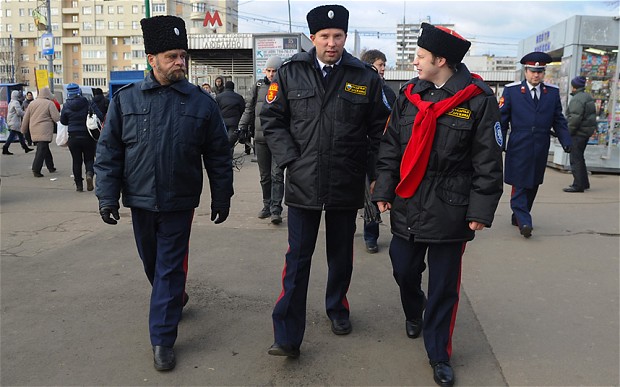
“Cossacks” and Nightclubbers in Petrograd

I guess being a “Cossack” is something like being a member of the KKK. You just take all the stupidity in your addled head and hatred in your twisted heart, and convert it into a violent little game of dress-up with other freaks like yourself.

In any case, if there are any “real” “ethnic” Cossacks out there in the world to whom none of the aforesaid applies, they should do something to stop the fake “Cossacks” who like playing dress-up and pushing other people around from sullying the good Cossack name.

Cossacks_2412858b

For the Russian-impaired, this post was inspired by this news article, published a few days ago in a reputable online national news outlet, about how “Cossacks” are going to start patrolling nightclubs in Petersburg and making sure that “Russian Orthodox” traditions are observed there.

I’m sure these dress-up dolls have no clue what these “Russian Orthodox” traditions are, especially as they apply to nightclubs. (No twerking allowed?)

It’s something on the order of all true Germans being “Aryans” back in the 1930s and how that also meant they could start pushing Jews, Roma, their leftist opponents, and, later, just about everyone else around.

That is, it’s a sick fascist fantasy, conceived by the power elite to satisfy the spiritual and moral longings of powerless people who have been humiliated most of their lives, but hardly by nightclubbers.

Photo courtesy of The Telegraph

Smychka

Naziya600

When you can’t think of anyone else to blame (and especially when you wouldn’t think of blaming your collective self), blame the Russian peasants:

Leonid Vasilyev, head of the Laboratory for History Studies at the Higher School of Economics, believes that the times are very bad not only in Russia, but throughout the world.

“Poverty and ignorance have come to the fore: they are the twin pillars of the world today. Over the past half century, the population of the Earth has increased from 1.6 billion people to 7 billion, of whom 6.2 billion are poor and ignorant. We are seeing the same thing in Russia,” he said.

Vasilyev believes that the Russian peasant commune—archaic, ignorant, inert and hostile to innovation—has now come to power in Russia. The commune has acted as a powerful canopy over the history of Russia or, rather, it  has not let our country’s history come into its own.

“After all, what was the Russian commune for most of its existence? A nomadic population. The commune would use slash-and-burn agriculture to exploit a piece of land from four to eight years, and then it would pick up stakes and go cultivate a new plot. Hence the lack of horizontal ties, of solidarity, in Russia. Serfdom was a blessing for this population; it reduced the costs of encampment. Please note that the Russian commune never raised a rebellion against serfdom. Cossacks and Old Believers protested, but not the Russian commune. The folk liked living under serfdom,”  the historian argued.

At the end of nineteenth century, the commune rejected the intelligentsia’s campaign of “going to the people,”  but the Bolsheviks were able to reach out to peasants by giving them simple slogans and restoring serfdom in the form of collective farms.

“Eighty years have passed, and commune members have moved into the Russian cities. They have not changed much: there is still the same old archaism and ignorance. That is, they are the people whom the current regime represents. If you held fair elections, they would win a stunning victory,”  lamented Vasilyev. “What hopes are there that the situation will change? Hope is almost nonexistent.” *

* Quoted in Pavel Pryanikov, “The child is crying, demanding the pacifier of xenophobia,” Russkaya Planeta, November 23, 2013; photo courtesy of Russkaya Planeta and RIA Novosti.