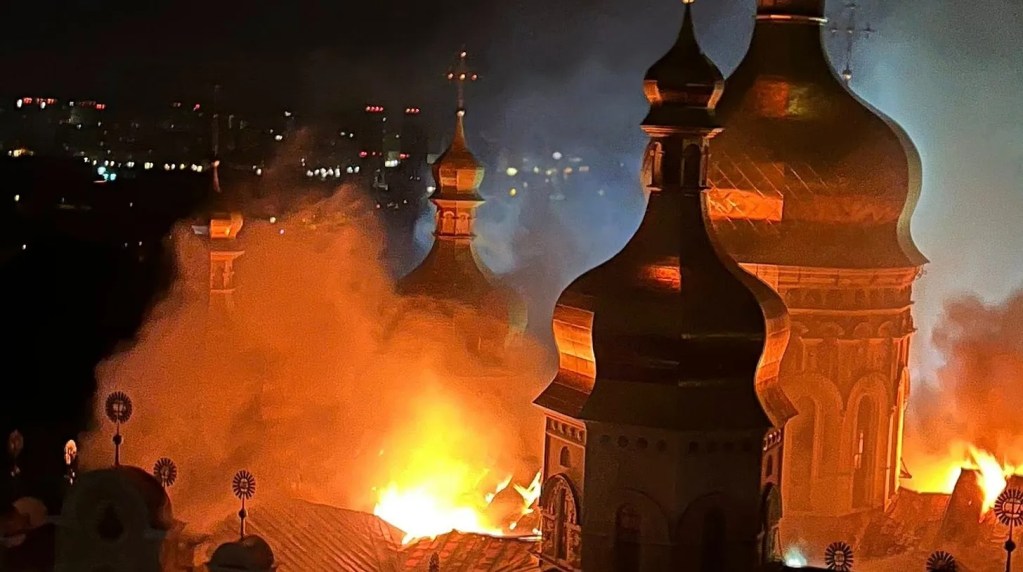
On June 15, a Russian strike set Kyiv’s thousand-year-old monastery ablaze. The act was charged to a country, Russia, and to no one in particular. This is an attempt to reconstruct how such a decision gets made, and by whom.
My feed is on fire, and for once the metaphor is indecent, because the fire is literal. On the night of June 15, the roof of the Dormition Cathedral of the Kyiv-Pechersk Lavra burned against the dark while rescuers climbed toward it. The monastery was founded in 1051, at the dawn of monasticism in Kievan Rus’. The cathedral that burned is a reconstruction; the original was blown up in November 1941, after German troops took Kyiv, and whether the Nazis or the retreating Soviets set the charge has never been settled.
The human cost first. In a barrage of seventy missiles and more than six hundred drones, at least eleven people were killed across Ukraine and more than fifty wounded, Ukrainian officials said. In Kyiv, the dead numbered five and the wounded thirty-five, among them a pregnant woman and two children. In Kharkiv, Ukraine’s emergency service said, a second missile struck a rescue site still crowded with the crews working the first, killing four of them for the crime of arriving. The evening before, a one-month-old girl had been among five people wounded when a drone hit the Kharkiv Art Museum.
And the buildings are their own kind of casualty list. The reposts come faster than anyone can read them. The Lavra. The Mystetsky Arsenal, the vaulted hall where the Book Arsenal festival had closed two weeks before. The Oleksandr Dovzhenko Film Studio, where a single strike destroyed what the culture minister called Ukraine’s oldest and largest costume archive: a hundred thousand costumes, three million items of clothing, the wardrobe of a national cinema turned to ash before morning. The House of Organ and Chamber Music in Dnipro. Karpenko-Kary, where Ukraine trains its filmmakers and its actors. A single day reached all of it.
The films made on those lots are what I study, so let me say plainly what burned. A studio’s wardrobe is the material memory of a national cinema, the actual cloth worn in the films through which a country learned to see itself: the embroidered shirts, the uniforms it had to wear on screen and then subvert, the furs and the partisan coats. A costume archive is the primary source by which a culture studies itself. You cannot reshoot the twentieth century. Some of the garments that burned were older than the younger states now debating how to respond.
Russia says none of this happened, or that something else did. The Defense Ministry called the night a strike with high-precision weapons against the defense-industrial complex, and denied hitting the Lavra at all: the cathedral, it claimed without evidence, was struck by a Ukrainian-operated Patriot interceptor. The Foreign Ministry spokeswoman Maria Zakharova called the reports “fakes”. By that account, the cathedral fire was a Ukrainian misfire, the dead rescuers were the fog of war, and the second strike on the Arsenal, launched while firefighters stood exposed at the Lavra, was a coincidence of timing.
Two things are happening at once, and they do not quite match. The grief is public and signed: thousands of people, in a dozen languages, share the same photograph and the same verdict. A Russian strike. Russian barbarism. The attribution is loud, and it is also the easiest one available. It names a culprit and, somehow, no person at all.
What is more, the argument about Russia usually collapses into sentiment. We have learned, rightly, to separate Vladimir Putin from the people we call “ordinary Russians,” many of whom, it is said, do not want this war. But this separation dissolves into the same anonymity that lets a cathedral burn with no hand on the match.
Drone studies calls the drone less a weapon than a chain, an act of violence dispersed across factories, suppliers, programmers, and launch crews until no single hand can be said to hold it, by design. The Shahed, the Iranian-designed drone behind most of that overnight barrage, pushes that logic to its industrial extreme. The burning of the Lavra happened in many places at once, and over many months. In July of last year, a Swiss plant made the microcontroller that would steer the drone. American and German firms, Texas Instruments and Infineon, made the chips that investigators keep pulling from the wreckage. Ukraine’s sanctions commissioner counts more than two million imported components in a single year. Trading offices in Hong Kong and free ports in the Emirates rerouted those parts around the sanctions meant to stop them. In Tatarstan, the Alabuga plant assembled the drone with schoolchildren recruited out of the ninth grade and women brought from Africa through a foreign outreach scheme. And before it ever left the ground, a crew set its route.
And there the trail goes cold. The closest anyone has come to naming the drone operators was for a different weapon entirely. In 2022, Bellingcat, The Insider, and Der Spiegel identified a unit of military engineers inside the General Staff’s Main Computation Centre who program the flight paths of Russia’s cruise missiles, the Kalibrs and the Kh-101s, plotting each trajectory by hand, far from any front. Most are young, many of them former software or game developers. Their commander was an avid coin collector; his phone records show him trading online about an hour before one such salvo hit Kyiv and killed dozens. When reporters reached the engineers, they denied everything, even when shown photographs of themselves in uniform. One said he was a plumber. One said she was a florist. One offered to explain how to butcher a pig. The metadata says these are the people who aim the missiles.
It is worth sitting with how little even that gave us. The Bellingcat investigation is now nearly four years old, and it named the people behind Russia’s cruise missiles, not its drones. The revelation was that a missile had not simply appeared over a city, the way weather appears. It had passed through offices, phones, maps, databases, commanders, and people who could be found, called, photographed, embarrassed, and named. But the war that followed, the Shahed war at industrial scale, has been harder to personify. As the drones multiplied into hundreds a night, the crews who prepare them, program them, and release them into the dark have remained mostly faceless.
The Russian drone operator has become one of the defining figures of the war. He is a technician of distance, converting coordinates, batteries, antennas, video feeds, maps, and orders into impact. Some work near the front, guiding FPV drones and reconnaissance quadcopters by hand. Others belong to more formal formations, including the elite Rubicon drone center, described by Radio Svoboda’s Russian-language investigation as a drone special-forces structure based in the Patriot Park complex, and by the Kyiv Independent as a central feature of Russia’s scaling drone war. But the long-range Shahed crews who send drones toward Ukrainian cities remain almost entirely unnamed. We can follow a microcontroller across three continents and still not put a name to the person who helped send it toward Kyiv. Component-tracing survives because it can be done at a distance. Naming people requires sources, time, physical danger, and the expensive human labor that has been gutted on both sides of the line: criminalized inside Russia, where reporters are exiled or imprisoned, and starved in the West, where the foreign desks that once did this work have been cut to the bone.
If everyone is responsible, it is tempting to conclude that no one is. That conclusion is what the system is built to produce. But responsibility accrues at every link, and it is uneven. It is heaviest where knowledge and choice are greatest, with the engineer who plots the path and the official who signs the order. It is lighter, though never absent, for the smuggled chip and for the schoolchild recruited into what was sold as a college and turned out to be a drone line. The Russia scholar Jade McGlynn, who has argued that this is Russia’s War and not only Putin’s, makes the necessary distinction: not collective guilt, which belongs to individuals tried for their own acts, but collective responsibility, held in different measure by everyone who takes part.
I have no verdict, only a refusal to let “Russia” be the last word. An engineer designed the chip. A broker moved it through Dubai. An official licensed the airframe. A commander signed the order. And a man with a name and a rank plotted the route into a thousand-year-old monastery. The last time it burned, in 1941, the question of whose hand lit it was left to die in the fog of another war. This time it does not have to. The ones who knew what they were doing are not the people we are asked to forgive in advance. So who burns the Lavra? People do, in different measures, with different degrees of knowledge and choice. Naming them scales the act back down from a country to a person and keeps the names where they belong: in the record, and one day, perhaps, in court.
Source: Sasha Razor (Substack), 15 June 2026. My huge thanks to Sasha for writing this and letting me share it here. \\\\\trr

 fell.
fell.