I see that Andrey [Loshak] and some other folks possessed of nice faces want Russians to begin distinguishing between breeds. We are elves, they are Orcs. We are professors, they are Sharikovs. “I do not want and cannot live in a country where medals are awarded and salaries are paid for killing civilians,” writes Andrey as is leaving the country (possibly forever). There are nice Russian faces at [anti-war] rallies in Tbilisi, just like in Moscow.
Dear Andrey Loshak! I’m younger than you and so it’s strange for me to remind you that our country has been through the First Chechen War, the Second Chechen War, a five-day war with Georgia, Donbas, and Syria. Nord-Ost happened, Beslan happened, and Chechnya is still happening. In our country, 177 thousand people with disabilities live in psycho-neurological residential treatment facilities (concentration camps). In our country, LGBT people have been “socially unequal” since 2013. Jehovah’s Witnesses are imprisoned for their religion. In our country, people are tortured and killed while being tortured in police stations, penal colonies, and prisons. We have a president for life, a cult of personality, a church that has fused with the state, political terror, and state propaganda. There is fascism in our country — and it didn’t happen a month ago.
Did you not know that Russia was fascist? The world says it didn’t know. Maybe you didn’t know either?
You are bashful about saying the word “intelligentsia,” so I’ll say it. Some people are doubly lucky at birth: they are born a little smarter than average and to families in which it is appreciated. Life gives them the opportunity and motivation to read books, study, and think. While our peers in Rubtsovsk, Altai Krai, are cutting nonferrous metals, working at gas stations, or adapting to society as it is for the sake of survival, we are learning, learning, and learning. They go to the army, we go to universities. Do you know why society affords us this opportunity? So that we look back and forth, paving the way, and if the way turns out to be wrong, we pull our country back from the edge of the abyss.
How did we fight fascism? Oh, we described its advent and progress.
(no, if fascism has dawned, it’s not enough just to do your job. and peaceful rallies against fascism, it turns out, do not work either)
But now, when the monster has grown and begun eating so much that the whole world has noticed, you can just leave, disavowing the murderers who send parcels of loot back home to their poor villages, and isolating them into another, separate breed — “not-us.”
They will be held accountable. But what about you? What about me?
Source: Elena Kostyuchenko, Facebook, 6 April 2022. Ms. Kostyuchenko and Mr. Loshak are well-known liberal Russian journalists. See the social media post by Mr. Loshak that occasioned Ms. Kostyuchenko’s philippic, below. Translated by the Russian Reader
18+. The video contains a description of murder scenes and footage of the war’s effects and is not recommended for viewing by persons with fragile mental health.
Elena Kostyuchenko traveled to Ukraine as a correspondent for Novaya Gazeta. Her reports from Kherson and Mykolaiv were published in the newspaper with censorship restrictions.
Despite complying with Russian federal law, the articles were deleted at the request of the Prosecutor General’s Office and Roskomnadzor, and Novaya Gazeta was forced to suspend operations.
Specially for the channel Novaya Gazeta Europe, Kostyuchenko talked about what she saw in the war in Ukraine.
Novaya Gazeta Europe will tell the world about what is happening in Russia in several languages. It will cover world and Russian news for people who read Russian and espouse European values.
Please subscribe to our channel!
Translated by the Russian Reader
I look at the footage and think about the stiffened bodies of the residents of Bucha, shot at point-blank range near their homes. I do not want and cannot live in a country where they award medals and pay salaries for murdering and robbing civilians. When I was leaving Moscow, perhaps forever, I was amazed at the faces of the passengers heading to Yerevan, clearly not out of a suddenly awakened interest in ancient Armenian culture. I would call those faces refined [intelligentnymi], but for several centuries a lot of rubbish has stuck to this word, so let’s just call them intelligent [osmyslennymi]. I saw the same faces at rallies in Moscow, and now I continue to encounter them in Tbilisi; there are probably no other Russians here now. But now look at the degenerates who piled into the Belarusian office of [the Russian express delivery service] CDEK. They’re really orcs. Led by their president, they have declared war on civilization and are marching in tight ranks into a new barbarism. Should these lowlifes be considered heroes now? Will the same degenerate teachers make our children proud of Bucha and Mariupol? It is not difficult to guess to what condition this gang of Sharikovs will reduce Russia in the shortest possible time. And nothing will stop them in this frenzy of self-destruction.
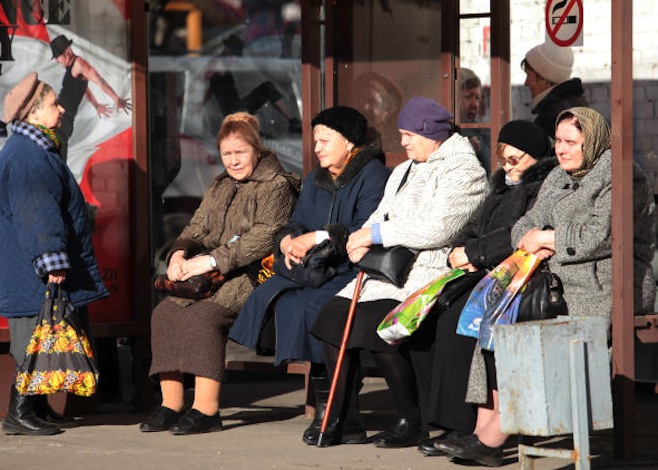
Russia’s old-age pensioners: menace to Russian liberal democracy?
Slava Rabinovich
October 2, 2015 Facebook
#ConcreteWall
Inflation: 14-17% in rubles.
Consumer basket inflation: 25-70% in rubles (depending on the specific consumer basket).
Currency devaluation: 50%. The value of foreign currency has risen 100%.
The government has decided to index pensions for inflation only by 4% in 2016.
Pensioners vote for Putin.
Putin has stoked and burnt their money in Crimea, Donbass, and Syria, and on an insane military and security services budget, and has stolen trillions right from the same budget.
Pensioners vote for Putin.
Putin has lucked out with pensioners.
________
And yet a little over ten years ago, it was the old-age pensioners (rather than portfolio investors like Mr. Rabinovich or the “rising middle class”) who mounted the first serious, massive grassroots challenge to Putin’s policies and his rule.
Maybe the old-age pensioners have gone silent now and no longer want to mount such challenges to Putin’s rule. But it is quite amazing to observe so many able-bodied and mentally competent folks in the prime of their life engaged in casting around for whole (mostly imaginary, mostly disempowered, mostly lower) classes of people to blame for Russia’s slide into totalitarianism lite. What sense does it make to say that any whole class of people “votes” for Putin and constitutes his “base,” when we know that elections in Russia are rigged six ways to Sunday?
This is not say that Russia’s old-age pensioners shouldn’t be distressed by their deteriorating economic fortunes, as reflected in the distressing and real figures cited by Mr. Rabinovich, above, but the search for the “rubes” who have buttressed Putin’s rise to minor godhood should start with the classes of Russians who have really benefited from his rule. It has most signally not been the mass of old-age pensioners who have made out like bandits, although they may be more vulnerable, in some instances, to Putin’s propaganda machine and, at the local level, to the blandishments offered by the United Russia electoral machine.
But it must be nice for Russia’s worldly and well-heeled urban hipsters, thirty- and fortysomethings, and go-getters (whose brains, again in my limited experience, are no less addled by the popular prejudices of the Putin era, and whose bodies are no less averse to putting themselves in harm’s way) to imagine that Putin’s “base” is made up of old-age pensioners, the chronically poor, blue-collar workers, and residents of the Russian hinterlands.
__________
Putin Reforms Greeted by Street Protests
Steven Lee Meyers
January 16, 2005 New York Times
KHIMKI, Russia, Jan. 15 – Mikhail I. Yermakov, a retired engineer, has never before taken to the streets to protest — not when the Soviet Union collapsed, the wars in Chechnya began, the ruble plummeted in 1998 or President Vladimir V. Putin last year ended his right to choose his governor.
On Saturday, however, he joined hundreds of others in the central square of this gritty industrial city on the edge of Moscow in the latest of a weeklong wave of protests across Russia against a new law abolishing a wide range of social benefits for the country’s 32 million pensioners, veterans and people with disabilities.
Demonstrations were held in at least three other cities in the Moscow region, in the capital of Tatarstan and, for the fourth straight day, in Samara in central Russia. In St. Petersburg, several thousand demonstrators blocked the city’s main boulevard, with some calling for Mr. Putin’s resignation.
Taken together, the protests are the largest and most passionate since Mr. Putin came to power in 2000. They appear to have tapped into latent discontent with Mr. Putin’s government and the party that dominates Parliament, United Russia.
“It is spontaneous, and this is the most dangerous thing for the authorities,” said Mr. Yermakov, 67, as speakers denounced the government from a step beneath a hulking bust of Lenin. “It is a tsunami, and United Russia does not understand that it is going to hit them.”
The law, which took effect on Jan. 1, replaced benefits like free public transportation and subsidies for housing, prescriptions, telephones and other basic services with monthly cash payments starting at a little more than $7.
In a sign of bureaucratic inefficiency, some of those eligible have yet to receive any payments.
Mr. Putin and United Russia’s leaders have defended the law as an important reform ending a vestige of the old Soviet Communist system, but they clearly failed to anticipate the depth of opposition from those who relied most on the subsidies: millions of Russians living on pensions of less than $100 a month.
The protesters have denounced the payments as insufficient to cover the cost of the benefits and as miserly for a country that recently reported a budget surplus of nearly $25 billion.
As the protests unfolded in city after city across Russia, the Patriarch of the Russian Orthodox Church, Aleksei II, who typically allies himself with what is known here as “the party of power,” questioned the law and the government’s handling of it.
“What counts is that this policy should be fair and effective,” he said in a statement on Thursday. “It should be met with understanding by the people. The latest events show that these principles are not observed in full.”
Aleksei P. Kondaurov, a Communist member of the lower house of Parliament, said the law and the protests underscored the shortcomings of the political system that had evolved under Mr. Putin, one dominated by United Russia, which has refused to debate with opposition parties, let alone compromise with them.
“It was clear that it was not carefully calculated,” Mr. Kondaurov said of the new law in an interview.
Mr. Kondaurov predicted the protests would grow and spread to other pressing social issues, which he said Mr. Putin’s government and United Russia were ignoring.
At a minimum, the protests have raised doubts about Mr. Putin’s other proposed reforms, including those in banking, housing and electricity, which were supposed to be the centerpieces of his second term.
“It’s not going to be like Ukraine,” Mr. Kondaurov said, drawing a parallel, as some have here, to the far larger demonstrations that overturned the election there for president in November. “But it is clear to me that a political and economic crisis is taking shape in Russia.”
After first brushing off the protests, United Russia’s leaders have begun scrambling to respond. They have accused the Communists and other parties of inflaming tensions and have tried to deflect blame to regional governments, which they say are responsible for implementing the benefit changes.
Some local governments, most prominently the Moscow city administration, have vowed to reinstate the benefits stripped at the federal level, but few other regions are wealthy enough to afford to do so.
On Friday, the chairman of Parliament’s social and labor committee, Andrei N. Isayev, said that next week, lawmakers would consider raising pensions by 15 percent in February, rather than 5 percent in April, as now planned.
Others in United Russia have also tried to distance themselves from Mr. Putin’s new government, which has been in place for only 10 months. The deputy speaker of Parliament, Lyubov K. Sliska, said Friday that she did not rule out the dismissal of Prime Minister Mikhail Y. Fradkov and his cabinet.
But the protests have continued to grow. They began quietly, with a rally organized by the Communist Party in Solnechnogorsk, near Moscow, on Jan. 9, the 100th anniversary of the 1905 uprising.
A day later, here in Khimki, several hundred people briefly blocked the main highway to St. Petersburg in what several of those involved called a spontaneous uprising. After a scuffle with the police, 12 elderly protesters were arrested, but initial threats to prosecute them were quickly dropped.
Since then the protests have erupted in at least a dozen other cities, drawing thousands. In Tula, 110 miles south of Moscow, aging protesters clashed with bus conductors who refused to allow them to board city transport without paying, prompting the city to post police officers on the buses.
In Novosibirsk, in Siberia, a dozen pensioners mailed their cash payments for transit — the equivalent of a little more than $3 — to Boris V. Gryzlov, the leader of United Russia and parliamentary speaker, according to the Regnum news agency.
The protesters here in Khimki’s central square on Saturday represented those who have fared the worst in Russia’s post-Soviet transition.
Mr. Yermakov’s monthly pension equals roughly $85 a month. As a resident of the Moscow region, a separate administration from that of the city government, he qualified for a supplement of $7 to replace the subsidies lost under the new law. The bus fare for three trips to the small tract of land he is allowed for planting a vegetable garden, four miles away, will take nearly half that amount.
Vladilena T. Berova, whose given name is an homage to Vladimir Lenin, served at the end of World War II as a corporal in Soviet intelligence and went on to work as a psychotherapist for five decades in Moscow. Now 78 and widowed, she survives on 2,000 rubles a month, about $71.
“The fascists took my youth,” she said, referring to the war. “And now these people are taking away my old age.”
The protests have included something still rare in today’s Russia: personal criticism of Mr. Putin, who has remained popular by projecting an image of stability, one carefully protected by officials and state television.
“Instead of listening to us, he is listening to an organ,” Mr. Yermakov said, referring bitingly to Mr. Putin’s participation in the unveiling of a newly restored organ in St. Petersburg on Friday with Germany’s president, Horst Köhler.
The benefits law has already been credited, at least in part, with a slip in Mr. Putin’s ratings, as well as a general decline in the public’s mood.
A poll by the Levada Center, released on Saturday, said that only 39 percent of Russians considered Mr. Putin the most trusted politician. That is still higher than anyone else, but a drop from 58 percent a year ago.
Sergei Y. Glazyev, a member of Parliament who challenged Mr. Putin during the election for president last year, said in an interview that “the people’s struggle for social rights” should be decided in a national referendum, rather than imposed by the Kremlin and its governing party. Voters, he said, had been fooled.
“A majority of those who voted for Putin,” he said, “had a quiet different expectation of what they would get.”
Mr. Rabinovich’s Facebook post translated by the Russian Reader. Image, above, courtesy of the Moscow Times