
[…]
On the first episode of his Twitter show, Tucker Carlson concluded that Ukraine was most likely the culprit.
“If this was intentional, it was not a military tactic. It was an act of terrorism,” he said. The dam was “built by the Russian government, and it currently sits in Russian-controlled territory. The dam’s reservoir supplies water to Crimea which has been, for the last 240 years, home of the Russian Black Sea fleet. Blowing up the dam may be bad for Ukraine, but it hurts Russia more. And for precisely that reason, the Ukrainian government has considered destroying it. In December, The Washington Post quoted a Ukrainian general saying his men had fired American-made rockets at the dam’s floodgate as a test strike.”
“So really, once the facts start coming, it becomes much less of a mystery what might have happened to the dam,” Carlson said. “Any fair person would conclude that the Ukrainians probably blew it up. Just as you would assume they blew up Nord Stream… and in fact, they did do that. As we now know.” But the American media has wasted no time “in accusing the Russians of sabotaging their own infrastructure.”
[…]
Source: Isaac Saul, “The Ukraine counteroffensive (and the dam attack),” Tangle, 7 June 2023
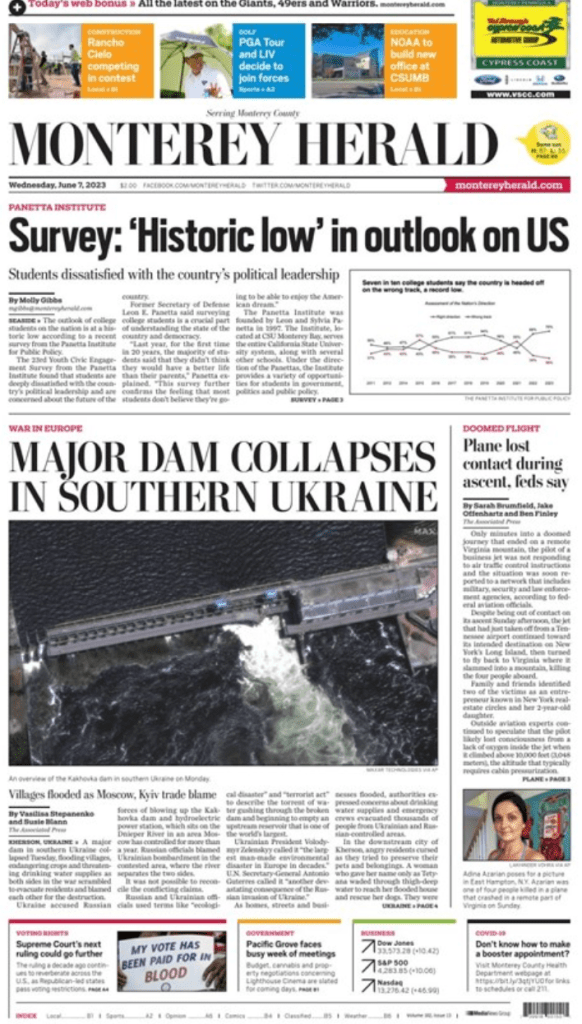
A screenshot of the front page of the 7 June 2023 Monterey Herald, as sent to this subscriber
The Nova Kakhovka Dam in Ukraine, controlled by Russia, has been destroyed. One consequence is a humanitarian disaster that, had it not taken place within a war zone, would already have drawn enormous international assistance. Thousands of houses are flooded and tens of thousands of people are in flight or waiting for rescue. Another consequence is ecological mayhem, among other things the loss of wetland and other habitats. A third is the destruction of Ukrainian farmland and other elements of the Ukrainian economy. So much is happening at once that the story is hard to follow. Here are a few thoughts about writing responsibly about the event.
1. Avoid the temptation to begin the story of this manmade humanitarian and ecological catastrophe by bothsidesing it. That’s not journalism.
2. Russian spokespersons claiming that Ukraine did something (in this case, blow a dam) is not part of a story of an actual event in the real world. It is part of different story: one about all the outrageous claims Russia has made about Ukraine since the first invasion, in 2014. If Russian claims about Ukrainian actions are to be mentioned, it has to be in that context.
3. Citing Russian claims next to Ukrainian claims is unfair to the Ukrainians. In this war, what Russian spokespersons have said has almost always been untrue, whereas what Ukrainian spokespersons have said has largely been reliable. The juxtaposition suggests an equality that makes it impossible for the reader to understand that important difference.
4. If a Russian spokesman (e.g. Dmitri Peskov) must be cited, it must be mentioned that this specific figure has lied about every aspect of this war since it began. This is context. Readers picking up the story in the middle need to know such background.
5. If Russian propaganda for external consumption is cited, it can help to also cite Russian propaganda for internal consumption. It is interesting that Russian propagandists have been long arguing that Ukrainian dams should be blown, and that a Russian parliamentarian takes for granted that Russia blew the dam and rejoices in the death and destruction that followed.
6. When a story begins with bothsidesing, readers are being implicitly instructed that an object in the physical world (like a dam) is really just an element of narrative. They are being guided into the wrong genre (literature) right at the moment when analysis is needed. This does their minds a disservice.
7. Dams are physical objects. Whether or how they can be destroyed is a subject for people who know what they are talking about. Although this valuable NYT story exhibits the above flaws, it has the great merit of treating dams as physical rather than narrative objects. When this exercise is performed, it seems clear that the dam could only have been destroyed by an explosion from the inside.
8. Russia was in control of the relevant part of the dam when it exploded. This is an elemental part of the context. It comes before what anyone says. When a murder is investigated, detectives think about means. Russia had the means. Ukraine did not.
9. The story doesn’t start at the moment the dam explodes. Readers need to know that for the last fifteen months Russia has been killing Ukrainian civilians and destroying Ukrainian civilian infrastructure, whereas Ukraine has been trying to protect its people and the structures that keep them alive.
10. The setting also includes history. Military history offers an elemental point. Armies that are attacking do not blow dams to block their own path of advance. Armies that are retreating do blow dams to slow the advance of the other side. At the relevant moment, Ukraine was advancing, and Russia was retreating.
The pursuit of objectivity does not mean treating every event as a coin flip, a fifty-fifty chance between two different public statements. Objectivity demands thinking about all the objects — physical objects, physical placement of people — that must be in the story, as well as all of the settings — contemporary and historical — that a reader would need in order to come away from the story with greater understanding.
Source: Timothy Snyder, “The Nova Kakhovka Dam in Ukraine: Ten guidelines for writing about catastrophe,” Thinking about…, 7 June 2023. Thanks to Mark Teeter for the heads-up
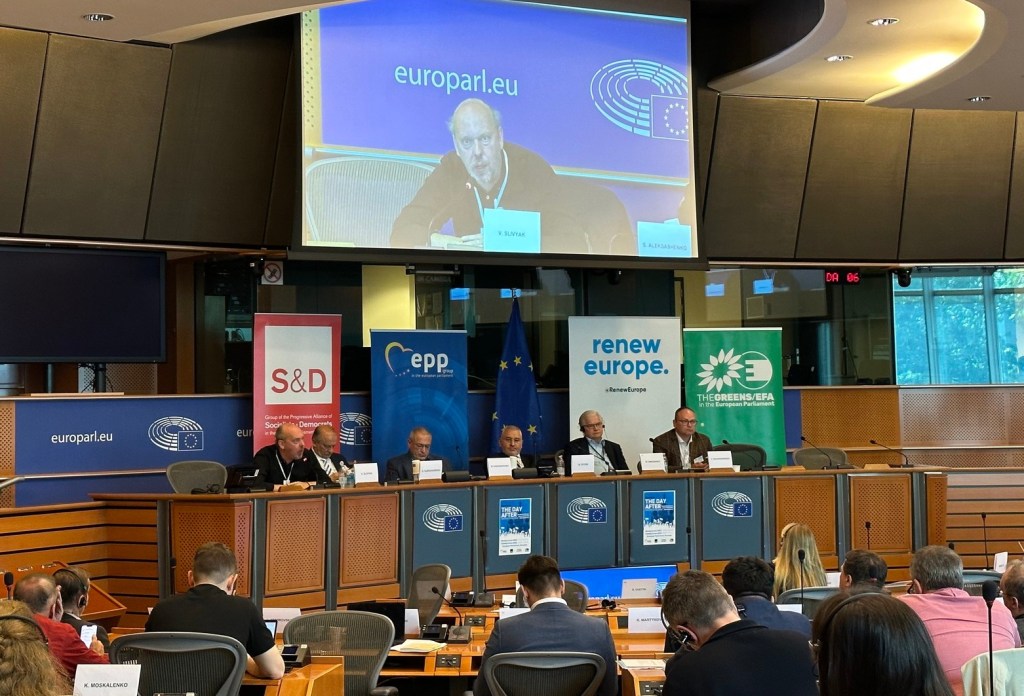
At the beginning of the week, an important conference, “The Day After,” was held at the European Parliament. I would not call it a “congress” of the Russian opposition, but rather something like a big meeting of Russian civil society. Some of the participants were those who are termed “opposition politicians” and their support groups. There were also human rights activists, women’s rights activists, LGBT+ rights activists, and many others. Environmentalists were extremely poorly represented (three out of the approximately 250 people in attendance). At the dozen or so panel discussions, in which more than fifty people took part, only one person addressed environmental issues—me.
Despite the fact that, as I observed, there were fewer politicians in attendance than non-politicians, the panel discussions were dominated by the topics that only the politicians talk about. Very rarely did anything different get talked about, but when it did the audience was usually quite supportive. I have no quarrel with the gist of what the opposition politicians said. Almost everyone spoke about supporting Ukraine, democratizing Russia, and the horror of the war, which must be stopped and all Russian troops withdrawn. There was a lot of discussion about what the political system of the new Russia should be, how to prevent a repeat of the dictatorship. This is all well and good, and I don’t think anyone in the audience disagreed with the main arguments. The big problem was something else. The vast majority of the speeches seemed to merge into a single digested mass: it was difficult to distinguish among people who, one after another, talked about the same thing in similar terms. If the audience expected just this, then that’s fine. But the audience were definitely expecting more. And they didn’t get it.
On the second day, the wonderful Karina Moskalenko organized a protest for women’s rights, threatening to leave the auditorium if the middle-aged white men in suits continued to dominate the panel discussions. Periodically, women did appear among the participants of the discussions, but not always. I fully supported the protest because the gripe was warranted: those who dominated the discussions (who had been involved in organizing the conference, of course) objectively had no desire to take into account the interests of other groups. This was the reaction of only one of the movements represented at the conference, but similar emotions (about the ignoring of all other interests) were also manifested by representatives of the other groups. Often one had the impression that there were the bearers of the truth, whose important cause everyone else should follow, while all other interests would be dealt with later (maybe). Someone said, How does this differ from Putin? No one else’s interests matter to him either.
There is no doubt that the opposition talked about important things, and I don’t think anyone at the conference questioned this. The topic of unifying the opposition was broached repeatedly. But it’s just that uniting people who don’t feel that their interests are taken into account won’t work. This is the answer to those who are always wondering why the opposition is fragmented. If you want someone to stand beside you, you have to make room for them.
On the morning of the second day, I spoke on the same panel with Mikhail Khodorkovsky, Sergei Aleksashenko, Mark Feygin, Fyodor Krashennikov, and one of the European MPs. It was all per usual until my turn came. Briefly put, I argued that climate policy and the transition to green energy were extremely important, and that it was necessary to deal with this now if you were thinking about how to set up a new democratic Russia: you couldn’t get by without it, because for any civilized country today it was one of the priorities and its importance would only grow. No one would ever take Russia seriously if it was run by politicians who did not understand climate issues. The demand for fossil fuels would decline, and this would become a big economic problem; it would not be possible to employ the previous economic model (which enabled Putin to save money for the war). Also, the opposition needed the support of voters and, most importantly, young people, because it was they who would have to vouchsafe democracy in the future and prevent a new dictatorship. It was young people who would have to face much more terrible manifestations of climate change than those we were witnessing today. So, young people needed politicians to understand the climate agenda and work on it. If you wanted young people to vote for you in the future, you wouldn’t get anywhere with them without it. Nothing would ever happen if you put it off for later. In the USSR and post-Soviet Russia, dealing with environmental issues was always postponed.
Despite the fact that the audience applauded my remarks loudly and more than once, the moderator, Feygin, could not hold himself in check no way no how. He made a brief comment to the effect that of course it’s important, but it’s not important. He went out of his way to show his disrespect for the opinion of the people in the audience who obviously supported my arguments, let alone the climate and environmental agenda. Well, okay, we’ve seen worse things in our lives. But what really struck me was how many people (not a few, but dozens) came up to me during the day to thank me for my speech and say that it was important. About half of those who approached me mentioned how the reaction from the other panelists (I think they meant Feygin) had been ugly.
My conclusion in the light of all this is simple: there is nothing wrong with people, but there is something wrong with the leadership. It is vital to learn to feel what your target audience wants. If you are a politician who, albeit sometime in the future, not now, wants to build a democratic Russia and get people’s support, you not only have to talk about what you stand for. You also need to hear people and respect their interests. It’s not a one-way street. And this is not only my opinion (among the participants of the conference). Within Russian civil society there is an enormous desire to work to change Russia and a huge potential for unification. We can’t let this moment slip.
Source: Vladimir Slivyak (Facebook), 7 June 2023. Translated by the Russian Reader. See Tomsk TV2’s recent interview with Mr. Slivyak, as part of its project Eyewitnesses.

Photo by the Russian Reader
There is a phenomenon that, by the way, unites us Ukrainians with Russians—a burning irrational hatred for Greta Thunberg. I can’t understand this phenomenon. Basically, she’s never wronged anyone. But yesterday, social media was just bursting at the seams with hatred for her, including from people who went to her Twitter account to tell her that she was a “juvenile slut.” The conservative momma’s boys at Tyzhden (The Ukrainian Week) even knocked off a column about it.
They don’t hate Tucker Carlson, who yesterday released a video claiming that Ukraine bombed the hydroelectric power station itself. They don’t hate Elon Musk, who reposted it. They don’t hate fucking Ben Shapiro or the Trumpists, who have been stumping against Ukraine from the get-go and at the same time are readily published here in Ukraine, in translation by Our Format, because “we must respect different opinions.” No, for some reason, the hatred is reserved for Greta Thunberg.
The irony here is also that the RePlanet movement, which she represents, just yesterday quite promptly condemned Russia for the situation with the hydroelectric power plant and once again called for the withdrawal of Russian troops from Ukraine’s sovereign territory. But who cares? Greta Thunberg, bitch, you’re going to answer for everything.
Source: Dmytro Rayevsky (Facebook), 7 June 2023. Translated by the Russian Reader