“Try Me for Treason”: Londoners Stand in Solidarity with Imprisoned Opponents of Russia’s War in Ukraine

“Try me for treason. I betrayed your deranged state”, the Russian anti-war protester Andrei Trofimov told the Second Western District Military Court in May.

In 2023, Trofimov was sentenced to ten years’ imprisonment, for opposing Russia’s war in Ukraine in social media posts, and trying to join the Free Russia Legion that fights on Ukraine’s side. At that hearing, Trofimov said he hoped for Ukraine’s victory, and called president Putin “a dickhead”.

On the basis of that statement alone, he was further accused of “justifying terrorism” and defaming the Russian army. For those “crimes”, the judge at the hearing in May this year, Vadim Krasnov, added three years to Trofimov’s sentence.

Before sentencing, Trofimov told the court that he had not justified terrorism, but supported the Ukrainian armed forces’ legitimate military actions against aggression, and had not defamed the Russian army whose actions were unconstitutional and illegal. He told the court that he considered himself guilty of a much more serious crime: treason – taking the enemy’s side in war.

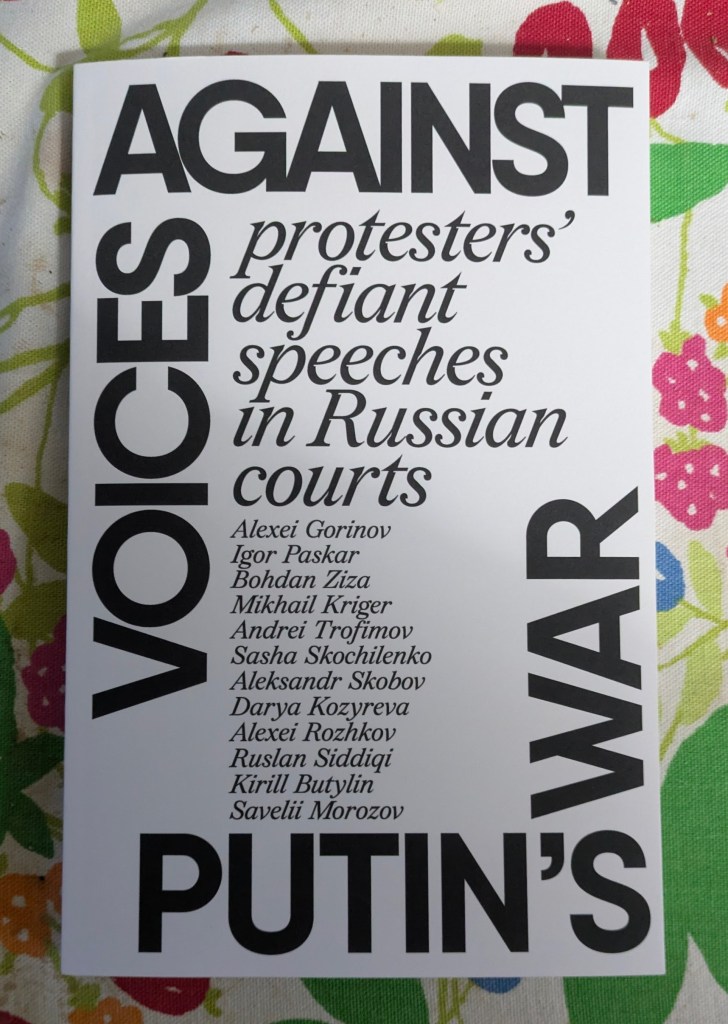
Excerpts from the speeches by Trofimov and three other anti-war protesters were read out in London last month, at a launch event for the book Voices Against Putin’s War: Protesters’ Defiant Speeches in Russian Courts. I said a few words about the book, which I edited.

Here’s a film of the event.

Ukraine Information Group, “Try Me For Treason (readings from anti-war protesters’ speeches in Russian courts),” 7 December 2025

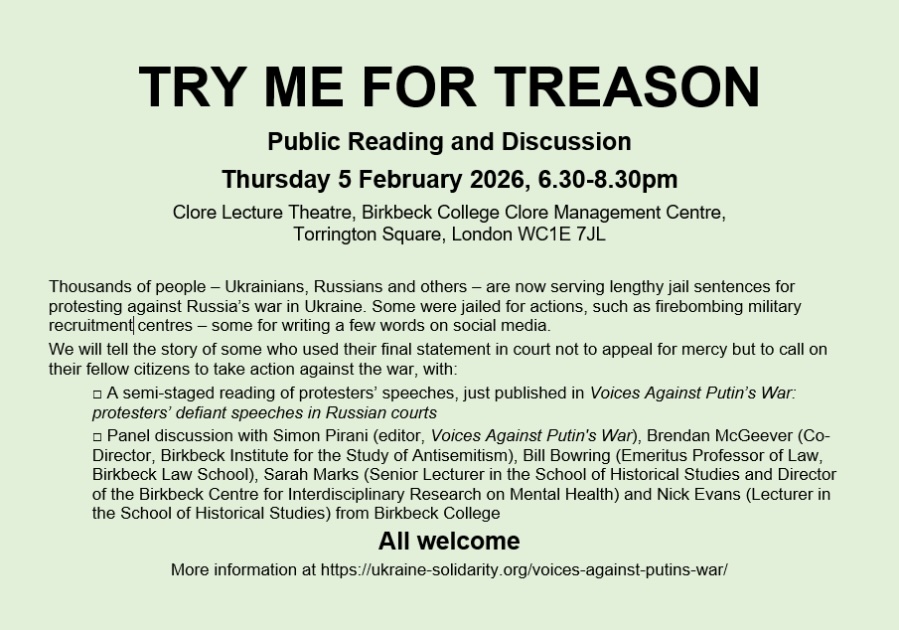
And there will be another chance to hear these powerful readings in London – on Thursday 5 February 2026, 6:30 p.m., at Birkbeck College. Here are the details.

You can order copies of Voices Against Putin’s War, or download a free pdf, here.

We published the book against the background of repeated claims that a peace agreement is about to be signed between Russia and Ukraine. These are louder than ever after this week’s talks in Berlin. At the time of writing this, it is not clear to me that the Kremlin is really interested in stopping the war, or what the “security guarantees” being offered to Ukraine actually mean.

I would recommend following the excellent arguments made about the peace process by Oleksandr Kyselov (most recently here, also here and here), Hanna Perekhoda (who writes on Facebook here), and other Ukrainian socialist writers.

If you want to know why the 20% of Donbas that Ukraine still controls matters so much, this comment by the Institute for the Study of War is worth reading. This speech by Valery Zaluzhny helps us understand what the Ukrainian political elite thinks.

Whatever the outcome of the talks now in progress, if any, the defence of victims of Russia’s military occupation of Ukrainian territory, and domestic political repression, will remain a central issue for our movement, right across Europe.

Source: Simon Pirani, “Try Me for Treason,” People and Nature, 21 December 2025

Voices Against Putin’s War

On May 16, 2022, the Ukrainian artist Bohdan Ziza poured blue and yellow paint – the colours of his country’s flag – on to a municipal administration building in his home town, Yevpatoria, in Crimea.

Ziza posted a video of the action online, with a call to “adherents of graffiti culture, all the vandals of Crimea, Russia and Belarus” to protest against “the most horrific war” unleashed by “[Vladimir] Putin and the machine of state.” He was soon arrested and charged with “committing a terrorist act” and “incitement to terrorism”.

In June 2023, Ziza used his final statement to the Russian military court that sentenced him to fifteen years’ imprisonment to denounce the war again: “My action was a cry from the heart, from my conscience, to those who were and are afraid — just as I was afraid — but who also did not want this war.”

Ziza is one of ten anti-war protesters whose speeches are published this month, in English translation, in Voices Against Putin’s War: protesters’ defiant speeches in Russian courts. The collection also includes two statements made outside court, related interviews and letters, a summary of seventeen other anti-war speeches in court, and a survey of the anti-war protest movement and the repression against it.

In Russia, dissenters since the Populist rebels of the 1870s have used their final statement in court to urge resistance to power. The tradition flourished in the workers’ movements that preceded the 1917 revolution, was broken by the 1930s Stalinist show trials with their formulaic confessions, and reborn after the 1950s “thaw”, with dissidents such as the writers Andrei Sinyavsky and Yulii Daniel.

In 2022, Russia’s all-out invasion of Ukraine was followed by a brutal crackdown on civil society in occupied territory, Crimea included, as well as repression of domestic dissent. Protest was driven off the streets. Individual non-violent direct actions like Ziza’s, or writing or speaking against the war, were punished with long jail sentences, such as those now being served by most of the protagonists in Voices Against Putin’s War

Ruslan Siddiqi, the Russian-Italian anarchist, went further: he is serving twenty-nine years’ imprisonment for derailing a train that was carrying munitions to Russian army units in Ukraine.

In court, he declared himself a prisoner of war, rather than a political prisoner: “My targets were Russian military equipment and the logistical chains used to transport military hardware and fuel. I wanted to impede military operations against Ukraine.”

Acting according to one’s conscience, in a dystopian world of militarism and big lies, was a central consideration for many of the protagonists.

Alexei Rozhkov, who firebombed a military recruitment centre in Sverdlovsk region, fled to Kyrgyzstan while on bail, before he was kidnapped by Russian special forces and returned to be put on trial.

He told the court that sentenced him to sixteen years: “Although I have never been a politician or a statesman, I could not remain indifferent when the war began. I have a conscience, and I preferred to hold on to it.”

The book’s protagonists oppose the war from a wide range of political viewpoints. On one hand, there are pacifists such as Sasha Skochilenko, the artist jailed for seven years for replacing labels in a supermarket with handwritten anti-war messages (and later freed in a prisoner swap between Russia and Western countries), who told the court: “Wars don’t end thanks to warriors — they end thanks to pacifists.”

On the other hand, there are political activists who spoke of Ukraine’s right to resist Russia militarily. Aleksandr Skobov, 67, the oldest protagonist, first jailed for activity in the socialist wing of the Soviet dissident movement in 1978, refused to stand when the judge came into court.

Skobov wished death on the “murderer, tyrant and scoundrel Putin.” He said he would never stop calling on honest Russians to join the Ukrainian armed forces, and for air strikes on Russia’s military facilities.

No less adamant in support of Ukraine was the youngest protagonist, Darya Kozyreva, 19, sentenced to two years and eight months’ imprisonment for laying flowers and a poem at the statue of Ukraine’s national poet, Taras Shevchenko, in St Petersburg.

In court, Bohdan Ziza denounced not only the 2022 invasion but also the frenzied assault on Crimean Tatar organisations that preceded it in Crimea, which Russia annexed in 2014. “Those who so passionately seek ‘Nazis’ in Ukraine have not opened their eyes to the Nazism in Russia, with its ephemeral ‘Russian world’,” with which the armed forces have “tried to extirpate Ukrainian identity”.

(Last month Ziza, on his own demand, had the Russian citizenship that was imposed on him along with all Crimean residents revoked. He is today in Vladimir Central jail, where “politicals” have been incarcerated since the 19th century.)

Voices Against Putin’s War results from the work of a small volunteer group of translators supporting Russian anti-war organisations, of which I was part, and is supported by the European Network for Solidarity With Ukraine. On top of the speeches published, we have summarised seventeen more from the wonderful “Poslednee Slovo” (“last word”) website.

The trials highlighted in the book also provide a snapshot of Russia’s wartime lurch towards a form of fascism. Against those who take non-violent direct action, charges under terrorism laws were standardised in 2022, with jail sentences of between ten and twenty years. Torture of detainees is routine.

Long sentences are designed to terrorise people into silence: Andrei Trofimov got ten years for social media posts justifying Ukrainian military actions against Russia.

For his two-minute speech in the military court, which ended “Glory to Ukraine! Putin is a dickhead” he was charged with “condoning terrorism” and “defaming the army”: a further three years were added to his sentence.

The monstrosity of Russia’s domestic repression may properly be understood in the context of the bloodbath it has visited on Ukraine, and especially on the occupied territories.

Hundreds of thousands of Russian and Ukrainian soldiers have been killed and wounded in action, and millions of Ukrainian civilians have been uprooted from their homes by bombing. Added to that, people in the occupied areas have faced enforced imposition of Russian citizenship, mass deportations including of children (the basis of a case against Putin in the International Criminal Court), legal nihilism, and an economic slump.

The primary instrument of social discipline in the occupied areas is enforced disappearances, including imprisonment. In September 2024, Ukraine’s register of persons “missing under special circumstances” counted some 48,324 names, of which 4,700 were confirmed by the Ukrainian government to be in captivity, although the true number may be far higher.

The Organisation for Security and Cooperation in Europe estimated that 16,000 people on the register were adult civilians. The Kharkiv Human Rights Protection Group identified 5,000 victims of enforced disappearances while preparing material for the International Criminal Court, and the Ukrainian ombudsman is working on 1,700 such cases. (All these numbers relate to civilians detained or missing, as distinct from Ukrainian prisoners of war, of which there are some 8,000–10,000.)

In short, Russia has taken many thousands of civilian prisoners in the occupied territories, whose fates often remain unknown. Many are political prisoners: 585 journalists, community leaders and activists from newly-occupied territories identified by human-rights organizations, 265 counted by the Crimean Human Rights Group, and others.

Furthermore, there are the thousands of civilian prisoners jailed by the so-called “People’s Republics” in Donetsk and Luhansk between 2014 and 2022, including for political offences, who have been transferred to prisons in Russia.

Alongside this orgy of violence, Russia’s machine of domestic repression has gone into overdrive.

A swathe of new censorious laws, for instance penalizing “disseminating knowingly false information about the Russian military” (which includes calling the war a war) have been added to the pre-existing laws on “foreign agents”, “undesirable organizations” and “extremism” from the last decade. Deranged police sweeps of people whose critical comments are harvested from social media have intensified.

The leading human-rights organisation Memorial: Political Prisoners Support, now based abroad, lists over 3,000 political detainees today, compared to just 50 in 2015 and 420 in 2021. After the post-Stalin “thaw”, historians reckon the number of political detainees in the Soviet Union fell to 5,000-10,000 in the 1970s (in the fifteen-republic union, with a population nearly twice that of Russia alone).

The trend reflected in these numbers justifies the term we have used in Voices Against Putin’s War: a “21st-century gulag.”

Amidst an international tide of rising right-wing authoritarianism and militarism, culminating in the genocide in Gaza, the speeches in the book are significant far beyond Russia. In his foreword, John McDonnell, a left-wing Labour MP in the UK, calls them “an inspiration to all those across the globe who see an injustice, and who refuse to passively comply”, from Israeli draft refuseniks and Palestine Action supporters in Britain to women demonstrating for life and liberty in Iran. That is where hope lies in our dark times.

□ You can buy Voices Against Putin’s War from the Resistance Books website.  

□ Thursday 20 November, 7:00 p.m. TRY ME FOR TREASON. Readings from anti-war protesters’ speeches in Russian courts, and book launch for Voices Against Putin’s War. Pelican House, 144 Cambridge Heath Road, Bethnal Green London E1 5QJ. Register free on Eventbrite here.  

□ There are English-languages pages on the websites of Memorial: Political Prisoners Support, Solidarity ZoneMediazona and The Last Word.

Source: Simon Pirani, “Raging against Putin’s war machine,” People and Nature, 20 October 2025. Originally published in Jacobin

Bohdan Ziza: “A Cry from the Heart”

Bohdan Ziza, a Ukrainian artist, poet and activist, is serving a 15-year sentence for “terrorism” after pouring blue and yellow paint – the colours of the Ukrainian flag – on to a municipal administration building in Evpatoria, Crimea, his home town. He made and circulated a video of the action – on 16 May 2022, shortly after the all-out Russian invasion of Ukraine – and for that was also charged with “incitement to terrorism”.

Bohdan Ziza. From his instagram channel

This is Bohdan’s speech from the dock, before being sentenced by a Russian military court on 5 June last year.

Do I regret what I have done?

I am sorry that I over-reached, and that my action resulted in charges under the Article [of the Russian criminal code] on terrorism. I am sorry that my grandmother is now without the care and support that she needs. Apart from me, she has nobody. And I am sorry that I can not now help others who are close to me, who need that help now.

As for the rest: I acted according to my conscience.

And also, according to my conscience, I do not deny or disavow what I did. I behaved stupidly, and could have expressed my opinion in some other way. But did I deserve, for what I did, to be deprived of my freedom for ten years or more?

I would like to appeal to the court: do not follow the regime’s script, do not participate in these awful repressions. But obviously that would have no effect. The judges and other similar political actors are just doing what they are told.

For these reasons, I will continue to protest, even in prison. And I am well aware of the sentence I may receive, and how it may affect my health and even my life.

But am I worthy of the life that I live? Is each one of us worthy of a carefree life, when we stay silent at a time when, every day, innocent people’s lives are being taken?

This was the worst night of my life. I never experienced anything like it. I thought we would die. There were three Kinzhal rockets, and loads of Kalibrs. They fell very close, they were right above our building. The building shook – several explosions, one after the other. For the first time in the war there was a white glow, the sky was white from the explosions. It was as though we were in a trench, not in our own home. At one moment I thought that it was all flying towards us. There was the very clear sound of a rocket, and then a very powerful explosion. But we have been lucky, again, and we are still alive.

That was a message from my sister, in Kyiv, who had to live through another night of bombardment of the city by the Russian armed forces.

When she went out in the morning, she learned that one of the rockets had hit the next-door building.

For many people, this war that is going on now is happening over there somewhere, far away.

One of the staff at the pre-trial detention centre said to me: “Bloody hell, I am sick of this war. Whenever you turn on the TV, it’s more of the same.” I answered that the war is not over and so you can not get away from it. And then he said: “Yeah, yeah, I know. It’s just that everything is getting more expensive. The cost of running a car now!”

And that’s the problem, here in Russia. For you, this war is an inconvenience, an irritation. You try to wait it out, living your usual life, trying to avoid bad news, and in that way simply not valuing simple things, not valuing the fact that you can wake up in a warm bed, in a warm flat, and say to someone who is dear to you, “good morning”. At a time when in the country next door, millions of people are losing their homes, losing their loved ones, when whole cities are being destroyed. Every day. That’s the everyday reality for Ukrainian citizens now.

In theory, Russian people’s failure to act could be explained, if only what is happening was not being done by Russian hands. The hands of those who bear arms, and those who don’t do anything to stop them. Every day that an ordinary Russian person carries on, reasoning that this is all politics and doesn’t concern him, and living his normal life, he adds money to the Russian Federation budget and in that way sponsors this criminal war.

Of course there are those who do not support what is happening, who take action, who are not silent participants: journalists, various activists – those who refuse to keep quiet.

My action was a cry from the heart, from my conscience, to those who were and are afraid – just as I was afraid – but who also did not want, and do not want, this war. Each of us separately are small, unnoticed people – but people whose loud actions can be heard. Yes, it is frightening. Yes, you can end up behind bars – where I, for sure, did not plan to be. Even for these words I could face a new criminal case. But it is better to be in prison with a clear conscience, than to be a wretched, dumb beast on the outside.

I am also an ordinary citizen of my country – Ukraine – who is not used to keeping quiet when confronted with lawlessness. I am not alone here today in this “goldfish bowl” [slang for the glass cage in which the accused appears in Russian courts]. There are more than 200 people with me: Ukrainian political prisoners, serving time in Russian prisons on fabricated charges. Many of them are Crimean Tatars, who are once again faced with repression by Russia. I am myself half Crimean Tatar, and angry at our people’s suffering.

Many Ukrainians are serving time in Russian prisons simply because they are Ukrainians, and were somewhere that the Russian state thought they should not be. In Russian prisons people are beaten up for speaking in Ukrainian. Or not even for speaking it, but simply for understanding it. Bastards among the guards at pre-trial detention centres or other places where people are imprisoned address prisoners in Ukrainian, to see if they get a reaction, to see if they provoke an answer or a response. If a person reacts, they beat him up.

Those who so passionately seek “Nazis” in Ukraine have not opened their eyes to the Nazism that has emerged in Russia, with its ephemeral “Russian world”, with which armed forces have come to us, to try to extirpate Ukrainian identity.

People in prison suffer in the most terrible conditions. Many of them are elderly. More than 40 people [in the pre-trial detention centre] have critical health problems, and can not access the medical treatment that they need. People die in prison. They are not criminals. Deport them from the country! Why do you keep them here?

I am no kind of terrorist. It sounds ridiculous to even say that. I am a person with morals and principles, who would rather give his own life than take the life of another person. But I am not ready to give my life to the Federal Penal Enforcement Service of the Russian Federation.

I declare a hunger strike, and demand that I be stripped of my Russian citizenship. I demand that all Ukrainian political prisoners be freed. If anything happens to me in prison, I want the world to know that it happened only because I am a Ukrainian, who took a stand against the war in his country.

And if this is my last word, let it be my last word in the Russian language. The last thing I will say publicly in Russian in this country, as long as this regime lasts. The reddish regime.

[Ziza then switched from Russian to Ukrainian, and recited this poem. Explanation of names mentioned below.]

I am not Red, I am Crimson!

I am not playing to the gallery!

These are not rhymes, they are wounds!

And I am not Melnik, I am Bandera!

The weather: it’s snowing in my summer,

From Symonenko’s motherland

I go to the end, like Teliha!

And I believe in wings, like Kostenko!

Note. The Ukrainian for “crimson” (“bahrianyi”), was also the pseudonym of Ivan Lozoviaha, a dissident writer and political exile from 1932 to his death in 1963. Andriy Melnik and Stepan Bandera were leaders of Ukrainian nationalist partisan military formations in the 1940s. Vasyl Symonenko was a Ukrainian poet, active in dissident circles until his death in 1963. Olena Teliha was a feminist poet, member of a nationalist underground cell in Nazi-occupied Kyiv, killed by the Nazis in 1942. Lina Kostenko is a Soviet-era dissident who has continued working as a poet and writer in post-Soviet Ukraine.

This is translated from the Russian text on the Graty news site, with reference to the Crimea Human Rights Group report. Thanks to M for help with translation.

What happened next. After Bohdan Ziza made this speech to the Southern District Military Court in Rostov, Russia, on 5 June 2023, he was sentenced by the judge, Roman Plisko, to 15 years in a high-security penal colony. Shortly after that, Ziza wrote to Zmina, the Ukrainian human rights organisation. He ended his hunger strike and then wrote to Uznik on-line, which coordinates correspondence with anti-war prisoners in Russia, to thank them and the many supporters who had written to him.

On 27 September 2023 Bohdan Ziza’s appeal against his sentence was rejected by Maksym Panin at the military court of appeal in Vlasikha, near Moscow.

Bohdan, who marked his 29th birthday on 23 November, was moved to Vladimir prison. On 5 December, the Kharkiv Human Rights Protection Group reported that he had been visited by his lawyer and is in good spirits. He is sharing a cell with Appaz Kurtamet, another Crimean Tatar political prisoner, and was serving time in a punishment cell after stating that he is not a criminal and refusing to wear prison clothing.

What we can do. Advice to non-Russian speakers who wish to write to Bohdan and Appaz is included in this article on the Kharkiv Human Rights Protection Group site. The group also appeals to other countries’ diplomats to help Ukrainian citizens in Russian prisons (although this does not include Bohdan, since he was compelled, as a teenager, to take Russian citizenship after Crimea was annexed by Russia in 2014).

More information. Solidarity Zone (see facebook, telegram and twitter) supports anti-war activists jailed in Russia. The Kharkiv Human Rights Protection Group, Crimea SOS and Zmina are among the Ukrainian human rights organisation that publicise the fate of more than 180 Crimean political prisoners in Russian jails. SP, 17 January 2024.  

□ Bohdan Ziza’s own art and poetry is on instagram and youtube.

Source: “Crimean political prisoner Bohdan Ziza: ‘My anti-war action was a cry from the heart’,” People and Nature, 17 January 2024. Thanks to my friend and comrade Simon Pirani for his outstanding work here and elsewhere, and for his kind encouragement to repost this important document of Ukrainian resistance to Russian fascism.