A Tale of Two Countries

‘MaiDOWN’ Banners Show Inhumanity
Andrei Malgin
The Moscow Times
Feb. 24 2015

A so-called “Anti-Maidan” march was held last weekend in the center of Moscow. It coincided with the anniversary of revolutionary events in Maidan Square in Kiev one year ago. Demonstrators wanted to show that they would not let the same thing happen in Russia. Watching the event on Russia’s state-controlled television, one large banner figured prominently in the coverage. It read, “We are not MaiDOWNS.”
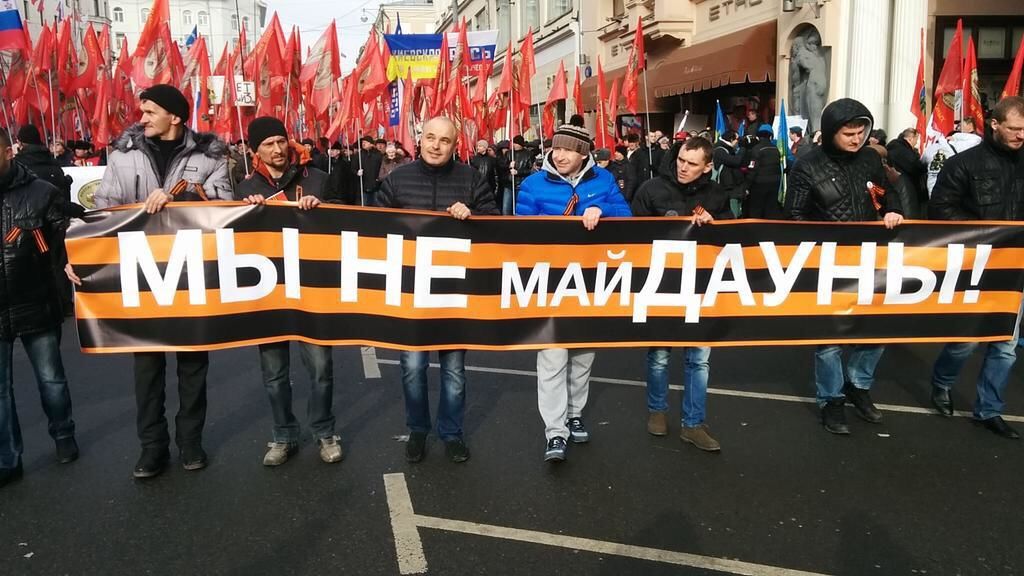
138343“WE ARE NOT MaiDOWNS!”

“MaiDOWNS” — a tactless reference to the Ukrainian revolution and a person with Down syndrome — is a bit of slang that long ago took root among pro-Kremlin Internet trolls. If any foreign readers were unaware, the term “Down” as used in Russia means “absolute idiot” or “imbecile” and carries a very negative connotation.

Language reflects the condition of society. If a protestor carries a sign showing an image of a black president and the word “monkey” below, that person is clearly intent on offending others with racist statements. And anyone who would insult others by comparing them to a person with Down syndrome must sincerely believe that Down patients are unworthy of our respect and represent the refuse of society.

Maternity ward workers regularly persuade mothers who give birth to children with Down syndrome and other defects to give their babies over to the state to be held in special institutions. The statistics are lamentable: More than half of Russian children born with Down syndrome die within their first year.

An unenviable fate awaits the rest: They have no hope for adoption and will spend the rest of their lives as virtual prisoners. I have seen that whole horrible picture with my own eyes because my wife and I regularly visited one such orphanage in Moscow.

As a result, we adopted a boy from the orphanage whose illness, fortunately, is less severe. Parents from the United States used to adopt Russian children with illnesses or disabilities, but the Kremlin authorities put a stop to that, calling it unpatriotic.

I am friends with an ordinary Italian couple who adopted a boy named Vitya in the Siberian city of Kemerovo two years ago. Just three days after they took him home, the Kemerovo authorities passed a law abolishing all foreign adoption.

Vitya was one of the lucky ones. The Russian orphanage staff had considered him mentally retarded and a hopeless idiot, and nobody even tried to teach him to speak until he was five years old. The staff gave him less to drink so that he would urinate less frequently. As a result, whenever he was thirsty, he would scoop water from the toilet bowl with his cupped hands. His adoptive parents had difficulty breaking him of that habit.

Just after the couple gained court approval for the adoption, a young female court clerk approached them and said, “Admit it, you’re only adopting him for his organs, right?”

It turns out that the young woman had read a story in a Russian newspaper claiming that foreigners adopted Russian children with medical problems in order to sell their organs to the thriving black market for organs in the West.

Thank God, Vitya has almost recovered from his mistreatment. Complete recovery is impossible, but at seven years old, he has finally begun to speak. That is largely due to the herculean efforts of his adoptive parents and the Italian medical system. It is terrible to even imagine what fate would have awaited Vitya in his homeland.

It was President Vladimir Putin’s spin doctors that coined the word “MaiDOWN,” and I winced every time I encountered it on the Internet. But now I have seen that same word emblazoned on a huge banner carried  in downtown Moscow.

In Hitler’s Germany, the authorities systematically eliminated children with Down syndrome as part of the Action T4 euthanasia program. Putin’s Russia will never resort to such measures: It will kill those children with indifference and inhumanity.

Andrei Malgin is a journalist, literary critic and blogger.

Photo courtesy of from-ua.com/news

_________

After a transgender diva and a bearded drag act, a group of middle-aged punk rockers with learning disabilities could be the next performers to challenge prejudice at the Eurovision song contest.

They are far from the kitsch and camp of Dana International or Conchita Wurst, who became heroes for Europe’s lesbian, gay, bisexual and transgender community after Eurovision victories in 1998 and 2014.

But Finland’s PKN are aiming to raise awareness of people with learning disabilities – and “have a fucking good time” along the way, the band say.

Opinion polls and bookmakers predict the band will be runaway winners on Saturday when television viewers select Finland’s entry to the Eurovision finals in Vienna in May.

“If Finland wasn’t ready before for a punk Eurovision entry, they are now,” said Sami Helle, the band’s bass player.

PKN, short for Pertti Kurikan Nimipäivät (Pertti Kurikka’s Nameday), comprises four men with an average age over 40. Their explosive Eurovision entry, Always I Have To, is about having to do things you might not enjoy , such as washing up or eating properly.

Barely 90 seconds long, it has an anthemic quality and its refrain, “aina mun pitää”, is much easier to sing along with than the double umlaut may suggest.

[…]

David Crouch, “Finnish punk band with a difference take a punt at Eurovision title,” The Guardian, February 27, 2015

Editor’s Note. On Saturday night, PKN won Finland’s New Music Contest, taking 37.4% of the popular and jury vote. The band will represent Finland at the Eurovision contest in Vienna this coming May.
Andrei Malgin: A Mere Four Words

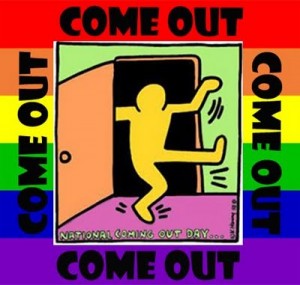
Today, October 11, is celebrated as National Coming Out Day in many countries around the world. Unfortunately, as respected Russian journalist and blogger Andrei Malgin reminded readers of his LiveJournal blog a few days ago, the Russian State Duma will, allegedly, soon be considering a bill that would make “non-traditional sexual relations” grounds for stripping Russian gays and lesbians of their parental rights.

NationalComingOutDay-300x285

__________

avmalgin.livejournal.com

A Mere Four Words

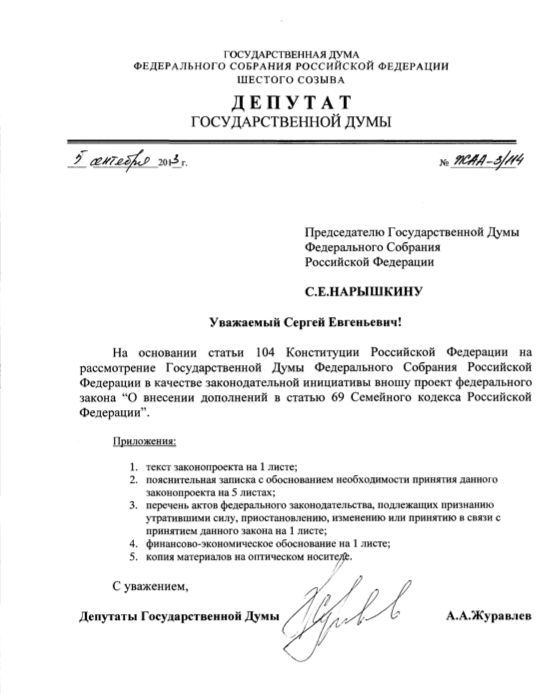
The State Duma has given the green light to Draft Bill No. 338740-6, “On Amending Article 69 of the Family Code of the Russian Federation (On Expanding the List of Grounds for Terminating Parental Rights).” A single line will be added to the list—a mere four words, but what weighty words they are.

Article 69 of the Family Code now reads as follows:

Parents (one of them) may be deprived of parental rights, if they:

 shirk the discharge of parental duties, including the willful refusal to pay child support;

refuse without good reason to take their child home from a maternity hospital (department) or other medical facility, educational establishment or social welfare institution, or other similar institutions;

abuse their parental rights;

treat their children cruelly, including exercising physical or mental violence against them, and infringing on their sexual inviolability;

suffer from chronic alcoholism or drug addiction;

have committed a premeditated crime against the life or the health of their children, or against the life or the health of their spouse.*

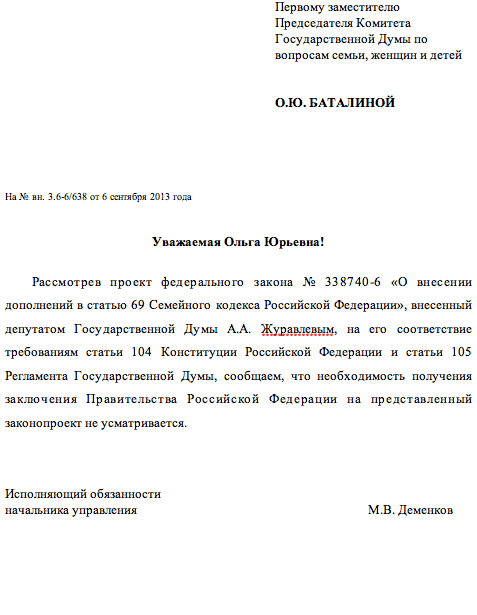
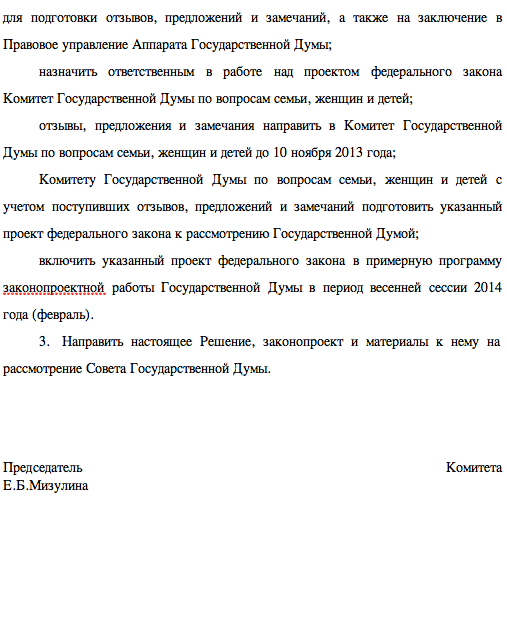
It all began with this. The draft bill itself looks like this. The draft bill was reviewed by the State Duma’s legal department, which issued a positive opinion. The relevant committee reviewed and approved it. All that remains is to schedule the date of the vote.

Full documentation of the bill is on the State Duma’s web site.

Thus, after the bill is passed into law, the Family Code of the Russian Federation will contain the following provision:

Parents (one of them) may be deprived of parental rights, if they:

have non-traditional sexual relations.

So, one divorced spouse wants to deprive the other of parental rights. She or he just has to inform the court that their ex-spouse once had non-traditional sexual relations. To make the charge stick, they can produce “witnesses” or get an affidavit from the neighborhood police inspector.

Or even better. Police raid a gay club and check people’s internal passports. Do any of them have children listed in their passports? That’s that: we’ll deprive them of their parental and send the children to an orphanage, where things will be better for them.

And so on.

And what scope for grassroots activism, for endless denunciations on the part of vigilant neighbors, disgruntled relatives, veterans committees, and so on.

Especially because, unless I’m mistaken, there is still no definition anywhere of what is considered traditional and what isn’t. If spouses have had oral sex, what is that? Traditional?

In an “Explanatory Note to the Bill,” the State Duma Committee on Families, Women and Children justifies the need to amend the Family Code thus:

In accordance with Article 63, Part 1 of the Family Code of the Russian Federation (hereinafter, “the Code”), parents are responsible for the upbringing and development of their children. They are obliged to take care of the health and the physical, mental, spiritual and moral development of their children […] Through life lessons and sometimes by their own example [they are obliged] to instill in the child traditional family values, loyalty to the Fatherland, respect for the older generation, and many other universal values.**

[…]

Unfortunately, experience shows that parents often do not completely fulfill their responsibilities for raising children, thus depriving them of a moral compass. […] In the final analysis, this is the cause of poor development, the degradation of a child’s personality and deviant behavior. Timely government assistance to such a child makes it possible to adjust their upbringing by transferring them to a foster family or putting them in the care of relatives or relevant institution. Implementing this assistance is only possible after the termination of parental rights, thus insulating the child from the immoral lifestyle of the parents or one of the parents.

On this basis, it appears that when one of a child’s parents has sexual contacts with persons of the same sex, the harm that may be caused to the psyche of this child is huge and cannot be measured by the Administrative Offenses Code, as the mother or father is a role model for their child. […] According to experts, the number of people in Russia with a non-traditional sexual orientation is around 5-7% (for large cities, the percentage is slightly higher), of which at least a third have children.

Based on this fact and the above-mentioned reasons, this bill proposes supplementing Article 69 of the Family Code of the Russian Federation with a new paragraph, according to which the grounds for terminating parental rights would be non-traditional sexual orientation on the part of one or both parents.

The adult population of Russia is 119 million people. Five percent (we’ll use the lower figure) is six million people. One third of them have a child, meaning there are two million such children. And what if they have two or more children? This is difficult to take into account, so let’s stick to the one-child minimum as the basis of our calculations. What do we end up with? It turns out that the State Duma is planning, in the spring of 2014, to add two million children to the ranks of the country’s orphans.

_____

Footnotes

* In his original post, Mr. Malgin does not quote the current wording of Article 69 in full. We have cited it here for convenience’s sake. The translation is our own.

** Actually, Article 63 of the Family Code does not stipulate that parents are obliged to inculcate “traditional family values, loyalty to the Fatherland, respect for the older generation,” etc., in their children.

_____

UPDATE. The draft bill has, reportedly, been withdrawn by its author, MP Alexei Zhuravlyov, but a spokesperson for him said that it would be revised and resubmitted to the State Duma. The news prompted journalist Masha Gessen to write this comment.