
A Shaman’s Tale
A modern-day shaman sets out across Siberia to Moscow on a protest march and is gradually joined by others. How will the Russian authorities react?
Alexander Gabyshev, a shaman from Yakutia in the Russian Far East, has a revelation: God has chosen him to be a crusader, whose role is to exorcise a demon – Vladimir Vladimirovich Putin – from the Kremlin. He’s willing to sacrifice his life to fulfil this task, which will lead to a new and bright future for Russia. Alexander’s walking pilgrimage captures the attention of many people as well as the police. He discusses his ambitious plan with passers-by in remote parts of Siberia and with lorry drivers travelling on the endless roads. His 8,000 km journey offers a mosaic of current pro- and anti-Putin opinions, and highlights the social instability in both the eastern and the western parts of Russia.
Source: One World

Five years ago, in the spring of 2019, Alexander Gabyshev, who calls himself a warrior shaman, set out on foot from Yakutsk to Moscow. When he arrived in the Russian capital, he wanted to perform a ritual to exorcise Vladimir Putin from the Kremlin. Along the way he was joined by kindred spirits, and he held numerous protest rallies.
The shaman’s trek was cut short: Gabyshev was detained on the border of Buryatia and the Irkutsk Region and charged with “calling for extremism.” In October 2021, a court ordered him to undergo compulsory treatment at a special psychiatric hospital.
The Memorial Human Rights Centre placed Gabyshev on its list of political prisoners, and Amnesty International recognized him as a prisoner of conscience. Despite an international campaign in his defense, the shaman remains in a psychiatric hospital.
The documentary film A Shaman’s Tale details Alexander Gabyshev’s plight. It was made by documentary filmmaker Beata Bashkirova (née Bubenets) and her husband, playwright Mikhail Bashkirov, who live in France. Bashkirova joined Alexander Gabyshev on his trek, while Mikhail Bashkirov wrote a play about the shaman. Performances of the play at Moscow’s Theatre.doc were disrupted by Putinists. This was not Bashkirova’s first clash with ultra-patriots: in 2017, screenings of her documentary film Flight of the Bullet, about the soldiers of the Ukrainian Aidar Battalion, fighting in Donbas, were disrupted in the same way.
This conversation with Beata Bashkirova for the Radio Svoboda programme “Cultural Diary” was recorded after the film’s premiere at the One World International Film Festival in Prague.
Beata, how did you meet the shaman Gabyshev?
I first heard about the shaman in March 2019, when he had just set off on his journey. At that time he was not yet known throughout Russia, but he was beginning to gain popularity in Yakutia and in the Amur Region. He initially gained popularity thanks to truckers: they shot videos [of him] and posted them on their own network, then on YouTube. When I went to Yakutia in the spring to look for an idea for a film, my friends sent me videos of the shaman, recommending him as my future protagonist. But I decided to film him only in June. That was when Vlad Ketkovich, an independent documentary film producer, contacted me. He had made many political films and not only offered to be my producer, but also contributed his own money to my project. We dreamed of making a road movie about the shaman, of filming for two years on the roads of Russia. It was a beautiful idea, which unfortunately didn’t come to pass, because it ended up being film about the political crackdown. In recent years, nearly all films from Russia are about that.
Did you become friends with the shaman?
Yes, we developed a very good relationship. When we were filming in Yakutsk, we were probably among the people closest to him.
He didn’t mind you filming?
He welcomed us filming: he wanted more people and different people to talk about him, to spread his ideas. He was accompanied by a lot of bloggers, and journalists were heavily filming him. Although in the beginning he didn’t let us in so easily. The distrust was not on his part, but on the part of his entourage. They were wary of us, but later everything was fine.

The shaman is certainly a charming man. But you can’t say that about some of the people in his entourage, judging by your film. Colourful personalities, I guess, always attract strange people, to put it mildly.
Yes, he had a very motley entourage, and he realised it himself. He gave everyone who joined him fabulous nicknames. He called his first two companions Raven and Angel. One was a good, happy man of the new world (the shaman divided the world into the new world and the old world), while other was a man of the old world, a dark character; he had been in prison before, he was this maverick. Raven had many conflicts with other members of the squad. The shaman told me often that yes, there are very different people walking with me, but this is Russia, you have to accept them as they are. Yes, they are different, everyone has their own peculiarities, not all of them are the nicest people in the world, but at the same time they are not the most terrible evil, which they all oppose.
In the film, Gabyshev tries to explain to a Japanese journalist how he became a shaman. Why did he decide to go to Moscow and exorcise the demon Putin?

He studied at university and served in the army: he had an ordinary life. Then he got married, but his wife was quite ill and died, and that was a huge blow to him. For some time he went to live in the woods: he lived there for several years. Naturally, he knew who Putin was, but he was not interested in politics. As he says, at some point he heard the voice of God telling him that Putin was a demon and you should go and exorcise him from the Kremlin. It was a very clear thought, a realisation that this was his mission. It didn’t come to him in 2019, when he set out, but much earlier. He started preparing years before his trek, but he prepared in secret; he didn’t tell anyone that he had this mission. He practised martial arts — not to fight, but for the spiritual benefits.
And for quite a long time he travelled unhindered, and the authorities didn’t immediately realise what was happening?
Yes, in fact, not many people took it seriously at first: everyone thought it was a joke. But then people started joining him. A few months later, when we were walking with him, there were thirty people with him, and new people were joining every day. His squad grew quite quickly. Two theories as to why he was stopped. The first is that after a few months there would have been hundreds of people walking with him, and that would have been a political threat. But the second theory is that the authorities were afraid of his mystical power. The closer he got to Moscow, the worse things went for Putin, the more protests kicked off. The protests in Belarus began around the same time. Putin was allegedly having health problems — again this is a matter of rumor. So, perhaps, the shaman has now been exiled to the farthest point from Moscow, not even to Yakutsk, but even farther away. That is, as he got closer to Moscow, the Russian authorities lost their grip on things.
Yes, they say there is a lot of superstition in the Kremlin. And in your film, the lawyer Pryanishnikov also explains that the authorities were afraid of the shaman’s mystical power.
That the authorities are superstitious is, of course, a hypothesis — Putin doesn’t perform rituals for us, and there are a lot of myths around this. It is known that one of his closest associates, Shoigu, is a Tuvan and he practices shamanism. So it is quite possible. My Yakutian acquaintances often said that an acquaintance of their acquaintance performed rituals for Putin himself. But, of course, this is all very secret and impossible to prove. I would not claim that Putin performs shamanistic rituals.
Did you have the feeling that Gabyshev actually has supernatural powers?
The first time was in 2020. When the year 2020 came, the shaman kept saying: guys, new times have come, everything will be different now, this year the worldview of all people on the planet will change. And in 2020 there was a pandemic, and mankind did indeed transit into another reality. His words proved prophetic.

People who met Rasputin spoke of his incredible magnetism. They say the same thing about many prophets and magicians. Did you feel something similar when you conversed with Gabyshev?
He is very kind and very open, and there were people in his entourage who believed in his mystical power. I am a rather skeptical person in this sense, but still I noticed a good energy emanating from him.
Did people in his entourage regard him as a prophet, as a saint?
Yes, of course, there were people in his entourage who believed primarily in his mystical power. The Moscow crowd, the opposition-minded liberal intelligentsia, basically sympathised with him, but regarded him ironically. If we’re not talking about Moscow, but about the rest of Russia, I had impression that people believed in his mystical power.
When you presented the film in Prague, you compared Gabyshev with Navalny. This is a quite unusual comparison: in Moscow, few people would agree that these people are cut from the same cloth. Why do you think it is possible to put their names in the same sentence?
At the time, it had been forty days since Navalny’s death. Navalny in his last years seemed like a loner who was fighting the system. Our protagonist is also a loner who fights the system. In this way, I think, they are similar.
Were you present at the moment when his journey to Moscow was finally thwarted?
That was 19 September, and I was not with him on that day. Eyewitnesses say it happened at night, and very quickly. For the first few days nobody knew where he was; there were various rumours. Then it transpired that he was in Yakutsk. We met almost immediately, and he was in pretty good spirits despite what had happened.
Why did they decide to permanently isolate him?
He was going to set out again in the spring. Members of his squad had come to see him. I don’t know whether that’s why they decided to shut him down permanently.
Maybe it was the New York Times article, the attention from the West?
Maybe, but that was in September. The first time he was detained, in the spring of 2020, he was taken away from his home, but then he was released. They finally decided to close him down in early 2021.

In the film, you show excerpts from a performance about the shaman at Theatre.doc. Did your husband direct this production based on his own play?
Yes, my husband wrote the play, and he and I staged it together. It was an experimental work. We decided to make a puppet show, a fairy tale, because the shaman conceived his own story as a fairy tale: he gave fairy tale names to all the folks who accompanied him, and he gave Putin a fairy tale name. That was the reason for our fairy-tale production, which did not last long, because on opening day pro-Kremlin provocateurs came and tried to disrupt it. Every time [the play was performed], they put obstacles in the way: they would come in a big group, stage a performance in front of the theatre, call the police, and start shouting from the auditorium during the performance. The owner of the premises where Theatre.doc was located became afraid that he would face consequences nd broke his lease with the theatre. It became apparent that we wouldn’t be able to perform the play.
Beata, when did you leave Russia?
We left in late March 2022.
And it was only in France that you decided to edit the film?
The film had been in post-production while we were still in Russia. The shaman predicted that he had to reach Putin in 2021, because otherwise there would be a catastrophe not only for Russia but for the whole world. Principal filming wrapped in early 2020, but we realised we had to wait. We were editing the film and discussing it with the producers. The producers suggested releasing the film in 2020, when it became clear that the shaman would not be allowed to go [to Moscow], but we understood that the story was not finished: the drama had already been defined by the shaman himself, and we would have to wait until 2022. The events that followed affected how I saw the story; I started to look at it differently, if we’re talking about the mystical aspects. The shaman had been right: he was talking about war. He was saying that there would be a physical war, not a spiritual war, if he wasn’t allowed to reach Moscow. It’s amazing that somehow he knew all the dates.
Did he have a premonition there would be a war in 2022?
He spoke about the fact that mankind, Russia had two ways to evolve. The first way was the good way, the happy way. If he were allowed to reach the Kremlin, Putin would simply resign peacefully, the regime in Russia would change, and then people would move to a new level. If they didn’t let him [reach the Kremlin], a dark path would ensue, the path of warriors, and that meant war. He didn’t say that there would be a war between Russia and Ukraine. He said that there would be a war and only by military means would it be possible to overthrow Putin.
He’s been transferred from one hospital to another several times. What is happening to him now?
He is in a psycho-neurological clinic in the Maritime Territory (Primorsky Krai). Since this system has several levels, the lawyer is trying to ensure he is transferred to Yakutsk, where he can be released through the court. A legal fight is now underway that is aimed at achieving his release step by step.
At first they held him in a high-security facility and tried to “treat” him with haloperidol?
At the very beginning, in Yakutsk, he was given harsh drugs that did have a negative effect on him. Things in the Maritime Territory are now easier: they give him medication, but it’s not so heavy.
You wrote that he knew about the film’s premiere in Prague and conveyed his greetings to the audience. Are you able to correspond with him?
Yes, we communicate through intermediaries; the lawyer Pryanishnikov has the most access to him. His friends talk to him on the telephone from time to time: he is able to call once a week.
What’s his condition? Haloperidol and other serious drugs can be very harmful to a person’s health.
Fortunately, they are not injecting him with these drugs now. He always tries to be in a cheerful mood. You can write him a letter or send him a card. He is very much encouraged by the thought that people remember him. He is, of course, happy that the film has come out because it is a continuation of the message he preached. His emotional state is also very much affected by whether his mission can be completed.
For several years he had many supporters who were will to march with him to Moscow. Did this circle disperse or has the core group remained intact?
We can say that the core has been preserved. For example, Viktor Yegorov (aka Father Frost), who makes videos (you can watch them on YouTube), is constantly in touch with him. Other Yakutian friends of his also continue to support him. There were those who walked with him, and those he met on the road, but there was also the rest of Russia, which did not walk with him, but followed him via YouTube. People still even ask me about him, and so I feel like there are a lot of people who remember him and support him.
Did you ever suspect that he might be mentally unwell?
No, never. He’s a fairly well-educated man, he has a broad outlook, and he is quite self-deprecating. I’m not a psychiatrist, but I haven’t detected any mental abnormalities in him. I much more often encounter people on the streets who are crazier looking than he is.
It is quite difficult to make films on Russian topics nowadays: Russian directors are viewed with suspicion in Europe because they are seen as representatives of an aggressor state. Was it complicated for you to make this film?
Yes, it was indeed difficult to make the film because of the tendency towards boycotting. I think that this boycott helps Russian propaganda first of all, because the voices of independent, opposition filmmakers are not heard, but the voices of the propagandists, who cannot be influenced by this boycott, are heard. Consequently, propaganda wins out in the information sphere. The boycott of Russian culture works in favour of Russian propaganda, it seems to me.
Will Russian viewers be able to see your film?
We’re in the festivals stage of screening now. The film will later be shown on Current Time, but it’s hard to say when yet. Current Time broadcasts to a Russophone audience, and so one will be able to watch the film on the internet in Russia.
Source: Dmitry Volchek, “He wanted to exorcise the demon from the Kremlin: a film about the Siberian shaman,” Radio Svoboda, 15 April 2024. Translated by the Russian Reader. All images in the article above courtesy of Radio Svoboda

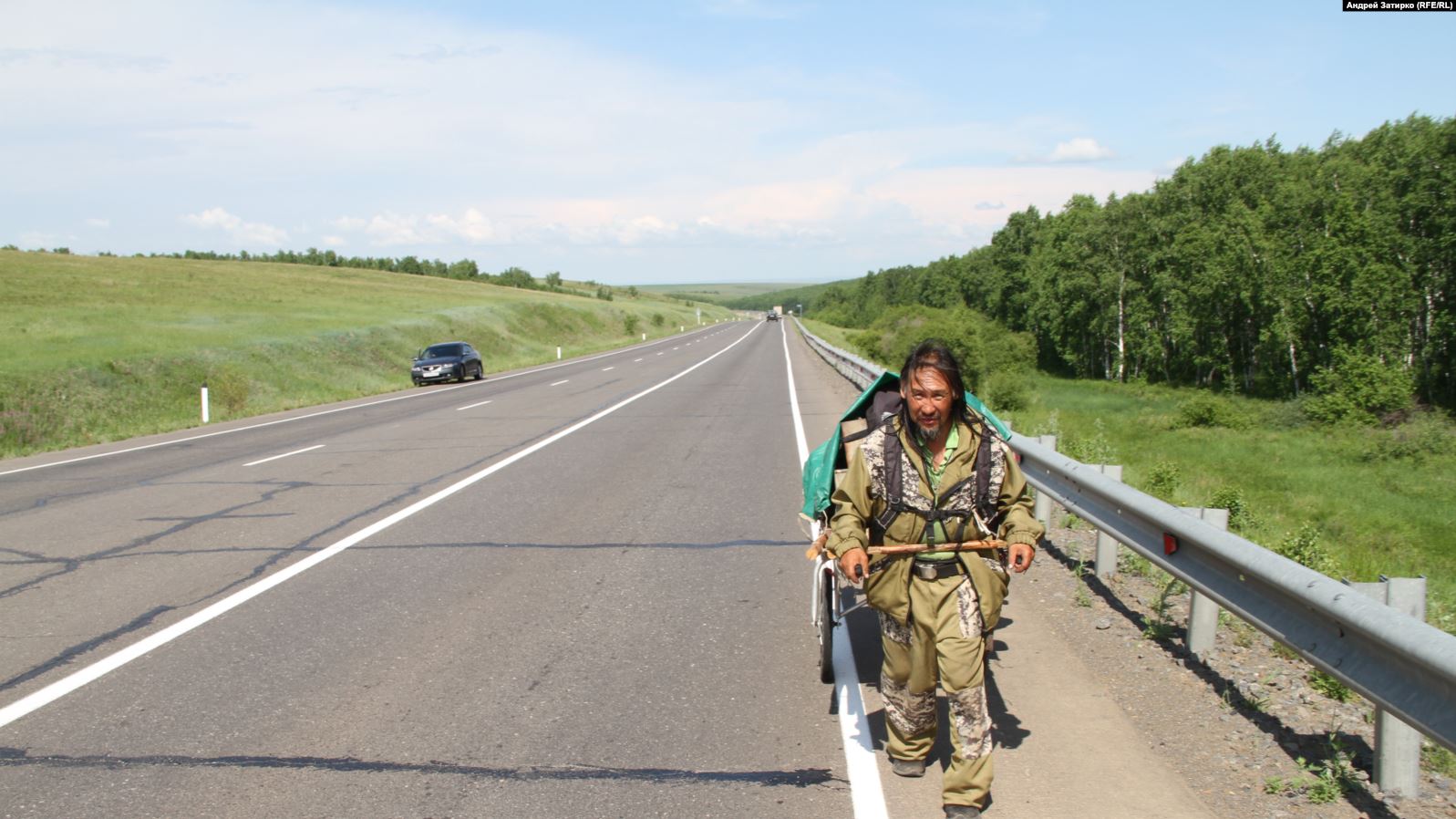 Alexander Gabyshev. Photo by Andrei Zatirko. Courtesy of RFE/RL
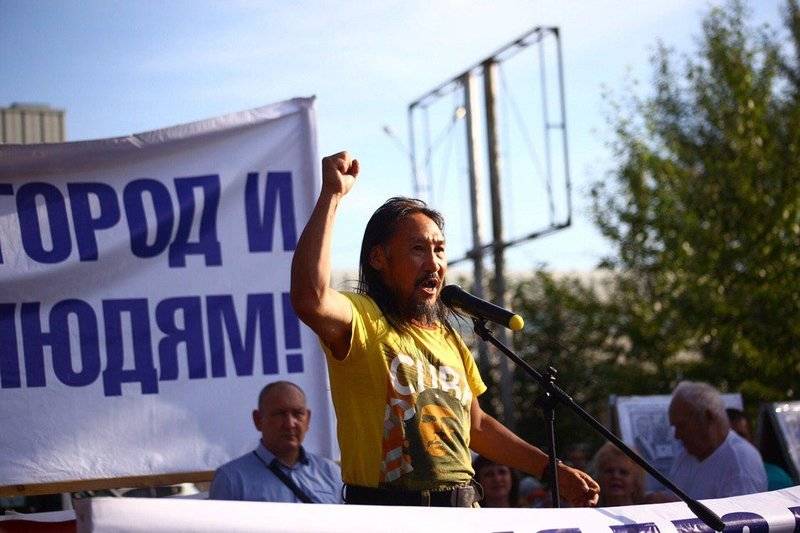 Opposition shaman Alexander Gabyshev was detained while walking to Moscow to exorcise Vladimir Putin. Photo courtesy of