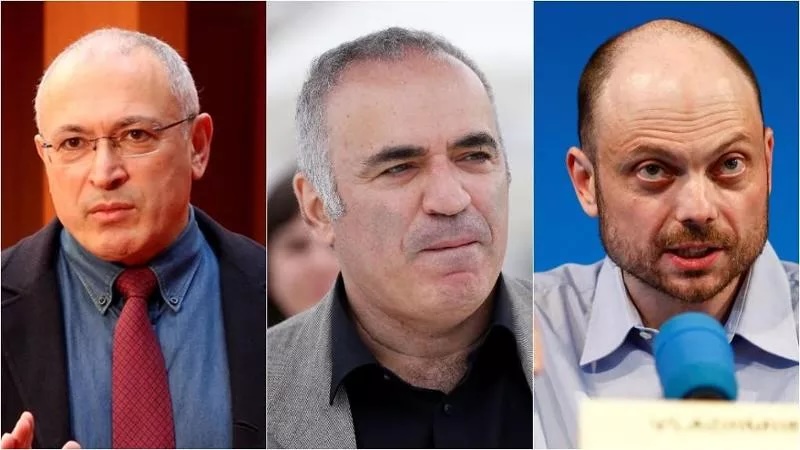
Vladimir Kara-Murza has resigned from the [Russian] Antiwar Committee after Garry Kasparov’s offensive outburst in Paris.
I was there when it happened.
What happened, exactly?
At a dinner before a morning meeting with the leadership of the Parliamentary Assembly of the Council of Europe (PACE), Kasparov adopted a mobsterish tone with Kara-Murza, demanding to know why he would not sign the Berlin Declaration. Kara-Murza tried to respond constructively, explaining that he had been in prison when the Berlin Declaration was drafted.
“Aren’t you ashamed to say that you only served two years in prison, when there is a man here who served ten years?” Kasparov said, (referring to [Mikhail] Khodorkovsky. — A.G.).
To which the retort was: “Are you speaking as someone who fled Russia in 2013? As far as we know, you have served five days in jail in your entire life.”
At that point, Garry Kimovich lost it and started yelling that all true militants against Putin’s regime had left [Russia] and were fighting for Ukraine, rather than serving time in prisons.
“Why aren’t you fighting for Ukraine yourself, instead of serving time in a restaurant in Paris?” I asked.
“Why aren’t you fighting?” the chess player blurted out.
“But you’re a man, aren’t you?”
“I’m sixty-two years old!”
***
“You scoundrel!” Kasparov shouted at Kara-Murza. “Who got you out of prison?! I got you out! You’re not signing the Berlin Declaration because you can’t say that Crimea belongs to Ukraine!”
FYI: In 2014, after Kasparov had already emigrated, Kara-Murza declared that Crimea was part of Ukraine during an [anti-war] march in Moscow.
***
But here is the most “brilliant” thing the future member of PACE’s Russian platform said:
“Kara-Murza has a British passport, he swore allegiance to the Queen! But I haven’t sworn allegiance to anyone. I have a Croatian passport… just for traveling.”
He’s a traveler all right.
Croatian, my ass.
This was how PACE’s Russian platform was assembled.
Source: Alexandra Garmazhapova (Facebook), 12 December 2025. Translated by the Russian Reader
PACE has decided to create a Platform for Dialogue between the Assembly and Russian democratic forces in exile.
Participants in the platform – whose composition has yet to be decided, based on a set of criteria – would be able to hold two-way exchanges with the Assembly on issues of common concern. They would also be able to attend meetings of selected committees during part-sessions.
Unanimously approving a resolution based on a report by Eerik-Niiles Kross (Estonia, ALDE), the Assembly said participants in the platform would be “persons of the highest moral standing” who, among other conditions, all share Council of Europe values, unconditionally recognise Ukraine’s sovereignty, independence and territorial integrity, and are working towards “regime change” in Russia.
The parliamentarians said the new platform – among other things – would help to strengthen the capacity of Russian democratic forces to “bring about sustainable democratic change in Russia and help achieve a lasting and just peace in Ukraine, alongside ensuring the responsibility of Russian actors for the international crimes committed”.
The Assembly said it honours the commitment of “those Russian human rights defenders, democratic forces, free media, and independent civil society who oppose the totalitarian and neo-imperialistic Russian regime, fight for democracy, human rights and the rule of law, and support Ukraine, sometimes at the risk of their lives and freedom”.
However, unlike Belarusian democratic forces, “Russian democratic forces do not have a single, unified political structure”, the Assembly pointed out. It encouraged Russian groups and initiatives in exile to join forces to advocate for democratic change in Russia, expose the crimes of the Russian regime and support Ukrainians.
On 1 October 2025, the Parliamentary Assembly of the Council of Europe (PACE) adopted a resolution to establish a Platform for Dialogue with Russian Democratic Forces (RDF). The initiative is intended to provide a framework for exchanges on issues of shared interest. The decision has sparked some controversy, which appears likely to grow.
A “Legitimate Alternative” Without Legitimacy
According to the report presented by the PACE General Rapporteur on RDF, Eerik-Niiles Kross, the Platform is designed to facilitate the participation of Russian opposition representatives in the Assembly’s activities. Approved candidates will form a delegation, gain access to committee meetings, and be able to address them. Yet the nomination procedure remains vague: Russian opposition groups are expected to reach a “common decision” on who will attend PACE sessions and then submit a candidate list to the President of the Assembly. This process is supposed to be completed by early next year.
The report describes Russian democratic forces as “a legitimate alternative to Putin’s regime.” However, the basis for such legitimacy remains unclear. Unlike the Belarusian opposition, which can point to Sviatlana Tsikhanouskaya’s electoral mandate from the 2020 presidential race, Russian opposition figures lack any comparable representative legitimacy. Strictly speaking, they represent no one but themselves.
PACE further specifies which actors it considers part of these “democratic forces”: structures associated with Mikhail Khodorkovsky, Garry Kasparov’s Free Russia Forum, Vladimir Kara-Murza’s Free Russia Foundation, as well as unspecified “representatives of the peoples of Russia.” The Anti-Corruption Foundation (FBK), founded by Alexei Navalny, is also mentioned, but the report explicitly excludes it from the category of democratic forces. The reason given is that the FBK refused to sign the Berlin Declaration, defined by the rapporteur as a conditio sine qua non for cooperation with PACE. In response, FBK representatives reiterated their lack of interest in working with what they called a “talk shop for expressing concerns” and branded the report “rude and vile.”
Defining Democratic Credentials
However, it is not only about the FBK. Some influencers and activists who denounce Russia’s crimes in Ukraine refuse to sign the Berlin Declaration, viewing it not as a universal document, but rather as an act of swearing personal allegiance to Mikhail Khodorkovsky and his Anti-War Committee, which drafted it. Even human rights defenders who did sign the Declaration question why it, in particular, has come to serve as the benchmark of democratic credentials. They regard its inclusion among the criteria for assessing the democratic legitimacy of a potential member as “odd,” since the Berlin Declaration represents “a private statement by one particular segment of the Russian opposition.”
Indeed, it is worth recalling that eight months before the Berlin Declaration, Alexei Navalny’s “15 Points”—a set of principles to which a significant number of Russian political activists still profess commitment—were published. These points outline similar foundations: ending hostilities and withdrawing Russian troops from the occupied territories, compensating Ukraine for the damage caused by the war, condemning imperial policies, committing to a European path of development, as well as dismantling the Putin regime and transforming Russia into a political system that would make the usurpation of power impossible. At the same time, both documents contain elements that appear puzzling. Notably, neither the Berlin Declaration nor Navalny’s 15 Points frames the war in Ukraine as Russia’s war, and both remain silent on the future of captive nations in Russia.
But even if one sets aside the questions raised by Navalnists as to why the “15 Points” are not adopted as the criterion of democratic legitimacy, how will PACE respond if other Russian opposition groups come up with similar declarations of their own?
Ukraine: Scepticism and Restrained Acceptance
Unsurprisingly, initiatives to create platforms involving Russian opposition figures within international organisations are viewed with deep scepticism in Ukraine. Most prominent Russian émigré politicians do not take part in armed resistance against the Putin regime, prefer to shift all responsibility for the invasion onto Putin personally, reject the idea of dismantling the Russian empire, and instead lobby for easing sanctions against “regular Russians.” Increasingly, they blame the west—rather than themselves—for the failure of democratisation in Russia. Nearly four years into the war, the exiled Russian opposition has proven largely irrelevant to Ukraine’s struggle against the invasion.
These arguments were strongly echoed by members of the Ukrainian delegation during the debate. Seven deputies took the floor. None opposed the resolution outright, but all signalled their distrust of the Russian political figures present in the chamber, stressing that they do not view them as a genuine opposition to Putin. Dialogue, they insisted, should be held only with Russians fighting in the Ukrainian armed forces and with representatives of captive nations.
Another concern raised was the lack of clarity in the procedure for determining Russian participants. The Ukrainian delegation succeeded in nearly doubling the criteria for candidate selection, but the Assembly rejected amendments that would have formalised Ukraine’s role in approving the list. This gave the impression that there is no genuine consensus within PACE on the establishment of the Platform for Dialogue with the RDF. As a result, some Assembly members began to doubt the wisdom of the initiative, suggesting that consultations with Russian opposition figures remain at the informal level.
Still, indirect signs suggest that communication between the PACE’s leadership and the Ukrainian delegation had taken place before the resolution was put to a vote. Notably, Ukrainian deputies refrained from openly torpedoing the resolution and instead largely abstained from the vote. Such restraint likely reflected a compromise, which may include the following items. First, the right of Ukraine to nominate representatives of Russian volunteer battalions serving in the Ukrainian armed forces, such as the Russian Volunteer Corps, which has already expressed willingness to join the Platform. Second, a commitment by PACE to establish a separate forum for indigenous peoples and national minorities of Russia, with one-third of seats on the current Platform reserved for them until that forum is created. Third, indirect Ukrainian involvement in controlling the Platform’s activities, possibly through performance indicators such as “feedback from Ukrainian civil society.”
Risks of Division Within the Platform
The creation of the Platform seems to carry potential risks for PACE while offering few tangible benefits. One of the key objectives declared by the resolution’s initiators is to foster greater unity among the highly fragmented Russian anti-Putin forces. In practice, however, it may have the opposite effect—further deepening and cementing the existing divisions among Russian diaspora political groups.
Besides, the inclusion of a diverse array of groups engaged in mutually irreconcilable conflicts raises the question of whether PACE can manage the level of potential tensions within the Platform itself. Frictions are likely to emerge between Russians fighting in the Ukrainian armed forces and well-known dissidents espousing pacifist convictions. Similarly, some Russian émigré politicians—despite condemning imperial policies—still advocate the armed suppression of any hypothetical secession by the North Caucasus. Such a position is unlikely to resonate with representatives of oppressed peoples, who view supporters of continued Russian control over their territories as foes.
It is also unclear whether PACE has a contingency plan should Ukrainian criticism intensify amid internal conflicts within the Platform. Such a scenario could place the Assembly in a difficult position, straining relations with Ukraine, a country whose citizens are dying daily for their independence and the values that the Council of Europe stands for. Were that to happen, the Platform would be remembered alongside PACE’s scandalous decision to restore the credentials of the Russian delegation in 2019 and the leadership’s attempts to shield its disgraced president, Pedro Agramunt—further damaging the Assembly’s image in Ukraine.
Defending his resolution proposal during the debate, Eerik-Niiles Kross drew a parallel with the Soviet occupation, noting that the Estonian diaspora played a vital role by representing the idea of an independent Estonia. By analogy, he argued, Russian democratic forces could play a similar role today, potentially producing their own Willy Brandt or Konrad Adenauer. The comparison, however, is not entirely accurate. Estonian émigrés did not enjoy a formal platform within PACE, but they still managed to convey their message effectively and ultimately saw it realised. Besides, the case of Germany clearly shows that it is not the establishment of a dialogue platform in Strasbourg that increases the chances of Russian Brandts and Adenauers emerging, but Ukraine’s victory on the battlefield. So far, there is scant evidence that prominent Russian emigrants have contributed anything of tangible significance to this cause.
Declaration of Russian Democratic Forces
In this darkest hour, we declare our strategic goals – to stop the aggression against Ukraine and create a free, rule of law based, federal Russia. To do this, we consider it necessary to strengthen the coordination of our actions.
We declare our commitment to the following fundamental positions:
- The war against Ukraine is criminal. Russian troops must be withdrawn from all occupied territories. The internationally recognized borders of Russia must be restored; war criminals must be brought to justice and the victims of aggression must be compensated.
- Putin’s regime is illegitimate and criminal. Therefore, it must be liquidated. We see Russia as a country in which the individual freedoms and rights are guaranteed, in which the usurpation of state power is eliminated.
- The implementation of imperial policy within Russia and abroad is unacceptable.
- Political prisoners in Russia and prisoners of war must be released, forcibly displaced persons must be allowed to return home, and abducted Ukrainian children must be returned to Ukraine.
- We express our solidarity with those Russians who, despite the brutal repressions, have the courage to speak up from anti-Putin and anti-war positions, and with those tens of millions who refuse to participate in the crimes of the Putin’s regime.
The signatories of the Declaration share the values of a democratic society, respectful communication, recognize human rights and freedoms, the principles of diversity and equal rights, rejection of discrimination.
The signatories refrain from public conflicts in the democratic and anti-war movements.
We call on the citizens of Russia to join this Declaration.
We commit to uphold this Declaration until our common strategic goals are achieved.
Berlin, April 30, 2023
Source: “Declaration of Russian Democratic Forces,” Russian Antiwar Committee, 30 April 2023
According to eyewitnesses who spoke to SOTA, the reason for Vladimir Kara-Murza’s departure from the “Anti-War Committee” today was an argument that took place in a restaurant where potential PACE delegation members were seated. The quarrel began with Garry Kasparov accusing Vladimir Kara-Murza of a lack of teamwork.
According to Kasparov, Kara-Murza deliberately brought Yulia Navalnaya and Ilya Yashin to meet the PACE President, bypassing the general meeting—despite neither of them having signed the Berlin Declaration, which implies support for Ukraine. It should be noted that the opposition will receive only 12 seats in PACE, 4 of which are allocated to “decolonizers.”
Alexandra Garmazhapova, who is close to “Free Russia” and heads the “Free Buryatia” foundation created under its protection, omitted the beginning of the conflict with “Free Russia” Vice-President Kara-Murza in her Facebook post.
According to the former journalist, “Kasparov started questioning Kara-Murza in a thuggish tone about why he had not signed the Berlin Declaration. Kara-Murza tried to respond constructively that he was in prison when work on the Berlin Declaration was underway.”
Meanwhile, Kara-Murza himself stated on X (formerly Twitter) today that he and his colleagues from “Free Russia” were allegedly ready to sign the declaration but did not explain why they have not done so yet.
Back in October, Kara-Murza had virtually refused to sign the declaration: “When the criterion for participation in the Russian democratic platform at PACE is signing a document that a significant number of people associate only with one specific political group—that, in my opinion, is a completely clear element of political manipulation, and it is strange, to say the least. Many colleagues feel the same way, including those who were here in Strasbourg last week at the PACE plenary session.”
The “political group” he referred to is the “Anti-War Committee,” which Kara-Murza only left today under the pretense of a conflict with Kasparov, who is only one of its participants.
Garmazhapova further reported that Kasparov accused Kara-Murza of having “only served two years” in prison, unlike Mikhail Khodorkovsky. Garmazhapova then intervened in the conflict on the side of her “Free Russia” colleague, asking why 62-year-old Kasparov is not on the front line but demands it of others.
It should be noted that Natalia Arno—head of “Free Russia”—and Ilya Yashin, who conducts his world tours with funds from this foundation, also joined the public conflict.
Arno stated that “G. Kasparov allowed monstrous insults directed at my colleague Vladimir Kara-Murza,” called it “dirty methods,” called Kara-Murza a hero, and Kasparov someone who fled Russia in 2013. Arno herself emigrated in 2012.
Ilya Yashin, on X, urged Kara-Murza to believe that “he is there for him.”
Thus, the conflict for leadership in PACE between Khodorkovsky and Kara-Murza, as Arno’s protégé, which SOTA previously wrote about, became public today: Kara-Murza’s self-removal from the “Anti-War Committee,” despite the formal conflict with Kasparov—who is only one of its members—only highlighted the brewing contradictions and “intrigues” that Kasparov had mentioned.
